
DOWNLOAD THE APP


Customer Services
Copyright © 2025 Desertcart Holdings Limited
DOWNLOAD THE APP

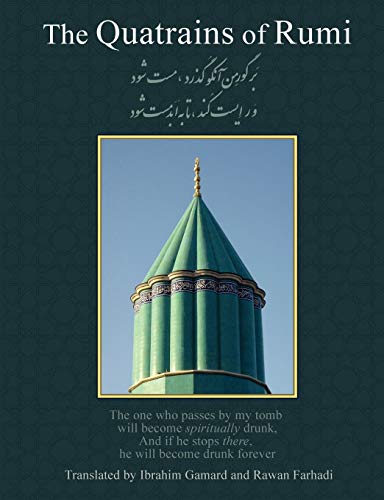
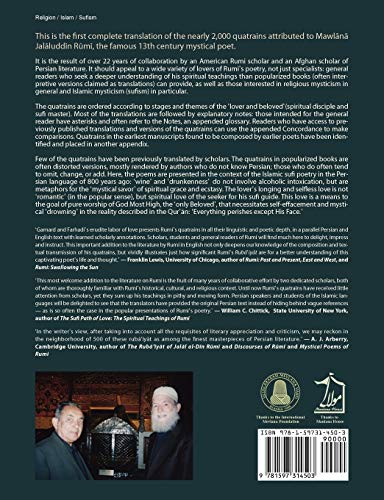


The Quatrains of Rumi: Ruba 'Iyat- Jalaluddin Muhammad Balkhi-Rumi [Jalal Al-Din Rumi, Rumi, Jalaluddin, Farhadi, A. G. Rawan] on desertcart.com. *FREE* shipping on qualifying offers. The Quatrains of Rumi: Ruba 'Iyat- Jalaluddin Muhammad Balkhi-Rumi Review: Scholarly yet eminently usable - I am a professional artist and calligrapher specializing in various scripts and languages. I first learned Persian (Farsi) calligraphy in grade school in Iran--along with having to memorize works by Iran's great poets. I cannot claim any greatness in my prowess in either skill at that time, but persistence and practice pay off in the long run. I love Rumi's poetry. Wonderfully, much of the English-speaking world now also loves Rumi, thanks to the translations by Coleman Barks and others. The problem: it is very difficult to match up the English translations with the original Persian poetry. This is complicated by the fact that Barks and others do not always offer actual translations. Often the poetry in English--beautiful and powerful as it is--is made up of selected lines from various places in Rumi's original, or is inspired by Rumi's poetry. Many times the language is changed so that the meaning is translated to a different time and place. This book is just what I have been looking for: each poetry selection is given in the original Farsi (Persian) language. There follows a translation as literal as possible. Each word that has been added in English to clarify the sentence structure or meaning is put in italics. Notes follow to explicate context, explain specific words, give alternate translations, etc. This book is scholarly yet eminently usable. Now, if only we had this for the entirety of Rumi's works! Stewart J. Thomas, calligrapher Review: Rumi - I love the book. I have several works on or about Hazrat Rumi. This is by far one of the best. There has been a 'Rumi craze' in the West for quite some time. I find that many of his admirerers do not associate him with his Islamic faith, but that is the essence of his work. This work has notes throughout the book with the quatrains so that the reader can get a clearer understanding of the work. Unfortunately, too many have translated his works without an understanding of Persian and without an understanding of his background and the purposes for which he wrote. This is clearly evidenced in the foreword, written by the 22nd generation direct descendent of Hazrat Rumi. who writes: "...And they interpret [his] thoughts and ideas by using their own points of view, which then creates a different Mevlana than the one who actually lived....This saddens me greatly....In spite of this...I thank them---while requesting that they exercise more care in the future."
| Best Sellers Rank | #1,423,096 in Books ( See Top 100 in Books ) #375 in Muhammed in Islam #514 in Sufism (Books) #1,614 in Mysticism (Books) |
| Customer Reviews | 5.0 5.0 out of 5 stars (18) |
| Dimensions | 7.44 x 1.52 x 9.69 inches |
| ISBN-10 | 1597314501 |
| ISBN-13 | 978-1597314503 |
| Item Weight | 2.95 pounds |
| Language | English |
| Print length | 764 pages |
| Publication date | July 1, 2008 |
| Publisher | Sufi Dari Books |
S**S
Scholarly yet eminently usable
I am a professional artist and calligrapher specializing in various scripts and languages. I first learned Persian (Farsi) calligraphy in grade school in Iran--along with having to memorize works by Iran's great poets. I cannot claim any greatness in my prowess in either skill at that time, but persistence and practice pay off in the long run. I love Rumi's poetry. Wonderfully, much of the English-speaking world now also loves Rumi, thanks to the translations by Coleman Barks and others. The problem: it is very difficult to match up the English translations with the original Persian poetry. This is complicated by the fact that Barks and others do not always offer actual translations. Often the poetry in English--beautiful and powerful as it is--is made up of selected lines from various places in Rumi's original, or is inspired by Rumi's poetry. Many times the language is changed so that the meaning is translated to a different time and place. This book is just what I have been looking for: each poetry selection is given in the original Farsi (Persian) language. There follows a translation as literal as possible. Each word that has been added in English to clarify the sentence structure or meaning is put in italics. Notes follow to explicate context, explain specific words, give alternate translations, etc. This book is scholarly yet eminently usable. Now, if only we had this for the entirety of Rumi's works! Stewart J. Thomas, calligrapher <[...]>
F**F
Rumi
I love the book. I have several works on or about Hazrat Rumi. This is by far one of the best. There has been a 'Rumi craze' in the West for quite some time. I find that many of his admirerers do not associate him with his Islamic faith, but that is the essence of his work. This work has notes throughout the book with the quatrains so that the reader can get a clearer understanding of the work. Unfortunately, too many have translated his works without an understanding of Persian and without an understanding of his background and the purposes for which he wrote. This is clearly evidenced in the foreword, written by the 22nd generation direct descendent of Hazrat Rumi. who writes: "...And they interpret [his] thoughts and ideas by using their own points of view, which then creates a different Mevlana than the one who actually lived....This saddens me greatly....In spite of this...I thank them---while requesting that they exercise more care in the future."
B**.
A must have
Ibrâhîm Gamard has given us a rare gift in these times of rampant translators who claim to have done authentic translations of Rumi's work, he has produced along with A. G. Rawân Farhâdî a masterful and faithful rendering of the Quatrains of Mawlana. Accurate translations of a large body of Rumi's work to English are rare as we have been fed revisions mostly of Nicholson's work by those who have no knowledge of Persian or other language translations of this great poet. Gamard and Farhâdî have done justice to the field of Persian to English translation of this part of Rumi's cannon of work. Some may find the Quatrains in this volume too literal, but isn't turning lines that are close to what Rumi said into our own heart's poetry part of Mawlana's original intent in offering them? This reader of "The friend of our Friend" has experienced the truth of this, as in No. 565 from this book: "If a thorn bush appears on top of my grave, The thorn bush will still be desirous of you." As I read this I hear: Even though I will be dead, and my soul sent Home, my body will still try to reach You, my Love. This book is both a scholarly effort as well as a labor of love on the part of the authors as they worked to bring Rumi alive for us. If the translations are to be placed in doubt, the Persian from early texts is given in a parallel format for those who know the language. Footnotes abound and an extensive appendix make this a necessary volume to sit next to the efforts of Annemarie Schimmel and William Chittick's endeavors. If you add Nicholson, Arberry and Gamard's translations from his website Dar Al Masnavi, very little else will be needed to feed your heart and soul with the words of the poet whom God took into God's very presence, and never let go. I cannot recommend this book too highly. "Take care, O thirsty heart! Be always seeking the running stream." No. 1176, Gamard and Farhâdî
D**D
A great work!
Very recently translated. (2008) It does not draw from the Masnavi, and is much more readable, and searchable. Indexed by subject matter.
T**R
Five Stars
Amazing, readable, and accurate interpretation of Maulana's lyrics--a must for lovers of Sufism and heart rendering poetry
P**A
Highly recommended!
I find this collection and translation to be an extremely valuable and reliable resource at a time when so many of Rumi's mistranslations are being shared. I use this book and highly recommend it to everyone including my students in the In The Footprints of Rumi [...] course that I teach both live and online. This work is a labor of LOVE!
H**H
The only English translation that is true and close to the original Persian version. What I really liked is that this book contains the original Persian couplets as well, which you would not find in any of the books by other translators like Coleman Barks, RA Nicholson, AJ Arberry or others. Also, one would easily get English translation of Rumi's literature Masnavi but not Divan-i-Shams. Perhaps no other author has attempted this, especially complete translation of Quatrains/Rubaiyat [4-line stanzas] which is a major section of massive volume book Divan-i-Shams. This book has complete appox. 2000 Rubaiyats [4-line stanzas] from the book Divan-i-Shams. Really feeling blessed to get hold of this book of wisdom. Truly appreciate the translators Gamard and Farhadi for their hard work. Whether you are a Rumi scholar or fan follower or just a beginning to understand/read Rumi for leisure reading, this book is a must. If you do not have this book in your library, then your understanding of Rumi is incomplete !!
P**S
Best book in this field.
M**B
This edition is clearly a labour of love, directed at all those who love Rumi's poetry; not only for its beauty but also for its profundity. What it attempts to do is redirect the attention back to the original words. While the translation of a classical language into modern idiom is in itself problematic - does one go for the literal translation or go for the spirit of the whole; it is also problematic in as much as a 'translator' is not always aware of both an individual and cultural perspective which can colour a translation. There is also the question, in the case of poetry, of the translation of form. Some 'translators' of Rumi's poetry have used a very un-Rumi idiom, and as Idries Shah pointed out in the 1980's, many of the so-called translations of Rumi in fact were versifications of earlier prose translations by Nicholson or Arberry. This edition addresses that problem, and the added complication that sometimes with genuine translators, the source material has been an inferior edition of the original. There has been a trend recently in terms of publishing material from the early Islamic period, of including the original source material in Persian (or Arabic): Nicholson's Divan e Shams i Tabriz is one example, Muhyiddin Ibn al-Arabi's Tarjaman Alashwaq, being another. (Al-Arabi, like Sana'i and Saadi was a contemporary of Rumi's ). Fidelity to Rumi, means that accuracy and not versification has been the primary intention of the translators. One correction that editors have made is to reveal material commonly attributed to Rumi that is not from Rumi. The glossary at the back is thorough. It is a large paperback and my only criticism is that I would have been quite happy to buy a hardback edition!
A**B
Rigorous, scholarly, beautiful and extensive, cannot thank the two authors enough for such a thorough labour of love for those seeking to approach Rumi in his true context, in Persian and English, beyond the wildly mistranslated, if occasionally beautiful Barks books. Highly recommended for the beginner and devotee alike, this edition will be a book you will return to again and again over the years.
S**I
Trustpilot
1 week ago
1 month ago