Some deliveries may take a little longer than usual due to regional shipping conditions.

DOWNLOAD THE APP


Customer Services
Copyright © 2025 Desertcart Holdings Limited
DOWNLOAD THE APP
Full description not available
B**K
Fair Assessment
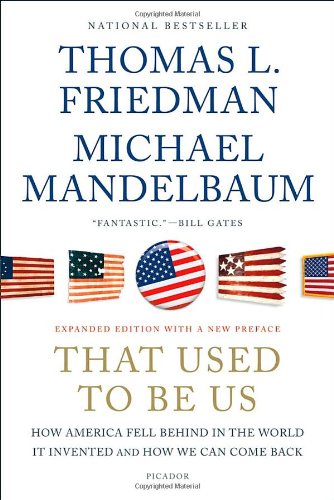
That Used to Be Us: How America Fell Behind in the World it Invented and How We Can Come Back by Thomas L. Friedman and Michael Mandelbaum"That Used to Be Us" is the thought-provoking and topical book about the steep economical challenges that America faces. The authors take a systematic approach on what ails America and what can be done to cure it. This 400-page book is broken out in five parts: Part I. The Diagnosis, Part II. The Education Challenge, Part. III. The War on Math and Physics, Part IV. Political Failure and Part V. Rediscovering America.Positives:1. Two great authors who come together to write a seamless engaging book on a very important topic.2. As well a researched book as you will find. Great historical references.3. Great overall approach. As an industrial engineer, it follows closely an engineering design process: define the problem, analyze the problem, generate alternative designs, evaluate the alternatives, select the preferred design and implement it. Well at least, that's how I see it.4. As even-handed a book as you will find. The authors go out of their way to be fair, and most importantly, it works!5. Elegant and engaging prose, full of interesting anecdotes.6. In the first part of the book the authors provide a solid foundation on our current problems and uses China as a springboard to illustrate them.7. The flattening of the economic playing field.8. The four major challenges to America: how to adapt to globalization, how to adjust to information technology (IT) revolution, how to cope with deficits, and how to manage a world of both rising energy consumption and rising climate threats.9. Great examples throughout book!10. The Five Pillars of Prosperity: education, infrastructure, immigration, research and development, and the implementation of necessary regulations.11. So many great facts sprinkled throughout the book. For instance, Lincoln signed the National Academy of Sciences into being on March 3, 1863.12. Great historical presidential facts.13. Education, education, education. The book does a wonderful job of stressing the importance of education and how America stacks up with the rest of the world. Educational indeed!14. Love how the authors relay the recurring theme of the dichotomy between Democrats and Republicans.15. As a technical guy, I enjoy all those references that have significance in my career. Technological history.16. The impact of technology.17. A look at today's job market. Very interesting. Creative creators and creative servers.18. Carlson's Law.19. Science literacy a topic that really hits home.20. Once again, a great look at education. Insightful!21. So much wisdom, "American young people have got to understand from an early age that the world pays off on results, not on effort". Agreed.22. The importance of critical thinking.23. An important look at the deficit! We need to shrink it to a manageable level.24. Excellent quotations, "If you are asking the wrong questions, the answers don't matter, and increasingly we are asking the wrong questions".25. Monetary systems.26. The realization that we are facing three unhappy options: raise interest rates, print money to cover the deficit; or close the gap with a combination of spending cuts and tax increases.27. The sins of Democrats and Republicans...28. The authors demonstrate convictions of their fiscal positions. They also provide four guidelines for America to follow: seriousness, purpose of exercise, cuts across the board, and raise revenue through taxation.29. 1979 an impactful year indeed!30. Global warming, it's a reality people!! Great succinct comments.31. Clean energy as the next major cutting-edge industry. And what other countries are doing.32. Interesting facts about President Nixon.33. Vicious food price cycle and how we can counter.34. Did I mention the importance of education??35. Our failing infrastructure.36. "Only two-thirds of the engineers who receive PHD's from the United States universities are not United States citizens". Worth sharing...get the book.37. The interesting case of California.38. Entrepreneurial start-ups.39. Deregulation...once a proponent of it, even I can understand the damages that resulted from lack of smart oversight.40. Time to cut entitlements, whether we like it or not...41. The reality that our political system is paralyzed.42. "Special interests" and their impact. Lobbyists...43. The realization that seventy-eight million baby boomers will cause the costs of Social security and Medicare to skyrocket. Ouch!44. Tough decisions need to be made, sensible arguments.45. The changes needed to regain America's greatness.46. Situational values vs. sustainable values.47. The armed forces as the bastions of civic idealism.48. Great examples of small businesses that work and their challenges.49. An amusing yet thought-provoking look at what the great French aristocrat, Alexis de Tocqueville's book "Democracy in America" would look like today.50. A compelling case for a third party.51. The authors leave us with hope!Negatives:1. Very disappointed that the book did not have a bibliography.2. No links or even a notes section.3. Not enough emphasis on the fact that our natural resources are limited and have a major impact on the economy.4. Supporters from both parties will have something to complain about, which is a good thing.5. Stats can be misleading especially when referring to other countries; references would have helped the readers look further into it.In summary, an excellent book. The authors defined America's economical and political problems and provided compelling arguments on how to address them. The book really worked for me. As an engineer it touched upon many subjects that are near and dear to my heart. The authors did a wonderful job of laying out their premise and provided a satisfactory route to address such problems. Authors like Thomas L. Friedman and Michael Mandelbaum remind me why I love reading so much. You may not agree with all their strategies but you will appreciate the wisdom provided. I highly recommend this book!Further recommendations: "The End of Growth: Adapting to Our New Economic Reality" by Richard Heinberg, "The Crash Course" by Chris Martenson, and "Aftershock" by Robert B. Reich.
M**I
take back our bedrock values
Things making Thomas L. Friedman and Michael Mandelbaum frustrated against and irritated about are similar to the Japanese situation. Lacking sense of facing crisis will be totally lethal combination of cockiness and complacency for every developed nations. Four big challenges we are facing, spreading globalization, advancing information technology, soaring budget deficit, rising energy consumption and climate threat, need an immediate action. Tom and Michael suggest Americans' recognizing these challenges and reminding America's strength developed to face similar challenges in the past are inevitable as two preconditions to tackle with these issues. They believe American society retains the characteristics of used to be them, which made the United States exceptional. And the fact the United States has rarely failed to meet major changes over the course of its history make them optimistic in clearing these obstacles. What Americans need is to understand their own history and need to adapt the formula, the priorities, and the practices that are embedded in their history and in their cultures. We are facing the very turn of our times, we shouldn't miss it. Tom and Michael propose five measures as pillars for solution; 1) providing public education, 2) the building and continual modernizing of infrastructure, 3) keeping doors to immigrants open, 4) government support for basic research and development, 5) the implementation of necessary regulations on private economic activity. These are also applicable to Japan, the Japanese society without any amendment.First of all, Tom and Michael say, we have to start treating education as an economic issue. As a natural result of globalization and automation, every workers are destined to be superseded by cheaper laborers, if they aren't creators or creative servers. Surviving companies want those who wants to belong to a values-based group, who can communicate, who is inquisitive, and who has an instinct to collaborate. We need to become a creative person by thinking like an immigrant, thinking like an artisan, thinking like a waitress. They report raising math, science, reading, and creativity levels in American schools is deteriorating. Japan faces similar trend. Figures they indicate in this book is hard to believe hastily. According to the research, 75 percent of young Americans, between the age of 17 to 24, are unable to enlist in the military today because they have failed to graduate from high school, have a criminal record, or are physically unfit. Tom and Michael sound an alarm as there comes a time we feel great stress against thick Chinese accent of anticipated out of college Chinese boss sooner or later.The political situation in Japan is thrown into confusion as like in America. Though we don't have two party system in our society, scrambling for political power blocks precisely the kind of initiatives we need, which lead to loss of confidence in our institution and in the authority of leaders across the society, resultantly the nation's infrastructure have been endangered due to decades of underfunding and inattention. Weakening of our sense of shared national purpose, as Tom and Michael point out in this book, seems to propel Japanese society into situational values, the short-term, me-first, never-mind-the-future attitude rather than seeking sustainable values. Tom and Michael say the intense pressures of the twenty-four-hour news cycle cause a bad effect over politics by elevating the passion to extreme, not allowing one to reflect well about one's doing. To connect a serious disjunction exists between the American people and the government they elect, they propose a shock therapy to American politics by injecting a third party. Using a third party as a sacrificed stone, Tom and Michael want to extract a hybrid politics that would replace grudging compromise between two hostile ideologies with a creative synthesis, which I don't fully agree with them. They seem to be prepossessed with the current political system. If they believe only a compelling third-party candidate offers an engine to harness that steam to move the country in the direction in which it needs to go and the number of voters who register as independents has grown steadily over the decades, why they don't help a third party to get a reasonable share of political power in a system of proportional representation. At the time 3D system becomes popular in IT world, why don't they seek the center of the three parties and candidates hang out on the extremes. Japan has experienced several "wave" elections, but we failed to utilized these opportunities. The outcome was the same war in the glass for the hegemony. Now is the time to take back our bedrock values which had drifted from us.
C**I
scary
Another Friedman book, Hot, flat and crowded was quite depressing because it spelt out exactly what was wrong with the world but the 2nd half recovered by explaining how to put it right. This book has much the same premise but from a wholly American view. However the solutions to the current, real-world problems that 'That used to be us' suggests has are not getting done and everyday seem to further away from politians minds. As they explain, America has a vital role to play in the modern world but if they continue on the present path the whole world suffers. Argueing about exactly where the president was born, a mostly pointless exercise in Afganistan and illegal immigrant arguements, while the rest of the world (especially Asia) improves its education, infrastructure, and development is suicide. As a European living and working in Asia, i found this book about and for Americans personally scary.
A**R
Good read, but already a bit dated
Very quick delivery!It's a good book, but so much has happened in the past 4 years since this book was written that it all feels a bit dated.The book is good, the premise of the book is still true, but not a book with a long shelf life.
J**T
a fantasy
a winge and not really a solution to anything in reale politic.got bored within 100 pages.
E**N
Five Stars
compelling
J**N
Somber Prospects
Friedman and Mandelbaum paint a gloomy picture for the future of America. Their analysis of the American malaise is detailed, insightful and well crafted. The section on political polarization and the resulting gridlock is excellent; America is dominated by the extremists, conservative and liberal. The section on education is disturbing but much too detailed. Their solution is naive and simplistic in the extreme. I believe Washington will address these fundamental issues only when the pain experienced by the moderate majority reaches levels that provokes a major change in politics. We are not there yet.
Trustpilot
1 week ago
2 weeks ago