We remain fully operational. Our teams are working around the clock to ensure your deliveries continue safely.

DOWNLOAD THE APP


Copyright © 2025 Desertcart Holdings Limited
DOWNLOAD THE APP
Buy anything from 5,000+ international stores. One checkout price. No surprise fees. Join 2M+ shoppers on Desertcart.
Desertcart purchases this item on your behalf and handles shipping, customs, and support to South Korea.
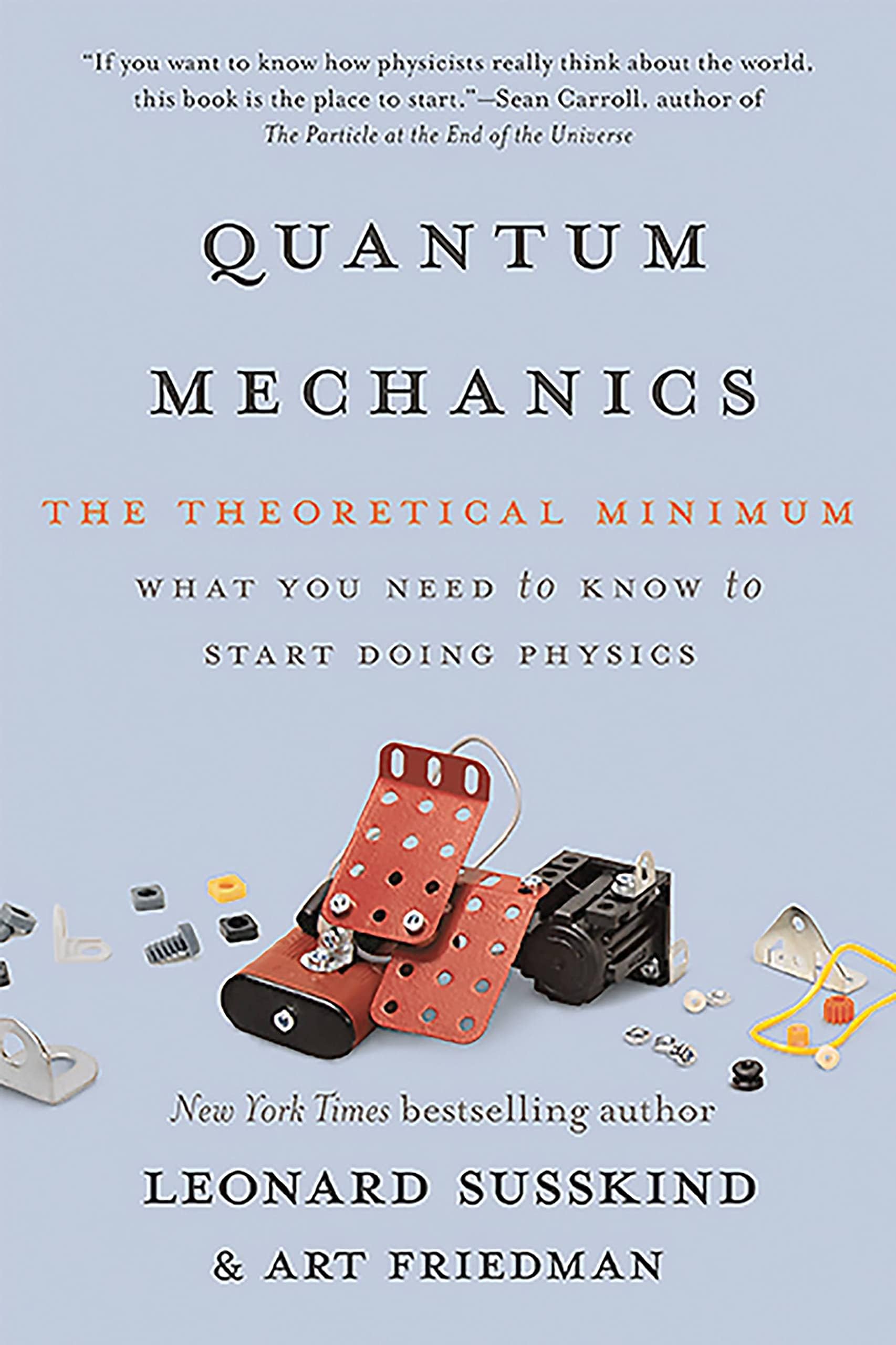
Buy Quantum Mechanics: The Theoretical Minimum on desertcart.com ✓ FREE SHIPPING on qualified orders Review: A Mind Tingling Challenge – Learn Quantum Mechanics - Physics lectures are of three types according to this anecdote of Niels Bohr: “A young man was sent by his own village to a neighboring town to hear a great Rabbi. He was to bring back a report in which all could share. When he returned he told his eagerly awaiting fellow citizens: “The Rabbi spoke three times. The first was brilliant; clear and simple. I understood every word. The second was even better, deep and subtle. I didn’t understand much, but the Rabbi understood it all. The third was by far the finest; a great and unforgettable experience. I understood nothing and the Rabbi himself didn’t understand much either.” Professor Susskind (1) of Stanford University is far ahead of Bohr’s Rabbi – he understands it all. To Susskind “Everything is easy in Quantum mechanics” (2). So easy that he always “destroys his lecture notes to prevent his lectures being the same next time” (3). “Given enough time, with no distractions, you could use [his book (4)] to eventually master Quantum Mechanics” (5). An attractive challenge as the book is only 350 pages. Only 350 pages perhaps, but it assumes you are versed in Classical Mechanics (which you aren’t). Realistically, you need Susskind’s first book (6) plus a preliminary YouTube series of 9 x 1.5 hour lectures on Quantum Entanglement (7). Plus you will need assistance from 10 x 1.5 hour YouTube lectures (8) in parallel with the book. Still a realistic challenge given the results (9). According to Susskind, Quantum Mechanics is much more fundamental that classical physics. “As far as we know quantum mechanics provides an exact description of every physical system” (10). Moreover, “the logic of classical mechanics of Newton is incorrect, the underlying structure is inadequate” (11). Not only should we logically learn quantum mechanics first, it is technically much easier than classical mechanics (12). Susskind lives in a Quantum Mechanical world, the real world, deploring our choice of units that makes Avogadro’s Number (13) and the speed of light (14) ridiculously large and Planck’s Constant (15) ridiculously small. He blames historical chemists who measured things by comparison to the size of their hands. Choosing units appropriate to the sub-atomic scale, such as making Planck’s constant = 1, would make his world feel normal. For those who enjoyed science and mathematics to a reasonable level (16) but who had to follow a career to survive in the world, this is more an opportunity than a challenge. Not that it is not a challenge! It is a mind tingling challenge. A way of familiarizing with the real subject with the actual equations - not a popularization. The fascinating history of Archimedes, Johannes Kepler and Isaac Newton fitting an ellipse to the Mars orbit and concluding with the Law of Gravity is only the half of it. Understand how the mathematics of vectors and matrices are fitted to the real world being Quantum Mechanics. Like Archimedes the French mathematicians Joseph-Louis Lagrange, Siméon Poisson, and the Irish mathematician William Rowan Hamilton were nice enough to magically or inadvertently provide the mathematics a long time prior to make it possible. Why this mathematical physics works no one knows, neither Susskind nor the Rabbi. One moment you feel like like Niels Bohr’s student in his third lecture then you are stunned when Professor Susskind commences a short summing-up by saying, in a matter-of-fact way, that an equation derived in the lecture is called Schrödinger’s equation (17)! Or that the postulates he has been talking about are Dirac’s postulates of Quantum Mechanics formulated in the 1930’s which have never needed to be replaced (18). Or, early on, describes a vector and says that it is Dirac’s notation (19). Finally, Susskind is to be applauded. If this can be done with Quantum Mechanics, it can be done in any subject of Physics or Mathematics or any other area of study. There must be a value in doing this (other than ex-auto workers retraining themselves for jobs at CERN) as the work will inevitably not continue to be publically funded unless tax-payers have some idea what it is. PS: The advantage of a career outside Physics is to know “you always write the minutes before the meeting”. Bohr’s student may finally have understood so little that he was not game to return to his village. As a precaution I have written this travelogue well before completing the trip. (1) Leonard Susskind is the Professor of Theoretical Physics at Stanford University, and director of the Stanford Institute for Theoretical Physics. His Wikipedia entry is a good read in itself. (2) Lecture 9, Quantum Entanglements (3) Lecture 9, Quantum Entanglements (4) Quantum Mechanics – The Theoretical Minimum by Leonard Susskind & Art Friedman. The “minimum” means just what you need to know to proceed to the next level. (5) Science News: quote from back cover of Susskind’s book. (6) The Theoretical Minimum – What you Need to Know to start doing Physics Leonard Susskind and George Hrabovsky. (7) Quantum Entanglements, Susskind, Stanford University, YouTube. It seems that the old unadorned lecture format has stood the test of time with only the whiteboard and marker (when it works) replacing the blackboard and chalk. (8) Modern Physics, Quantum Mechanics, Susskind, Stanford University, YouTube. (9) Well, you did not expect to read 350 pages straight cover to cover and then know Quantum Mechanics, did you? This is a 6 to12 month project – reading, watching YouTube lectures, frantic note taking hoping you might understand it later (the iPad pause button being a luxury unavailable in university lectures), revision, pushing forward, retreating, then finally with your newfound knowledge applying for a job at CERN. (10) Page xix. (11) Lecture 1, Quantum Mechanics (12) Page xx. (13) Avogadro's number, number of units in one mole of any substance (being its molecular weight in grams) ≈ 6×10²³. (14) Speed of Light: c ≈ 3×10⁸ m/s. (15) Planck’s Constant: The energy contained in a photon, the smallest possible ‘packet’ of energy in an electromagnetic wave ≈ 6.6x10⁻³⁴ joule-seconds. (16) Realistically, for those who think they know classical Newtonian Physics and remember studying vectors and matrices, exponentials such as eiθ = cosθ + isinθ and who once knew the expansion of sin(θ + Φ). (17) Lecture 9, Quantum Entanglements (18) Lecture 4, Quantum Mechanics (19) Page 11, Quantum Mechanics – The Theoretical Minimum Malcolm Cameron 8 May 2016 Review: THEE quantum book + Solutions available online - I've been working through this book. I learned quantum in my undergrad years from the Tannoudji book. It was very dry and I spend most my time trying to figure out what he (Tannoudji) was trying to say, THEN figure out whether I can prove it, etc. Funny how really smart people can create creatively new ways to make stuff more difficult through weird explanations. This is not so with Susskind. Susskind writes like Feynman: clear explanations on complex topics. I assume he's a native english speaker, as his tone is very colloquial and uninimtidating. He assumes the reader knows nothing of quantum and explains things in bit-sized pieces which are easy to digest. He rarely says things like "well OBVIOUSLY this flows from this" (when the things are so obvious). Anyways, the book is a bit unorthodox. It starts off talking about spin states and vector spaces. This is different than the typical quantum books that start off with talking about solving the Schrodinger equation. Which, now that I think about it, isn't really a great place to start. It's a wave equation that's only once-piece of the bigger picture. The result is a book that has a very gradual learning curve. That said, readers still need a bit of math background if they want to get through this book. I'd say at least a decent understanding of complex numbers and matrix algebra are a prerequisite. Both those subjects are thoroughly explained in places online (Khan Academy) for free. SOLUTIONS: I read another reviewer rate the book low because there is a lack of worked out solutions. That I disagree with. Google search "Quantum theoretical minimum solutions" and they will pop up. There are several unofficial sites out there that have answers to the solutions. For instance, google search "the uncertain biscuit quantum" or "chris brittain quantum". The solutions are out there. Also, on that note, the problems in this book are few..but concise and great. Very on-point. Regarding the reviewers who are rating this book low b/c it's too difficult. That's not really a good reason to rate a QUANTUM book low. For two reasons (1) it's a quantum book for christsakes. it is by far the most math-friendly book written on the subject. reading about quantum mechanics without math is not "doing" physics..it's just cataloging knowledge (e.g. stamp collecting), (2) how can you rate a book low if you don't understand it? What are your reviewing parameters? If you have a little complex number knowledge and rudimentary matrix operations (e.g. matrix multiplication, etc.) under your belt, you'll be fine. The Kindle version is fine. That's what I bought (I have a paper copy too). I prefer the kindle version because I can read it on my phone while waiting in line, etc. The equations come out fine (I'm not sure what the other revieweres were complaining about, I'm reading it on my iPhone 5s just fine.) If you know nothing of quantum and want to learn, I highly HIGHLY recommend this book.


| Best Sellers Rank | #28,298 in Books ( See Top 100 in Books ) #3 in Mathematical Physics (Books) #13 in Science for Kids #22 in Quantum Theory (Books) |
| Customer Reviews | 4.6 out of 5 stars 2,533 Reviews |
M**N
A Mind Tingling Challenge – Learn Quantum Mechanics
Physics lectures are of three types according to this anecdote of Niels Bohr: “A young man was sent by his own village to a neighboring town to hear a great Rabbi. He was to bring back a report in which all could share. When he returned he told his eagerly awaiting fellow citizens: “The Rabbi spoke three times. The first was brilliant; clear and simple. I understood every word. The second was even better, deep and subtle. I didn’t understand much, but the Rabbi understood it all. The third was by far the finest; a great and unforgettable experience. I understood nothing and the Rabbi himself didn’t understand much either.” Professor Susskind (1) of Stanford University is far ahead of Bohr’s Rabbi – he understands it all. To Susskind “Everything is easy in Quantum mechanics” (2). So easy that he always “destroys his lecture notes to prevent his lectures being the same next time” (3). “Given enough time, with no distractions, you could use [his book (4)] to eventually master Quantum Mechanics” (5). An attractive challenge as the book is only 350 pages. Only 350 pages perhaps, but it assumes you are versed in Classical Mechanics (which you aren’t). Realistically, you need Susskind’s first book (6) plus a preliminary YouTube series of 9 x 1.5 hour lectures on Quantum Entanglement (7). Plus you will need assistance from 10 x 1.5 hour YouTube lectures (8) in parallel with the book. Still a realistic challenge given the results (9). According to Susskind, Quantum Mechanics is much more fundamental that classical physics. “As far as we know quantum mechanics provides an exact description of every physical system” (10). Moreover, “the logic of classical mechanics of Newton is incorrect, the underlying structure is inadequate” (11). Not only should we logically learn quantum mechanics first, it is technically much easier than classical mechanics (12). Susskind lives in a Quantum Mechanical world, the real world, deploring our choice of units that makes Avogadro’s Number (13) and the speed of light (14) ridiculously large and Planck’s Constant (15) ridiculously small. He blames historical chemists who measured things by comparison to the size of their hands. Choosing units appropriate to the sub-atomic scale, such as making Planck’s constant = 1, would make his world feel normal. For those who enjoyed science and mathematics to a reasonable level (16) but who had to follow a career to survive in the world, this is more an opportunity than a challenge. Not that it is not a challenge! It is a mind tingling challenge. A way of familiarizing with the real subject with the actual equations - not a popularization. The fascinating history of Archimedes, Johannes Kepler and Isaac Newton fitting an ellipse to the Mars orbit and concluding with the Law of Gravity is only the half of it. Understand how the mathematics of vectors and matrices are fitted to the real world being Quantum Mechanics. Like Archimedes the French mathematicians Joseph-Louis Lagrange, Siméon Poisson, and the Irish mathematician William Rowan Hamilton were nice enough to magically or inadvertently provide the mathematics a long time prior to make it possible. Why this mathematical physics works no one knows, neither Susskind nor the Rabbi. One moment you feel like like Niels Bohr’s student in his third lecture then you are stunned when Professor Susskind commences a short summing-up by saying, in a matter-of-fact way, that an equation derived in the lecture is called Schrödinger’s equation (17)! Or that the postulates he has been talking about are Dirac’s postulates of Quantum Mechanics formulated in the 1930’s which have never needed to be replaced (18). Or, early on, describes a vector and says that it is Dirac’s notation (19). Finally, Susskind is to be applauded. If this can be done with Quantum Mechanics, it can be done in any subject of Physics or Mathematics or any other area of study. There must be a value in doing this (other than ex-auto workers retraining themselves for jobs at CERN) as the work will inevitably not continue to be publically funded unless tax-payers have some idea what it is. PS: The advantage of a career outside Physics is to know “you always write the minutes before the meeting”. Bohr’s student may finally have understood so little that he was not game to return to his village. As a precaution I have written this travelogue well before completing the trip. (1) Leonard Susskind is the Professor of Theoretical Physics at Stanford University, and director of the Stanford Institute for Theoretical Physics. His Wikipedia entry is a good read in itself. (2) Lecture 9, Quantum Entanglements (3) Lecture 9, Quantum Entanglements (4) Quantum Mechanics – The Theoretical Minimum by Leonard Susskind & Art Friedman. The “minimum” means just what you need to know to proceed to the next level. (5) Science News: quote from back cover of Susskind’s book. (6) The Theoretical Minimum – What you Need to Know to start doing Physics Leonard Susskind and George Hrabovsky. (7) Quantum Entanglements, Susskind, Stanford University, YouTube. It seems that the old unadorned lecture format has stood the test of time with only the whiteboard and marker (when it works) replacing the blackboard and chalk. (8) Modern Physics, Quantum Mechanics, Susskind, Stanford University, YouTube. (9) Well, you did not expect to read 350 pages straight cover to cover and then know Quantum Mechanics, did you? This is a 6 to12 month project – reading, watching YouTube lectures, frantic note taking hoping you might understand it later (the iPad pause button being a luxury unavailable in university lectures), revision, pushing forward, retreating, then finally with your newfound knowledge applying for a job at CERN. (10) Page xix. (11) Lecture 1, Quantum Mechanics (12) Page xx. (13) Avogadro's number, number of units in one mole of any substance (being its molecular weight in grams) ≈ 6×10²³. (14) Speed of Light: c ≈ 3×10⁸ m/s. (15) Planck’s Constant: The energy contained in a photon, the smallest possible ‘packet’ of energy in an electromagnetic wave ≈ 6.6x10⁻³⁴ joule-seconds. (16) Realistically, for those who think they know classical Newtonian Physics and remember studying vectors and matrices, exponentials such as eiθ = cosθ + isinθ and who once knew the expansion of sin(θ + Φ). (17) Lecture 9, Quantum Entanglements (18) Lecture 4, Quantum Mechanics (19) Page 11, Quantum Mechanics – The Theoretical Minimum Malcolm Cameron 8 May 2016
J**A
THEE quantum book + Solutions available online
I've been working through this book. I learned quantum in my undergrad years from the Tannoudji book. It was very dry and I spend most my time trying to figure out what he (Tannoudji) was trying to say, THEN figure out whether I can prove it, etc. Funny how really smart people can create creatively new ways to make stuff more difficult through weird explanations. This is not so with Susskind. Susskind writes like Feynman: clear explanations on complex topics. I assume he's a native english speaker, as his tone is very colloquial and uninimtidating. He assumes the reader knows nothing of quantum and explains things in bit-sized pieces which are easy to digest. He rarely says things like "well OBVIOUSLY this flows from this" (when the things are so obvious). Anyways, the book is a bit unorthodox. It starts off talking about spin states and vector spaces. This is different than the typical quantum books that start off with talking about solving the Schrodinger equation. Which, now that I think about it, isn't really a great place to start. It's a wave equation that's only once-piece of the bigger picture. The result is a book that has a very gradual learning curve. That said, readers still need a bit of math background if they want to get through this book. I'd say at least a decent understanding of complex numbers and matrix algebra are a prerequisite. Both those subjects are thoroughly explained in places online (Khan Academy) for free. SOLUTIONS: I read another reviewer rate the book low because there is a lack of worked out solutions. That I disagree with. Google search "Quantum theoretical minimum solutions" and they will pop up. There are several unofficial sites out there that have answers to the solutions. For instance, google search "the uncertain biscuit quantum" or "chris brittain quantum". The solutions are out there. Also, on that note, the problems in this book are few..but concise and great. Very on-point. Regarding the reviewers who are rating this book low b/c it's too difficult. That's not really a good reason to rate a QUANTUM book low. For two reasons (1) it's a quantum book for christsakes. it is by far the most math-friendly book written on the subject. reading about quantum mechanics without math is not "doing" physics..it's just cataloging knowledge (e.g. stamp collecting), (2) how can you rate a book low if you don't understand it? What are your reviewing parameters? If you have a little complex number knowledge and rudimentary matrix operations (e.g. matrix multiplication, etc.) under your belt, you'll be fine. The Kindle version is fine. That's what I bought (I have a paper copy too). I prefer the kindle version because I can read it on my phone while waiting in line, etc. The equations come out fine (I'm not sure what the other revieweres were complaining about, I'm reading it on my iPhone 5s just fine.) If you know nothing of quantum and want to learn, I highly HIGHLY recommend this book.
A**G
Very entertaining - brilliant mind
Very entertaining book - like every single lecture Prof. Susskind has posted on youtube. It gives an excellent conceptual overview particularly for first time learners, or non-physics students who want to understand what QM is all about, without investing years of study. I very much like the entire series - and recommend to first read the mechanics book by Susskind. The QM book only requires very little linear algebra knowledge, thus making it accessible to a broad audience. Just don’t expect you are able to carry out analytical QM to solve problems towards a BS or MS degree. For that there is probably no way around „full size“ intro to QM textbooks like those by R. Liboff or J.J. Sakurai (or B. Zwiebach youtube lecture series). In any case Susskind‘s book series is unique, simplistic but deep, and a must read for any physicist, upcoming quantum engineers, or in fact anyone who likes to listen to and get inspired by brilliant minds.
A**N
Readable introduction to Quantum Mechanics with bonus of videos to refer to
Following the Stanford online lecture series, Susskind and Friedman's new book introduces the reader to the field of quantum mechanics assuming little prior knowledge. The book does take a mathematical approach, though it is relatively light, and introduces some substantial concepts and results. It probably makes sense to read the book as well as watch the lectures but this book is self contained and approachable. The writing style is engaging and the book has various exercises that can help the reader confirm their understanding. The book starts by considering how to think about states of a system and measurement. In particular ideas about intrinsic spin are more or less the starting point of discussing quantum mechanics. This is a different track to most other introductory QM authors but the point is to introduce the most simple quantum mechanical Hilbert space, namely the space where spin vectors reside. The author goes through things like Pauli Matrices and commutating operators. The author discusses the postulates of quantum mechanics and results from Hermitian operators as well as the uncertainty principle. The author introduces time dependent Schrödinger equation naturally by first looking at the eigenstate solutions and then the superposition. The author then gets into the concept of entanglement. Another concept that usually comes later in quantum mechanics but is introduced naturally in the book. The basics of tensor products are considered and the authors work through canonical examples of entangled states and the uniqueness of them to quantum mechanics. There are aspects of this part which can be challenging to follow but watching the lectures online can help the reader who might feel a bit lost. The authors then discuss particle wave duality and the collapse of the wave function. And finally the authors get to the harmonic oscillator and discuss ladder operators and the solutions to the harmonic oscillators with the Hermite polynomials. This chapter I found more readable than most quantum mechanical texts so think they did a good job making intuitive a difficult set of ideas. Quantum Mechanics- the theoretical minimum largely achieves its goals of introducing the reader to quantum mechanics when they have little background and are absent a teacher to guide them. It still is a hard subject and this book uses more the simpler toy models than the typical arbitrary wavefunction. I prefer Bowman Essential Quantum Mechanics as a first introduction to the subject which I think is at the same level but I do like this and am glad I read it to get a different flavor of the subject, challenging for the uninitiated, but readable.
J**S
If You Have Some Background This Is A Good Source For Filling In The Gaps!
One should have some familiarity with topics such as vectors and their representations, summation notation, matrices/matrix manipulations, and complex numbers! In addition, knowledge of trigonometry and calculus would be helpful. Why? The book takes full advantage of the symbolic representations of vectors, matrices, and integrals.This is the type of book that is compatible with the efforts of anyone who has some familiarity with these topics and desires to increase her/his understanding of Quantum Mechanics. The book should ease some of the confusion that one might encounter as the topics unfold. During the latter part of the book, some understanding of Classical Mechanics would be helpful (See Susskind's book on Classical Mechanics.). I like this book because (1) it introduces one to a modern presentation of the subject, (2) it emphasizes the statistical nature of quantum states from the very beginning, and (3) it has exercises interspersed throughout the book so that one can check progress. No answers are provided for the exercises. However, a close reading of the exercises demonstrate, for the most part, that they are of the "show that type." I am trying to convince myself that the author's proofs and suggestions (provided in the exercises) are sufficient to allow one to arrive at her/his own reliable solutions! I "have only just begun;" time will tell! Even though the book has ~350 pages, they are not cluttered! The pages are manageable in that the print is of an "ideal size" and it doesn't take long to read a page. This enhances one's sense of accomplishment! The placement of the exercises is reminiscent of the "Programmed Instruction" books of yesteryear; you had to work your way to success! I gave the book five stars because it is an excellent source for readers who have some previous experience with both the "older" and "newer" presentations of Quantum Mechanics but still remain intolerably confused. I fall in this category and have plenty of "fog" obscuring the topic! My copy of the book arrived over a week ago and at this point some of the "fog" is beginning to dissipate.
J**H
Communicates the fundamentals better than textbooks 6 times the price.
So often physics writers are so enamored with the fact they know the material, that the deliberately talk about the material in a terse and inaccessible way. The beauty of physics is that it makes sense, so there is no reason for anybody to try to alienate those looking to learn physics, academia and knowledge should not be a club people attempt to exclude others from but rather should be something we all welcome each other into and try to make knowledge as accessible as possible. The drive of this book seems to do just that for quantum physics, the goal is to communicate to the reader the concepts in the most digestible and accessible way possible. This isn't "dumbing it down" it's simply "not being obtuse for obtuse sake". In my Quantum Physics course we have 2 textbooks, this one and a more traditional one, the more traditional one has slightly more challenging problems, but it does a terrible job teaching the fundamentals whereas this book teaches the fundamentals beautifully. I give this book 5/5 stars because most textbooks don't try hard enough to be disarming and accessible, most textbooks try to tell the reader that "if you don't understand this, the problem is with YOU" this book is all about making the material accessible, and taking the responsibility to make everything understandable from the writers perspective, not putting all that judgement/burden on the reader. So you take all that and you consider the fact that the book doesn't waste time with irrelevant things AND is less than 20 bucks? How can you not love a book that communicates all the fundamentals so much better than a book 6 times it's price?
A**R
Real quantum mechanics with real math.
This is a marvelous introduction to quantum mechanics. As Professor Susskind and many other physicists have noted, our natural intuition of how everyday objects behave simply does not apply to things at scales on the order of Plank’s length. Indeed, there is no reason to expect humans to have any intuitive sense of these phenomena—aside from an improbable extrapolation down 35 orders of magnitude! Our window into this world is, instead, a beautifully crafted mathematical framework, faithful to experimental observations. This book successfully presents that framework in a compelling and very approachable way, provided you commit to studying it closely and doing the (generally simple) exercises. The online video lectures are an excellent supplement and former students have posted solutions to the exercises (some more reliable than others). Your efforts will be amply rewarded with a satisfying understanding of the theoretical foundations of what is arguably the towering achievement of 20th century physics. It is intended for the mathematically literate. You will need • A basic knowledge of linear algebra — really no more than undergraduate-level familiarity with vectors/matrices and operations on them. The core engineering curriculum is more than enough. • A good working knowledge of complex variables. • Undergraduate calculus. I quickly discovered I needed to refresh my own memory on the chain rule for differentiation. I did take a class in differential equations while in grad school some 40+ years ago, have forgotten most of it, but found I really did not need it to get through this book. • Finally, a willingness to learn some unfamiliar notation. There is quite a lot of this, but Professor Susskind is careful to distinguish notation from new concepts.
J**S
Good Intro to Quantum Mechanics
If you have the mathematical chops to absorb the material, this is a very good introduction to quantum mechanics. Unlike a lot of popular treatments, this one does not shy away from using mathematics to describe its subject. Technically, you do not need much more than high school algebra since the author does a good job of explaining the math he does use, but it would not hurt to have some college or AP level math courses (linear algebra and calculus especially) under your belt. Ironically, this approach seems to make the material more understandable. Most of the popular treatments gloss over the math, which leaves some pretty substantial holes in their explanations (Feynman's QED is a notable exception). A comment about the Kindle edition: Most Kindle books with math are horrendously formatted. This book is an exception. The equations are not microscopic (which is usually the case), nor are they enormous (which also happens rather frequently). I have noted that depending on the particular Kindle device you use, there is still some variation in the quality, so your mileage may vary. Just so you are not confused, this comment only refers to the Quantum Mechanics volume of The Theoretical Minimum. The first volume, surprisingly, is not so well formatted.
Trustpilot
2 weeks ago
2 weeks ago