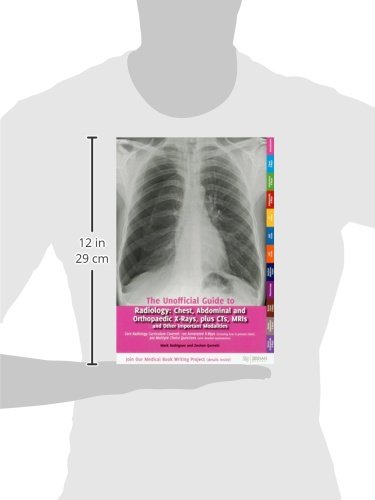

Unofficial Guide to Radiology: Chest, Abdominal and Orthopaedic X Rays, Plus CTs, MRIs and Other Important Modalities: Core Radiology Curriculum: 9780957149946: Medicine & Health Science Books @ desertcart.com Review: 5 Stars - An invaluable resource. Review: Education resource - As a new FNP I found this book particularly useful in the clinic when needing to read an X-ray before our radiologist could read it. Great tool!
| Best Sellers Rank | #1,373,162 in Books ( See Top 100 in Books ) #564 in Radiology (Books) #1,521 in Medical Test Preparation & Review #2,403 in Allied Health Services |
| Customer Reviews | 4.7 4.7 out of 5 stars (253) |
| Dimensions | 8.36 x 1.5 x 11.76 inches |
| Edition | 1st |
| ISBN-10 | 0957149948 |
| ISBN-13 | 978-0957149946 |
| Item Weight | 8.4 ounces |
| Language | English |
| Part of series | Unofficial Guides to Medicine |
| Print length | 850 pages |
| Publication date | March 31, 2014 |
| Publisher | UGTM (Unofficial Guide to Medicine) |
D**R
5 Stars
An invaluable resource.
R**Z
Education resource
As a new FNP I found this book particularly useful in the clinic when needing to read an X-ray before our radiologist could read it. Great tool!
K**M
The material of the pages make it easy to read the relevant radiology and information
Essential Book. The information is precise and to the point, aiding in understanding and retention. The material of the pages make it easy to read the relevant radiology and information. The layout, colour guidance assisted in easy navigation. It is highly recommended to all medical students, especially those that are undertaking the OSCE.
K**A
Good book
Good book
H**H
good read
lots of detailed pics
S**B
I would recommend this book highly.
The initial page of the book includes the abbreviations used in the book and lays out the vocabulary well. The contents page is very concise and made navigating the book simple. In addition, the book covers the majority of subsections within the specialty of radiology including MRI, US scans and CT scans. I found the layout of the book to be excellent, and the colour schemes were a superb addition to the overall design. The informal appearance of the book differentiated it from so many others and made it more accessible to me as a medical student. I appreciated the way that the book described the systematic method for reading an x ray. The basics were well covered with clear x ray images which were clearly labelled. The ‘key point’ that appeared every so often within the content was a clinical point of significance and added an extra dimension to the reading experience. The way that the book was labelled was excellent. The structures were clearly identified and the main landmarks were well labelled. The chest x ray chapter was well rounded off with a checklist of things to complete in assessing the scan correctly. The cases were an excellent addition to the book, especially the plain scan followed by a scan labelled with the landmarks. This was an excellent visual learning tool and complemented the end of chapter questions well. Some textbooks have no questions or very few, so a good summary of the chapters main points as well as a good set of demanding questions was the perfect mix. The answers also being provided on the next page to the question was useful as I didn’t need to flick back and forth between questions and answers. I really liked the way the book covered a great deal of different x ray types e.g. hip, chest, abdominal. The flow chart for the intra-capsular hip fracture was particularly concise. The comprehensive approach of the book is essential for a rounded medical student. The CT, fluoroscopy, nuclear medicine and ultrasound scans sections were refreshing, as they went back to basics and actually explained the nut and bolts of CT scanning. The same occurred with the MRI section; very few books actually go through the trouble of explaining the way the scanning works. This section was perhaps a bit too wordy, but the message was important and well communicated.
T**I
The clear images with helpful annotations makes this book extremely easy to follow
I'm a fourth year student at Southampton and have just completed my first clinical year and intermediate exams. I found this book an invaluable resource in tackling a tricky subject. The clear images with helpful annotations makes this book extremely easy to follow. The information is clear and concise making it easy to understand. The questions/cases ensure that the information has been understood and provide a great form of informal assessment. I found the cases were great in boosting confidence or highlighting particular areas which needed extra attention. Overall, I would recommend this book to all medical students right from the beginning of your training. It is a great reference book and will allow you to master radiology, a key skill and one that is often examined.
M**S
Engaging, great pictures, easy to understand, PERFECT text to help any medic understand radiology
I'm a second year medic and have found this invaluable (radiology is covered extremely briefly during our anatomy classes). The biggest hurdle in understanding radiology is finding a good text, and i feel this is the text that has helped me FINALLY understand radiography!!! The book is engaging, interesting and starts from basics to ensure a solid foundation of understanding is achieved. I particularly like how this text provides; suggested approaches to analyse x-rays, over 100 annotated X-rays, questions and summaries/key points. Colour coded into sections such as chest x-rays, abdominal x-rays, CT and MRI scans this book covers a lot for a very reasonable price. I would recommend this text to ANY medical student in ANY year
G**O
Being asked to present an X-ray is generally a terror-inducing moment for the medical student (and junior doctor), but An Unofficial Guide to Radiology provides you with a framework to rely on when presenting imaging which is both systematic and easy to remember. The book is divided into sections based on imaging type, starting with plain films of chest and abdominal imaging before progressing through orthopaedics and into specialised imaging modalities such as CT scans and MRIs. The quality of the images used in the book are exceptionally high, allowing you to appreciate subtle detail in a way rarely possible with printed radiographs. Each image is coupled with a clinical case and an annotated version on the following page – telling the reader what they should have spotted and how to describe it. This is also accompanied by several exam-style questions, which helps make every case invaluable for revision. An Unofficial Guide to Radiology is a book that can accompany every doctor throughout their career as it provides detailed examples of the most common conditions in each speciality with a range of complexity. This ensures that the book remains relevant to the trainee doctor.
M**Y
Very compact, helpful book for learning radiology. The cases were well chosen. The information provided was accurate & well explained. Would definitely recommend it.
G**N
A very good book for 1st year residents.
F**I
I wish all the medical book were like this: learning would be easy and, unexpectedly, fun.
S**C
This book is a fantastic resource for any medical student or junior doctor! It teaches the reader how to systematically analyse radiological images in a clear and concise way and to become familiar with common clinical presentations. It covers not only X-rays, but also CTs, MRIs and some other modalities such as ultrasound scans. The images are of very good quality and the presentation of the book is great. As a final year medical student I still refer to the book on a regular basis and I am certain I will continue to do so when I qualify. I find the 'Key Points' provided throughout each chapter particularly handy and the quizzes at the end of each chapter help to consolidate your knowledge.
Trustpilot
2 months ago
2 weeks ago