We remain fully operational. Our teams are working around the clock to ensure your deliveries continue safely.

DOWNLOAD THE APP


Copyright © 2025 Desertcart Holdings Limited
DOWNLOAD THE APP
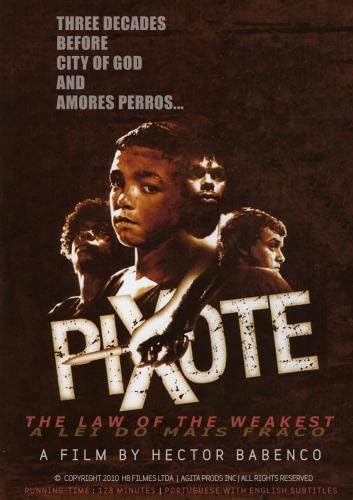
Hector Babenco, who went on to direct the acclaimed KISS OF THE SPIDER WOMAN, made an international splash with this gritty portrait of juvenile poverty and street crime in Brazil. Pixote (Portuguese slang for "Peewee") is the name of a chubby-cheeked 10-year-old runaway played by real-life slum kid Fernando Ramos da Silva. He's a natural, creating a childlike and vulnerable character left emotionally hardened and morally adrift by his brutal experiences. In an overcrowded São Paulo "reform school," a cross between a prison and an army barracks, he learns the hard facts of survival as he watches gangs prey on weaker kids, and the cops and guards abuse, beat, and even murder their charges. Pixote escapes and turns to street crime in Rio with a small gang, but his dreams of big money and a good life are dashed as they play at crime in a violent kill-or-be-killed world. Equal parts exposé and social drama, PIXOTE dramatizes the plight of millions of children who live on the streets or get ground up in the system that breeds hardened criminals from juvenile delinquents. Like Luis Buñuel's LOS OLVIDADOS, one of Babenco's inspirations, this occasionally melodramatic portrait of poverty is shocking and affecting, but no more so than da Silva's own life story. After completing the film he sank back into poverty and crime, and died on the streets. His life became the subject of the 1996 film WHO KILLED PIXOTE?, which showed that despite the outcry created by PIXOTE Brazil has done little to alleviate these conditions. --Sean Axmaker (film is in Portuguese with English subtitles) Review: Tremendously powerful, disturbing look at the life of an abandoned street child - A deeply disturbing and heartbreaking neo-realist film, about an abandoned, unwanted 10 year old living first in a reformatory, and then on Brazil's mean streets. The performances Babenco gets from his non-professional cast are amazing, especially his tiny young lead. The film almost totally avoids the twin traps of false sentimentality (although it's got plenty of emotion), or needless flashiness. It occasionally feels aimless, but somehow, in the end, always adds up. Probably the weakest, most problematic moment is the opening, where the `director' (Babenco, or an actor?) tells us that these actors are real people, gives us some facts and figures about them, and tells that their lives are much like those shown in the film. It then took me the first few minutes of the movie to forget about that, and get involved with the characters, and not get all intellectually caught up the artistic complexities of `real people' playing a dramatic variation on their lives. So perhaps I don't consider this terrific, important film a 'perfect' masterpiece as so many do- but I deeply admire it and respect it, would encourage everyone to see it (though you doubtless find the experience upsetting) and look forward to seeing it a third time. You will never be able to look at a poor kid on the street quite the same way again. And I'm thrilled that after years of waiting, a proper 1:85 release is available. Yes, it's DVD-R, which means it may not play on your computer, theoretically will have a shorter shelf life, and has no extras. But after years where this important, influential film was out of print and very difficult to see - and when you could find it it was a terribly transferred 4:3 VHS based version that someone wanted $60 for - this is a big step in the right direction Review: Forgotten masterpiece - Truly a chilling, and vivid account of Brazil's homeless children and teenagers. How they are used by corrupt police and other criminal organizations to commit crimes. This stars Fernando Ramos Da Silva as your main star Pixote who sadly in real life at the age of 19 was killed by Brazilian police in São Paulo. Art sadly came true and ended in a gun shoot out. Sadly Fernando Ramos Da Silva was never able to get out of the slums in real life and seemed to become the part. Although there is a mystery behind his death. Some say he was murdered by the very corrupt police the movie showcases. He often stated that he could never get away from the image of Pixote and that the police could never differentiate his real self from his character or maybe it was him who could not. This deals with the poverty of street children. Children that end up committing crimes because they are exploited by adults. Most once caught are sent to overcrowded dormitories where they struggle to survive. On the outside kidnapped, they struggle to find food and are treated as sexual objects. This is a vivid depiction of the world of innocence’s lost. This holds nothing back. The rape of children, the abuse of children, the lost souls. All seen through the eyes of one young boy named Pixote. You can finish my review here: http://www.abucketofcorn.com/2013/11/pixote-1981.html?m=0
| Contributor | Edilson Lino, Fernando Ramos da Silva, Gilberto Moura, Hector Babenco, Jardel Filho, Jorge Julião, Marília Pêra, Paulo Francini Contributor Edilson Lino, Fernando Ramos da Silva, Gilberto Moura, Hector Babenco, Jardel Filho, Jorge Julião, Marília Pêra, Paulo Francini See more |
| Customer Reviews | 4.1 out of 5 stars 172 Reviews |
| Format | NTSC |
| Genre | Kids & Family, Mystery & Thrillers |
| Number Of Discs | 1 |
| Runtime | 2 hours and 8 minutes |
K**G
Tremendously powerful, disturbing look at the life of an abandoned street child
A deeply disturbing and heartbreaking neo-realist film, about an abandoned, unwanted 10 year old living first in a reformatory, and then on Brazil's mean streets. The performances Babenco gets from his non-professional cast are amazing, especially his tiny young lead. The film almost totally avoids the twin traps of false sentimentality (although it's got plenty of emotion), or needless flashiness. It occasionally feels aimless, but somehow, in the end, always adds up. Probably the weakest, most problematic moment is the opening, where the `director' (Babenco, or an actor?) tells us that these actors are real people, gives us some facts and figures about them, and tells that their lives are much like those shown in the film. It then took me the first few minutes of the movie to forget about that, and get involved with the characters, and not get all intellectually caught up the artistic complexities of `real people' playing a dramatic variation on their lives. So perhaps I don't consider this terrific, important film a 'perfect' masterpiece as so many do- but I deeply admire it and respect it, would encourage everyone to see it (though you doubtless find the experience upsetting) and look forward to seeing it a third time. You will never be able to look at a poor kid on the street quite the same way again. And I'm thrilled that after years of waiting, a proper 1:85 release is available. Yes, it's DVD-R, which means it may not play on your computer, theoretically will have a shorter shelf life, and has no extras. But after years where this important, influential film was out of print and very difficult to see - and when you could find it it was a terribly transferred 4:3 VHS based version that someone wanted $60 for - this is a big step in the right direction
L**S
Forgotten masterpiece
Truly a chilling, and vivid account of Brazil's homeless children and teenagers. How they are used by corrupt police and other criminal organizations to commit crimes. This stars Fernando Ramos Da Silva as your main star Pixote who sadly in real life at the age of 19 was killed by Brazilian police in São Paulo. Art sadly came true and ended in a gun shoot out. Sadly Fernando Ramos Da Silva was never able to get out of the slums in real life and seemed to become the part. Although there is a mystery behind his death. Some say he was murdered by the very corrupt police the movie showcases. He often stated that he could never get away from the image of Pixote and that the police could never differentiate his real self from his character or maybe it was him who could not. This deals with the poverty of street children. Children that end up committing crimes because they are exploited by adults. Most once caught are sent to overcrowded dormitories where they struggle to survive. On the outside kidnapped, they struggle to find food and are treated as sexual objects. This is a vivid depiction of the world of innocence’s lost. This holds nothing back. The rape of children, the abuse of children, the lost souls. All seen through the eyes of one young boy named Pixote. You can finish my review here: http://www.abucketofcorn.com/2013/11/pixote-1981.html?m=0
J**K
A cold hearted system produces cold hearted criminals
From what I have heard this movie is a fairly realistic account of what life is like for homeless children in Brazil. This movie shows a cold hearted system which produces cold hearted young hoodlums. We watch the 10-year-lod Pixote (a somewhat reserved child, at least compared to some of the others) caught up in a law enforcement sweep of local youth, and placed in a reformatory where abuse by officials and other residents is rampant, and the children practice how to improve their criminal skills. By the end of the movie, and by which time Pixote is back on the streets, Pixote has become a cold hearted criminal.
M**W
Excellent but disturbing movie about street kids in Brazil
A superb movie depicting what street kids in Brazil go through to survive. I wonder who the real criminals are, where the police are brutal towards the kids, and the cover ups they used. Although inspired by the book Childhood of the Dead, with a lot more in the book and the characters loosely based on the ones in the book.The movie wouldn't have gotten passed the censors if everything was depicted in the book was on screen. I like the vulnerability of the main character, especially when it seemed he had never been weened from his mother properly after his breast suckling moment with the prostitute
S**Y
not good
wrong region didnt work
D**G
Truth or magic realism?
The profusion of 5-stars awarded to this movie by its reviewers puzzles me. Like many of them, I too saw it when it first appeared and had sufficiently fond memories to purchase this DVD recently. Much of what I saw this time round was unfamiliar and shocking, and I can only presume that in 1981, the censors did an excellent job in protecting the artist (and his public) from his own excesses. The film cannot make up its mind about its own identity: the opening frames suggest that it is a virtual documentary but the incidents portrayed progress into the realm of the incredible and the director weakens his own case by almost turning the whole work into a fantasy. This schizophrenia seems to have touched several of its eminent reviewers; some praise its graphic truth, while others (notably Pauline Kael) were captivated by its "magic realism". All of this would be less contentious if the film-making was of a high artistic and poetic order, but I did not find this to be the case. Ugliness and brutality are emphasized beyond the needs required to explore this deplorable social phenomenon. How many rapes and murders does Babenco need to make his point? The movie goes on far too long and eventually becomes boring and repetitive. It is violence at its crudest, with none of the visual elegance with which Kubrick (Clockwork Orange) or Peckinpah (The Wild Ones) can present this ugly phenomenon. Nor does it possess the lyrical quality that De Sica (Shoeshine) or Bunuel (Los Olvidados) brought to their exposition of street-children. We all know from more recent events how easy it is to turn children into remorseless killers: Charles Taylor (Liberia) and Joseph Koney (Uganda) have taught us that lesson most effectively. If you give Pixote 5-stars, how many more should you give that other Brazilian film focusing on a single street child, where every frame is filled with hope, courage, compassion, and the structural skills of a real camera artist ------ Central Station? As a piece of well-meaning propaganda, Pixote has passed its period of utility. As propaganda, it seems to have had no beneficial effect on the problem to which it was designed to draw attention, and as a work of art it is no more than passable.
P**A
Powerful insight!!
This is perhaps one of the most accurate depictions of life on the streets for millions of homeless, and parentless, children around the world. Vivid. Hard-hitting. Certainly not for the weak of stomach. Pixote tells the straight story of a young child's search for "familia", security and the realization of every child's dream for opportunity...... and of the sex, drugs, loneliness, violence and brutality that he finds instead in the streets. A great learning tool for students, social workers, law enforcement and those in the ministry: you will NEVER view street children the same after watching this. (...)
C**L
Pixote
An excellent film showing the plight of the homeless especially when the homeless involves children, and to survive some of them like Pixote had to resort to criminal acts. The film also showed somewhat accurately the handling of this matter by the enforcement authorities who seemed their ways of handling this situation like herding them about like animals rather than people may be a part of their reasons for their criminal behavior. Apparently these authorities do not have love and respect in their job descriptions.
Trustpilot
2 months ago
1 month ago