We remain fully operational. Our teams are working around the clock to ensure your deliveries continue safely.

DOWNLOAD THE APP


Copyright © 2025 Desertcart Holdings Limited
DOWNLOAD THE APP
Buy anything from 5,000+ international stores. One checkout price. No surprise fees. Join 2M+ shoppers on Desertcart.
Desertcart purchases this item on your behalf and handles shipping, customs, and support to South Korea.
♾️ Unlock the infinite joy of math — no fear, just fascination!
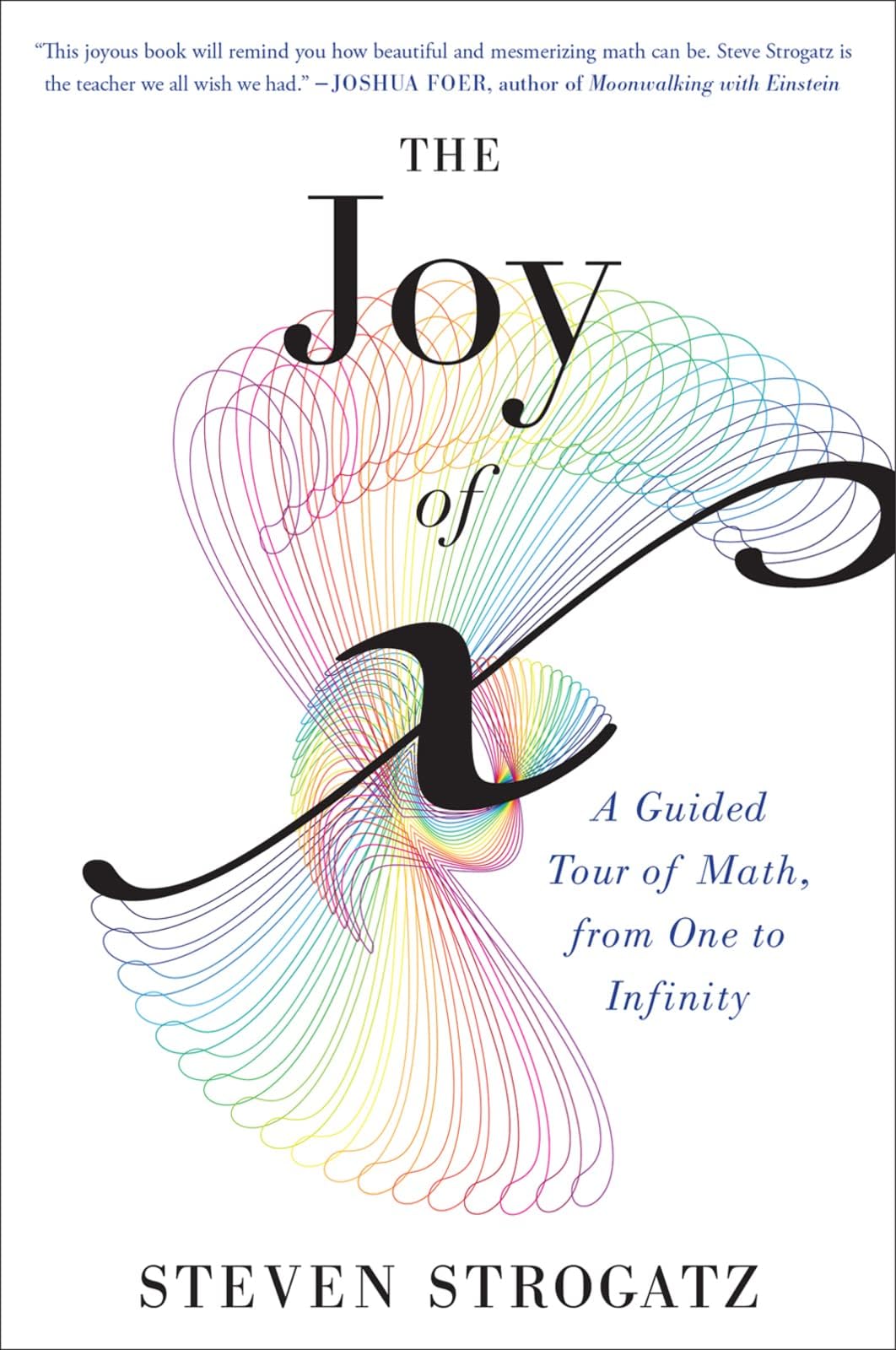
The Joy Of X by Steven Strogatz is a bestselling, highly rated guided tour through fundamental math concepts—from numbers and algebra to calculus, statistics, and the mysteries of infinity. Designed for a broad audience, this used book in good condition offers clear, engaging explanations and real-life applications that demystify math and inspire curiosity, making it a must-have for lifelong learners, educators, and anyone eager to rediscover the elegance of mathematics.
| Best Sellers Rank | #29,257 in Books ( See Top 100 in Books ) #7 in Mathematics History #14 in Calculus (Books) #83 in History & Philosophy of Science (Books) |
| Customer Reviews | 4.5 out of 5 stars 2,578 Reviews |
H**I
A delightful tour of the beauty and ubiquity of mathematics
The joy of x is indeed what the author claims it to be in its subtitle: a tour through the enchanting and often intriguing world of mathematics by a wise and selective guide intent on passing over his enthusiasm for the subject regardless of former mathematical training. I must say I have been a fan of Strogatz since I first read his (more technical) Nonlinear Dynamics and Chaos. His lucidity in explaining advanced mathematical concepts made me wish he wrote a book on the more introductory realms of mathematics, and intended for a much broader audience. Soon enough, I heard about his series in the NY times, which clearly indicated his expertise in this arena. And now that it is has been expanded and put out as a hardcover, I made sure I ordered a copy right away! Strogatz focuses not on those who were math wiz-kids in high school. His pace and clarity particularly are meant to encourage those who were even scared of areas of mathematics to try and read this book. As to those who can digest more advanced math, the book still is charming; offering a "snack", to quote Strogatz himself, in any chapter of his work. And this is not a complete book in any-sub area of math, but merely an attempt at revising and rediscovering elementary concepts of the subject. The book is divided into six parts, constructed more or less in a sequence that resembles the way we are (or at least, should be) introduced to elementary mathematics. The first two build up on what numbers mean, their properties, the need for larger number sets, their relationships, and a whirlwind primer to algebra. Strogatz constantly focuses on insight, often digressing into alternative methods to understand concepts, and with a generous supply of figures to support that. He then moves on to Geometry, followed up by a short but extremely illustrative companion to introductory calculus. His examples are interesting and often ingeniously pulled out of daily life. Particularly worth mentioning is the fact that proofs, when presented, are discovered as a child learning math should rather than merely presented, as unfortunately the case is in most introductory textbooks. The penultimate chapter focuses on why statistics and probability should be at the fingertips of anyone today (a point not justified in most education systems today), followed by the extremely interesting final section on the 'frontiers', where topics from prime numbers to differential geometry to the meaning of infinity are touched upon (arguably my favorite section). Who is this book intended for? In my opinion, this work is qualified to be supplementary reading at a high school level. No, this is not a stand alone book in number theory or algebra or calculus or any branch of introductory math, and the author clearly does not intend to make this one. This is a tour, a joyous ride, a display piece that swiftly (half a day in my case, un-put-down-able!) takes you through the intricacies and beauty of mathematics without the terrors of rigor or the banality of (most) textbooks. I would recommend even that every parent of math students attempt to read this, to try and learn (and hopefully enjoy) the beauty of the subject along with their kids. Advanced students of math (like myself) can read this for a tour back into the days when they first meddled with introductory concepts, and see how much easier and more elucidating this could have been. And instructors of math must try this for wonderful pedagogic tools and original ideas that could make passing the tricks on to the next generation so much easier and enjoyable to both parties. PS: For those interested and motivated in more, the 250 or so snippet-notes at the back of the book (sadly not cited systematically through the course of the book except in a handful of occasions) are a treasure trove of information. Keep a log of it along with the chapters you read, and you can unearth a ton of references, links and in many cases deeper insights into the point being conveyed.
M**R
Amazing and Underwhelming
Reflecting back at my mathematics education, many topics were poorly motivated (complex numbers, logarithms, related rates, etc.). And in writing the Joy of X, Strogratz makes a rather ambitious (and perhaps unrealistic) goal to inspire the masses by providing intuitive and meaningful explanations for these formidably esoteric mathematical areas. In many instances, the Joy of X triumphs; in particular, the motivation for complex numbers was well presented; and the chapters on "infinity" topics , such as the Hilbert Hotel, illustrate interesting mathematical problems that are accessible to a general audience, but are often not discussed until an upper level undergraduate mathematics course. Then there are the serious shortcomings; the discussion on logarithms, a topic that many people find to be challenging is not discussed at any reasonable length; and while the author lists a bunch of applications for logarithms, that in it of itself will not remedy the trauma caused by what many (incorrectly) perceive to be an unnecessary topic in precalculus. And finally there are the abysmal math topics that should never be taught and somehow are considered as the cornerstone in the mathematics curriculum.. My interest in finding the optimal path for walking in a field with varying amounts of snow only rivals my fascination for the changing rate for the height of a falling ladder. While these topics should crash and burn, they make unsavory appearances in the "Joy" of X. But putting these (serious) shortcomings aside, the Joy of X is a mostly accessible and inspiring read to a discipline that many people consider to be monotonous and perplexing..
A**N
Excellent collection of mathematical insights made very approachable
The Joy ox X is a collection of important mathematical ideas made understandable to the non mathematical reader. It covers a wide range of topics and is split into 6 parts, Numbers, Relationships, Shapes, Change, Data, Frontiers. Each part has several small chapters on selected topics. It is both enjoying to read and understandable given the authors ability to communicate well. I'll go through a few of the kinds of chapters briefly. Despite using numbers all the time, many of the properties of the real number system remain unintuitive for most people who havent been forced to think of the subtle logic often associated with the group. The first part deals with some of these nuances and describes important and understantable aspects of the number system including the properties of negative numbers and things like how operations commute (ie the order of operations can be reversed). The author then goes into using variables and algebra in the section on relationships. The complex numbers are discussed and author discusses one of the most important of formulas, the quadratic formula which gives the solutions to quadratic equations. Also included are how logarithmic and exponential functions arise. The author also discusses geometry and gives a visual proof of the pythagorean theorem. The author also shows some of the logic in simple proofs regarding triangles, like how the interior angles must equal 180 degrees using simple axioms. The author also goes into some of the math associated with conic sections. The first ideas of limiting used by Archimides are included and are the precursor to the next chapter. Change is an overview of ideas in calculus. It discusses calculus's use in finding minimums and maximums. It includes a discussion of the limit of continuous compounding ie the constant e. It discusses some aspects of differential equations as well as some simple ideas associated with maxwells equations. Data gives some nuggets of information in statistics. The author discusses power law distributions and the normal distribution. The author also discusses the ease of thinking about things in frequency terms instead of trying to compute probabilities (sort of like using monte carlo instead of explicit calculation). And the author also discusses how google uses matrix algebra to find best searches. Frontiers is a collection of interesting ideas that use the previous chapters to build on. The author discusses the distribution of primes and the infinity of twin primes. He discusses the group theory involved in rotating mattresses, shortest flights and some properties of infinity. The Jox of X has lots of compact mathematical wisdom for those interested. It is easy to follow and illuminating to read. Not all the chapters are as interesting as one another but it would be hard for almost any reader to not come out after reading it with some new intuition about aspects of math and the world. Definitely worthwhile non-technical read.
B**S
The Joy is His in Telling You All This Stuff
Supposedly publishers ask authors to begin writing by defining the audience for whom they are writing their book. Later, reviewers delight, de rigueur, in saying who the book was "intended for". When this book starts with arithmetic and gets to topics like group theory, we might wonder. But he is NOT trying to teach us any of these things. He is telling us, I think, why these things REALLY are so interesting, why he loves them, and why we should too. And he has done a remarkable job of establishing a relatively uniform level of understanding (or is appreciation the word) despite varying levels of mathematical sophistication that WOULD be necessary, IF one were inclined to take on an extensive study. Perhaps his MO was to put himself in the position of being asked at a party "What is X all about?" knowing that the questioner really wanted to know, was an intelligent person, had limited time, and really would be derailed by any patronizing snags in any descriptions proffered. Everything here is thoughtful and respectful. So it may have been intended by some involved in the publication as basically an introduction, but it is hard for me to envision anyone who would not find this interesting, if not compelling. Will a professional mathematician of engineer be bored? Not likely. I had never thought of "fish, fish, fish, fish, fish, fish" as being different from 6 fish - he is making a point about numbers, not about arithmetic. Later, seemingly more profound ideas emerges, such as: "Whenever a state of featureless equilibrium loses stability - for whatever reason, and by whatever physical, biological, or chemical process - the pattern that appears first is a sine wave, or combination of them." In some sense, the sine wave and fish comments are equally deep. So I envision Strogatz as enthusiastically sitting you down to tell you some things that he finds interesting, and imagining that you would too. Perhaps his narratives are accordingly described as infectious. Reading this, you have run into a person who delights in telling you interesting things - the kind of person who is sometimes a pest - if he really did grab you off the street and begin his spiel. But after all, YOU picked up the book. Oh - did I mention that you really should pick up this book?
A**R
My favorite book about math!
I loved, loved, loved this book! It doesn't teach you how to do math, but it really helps you understand how the various equations, formulas, and types of math are used and why. The author's voice throughout is entertaining and friendly. He gives wonderful examples, analogies, and metaphors for the math concepts. I finally understand what logarithms are and what they're used for! I learned how to calculate log equations recently, but I couldn't fathom why you'd need or want to do that. Steve explained it in ways that made sense and using examples I'll remember. The chapters are organized nicely, all terms are explained, and it ends with a lot of resources. But I have to say, I'm disappointed to have reached the end of the book! I want more. This was a fun read, and I learned a lot. It made so much sense of the math I'm learning. I also want to remark I am 50 years old and decided to finally learn math because of my interest in science. I have plenty of math text books and watch online videos to learn *how* to do math. But this was the best book ever to *understand* math and the ways it's used. Steve, please, please, please write another Joy of X. Maybe call it, The Joy of X^. You know you only touched on a few mathematics in this book. I'd love to read another by you, written in the same style, digging into more algebra, geometry, trigonometry, calculus, linear algebra, etc. This was a great book. I highly recommend it. This book is a fun, interesting read even if you don't do math, even if you're not interested in learning more math, and especially if you are doing math.
A**N
Enjoyment=attitude x (aptitude + interest) / ln(perseverance)
Before you buy this book, take a second to examine yourself. If you always hated math, don't bother with this book. You will just use it to reinforce your dislikes. But if you have ever looked at numbers, triangles, or even google page rankings and wondered how anyone ever figured any of that stuff out, this might be your book. === The Good Stuff === * This is not a math book. You won't learn how to calculate the area of a triangle, the odds of a no-hitter or the present value of a 40 year annuity. But if you are willing to read carefully and think about the concepts presented, you will have a better understanding of how math is used to model and predict the way the world works. * I am an Electrical Engineer, a field that uses moderate level math on a daily basis. Even though none of this material was new to me, there was some interesting ways of explaining things which I had never considered before. This always comes in handy, even among fellow techies. And there were numerous facts and observations which, while I probably could derive them myself, were interesting enough to spend some time examining. * All the material presented in the book is certainly at the level that any high-school graduate could understand. You might not be able to grasp the nuances of the material, or be able to use the concepts to solve real world problems, but you will have an understanding of how the math works. Depending on the amount of math your have been exposed to, some topics might require the reader to think a bit to understand the concepts. Think about a two page article that describes how an internal combustion engine works. After reading it, you might understand the basic concept operation-gas/air mixture igniting and driving pistons, which rotate a shaft, which drives the wheels. You certainly couldn't design one, or fix one, and you would not know how to drive a car. But you certainly would have a better appreciation for what goes on under the hood, and it might spark your interest to learn more. * All of the sections are short, and err on the side of over simplification and minimal explanation. This is not a math textbook, or a history of math. It is more an overview of various topics. === The Not So Good Stuff === * Strogatz tries to do too much. As an example, the equations of James Clerk Maxwell are some of the most profound mathematical models ever conceived by the human race. They predict and allow analysis of just about anything in the world that uses electricity or magnetism. But they are not at all simple, either in conception or mathematical constructs. A three page summary of them borders on the absurd. I doubt whether any person without a decent physics and math background would ever see the beauty or elegance of them. * The chapters all seem to need to be the same length, likely a result of the newspaper articles this material was originally developed for. As a result, some simple topics seem stretched out to fill space, while some of the more complex topics are condensed beyond usefulness. * "Advanced" math users, such as those who have studied differential and integral calculus, analytic geometry and differential equations will find some limited tidbits, but will mostly be bored by the book. === Summary === Strogatz sets himself a fairly difficult task. He tries to write a single book, which gives introductory explanations of topics ranging from integers and rational numbers all the way to linear algebra and differential equations. He tries to do this is a "mass market" book, targeted at readers with a wide gamut of math experience. I am not sure that is a reasonable goal. In fact, I think it borders on the impossible. Still, Strogatz makes as valiant an attempt as possible. I believe the book is "readable" by users of advanced math, and there are enough tidbits and interesting ways of explaining things to hold their interest. The book is also simple enough that most anyone can work their way through the examples and appreciate the concepts. I enjoyed it, but not sure I would recommend it.
R**A
Highly entertaining read
This book is indeed a joy to read. There were many "aha" moments, some of which are : 1) Google's Page rank explained using a simple Markov chain example. Demonstrates the power of linear algebra. 2) Thinking about conditional probability in terms of frequencies is more intuitive and less confusing than the usual Bayes formula. 3) Power Law is the new Normal Distribution of the world.They are everywhere. 4) Log scale verbalized brilliantly :Markings on the axis differ by the same factor than same absolute number. 5) Div, Grad and Curl in Maxwell's equations. 6) Differential equation to understand a love affair. In the same context, Newton's three body problem has no closed form solution. May be that's the reason why love triangle movies always seem to work, for there is always some novelty that audience can expect. 7) To explain Euler's constant, an example with some equation is usually the standard choice. But the author does it in style when he says "e arises when something changes through the cumulative effects of tiny events." 8) Usage of Goldilocks Principle in many places in the book. 9) Stair case analogy to explain Fundamental theorem of Calculus. 10 Zero antiderivative property of slopes and peaks verbalized as : Things always change slow at the top or bottom. 11) "Sine qua non" - word used to cutely explain the ubiquitous sine curve, the nature's building block . 12) Cone's hidden role in the manifestation of parabola, ellipse and hyperbola . 13) Solving a quadratic equation visually. 14) Exploring Connections between "Using Newton Raphson to solve an equation with multiple roots" , Chaos theory and fractals. Truly amazing! 15) Why Hindu Arabic system of numbering flourished while others fell astray? The unsung background hero of the story is the "Zero". 16) Gibbs Phenomenon and the way it unpleasantly crops up in digital photographs and MRI scans. 17) Connection between "How to effectively use Mattress" and group theory. 18) Mention of Mobius Strip and its strange characteristics The book begins with natural numbers that made counting and tallying easy. It ends with with the subject of infinity where everything is on a slippery ground. In this journey from natural numbers to infinity, the book explores various subfields of mathematics. This book is a pleasure to read as the author connects some basic math stuff with everyday life.
D**G
Entertaining and interesting - but don't get the Kindle edition....
An entertaining, well-written and informative book - suitable for folks with little or no background in math, but also for those who know a fair bit of math (you will still learn a lot, I suspect). Amusingly written, with a pleasing authorial voice. One serious problem with the Kindle edition: the extensive and informative notes at the end of the book are not properly linked within the body of the text - no reference links or footnotes numbers at all! So, you don't know which topics in a given chapter have notes, and you don't even know about the existence of said notes until you stumble on them at the end. So, go for the paper edition, *not* the Kindle edition. Whoever does the technical editing for Kindle editions of non-fiction is doing a rotten job - several other books I have purchased for the Kindle have had similar issues. I am tempted to only use the Kindle for fiction, not for non-fiction. Too bad Amazon doesn't allow one to rate the content separately from a rating on the digitization for the Kindle; I gave 5 stars for content, but would have rated the technical aspects of the Kindle at best 2 stars....
Trustpilot
1 day ago
2 months ago