We remain fully operational. Our teams are working around the clock to ensure your deliveries continue safely.

DOWNLOAD THE APP


Copyright © 2025 Desertcart Holdings Limited
DOWNLOAD THE APP
Buy anything from 5,000+ international stores. One checkout price. No surprise fees. Join 2M+ shoppers on Desertcart.
Desertcart purchases this item on your behalf and handles shipping, customs, and support to South Korea.
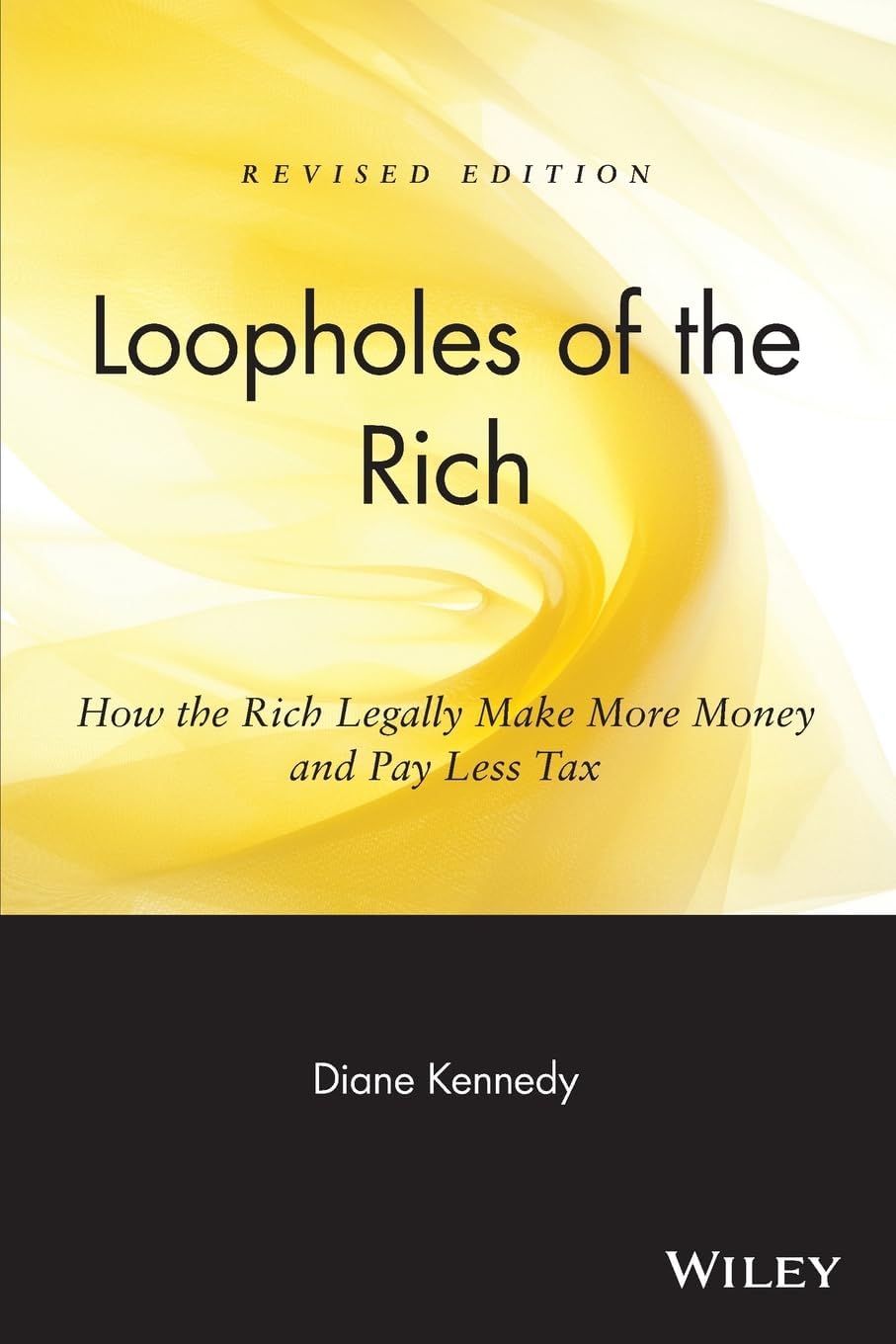
Loopholes of the Rich: How the Rich Legally Make More Money and Pay Less Tax [Kennedy, Diane] on desertcart.com. *FREE* shipping on qualifying offers. Loopholes of the Rich: How the Rich Legally Make More Money and Pay Less Tax Review: A Path So You Can Work For You - It's Not How Much Money You Make, It's How Much Money You Keep. The title of this book is accurate, and it could have also been entitled, "Loop-Holes Of Those With Common Sense." There are numerous advantages available to those who take the risk and have the creativity and fortitude to do something on their own. These people are compensated for it if they educate themselves and IF they succeed. And on the contrary, being an employee is for most people. Much less control but some security, the routine of the comfort zone, and a familiar role defined within the job and confines of a corporate or governmental job. But today, for the employee, is there job security? Is there a routine and comfort zone? Will your job be there for you every morning? And, when it's not, will it be gone by your choosing or your employers? After only a few chapters we'll once again be reminded of the futility of being a W-2 working stiff, perfunctorily accepting the crumbs that are left over after taxes. This book will be most beneficial to people who have recently, or have now just started to change, the way they think. Experienced small business folks, entrepreneurs, and MLMers, will likely (but not necessarily) already have most of this information down. The premise of "Loop-Holes" provides us with the facts: since the 1943 federal tax law tragedy Americans work, pay taxes, earn, then spend. All in that order. After taxes and paying expenses, what's left for the middle class person who works as an employee? Ask yourself how much YOU have left. Whether your a service sector employee or upper-middle class professional, how much of the money you earn, goes in your pocket? And of what does go into your pocket, how much of it stays there? If you file a W-2 and are classified as an employee you will work a lot, but you are not likely to "make money." But you will have the liabilities (<--Kiyosaki) of a mortgage, car payment, credit card debt, and dinner out at a local budget franchise, once a week as a treat. Welcome to the reality of 2003, America. The common notion of getting raises at work as an employee to earn a higher income has unfortunately become a fallacy today. "The more you make, they more they take." Congratulations, you've just been bumped up to a higher tax rate. Diane Kennedy provides more facts, proven strategies, and common sense than what we get from our educational system, and electronic and print media. Kennedy's information is contemporary, valuable, and necessary knowledge that we need on how to proceed in making our lives better. To pay an advisor for this knowledge would be costly. These is a lot of practical information and real-life examples provided in Loop-Holes: If your starting a business in hopes of receiving passive income in the future, there are 9 criteria the IRS uses to qualify your gig as a "true business" and not a "hobby business." The latter scenario cannot be used to deduct losses from your earned income. Setting up Limited Liability Companies (LLCs)is highly recommended when investing in income producing real estate for the protection of personal assets. And how this is structured is very important. The C and S corporations are are also covered. When, why, and how should you begin the process. Deductions, leasing, licensing, royalties, trusts and many more things are explained also. People often state how great it is to get the the tax deduction on mortgage interest: What do you get on average? For every dollar you pay to the bank in interest on a mortgage, you get 30 cents back with the deduction. I'll take it, but is 30 cents on the dollar a good deal to you? There are several questionaires to fill in, so a person can assess (honestly!) what their true financial situation is. Their risk tolerance, what resources they can tap into, and what timeline can be established. Very important is the team of folks needed for a person or couple to be able go to for advice, support, and information. The most common money people work and toil for is the W-2. As we know this is the 50 percent money we hear about from the Rich Dad Advisors. Great, you just got a raise. And, so did the government. Find out the steps to start making the other 3 types of money with Diane Kennedy. This is excellent, especially for folks without a lot of business background, to understand the some of the nuts and bolts. Review: Most helpful guide on best tax structuring for a business - For me, it was apparent by about page 60, that Diane Kennedy is a brilliant tax strategist. Having always been baffled by the rules of taxes, I took an 8 week class offered by a large tax agency. During this class, I did a case study involving a self-employed person with an income of $170,000 a year. My answer on the case study was that the annual federal taxes due were about $70,000! Yikes! That's about the 41% tax bracket including self employment tax. I thought for sure that my answer was incorrect. Nope. That's the way it is for the high-income self-employed with no deductions and all income subject to the self-employement tax, which has no limit for the self-employed. That's when I knew I had to learn from someone who knew the ropes. Fortunately, I came upon this book a bit early in my search. I found loop holes that can effectively keep the self employed wanting to go to work at the same time they are not violating any tax laws. Thank you Diane Kennedy for writing such a useful book and educating the lot of us who have spent our work lives as self-employed.
| ASIN | 0471711780 |
| Best Sellers Rank | #848,860 in Books ( See Top 100 in Books ) #2,596 in Economics (Books) #3,823 in Business & Finance #6,172 in Personal Finance (Books) |
| Customer Reviews | 4.3 4.3 out of 5 stars (128) |
| Dimensions | 6.08 x 0.9 x 9.06 inches |
| Edition | Revised |
| ISBN-10 | 9780471711780 |
| ISBN-13 | 978-0471711780 |
| Item Weight | 13.6 ounces |
| Language | English |
| Print length | 336 pages |
| Publication date | December 20, 2004 |
| Publisher | Wiley |
K**N
A Path So You Can Work For You
It's Not How Much Money You Make, It's How Much Money You Keep. The title of this book is accurate, and it could have also been entitled, "Loop-Holes Of Those With Common Sense." There are numerous advantages available to those who take the risk and have the creativity and fortitude to do something on their own. These people are compensated for it if they educate themselves and IF they succeed. And on the contrary, being an employee is for most people. Much less control but some security, the routine of the comfort zone, and a familiar role defined within the job and confines of a corporate or governmental job. But today, for the employee, is there job security? Is there a routine and comfort zone? Will your job be there for you every morning? And, when it's not, will it be gone by your choosing or your employers? After only a few chapters we'll once again be reminded of the futility of being a W-2 working stiff, perfunctorily accepting the crumbs that are left over after taxes. This book will be most beneficial to people who have recently, or have now just started to change, the way they think. Experienced small business folks, entrepreneurs, and MLMers, will likely (but not necessarily) already have most of this information down. The premise of "Loop-Holes" provides us with the facts: since the 1943 federal tax law tragedy Americans work, pay taxes, earn, then spend. All in that order. After taxes and paying expenses, what's left for the middle class person who works as an employee? Ask yourself how much YOU have left. Whether your a service sector employee or upper-middle class professional, how much of the money you earn, goes in your pocket? And of what does go into your pocket, how much of it stays there? If you file a W-2 and are classified as an employee you will work a lot, but you are not likely to "make money." But you will have the liabilities (<--Kiyosaki) of a mortgage, car payment, credit card debt, and dinner out at a local budget franchise, once a week as a treat. Welcome to the reality of 2003, America. The common notion of getting raises at work as an employee to earn a higher income has unfortunately become a fallacy today. "The more you make, they more they take." Congratulations, you've just been bumped up to a higher tax rate. Diane Kennedy provides more facts, proven strategies, and common sense than what we get from our educational system, and electronic and print media. Kennedy's information is contemporary, valuable, and necessary knowledge that we need on how to proceed in making our lives better. To pay an advisor for this knowledge would be costly. These is a lot of practical information and real-life examples provided in Loop-Holes: If your starting a business in hopes of receiving passive income in the future, there are 9 criteria the IRS uses to qualify your gig as a "true business" and not a "hobby business." The latter scenario cannot be used to deduct losses from your earned income. Setting up Limited Liability Companies (LLCs)is highly recommended when investing in income producing real estate for the protection of personal assets. And how this is structured is very important. The C and S corporations are are also covered. When, why, and how should you begin the process. Deductions, leasing, licensing, royalties, trusts and many more things are explained also. People often state how great it is to get the the tax deduction on mortgage interest: What do you get on average? For every dollar you pay to the bank in interest on a mortgage, you get 30 cents back with the deduction. I'll take it, but is 30 cents on the dollar a good deal to you? There are several questionaires to fill in, so a person can assess (honestly!) what their true financial situation is. Their risk tolerance, what resources they can tap into, and what timeline can be established. Very important is the team of folks needed for a person or couple to be able go to for advice, support, and information. The most common money people work and toil for is the W-2. As we know this is the 50 percent money we hear about from the Rich Dad Advisors. Great, you just got a raise. And, so did the government. Find out the steps to start making the other 3 types of money with Diane Kennedy. This is excellent, especially for folks without a lot of business background, to understand the some of the nuts and bolts.
M**S
Most helpful guide on best tax structuring for a business
For me, it was apparent by about page 60, that Diane Kennedy is a brilliant tax strategist. Having always been baffled by the rules of taxes, I took an 8 week class offered by a large tax agency. During this class, I did a case study involving a self-employed person with an income of $170,000 a year. My answer on the case study was that the annual federal taxes due were about $70,000! Yikes! That's about the 41% tax bracket including self employment tax. I thought for sure that my answer was incorrect. Nope. That's the way it is for the high-income self-employed with no deductions and all income subject to the self-employement tax, which has no limit for the self-employed. That's when I knew I had to learn from someone who knew the ropes. Fortunately, I came upon this book a bit early in my search. I found loop holes that can effectively keep the self employed wanting to go to work at the same time they are not violating any tax laws. Thank you Diane Kennedy for writing such a useful book and educating the lot of us who have spent our work lives as self-employed.
R**N
Loopholes of the Rich: How the Rich Legally Make More Money
Having just started my own small business, this book really provided the insight and perpective I needed on ways to structure my enterprise. What particularly appealed to me was Diane's style and approach. Too many books of this nature don't create a comfortable and readable format that makes intimidating information like this understandable and easy to digest. Her five steps to financial freedom helped define for me what income is, how to create a good team to position myself for success, and the best ways to evaluate the progress. Same with the 3-step tax code, which sums up the reams of government-speak tax laws on regulations, rulings and procedures. The book is a great compliment to the Rich Dad series. Kiyosaki walks the talk by having Diane on his team.
T**S
Good info but outdated.
The book had a lot of great information however it was outdated. Hopefully, the author will update the book soon.
C**Y
The books title was challenging for me initially, but ...
The books title was challenging for me initially, but I'm about a a third of the way through it and the book is a must read for anyone interested in understanding wealth management. In Loopholes of the Rich while Ms. Kennedy strongly encourages that we pay taxes, she also shares strategies designed to minimize the amount of tax paid in order to build wealth. This book explains the benefit of understanding the system, and the power of building a team of advisors. For people seeking to grow personal wealth and financial freedom this book is a must read.
M**N
Great Book on Tax Loopholes and Biz Deductions
Great book. Really convinces you that you need to become a corporation, even though an LLC would be fine. Diane Kennedy has a business where she will help you set one up online. She is also one of Robert Kiyosaki's friends, so don't let the lack of purple fool you. (They're catching on ; ) Still, very good advice to be loaded with when you go to a tax preparers office, or are thinking about separating your business from your personal assets. Get this book. You will like it.
D**N
Very informative
I'm not rich but I plan to use some of the strategies in this very good book!
J**G
Great book
I got a little worried when I purchased this book that it was going to be one of the "gimmicky" business books. Once I started getting through it I realized it wasn't. It's full of useful and practical information.
B**N
Excelente, El libro fue entregado antes de la fecha estipulada y llego en condiciones muy buenas, ningun maltrato ni nada todo perfecto
Trustpilot
2 months ago
2 weeks ago