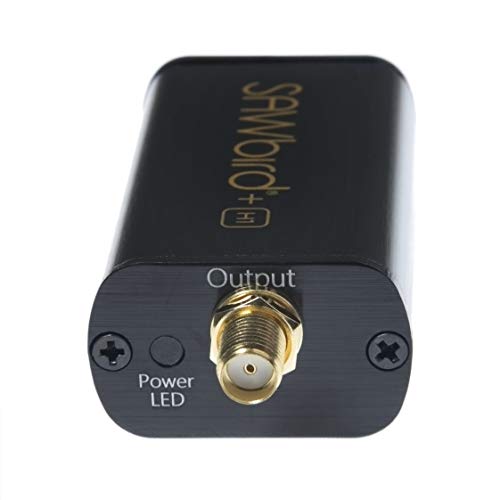

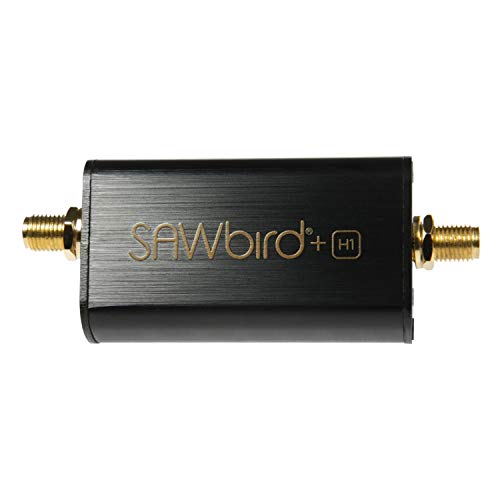
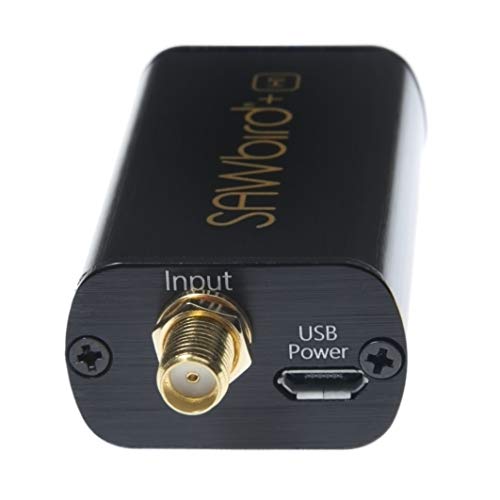

🚀 Unlock the secrets of the galaxy with pinpoint signal clarity!
The Nooelec SAWbird+ H1 is a premium, self-contained LNA module designed specifically for hydrogen line (21cm) radio astronomy at 1420 MHz. Featuring dual ultra-low noise amplifiers and a custom SAW filter, it ensures exceptional signal-to-noise performance. With versatile powering options and robust North American manufacturing backed by a 2-year warranty, it’s the go-to choice for SDR professionals and amateur astronomers aiming to capture faint cosmic signals with precision.
| ASIN | B07XPV9RX2 |
| Best Sellers Rank | #66,328 in Industrial & Scientific ( See Top 100 in Industrial & Scientific ) #4 in Radio Frequency Filters |
| Brand | NooElec |
| Date First Available | September 9, 2019 |
| EU Spare Part Availability Duration | 2 Years |
| Item Weight | 1.76 ounces |
| Item dimensions L x W x H | 3.15 x 1.18 x 0.39 inches |
| Item model number | SAWbird+ H1 |
| Manufacturer | Nooelec Inc. |
| Maximum Supply Voltage | 12 Volts (DC) |
| Mounting Type | Surface Mount |
| Number of Channels | 1 |
| Output Power | 7.2 Watts |
| Package Type Name | box |
| Product Dimensions | 3.15 x 1.18 x 0.39 inches |
| Specification Met | Emi Shielding, Overvoltage Protection, and Protection Circuitry |
| UPC | 616469146557 |
| Voltage | 5 Volts |
G**Y
Great tandem performance with astro spectrometer
Amateur radio enthusiasts now have amazing and powerful technical capabilities at their disposal. My initial plan was to replicate some of the results documented by a group of students on the Internet. Their project demonstrated how the native H1 frequency (1420.4 Mhz) of neutral hydrogen can become red and blue-shifted due to the Doppler effect and the rotation of our Milky Way galaxy (MWG). Likewise used the spectrometer software from the West Virginia University Radio Astronomy project (WVU RAIL) which employs the polyphase filter bank technique to enhance harvesting of weak astronomical signals from the noise clutter. Instead of a horn antenna, a simple grid-wifi dish was used in conjunction with a dipole feed element tuned to 1420 Mhz via return-loss testing. The Sawbird+H1 served as the upstream LNA because of its lower published noise figure and a spectrum analyzer confirmed a relatively flat 30 db passband. Downstream devices included a Raspberry Pi-4 running the spectrometer software and an NESDR Smartee sampling at 2.4 MSPS. The accompanying image has the dish pointed in the vicinity of the star Alya near the galactic plane with coordinates of approximately +35 degrees longitude and 0 degrees latitude. There is a noticeable peak at roughly 1420.56 Mhz, followed by a dip, and then another slight peak at 1420.59 Mhz. These blue-shifted frequencies appear related to H1 concentrations in regions of the spiral arms of the MWG that are moving toward the observer. The frequency deviations from the baseline H1 correspond to a tangential (line-of-sight) velocity of 33.8 km/sec and 40.1 km/sec, respectively. By factoring in the Sun's velocity relative to the galactic core, the rotational speed of the galaxy can be estimated. Calibration of the spectrometer using its "hot" and "cold" benchmark temperatures is vital prior to observation.
C**E
Nice!!!!
The package arrived safely. The device works as intended. The Signal to Noise ration for 1420 mhz in this device is extraordinary compared to wideband LNA's. I've been doing 24 hrs straight testing for 4th time now and the device is stil great!!! Definitely worth the money.
A**P
Outstanding Performance for H Line Radio Astronomy
The LNA for H Line Radio Astronomy ... For info on building your own radio telescope antenna and links to download free software capable of creating the 3D graphics shown in the photo, search " Project HLine3D "
A**.
Good support from Nooelec
Used this in conjunction with an RTLSDR running SDR# and IFAve., this unit helped me map H1 through most of the Milky Way. I am on my second unit. The first one ceased proper functioning and was replaced by Nooelec after filing the proper documents.
A**R
Great little product.
Worked as advertised. Amplified my reception in the desired frequency domain.
S**N
Detected Milky Way galactic Hydrogen 21 cm emissions.
As many reviews note about this device is that it runs a bit warm. Simply cut a piece of finned heatsink (https://smile.amazon.com/gp/product/B07M6Y8TYF/ref=ppx_yo_dt_b_search_asin_title?ie=UTF8&psc=1) and glued with heat conducting cement. Problem solved.
A**I
I will buy it again
Very good product
A**R
Excellent
These filter amplifiers are well engineered. They work. period.
D**A
El LNA llegó acompañado de un latiguillo adaptador USB/conector de barríl de 5,5mm para la conexión de alimentación externa y un barrilete SMA macho/macho. El rendimiento de nuestra unidad honra los valores anunciados: ganancia sensiblemente superior a los 40dB en la banda de trabajo, con un ancho de 67MHz. Como se aprecia en las imágenes, la banda de trabajo está sensiblemente desplazada hacia abajo respecto a la frecuencia de funcionamiento nominal. Ahora, ¡a montarlo en una antena!
E**I
It did what it said on the box. I was able to finish my homebuilt telescope and see the hydrogen line!
J**.
excellent produit, faible bruit, et bien filtré, ne laisse passer que la bande SHF du H1, pour les radioastronomes, et les amateurs du SETI.
M**S
Low noise amplifier with essential filter for observing Hydrogen 1 line on 1.42 GHz. Reduces great amount of noises all around wanted spectra. Great amplification (40 dB+).
A**R
Works very well to specification.
Trustpilot
2 weeks ago
4 days ago