We remain fully operational. Our teams are working around the clock to ensure your deliveries continue safely.

DOWNLOAD THE APP


Copyright © 2025 Desertcart Holdings Limited
DOWNLOAD THE APP


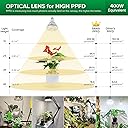

🌿 Illuminate your indoor jungle with science-backed sunlight!
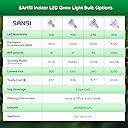
The SANSI 36W Full Spectrum Grow Light Bulb replicates natural daylight with a 4000K color temperature and a high color rendering index (Ra ~100), delivering 65.6 umol/s PPF and 265.58 μmol/s/㎡ PPFD at 1ft. Featuring patented Chip on Ceramic technology for superior heat management and a 25,000-hour lifespan, this energy-efficient LED bulb ensures optimal plant growth indoors. Its flame-retardant ceramic body and ETL certification guarantee safety and durability, backed by a 5-year warranty.


| ASIN | B07BRKG7X1 |
| Accepted Voltage Frequency | 100 to 120 Volts and 60 Hertz |
| Additional Features | Full spectrum LED grow lights promote growth of plants! |
| Brand Name | SANSI |
| Brightness | 2500 lumen |
| Bulb Base | E26 |
| Bulb Shape Size | BR30 |
| Color Rendering Index | 95.00 |
| Color Temperature | 4400 Kelvin |
| Connectivity Technology | e26 |
| Control Method | Touch |
| Controller Type | Push Button |
| Customer Reviews | 4.4 4.4 out of 5 stars (2,333) |
| Efficiency | High Efficiency |
| Incandescent Equivalent Wattage | 400 Watts |
| Indoor Outdoor Usage | Indoor |
| Item Dimensions W x H | 13.1W x 16.9H centimeters |
| Item Type Name | grow light bulbs |
| Light Color | daylight white |
| Light Source Operating Life | 25000 Hours |
| Light Source Type | LED |
| Light Source Wattage | 36 Watts |
| Light Type | LED |
| Manufacturer | SANSI |
| Material Type | Ceramic |
| Model Name | C21GL-CE26-36W |
| Model Number | C21GL-CE26-36W |
| Number of Items | 1 |
| Package Quantity | 1 |
| Power Consumption | 36 Watts |
| Power Source | AC |
| Shape | A-shape |
| Specific Uses For Product | Plant Growing |
| Unit Count | 1.0 Count |
| Voltage | 110 Volts |
| Wattage | 36 watts |
| White Brightness | 3250 Lumens |
A**D
It was defective
L**.
Para plantas de interior, la marca sansi es mi opinión es muy buena,la recomiendo.⭐⭐⭐⭐⭐
T**Z
I’ve been using the SANSI 34W Grow Light for about 4 years now, and it has been absolutely awesome. This light has allowed me to grow massive, healthy plants completely indoors with strong growth, great leaf size, and consistent results year after year. The light output is powerful for its size, energy-efficient, and reliable long-term—I’ve never had issues with it burning out or losing intensity. It’s perfect for houseplants and makes a noticeable difference in plant health and growth, especially if you don’t have ideal natural lighting. If you’re serious about indoor plant growth and want something dependable that actually works, I highly recommend the SANSI 34W grow light. It has more than proven itself over time. 🌱💡. Last week I had to use their customer service for blown bulbs and it was top notch service and hassle free replacement.
J**O
Lo compré porque en mi casa no entra casi nada de luz y me gustan mucho las plantas, algunas se me murieron y las pocas que quedaban dejaron de crecer, se etiolaron y en general no se veían bien. Ya llevan aproximadamente 20 días y ya presentan retoños, se ven más verdes, con brillo y las que tienen manchas más claras se están resaltando. Solo hay que tener cuidado de no exponerlas demasiadas horas porque se pueden quemar un poco las hojas o como en mi caso, que necesitaron hacer el cambio más progresivo. Lo único que no he podido evaluar es el consumo energético, pero vale la pena ver bien mis plantitas
A**E
So at this point I have purchased 3 different sizes of Sansi grow lights, 15, 24, and 36W over the past 3 or so years. They are all excellent bulbs, so bright it is annoying to have them pointed at your eyes. I was attracted to the Sansi brand thanks to a few online reviews, especially some that used their own spectrometers to confirm that these give a proper full spectrum including a little UV. I like to think my bird likes it too since she can see UV! I wonder if the UV helps with winter depression? In summary: I recommend the 15W for individual low-light houseplants, like a mini moth orchid, succulent, or mini African violet. I recommend the 24W if you have a small collection of plants. I recommend the 36W if you have a medium collection or want to grow a fruit/veg.. I recommend multiple 36W if you have a large collection or a small tree, but if you have that many plants you probably already know what you are doing. ;) Of note: Of note is that the bulbs do get hot after running about 12hrs a day, so it hurts a little to touch the diodes directly, and do not put them in lampshades that would restrict airflow. They do not run hot enough to affect the plants whatsoever though. I have to put my hand 1 inch away from the diodes before my hand detects it as being hot. I think the passive vents do a great job of directing the heat up and away rather than down towards the plants. Also of note is that there is an audible coil whine when any of the bulbs are on. This is not loud or obtrusive (I regularly have one about 3ft from me when I am studying), but it is noticeable if you have young ears. It is also worth noting that the light cone is fairly narrow/focused, so plants directly under the bulb get significantly more light than those around the periphery. This is not a bad thing; it means more of the light is efficiently being beamed on your plants instead of scattering around the room. Below is a comparison of my personal experience with the 3 sizes: The 15W was excellent for a tall desk lamp with a few mini African Violets huddled around it. It was insufficient for outdoor plants that like full sun such as Egret Orchids. I upgraded to a 24W once my plant collection grew to the dozen mark, so I could have a larger illuminated space to work with. Of note is that this bulb was visibly warmer in color than the 15W or 36W. It reminded me of a nice incandescent bulb's glow. I am not sure if this is a consistent thing with the 24W or if it was just my bulb. Otherwise, the 24W was actually my preference for houseplant use with my personal setup. I bought the 36W for a friend to use in a fish-tank sized terrarium, again, for the wider radius able to cover more plants. It is strong! It would be interesting to see if more outdoor semi or full-sun type plants would be satisfied by the 36W; it is a very bright bulb. As is, my low-light houseplant African violets needed to be placed an extra foot away from the bulb to stop from getting sun burn or bleaching. I would mention that the bulb is quite heavy at this point, so if you are using a flexible goose-neck lamp, make sure it is nice and stiff or it might sag under the weight. Tip: If you have a proper light sensor, it is super handy when setting up your plants around your new bulb. I resorted to the free Arduino Science Journal app on my phone to compare light intensity (in lux units), and using recommended lux levels from google for my particular plants. I get about 22K lux directly ~1ft below the 36W bulb, for example, but about 8k lux ~2ft directly below. I currently have my mini african violets arranged in a ring of ~2ft diameter, about ~1.6ft below the light. This gives them the recommended ~7k lux of light according to google.
Trustpilot
1 day ago
1 month ago