

Desert Online General Trading LLC
Dubai, United Arab Emirates
Desert Online General Trading LLC
Dubai, United Arab Emirates
Full description not available
E**C
Outstanding message!! Thought provoking and timely too.
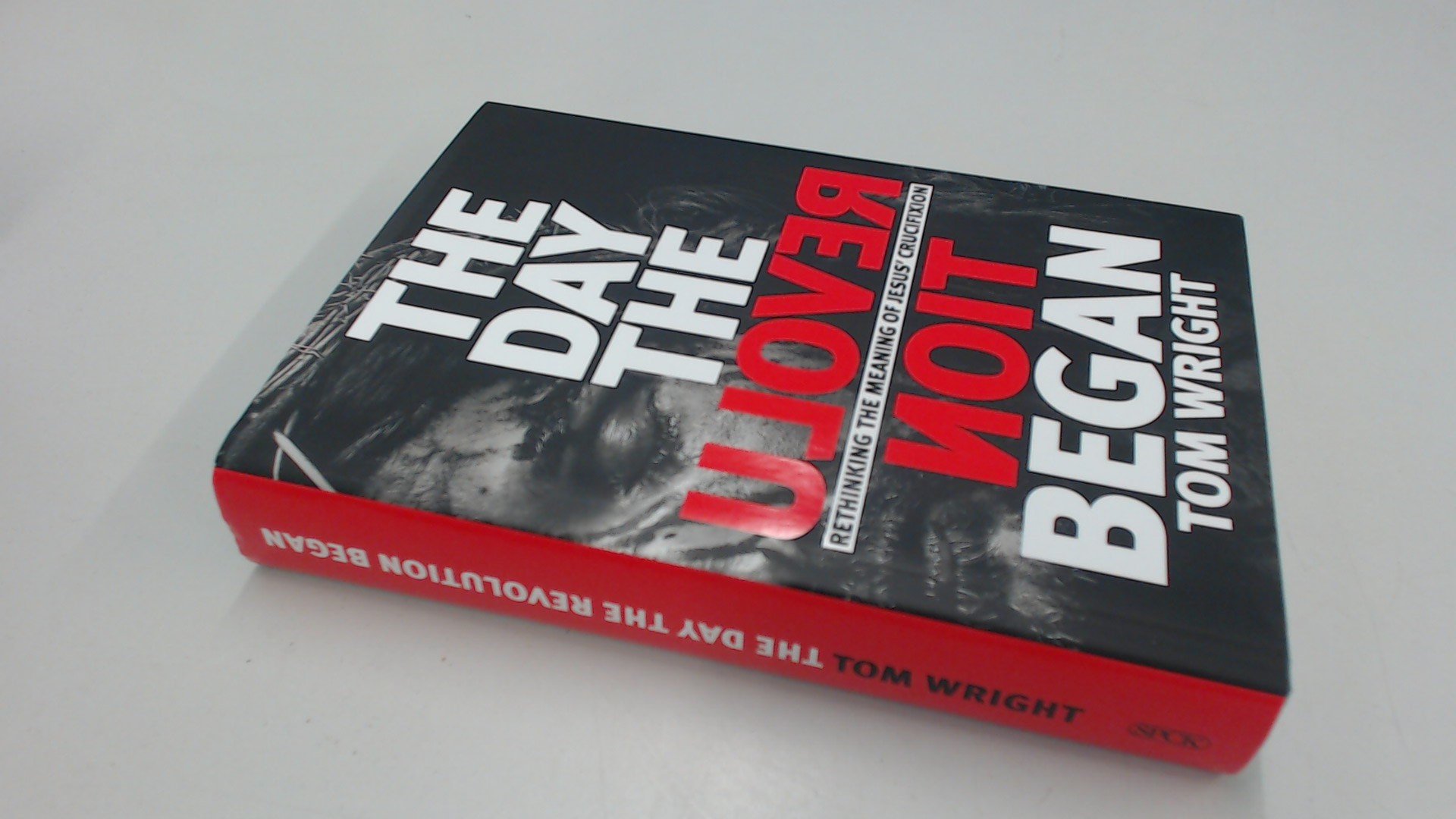
Great book!!! A bit dense, in need of editing, and at times pedantic. The content and core messages are brilliant. The authors' knowledge about early Christianity and the pagan world of that time provide a unique perspective. Christ and the New Covenant are for both the Jews and the Gentiles. Wright presents the case for this inclusiveness and more regarding the relationship of the Judaic, pre-Christian world with the new Christian world. Christ not only died for our sins, and yes therefore we go to heaven. Christ's death and revolution on the cross allows us to be free from paganism and idolatry, should we awake to and accept this profound relationship with God and choose to bear His image as our vocation.This book has and will continue to have a meaningful impact for a long time to come.From the final paragraph of the book:"The message for us, then, is plain. Forget the “works contract,” with its angry, legalistic divinity. Forget the false either/ or that plays different “theories of atonement” against one another. Embrace the “covenant of vocation” or, rather, be embraced by it as the Creator calls you to a genuine humanness at last, calls and equips you to bear and reflect his image. Celebrate the revolution that happened once for all when the power of love overcame the love of power."page 416Wright, N. T. (2016-10-11). The Day the Revolution Began: Reconsidering the Meaning of Jesus's Crucifixion
J**N
Wright wonderfully delves into the cross... and my extra thoughts on how the traditional views can perhaps mix in with his
First off to explain my rating, it is a wonderful, albeit dense, read. I have a feeling that this is an important book in the series of N. T. Wright's popular authorship (e.g. Surprised by Hope, Simply Christian, How God Became King, among others). Here he undertakes an ambitious attempt to weave various strands of his original expositions set out on numerous occasions into the very epicenter of our Christian faith. The enormous emphasis he has vigorously and justifiably placed through his past publications on the so-called Jewish contexts SURROUNDING the cross is here leveraged for the purpose of DIRECTLY illuminating the meaning of Jesus' crucifixion. I kind of consider this book as his delving into the very core of his own theological framework, where he examines all his previous enlightening arguments (e.g. the meaning of resurrection, ascension and new creation, human vocation and creation narrative, the Gospels' accounts of God's kingship, Jesus' representative substitution, the significance of Israel's rugged history, the unity of the Church, the role of the Spirit, heaven-and-earth interplay, among countless others) against Christianity's overriding centrality of "what happened on the six o'clock of that Dark Friday." And he discovers that it actually makes breathtaking sense within his theological framework; the process of this discovery makes this book a fascinating read, especially for an avid reader of Wright as I am.Now that was a lengthy one-paragraph comment to explain my five-star rating. I am actually writing the review in order to address the extreme polarity of ratings I currently observe. Even given the small sample size of seven ratings at the moment of my writing, 57% five-stars and 43% one-stars with no in-betweens certainly is not an ordinary pattern for any book, regardless of actual quality.I think it is due to the fact that in this book, Wright sounds overly confrontative with the 'traditional' Protestant framework of understanding the crucifixion. Throughout the gradual buildup of arguments in the early parts of the book, he harshly belabors how the criticisms of his dissenters are missing the point. I understand his motivation since some people really will mount such oversimplified objections when he is at his crucial logical progression towards the climax. But even though I'm his fan, I still get the impression that he himself somehow repeatedly oversimplifies the 'traditional camp', especially Calvinist and Protestant formulations of Christian theology, that he differs with.Excluding those grossly distorted angry-God-in-the-sky-sending-people-except-some-to-hell theologies that Wright, AND the traditional campers, rightly criticize, I have always felt that the issue arises more from the difference in approaches and emphases than from the degrees of theological validity. Wright, on one hand, enriches our Christian understandings with the highly needed historicity of the good news in multifarious layers and scales, spanning from Israel's stories all the way up to the cosmic narratives of creation and new creation. (I think that in this book, he shows that this multilayered historicity of the good news truly culminates squarely in the cross, much to many skeptics' relief.) The traditional Protestant perspectives, on the other hand, have had the philosophical underpinnings, addressing the fundamental relationship between the quintessentially human conditions and quintessentially divine providence that underlies the entire history. It is true that the traditional frameworks have had to undergo numerous improvements and corrective adjustments, but that does not prove their ultimate inadequacy at all.I think the right theology has to possess both of these two pillars, covering the historical dimension of how the Bible weaves the story of God's initiatives in the world as well as the philosophical one of what it really means to us who are living in our own stories. The former complements the latter by, as Wright always masterfully suggests it does, inviting us to live our stories as part of God's, while the latter complements the former by filling God's story with the praises of people whose stories are personally (and yes, sometimes sentimentally) overwhelmed with his infinitely profound grace. They are mutually reinforcing, and definitely not at odds with each other.For example, let me talk about the highly contentious imputation theology. I personally am more sympathetic to Wright's assertion that it is a caricature of the real thing. His alternative explanation of what it intends to convey seems to me to make more natural sense in the broader narratives of the Bible. I feel, however, that Wright's alternative somehow rids us of the feeling of overwhelming awe that we have when we realize that we are "put to right" (Wright's way of saying it) even though we have done nothing; that sense of personal significance is much better captured by the "imputed righteousness" account, even if it is indeed a caricature. I think the "Imputation" explanation delivers the sense of immense personal relevance at the cost of contextual simplification, while Wright's "Covenant membership" one conveys what that relevance really means in the grand scheme of God's world-saving plan at the expense of personal sensitivity, which does matter. In my humble opinion, it is much better if we retain both elements.Personally speaking, while being a serial reader of N. T. Wright, I attend a church in South Korea where the main pastor, also a highly influential Christian author in my country, preaches from an utterly traditional Protestant framework. I sometimes find his understandings of grand historical undercurrents in the scriptures quite crude, and yet it is his sermons, not Wright's books and lectures on YouTube, that never fail to seriously challenge my personal faith and life towards more and more resolute obedience. At the same time, Wright has genuinely broadened my eyes to see God at work through the grand history of creation, and this is increasingly becoming a solid ground for my career aspirations (to somehow--I don't know how yet--implement Christ's victory in the greed-distorted fields of finance!), something my endeared pastor has not quite helped with. I am tremendously indebted to both trustees of God's Word, and I believe that they are both God's genuine theologians.I write this review in order to contribute even just a little to promoting a reconciliatory conclusion for this unproductive controversy, where some critics nitpick Wright's every argument out of the understandable conservative fear that the essence of Christian faith might be at risk, and Wright in response becomes growingly defensive/accusative in his writing and ends up unduly caricaturing the differing perspectives, as he unfortunately does several times in this otherwise fantastic book. Here, Wright emphatically affirms the utter centrality of the cross and the forgiveness of sins, the two topics that he has not quite directly delved in before, and I do not think God would forbid him to work out their implications freshly onto the historical plain of the stories of Israel and humankind, rather than onto the already much-explored philosophical plain of intimately personal relevance.
P**N
Revolutionary
Wright has written another theologically provoking book. This one challenges the typical points of evangelical soteriology: humans sinned, and Jesus takes the penalty so we can gain heaven. This is the same framework that Dallas Willard labels the gospel of "sin management." Wright demonstrates that atonement theology in the NT is far deeper than this deficient "works contract" model. The atonement is centred on deliverance from evil powers and "Sin" through Jesus' death, which has changed reality at a cosmic level. The result is that Christians are able to live out their full vocation as imagers of God.This book is well-argued and persuasive. It will definitely challenge traditional readings of Romans, but does so in a way that honours the text and the fuller Bible story. The gospel Wright presents is one that is truly liberating, inspiring, and worth giving one's life for. Highly recommended.
M**Z
This book sent me in the right direction
All I can say is that, if you haven't given yourself the opportunity to study with depth the Gospel, the crucifixion and atonement, this is a good place to start.
S**
"The Day Confusion Began"
I think, as in his other books, Wright causes enough confusion with his own principles of interpretation. No clear idea about what he believes/teach about the Gospel, sin, salvation, church, heaven, hell, eternal life, etc. Just beating around the bush with his three favourite words (New Exodus, New Passover, and a New Kingdom) and twists the bible to fit his view. Mostly all his books are repetition of words and sentances and nothing new as I read his other books, "Surprised by Hope" and "The Day God Became King".He gives enough informations to keep the conservative theologians to waste their times defending his fallacy. Following the footsteps of Sanders and Dunn, he thinks that he is bringing a new reformation, but preaches a different gospel, different Jesus, and a different kingdom of his own invention.
C**N
Poca calidad
Fatal. El libro llegó en malas condiciones. Tapa doblada y con la sensación de que la calidad de impresión y materiales no es nada buena.Una pena porque es un libro increíble.
J**F
I believe Wright's thesis provides the greatest explanatory power to what the text of Scripture actually ...
Having written my Th.D thesis on penal substitution, and having spent years reading much of the available literature I can say that I wish Wright's work was available when I was a student. His work adds something to the field that no other book has done: it puts penal substitution, christus victor, and many other models at the heart of the biblical storyline instead of allowing our atonement models to function as abstract ideas. I believe Wright's thesis provides the greatest explanatory power to what the text of Scripture actually says: he makes sense of Israel's story, the gospels, the letters, and the shoe fits from Genesis to Revelation.It is obvious that people will misrepresent Wright's work and even say he denies penal substitution (if you isolate certain phrases you can misconstrue him that way; yet his real critique is of poor articulations of the theory, not the belief itself which he affirms): On p.30 he quotes Romans 8:1-4 and says "the punishment had already been inflicted on Jesus himself in the sinner's place." While it may seem like he is articulating the Reformed view for historical purposes, he says this with approval. On p. 31 he says "the doctrine known as "penal substitution" (Jesus bearing punishment in the place of his people), is "biblical" and "patristic." Wright's conception that atonement must be understood in light of eschatology is ground-breaking and amazing and has major impact on how we do evangelism and view discipleship and sanctification.
F**O
Very articulated argument, but sounds too much like one of his previous books
A very important theological subject dealt with bold statements an sound arguments. The only problem is this book sounds too much like one of his previous books "How God became King".
Trustpilot
2 weeks ago
4 days ago