We remain fully operational. Our teams are working around the clock to ensure your deliveries continue safely.

DOWNLOAD THE APP


Copyright © 2025 Desertcart Holdings Limited
DOWNLOAD THE APP
Buy anything from 5,000+ international stores. One checkout price. No surprise fees. Join 2M+ shoppers on Desertcart.
Desertcart purchases this item on your behalf and handles shipping, customs, and support to South Korea.
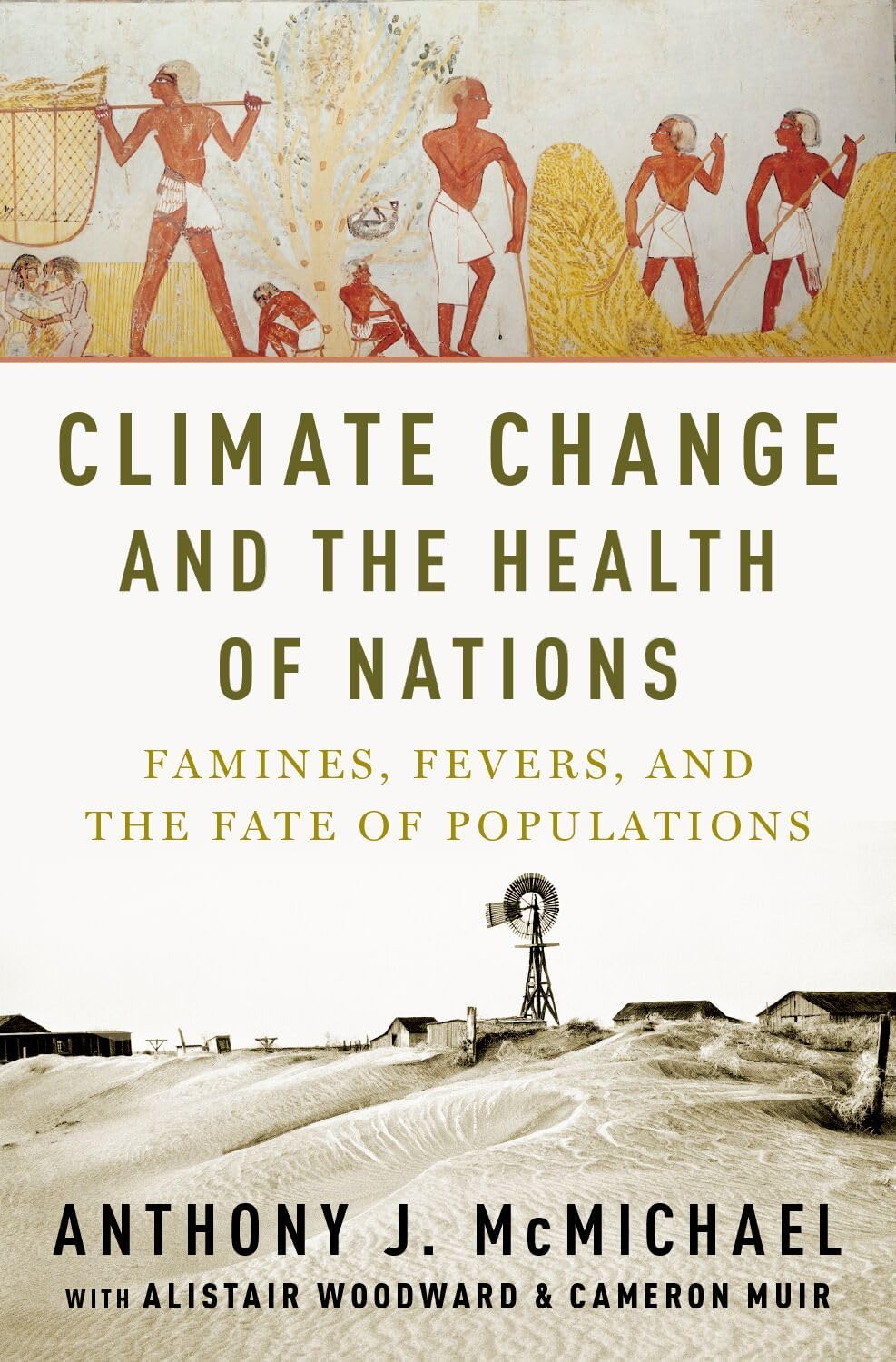
Climate Change and the Health of Nations: Famines, Fevers, and the Fate of Populations: 9780190262952: Medicine & Health Science Books @ desertcart.com Review: Terrific!! - This is a masterful book; a real achievement and a VERY important contribution to the climate literature.... Review: Excellent piece from the author - I just finished reading this book. This book puts together a lot of things including history, climatology, epidemiology and economics. It transcends millions of years to provide evidence of how climate change has caused many deaths and attributed these climate change to have indirectly caused civilisations to fall. It is a brilliant piece of work which was pretty heavy on climatology terms at the beginning and a number of repeats throughout the book.
| Best Sellers Rank | #2,339,183 in Books ( See Top 100 in Books ) #1,637 in Human Geography (Books) #2,685 in Ecology (Books) #2,751 in Environmental Science (Books) |
| Customer Reviews | 4.6 4.6 out of 5 stars (37) |
| Dimensions | 6.3 x 1.5 x 9.4 inches |
| Edition | Illustrated |
| ISBN-10 | 0190262958 |
| ISBN-13 | 978-0190262952 |
| Item Weight | 1.4 pounds |
| Language | English |
| Print length | 392 pages |
| Publication date | February 6, 2017 |
| Publisher | Oxford University Press |
O**N
Terrific!!
This is a masterful book; a real achievement and a VERY important contribution to the climate literature....
G**R
Excellent piece from the author
I just finished reading this book. This book puts together a lot of things including history, climatology, epidemiology and economics. It transcends millions of years to provide evidence of how climate change has caused many deaths and attributed these climate change to have indirectly caused civilisations to fall. It is a brilliant piece of work which was pretty heavy on climatology terms at the beginning and a number of repeats throughout the book.
C**A
Climate change and the health of nations
While still absorbing the statement in a recent book that humans are now the most populous mammal on the planet, I find the claim in this book that humans and their livestock now account for almost 98% of the vertebrate biomass on the planet. Edit: the book is not clear, but I'm going to say land animals, based on what I find elsewhere, so that excludes ocean life. Climate written records were kept first in Europe and China, regularly from the fourteenth century. Other records have been discovered in ice cores, soil deposits, tree rings, cave speleothems like stalactites, coral growth and lake and seabed sediments. The records are now also findable in DNA of creatures, such as the human louse which separated from ape lice and came to share our caves and fur garments. The author McMichael looks back over climate shifts in the past, warmer and cooler periods, to see how they affected social order, health and the fate of nations. Later he mentions that Egypt kept records of the Nile floods which enriched their farms. The author lives in Australia and is an epidemiologist, so his focus is on human health and indeed, expansion, and how climate changes will affect humans in the future. As far back as the 1950s warming was mentioned as a threat to social stability, and a 2009 quote is given from Hans Joachim Schellnhuber of the Potsdam Institute, warning that a four degree rise would make Earth's carrying capacity probably below one billion people. The IPCC is a great source of information. If the increasingly sheltered, artificial, net-dependent society is to survive it will have to prepare; Superstorm Sandy is one example of what is to come. Nitrous oxide from fertiliser and carbon dioxide have been pumped into the atmosphere by humans at a rate never before seen. We have been clearing forests and killing off animals for thousands of years. Yet when we started farming ten thousand years ago, there were only about five million of us. When the Roman empire was prospering there were 200 million of us. During the twentieth century the world population quadrupled to six billion. By 2100 bar disaster, we are on course for 11.2 billion. How can we possibly grow and distribute enough food for all these people, and given that the rate of human growth increases to match the food available, my thought is, why should we? Why not make aid distribution dependent on contraception? As fertile deltas sink under a swelling ocean and dropping land mass through aquifer extraction, and desertification spreads, while heavily pregnant women with several children do the hard farm labour, it's clear that populous countries are already on the move. Men are moving first. McMichael takes a look at the atmospheric distribution of heat. The equator, bulging towards the sun, heats and warm air expands so moves towards the poles. The air had been moving east a bit slower than the land, so creating the trade winds. As it arrives at the 40 degree latitude, the fast-moving equatorial air has more velocity than the slow-moving higher latitude land, so it arrives as wind from the west. Giant cells in constant motion opposite to one another keep the atmosphere moving and shedding or gaining moisture; the Polar cell, the Ferrell cell and the Hadley cell at the equator. The Sahara is in a dry band, generating heat that crosses the Atlantic gathering moisture for instance. The monsoon in India was seen around 1900 by a man called Walker who studied records, to be a result of a larger climactic pattern from the El Nino. And the ocean currents, thermohaline as we now call them, circulate heat and salt or fresh water. We're accustomed to thinking of the Polar caps as heat reflectors; McMichael calls the Pacific our planet's solar panel. I am sure experts love to champion their own version but McMichael says the warming of the seawater in the Gulf of Mexico drives the North Atlantic Conveyor, whereas I have seen elsewhere that the plunge to the depths of the light saline water when it meets the cold, dense melting freshwater from the Arctic is the engine dragging water north across the sea surface. Probably a combination of the two. The latest I have seen about the Antarctic (not mentioned) is that seawater meeting the cold shore freezes out water into sea ice, so the seawater below is supersaturated with salt and this dense water has to drop, pulling the ocean after it and starting a deep seabed current full of nutrients back to the north. I was pleased to see the rubber ducks which washed off a cargo transport ship in 1992 mentioned, as these provided invaluable evidence about global currents. After a look at droughts, we go to climate change science, much of which can be read elsewhere. Temperate zones now see spring arriving two weeks earlier than it used to, with movement of species to higher latitudes where cooler conditions than near the equator suit them. Other species are migrating up mountains after fast-shrinking glaciers, or in South Africa, down to the toe of the continent. Many primate species are already endangered and can't survive the predicted warming and habitat destruction. Feedback loops mentioned include the shrinking polar ice; the methane bubbling out of permafrost; warming at higher latitudes increasing soil decay gases. Loss of vegetation can create a desert reflecting heat but on the other hand, vegetation locks up moisture and carbon. Health risks include diseases. I hadn't heard of the Nipah virus, transmitted by fruit bats fleeing forest fires to pigs via fruit orchards, and from pigs to their handlers. This was in Malaysia in 1988 and 100 people died. Heatwaves cause deaths, such as 500,000 deaths in Europe during 2003 as well as forest fires and lost harvests. People fleeing drought, famine and war bring diseases to other populations. People may just be unable to live or work in zones that overheat, Singapore being suggested, and productivity will fall. Bushfire smoke caused breathing problems in Sydney which also suffered dust storms. Glacier melt rivers will shrink. Cholera has been shown to rise among coastal communities when sea water warms. Livestock are getting bluetongue from midges moving north in Europe. The Chinese parasite schistosomiasis, spread by water buffalo, water snails and back to humans, may increase, although the replacement of buffalo with tractors could reduce it. Each chapter ends with several pages of notes and references, and the later chapters look more at agriculture, our prehistoric past and evolution, the Nile valley and Eurasian Bronze Age, the Romans, the bubonic plague, the Anasazi in southern North America, the Little Ice Age, which caused famine, deaths and social instability leading to the Hundred Years' War, the nineteenth century's potato blight, before going back to the long look at the Holocene. Then we are facing the future. Markets look at GDP and consumption and while this may be partly what got us into this mess, it may also be what will get us out of it. The global economy can put us all to work coming up with solutions. We have been striving to eradicate poverty, yet if everyone consumed at the same rate the planet could not provide nearly enough goods and foods. McMichael briefly mentions retrofitting cities such as Melbourne's planting thousands of trees to lessen the urban heat island effect. This book is well written with diagrams - a few photos would not have gone amiss - and could be read by a reasonably advanced reader of natural or social history. The terms used could occasionally have had more explanation for those unfamiliar with them, but that is what Google is for. There is a distinct focus on past eras and less on disease than I'd expected. Students will find a lot to learn, neatly encapsulated. Why should the rest of us read it? Because it's the climate, stupid. I downloaded a copy from Net Galley for an unbiased review.
A**1
easy to get lost
I had assumed I would be reading how increases in temperature caused famine, disease and war. They can, but so can cooling. Climate variability, both temperature and precipitation, are what the book is really about – its history and many of the mechanisms by which it has wreaked havoc. McMichael’s impetus for the book is the concern that due to the rise in carbon dioxide caused by man, there will be warming of historically very rapid magnitude, and associated increased climate variability as well as rises in sea level. I found it easy to get lost in this book, which I blame in part on mediocre organization, mediocre or absent charts, mediocre or absent chapter introductions and summaries. At the same time, there was much of interest. I owe McMichael this debt: I had previously encountered explanations for the “Easterlies” and “Westerlies” wind patterns, and despite supplementing what I read with internet searches I was still confused, probably because of a poor background and interest in physics; McMichael’s provides clear and simple explanations.
G**F
History of climate change related to human welfare
This is a well done history of climate change effects on humans, not the other way round. The book depicts climate history throughout the Holocene era featuring effects on human institutional development. It's based on the premise that the past informs the future, a brave attempt that doesn't quite work. Past history is all about natural climate change whereas modern speculation, or is it hysteria, says future change is predicated on man made change. The link between the two is thin at best. Most droughts and famines occurred during cold periods. McMichael concludes with a lengthy statement: “Human induced climate change is beyond politics. “ He's right about the book which has no specifics of mitigation, but the only possible motive for such a ridiculous statement is an attempt to politicize the alarmism. However, in practice ethanol, carbon taxes, anti-energy, California renewable portfolio legislation and population control is all politics. Global warming, in practice, is 5% science and 95% politics. Prof. McMichael recognizes the fatuity of climate science certainty but not the effect of population on atmospheric CO2 or that climate “science” is mostly political. Up until the last chapter, the book is excellent. It's a more formal treatment than that of Jared Diamond.
H**D
A fascinating and extremely well written book. It gives you a review mirror view of future possibilities.
Trustpilot
3 weeks ago
2 months ago