We remain fully operational. Our teams are working around the clock to ensure your deliveries continue safely.

DOWNLOAD THE APP


Copyright © 2025 Desertcart Holdings Limited
DOWNLOAD THE APP
Buy anything from 5,000+ international stores. One checkout price. No surprise fees. Join 2M+ shoppers on Desertcart.
Desertcart purchases this item on your behalf and handles shipping, customs, and support to South Korea.
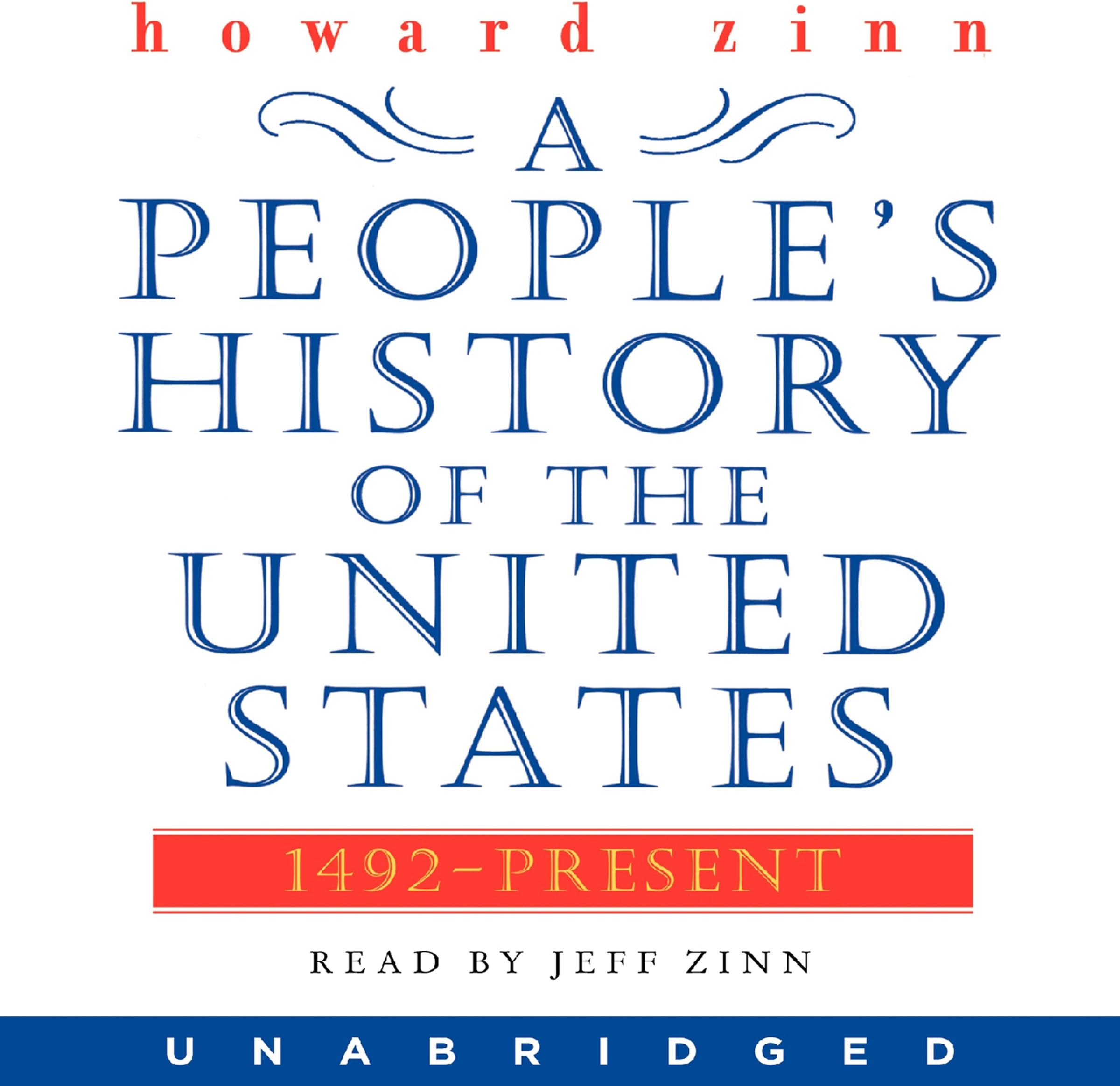
desertcart.com: A People's History of the United States (Audible Audio Edition): Howard Zinn, Jeff Zinn, Harper: Books Review: My Thoughts on A People’s History of the United States - A People’s History of the United States is a book about the history of the United States of America from the very beginning. It was written in 1980 by Howard Zinn. Zinn is a historian, political scientist, and a social activist. I think this a very good book to read because it not only tells about the history of the United States but it give the real truth about things that have never been discussed before. The book starts off at the very beginning of America. Some of the topics discussed range from Christopher Columbus’ travels to Hernando Cortes adventures. From there it talks about slavery and such. The book is written in a time line of history. It starts from the beginning and then goes on. In history there are many conflicts. Some that were discussed were about how Christopher Columbus Day has always been a celebration. After reading this book, you may have a different view on him. It then tells about the conflicts of slavery and gives very vivid details about the conditions that slavery really consisted of. This book is the real deal. It gives you the straight facts and information about history that you never knew about. Even though A People’s History of the United States was written in 1980 and may be considered an older book, it is still a good read. The realness of the book and how it gives so much information about history that is not taught in schools is what makes this book so great. It is a very important book and it should be read by others to understand the true history. I believe the reasons the book was/is popular still hold true because it is about history. It is telling the real truth about history. History will never become a subject that is forgotten. My judgement and evaluation on A People’s History of the United States is that the quality of writing was very strong. It shows strength in its vivid details and the choice of words that were used. One of my favorite quotes from the book is a piece quoted from the Virginia slave code. It says: “Whereas many times slaves run away and lie hid and lurking in swamps, woods, and other obscure places, killing hogs, and committing other injuries to the inhabitants...if the slave does not immediately return, anyone whatsoever may kill or destroy such slaves by such ways and means as he…shall think fit…If the slave is apprehended… it shall…be lawful for the county court, to order such punishment for the said slave, either by dismembering, or in any other way…as they in their discretion shall think fit, for the reclaiming any such incorrigible slave, and terrifying others form the like practices…” That quote is one of my favorites because it is so descriptive. Another one of my favorites is a quote by writer J. Saunders Redding as he describes the arrival of a ship in North America. It says: “Sails furled, flag drooping at her rounding stern, she rode the tide in form the sea. She was a strange ship, indeed, by all accounts, a frightening ship, a ship of mystery. Whether she was trader, privateer, or man-of-war no one knows. Through her bulwarks black-mouthed cannon yawned. The flag she flew was Dutch; her crew a motley. Her port of call, an English settlement, Jamestown, in the colony of Virginia. She came, she traded, and shortly afterwards was gone. Probably no ship in modern history has carried a more portentous freight. Her cargo? Twenty slaves.” That quote is another one of my favorites because it is also very descriptive. It paints a clear picture of the truth about what used to really happen. That to me is a very strong strength. In conclusion, my overall thoughts about the book are very positive. It has changed the way I look at history. It has showed me that there is a whole lot more truth about history than just what is taught in schools. One particular thing it has made me realize is that history is a lot more gruesome and violent than I originally thought. It also has given me a different perspective of Christopher Columbus. I do not see him the same as I once did. A People’s History of the United States was really an eye opener about giving the real truths about history. Review: “This country is not in good condition.” Calvin Coolidge, 1931. (p. 387). - Apart from his unique view of American history and of his treatment of many of the landmark events of that history, Howard Zinn gives us any number of interesting and noteworthy observations in the course of this 700-page text. I beg your indulgence while we look at just a few…. On p. 73, “(t)o say that the Declaration of Independence, even by its own language, was limited to life, liberty and happiness for white males is not to denounce the makers and signers of the Declaration for holding the ideas expected of privileged males of the eighteenth century. Reformers and radicals, looking discontentedly at history, are often accused of expecting too much from a past political epoch – and sometimes they do. But the point of noting those outside the arc of human rights in the Declaration is not, centuries late and pointlessly, to lay impossible moral burdens on that time. It is to try to understand the way in which the Declaration functioned to mobilize certain groups of Americans, ignoring others. Surely, inspirational language to create a secure consensus is still used, in our time, to cover up serious conflicts of interest in that consensus, and to cover up, also, the omission of large parts of the human race.” And then, on p. 96: “(t)he problem of democracy in the post-Revolutionary society was not, however, the Constitutional limitations on voting. It lay deeper, beyond the Constitution, in the division of society into rich and poor. For if some people had great wealth and great influence; if they had the land, the money, the newspapers, the church, the educational system – how could voting, however broad, cut into such power? There was still another problem: wasn’t it the nature of representative government, even when most broadly based, to be conservative, to prevent tumultuous change?” For the answer to that last question, we can, of course, always turn to the pleasantly incendiary words of no less than Thomas Jefferson, which Mr. Zinn naturally and deftly does: “‘I hold it that a little rebellion now and then is a good thing…. It is a medicine necessary for the sound health of government…. God forbid that we should ever be twenty years without such a rebellion…. The Tree of liberty must be refreshed from time to time with the blood of patriots and tyrants. It is its natural manure.’” One can only imagine how Jefferson would’ve reacted to the following open letter penned by Ralph Waldo Emerson to President Van Buren in 1838 as the still young nation hung its head in shame for the Trail of Tears it had just blazed: “(t)he soul of man, the justice, the mercy that is the heart’s heart in all men, from Maine to Georgia, does abhor this business…a crime is projected that confounds our understanding by its magnitude, a crime that really deprives us as well as the Cherokees of a country for how could we call the conspiracy that should crush these poor Indians our government, or the land that was cursed by their parting and dying imprecations our country any more? You, sir, will bring down that renowned chair in which you sit into infamy if your seal is set to this instrument of perfidy; and the name of this nation, hitherto the sweet omen of religion and liberty, will stink to the world” (p. 147). Was the very noble Van Buren at all distressed by the death of thousands of Cherokee Indians along this Trail of Tears when, at the end of the same year, he spoke to Congress? “It affords sincere pleasure to apprise the Congress of the entire removal of the Cherokee Nation of Indians to their new homes west of the Mississippi. The measures authorized by Congress at its last session have had the happiest effects” (p. 148). (Emphasis is mine.) And if you think that all of the wars the U. S. participated in right up to Vietnam were “good” wars (as I did until now), consider what we have in the way of a diary entry from a certain Colonel Hitchcock: “I have said from the first that the United States are the aggressors…. We have not one particle of right to be here…. It looks as if the government sent a small force on purpose to bring on a war, so as to have a pretext for taking California and as much of this country as it chooses, for, whatever becomes of this army, there is no doubt of a war between the United States and Mexico…. My heart is not in this business … but, as a military man, I am bound to execute orders” (p. 151). As I’ve already said, Zinn has a singular way of characterizing some of history’s more significant events. As yet another example, I give you the following from p. 171 (on the first page of Chapter 9, titled “Slavery without Submission, Emancipation without Freedom”: “…it was Abraham Lincoln who freed the slaves, not John Brown. In 1859, John Brown was hanged, with federal complicity, for attempting to do by small-scale violence what Lincoln would do by large-scale violence several years later – end slavery.” And lest there still be any doubt about Abraham Lincoln’s position on American blacks and the issue of slavery, Zinn gives us these two very telltale quotes: “I will say, then, that I am not, nor ever have been, in favor of bringing about in any way the social and political equality of the white and black races; that I am not, nor ever have been, in favor of making voters or jurors of negroes, nor of qualifying them to hold office, nor to intermarry with white people…. And inasmuch as they cannot so live, while they do remain together there must be the position of superior and inferior, and I as much as any other man am in favor of having the superior position assigned to the white race” (p. 188). Moreover, and in direct response to the Editor of the New York Tribune, Horace Greeley, we find this (on p. 191): “Dear Sir: … I have not meant to leave any one in doubt…. My paramount object in this struggle is to save the Union, and is not either to save or destroy Slavery. If I could save the Union without freeing any slave, I would do it; and if I could save it by freeing all the slaves, I would do it; and if I could do it by freeing some and leaving others alone, I would also do that. What I do about Slavery and the colored race, I do because it helps to save this Union; and what I forbear, I forbear because I do not believe it would help to save the Union…. I have here stated my purpose according to my view of official duty, and I intend no modification of my oft-expressed personal wish that all men, everywhere, could be free. Yours, A. Lincoln.” But history (and human “progress”) moves on – and so, we have this: “(i)n 1877, (the year, according to David Burbank, in his book REIGN OF THE RABBLE, ‘no American city has come so close to being ruled by a workers’ soviet, as we would now call it, as St. Louis, Missouri’ – p. 250), the same year blacks learned they did not have enough strength to make real the promise of equality in the Civil War, working people learned they were not united enough, not powerful enough, to defeat the combination of private capital and government power” (p. 251). And Zinn then opens Chapter 11 (“Robber Barons and Rebels”) with this: “(i)n the year 1877, the signals were given for the rest of the century: the black would be put back; the strikes of white workers would not be tolerated; the industrial and political elites of North and South would take hold of the country and organize the greatest march of economic growth in human history. They would do it with the aid of, and at the expense of, black labor, white labor, Chinese labor, European immigrant labor, female labor, rewarding them differently by race, sex, national origin, and social class, in such a way as to create separate levels of oppression – a skillful terracing to stabilize the pyramid of wealth” (p. 253). For those who think the “Occupy Wall Street” movement of the new millennium was a singular invention of the millennial generation, you might want to consider what Mary Ellen Lease, of the newly formed People’s Party, had to tell those assembled at that party’s first convention in 1890 in Topeka, KS: “Wall Street owns the country. It is no longer a government of the people, by the people, and for the people, but a government of Wall Street, by Wall Street and for Wall Street…. Our laws are the output of a system which clothes rascals in robes and honesty in rags…. The politicians said we suffered from overproduction. Overproduction, when 10,000 little children … starve to death every year in the U. S. and over 100,000 shop girls in New York are forced to sell their virtue for bread…. “There are thirty men in the United States whose aggregate wealth is over one and one-half billion dollars. There are half a million looking for work…. We want money, land and transportation. We want the abolition of the National Banks, and we want the power to make loans direct from the government. We want the accursed foreclosure system wiped out…. We will stand by our homes and stay by our firesides by force if necessary, and we will not pay our debts to the loan-shark companies until the Government pays its debts to us. “The people are at bay, let the bloodhounds of money who have dogged us thus far beware” (p. 288). For those (like me until now) who’ve always thought only the best of Teddy Roosevelt, the following two direct quotes – not to mention William James’s rejoinder – might be a bit of a news-breaker: “(i)n strict confidence…I should welcome almost any war, for I think this country needs one” (p. 297). And in his address to the Naval War College, he has this to say: “(a)ll the great masterful races have been fighting races…. No triumph of peace is quite so great as the supreme triumph of war” (p. 300). Thankfully – and from James – comes the sobering suggestion that he (Roosevelt) “gushes over war as the ideal condition of human society, for the manly strenuousness which it involves, and treats peace as a condition of blubberlike and swollen ignobility, fit only for huckstering weaklings, dwelling in gray twilight and heedless of the higher life…” (p. 300). For those who think Obama’s recent initiative at a rapprochement with Cuba bodes well for that impoverished Caribbean island, you might want to consider what another historian, Philip Foner, writes about the last time (towards the end of the nineteenth century) this country took a keen interest in Old Havana: “(e)ven before the Spanish flag was down in Cuba, U. S. business interests set out to make their influence felt. Merchants, real estate agents, stock speculators, reckless adventurers, and promoters of all kinds of get-rich schemes flocked to Cuba by the thousands. Seven syndicates battled each other for control of the franchises for the Havana Street Railway, which were finally won by Percival Farquhar, representing the Wall Street interests of New York. Thus, simultaneously with the military occupation began … commercial occupation” (p. 310). But it gets even better on the other side of the planet, and the same William James who pronounced upon the clearly bellicose character of Teddy Roosevelt has the last word on American behavior in the Pacific: “God dam* the U. S. for its vile conduct in the Philippine Isles” (p. 315). And on that same subject, consider what none other than Mark Twain has to say: “(w)e have pacified some thousands of the islanders and buried them; destroyed their fields; burned their villages, and turned their widows and orphans out-of-doors; furnished heartbreak by exile to some dozens of disagreeable patriots; subjugated the remaining ten millions by Benevolent Assimilation, which is the pious new name of the musket; we have acquired property in the three hundred concubines and other slaves of our business partner, the Sultan of Sulu, and hoisted our protecting flag over that sway. “And so, by these Providences of God – and the phrase is the government’s, not mine – we are a World Power” (p. 316). Where, by the way, was all of this war-mongering and industrial development at breakneck speed headed? Zinn’s choice of a quote from Sinclair Lewis’s BABBITT couldn’t be more appropriate: “(i)t was the best of nationally advertised and quantitatively produced alarm-clocks, with all modern attachments, including cathedral chime, intermittent alarm, and a phosphorescent dial. Babbitt was proud of being awakened by such a rich device. Socially it was almost as creditable as buying expensive cord tires. “He sulkily admitted now that there was no more escape, but he lay and detested the grind of the real-estate business, and disliked his family, and disliked himself for disliking them” (pp. 383-384). Two more brief quotes from Howard Zinn himself, and then I’ll conclude. On p. 636, “(w)e may, in the coming years, be in a race for the mobilization of middle-class discontent.” And almost immediately following, on p. 637, “(c)apitalism has always been a failure for the lower classes. It is now beginning to fail for the middle classes.” I suggested, at the beginning of this review, that Howard Zinn had a “unique view of American history.” That suggestion was in no sense ironic or tongue-in-cheek. After a couple of weeks and 700+ pages, I can only say that this is some of the most valuable reading time I’ve ever spent. I’m humbled – and yes, also somewhat ashamed – that I’ve discovered this historian and his work at the very ripe old age of 64. I obviously wish it could’ve been sooner. But as it was not, the next best thing I could do was give my copy of A PEOPLE'S HISTORY OF THE UNITED STATES, still slightly warm to the touch, to my daughter on the occasion of her 21st birthday. God willing, she’ll grow up better informed than I – at the very least, about the country whose passport she carries. RRB 06/08/15 Brooklyn, NY
A**R
My Thoughts on A People’s History of the United States
A People’s History of the United States is a book about the history of the United States of America from the very beginning. It was written in 1980 by Howard Zinn. Zinn is a historian, political scientist, and a social activist. I think this a very good book to read because it not only tells about the history of the United States but it give the real truth about things that have never been discussed before. The book starts off at the very beginning of America. Some of the topics discussed range from Christopher Columbus’ travels to Hernando Cortes adventures. From there it talks about slavery and such. The book is written in a time line of history. It starts from the beginning and then goes on. In history there are many conflicts. Some that were discussed were about how Christopher Columbus Day has always been a celebration. After reading this book, you may have a different view on him. It then tells about the conflicts of slavery and gives very vivid details about the conditions that slavery really consisted of. This book is the real deal. It gives you the straight facts and information about history that you never knew about. Even though A People’s History of the United States was written in 1980 and may be considered an older book, it is still a good read. The realness of the book and how it gives so much information about history that is not taught in schools is what makes this book so great. It is a very important book and it should be read by others to understand the true history. I believe the reasons the book was/is popular still hold true because it is about history. It is telling the real truth about history. History will never become a subject that is forgotten. My judgement and evaluation on A People’s History of the United States is that the quality of writing was very strong. It shows strength in its vivid details and the choice of words that were used. One of my favorite quotes from the book is a piece quoted from the Virginia slave code. It says: “Whereas many times slaves run away and lie hid and lurking in swamps, woods, and other obscure places, killing hogs, and committing other injuries to the inhabitants...if the slave does not immediately return, anyone whatsoever may kill or destroy such slaves by such ways and means as he…shall think fit…If the slave is apprehended… it shall…be lawful for the county court, to order such punishment for the said slave, either by dismembering, or in any other way…as they in their discretion shall think fit, for the reclaiming any such incorrigible slave, and terrifying others form the like practices…” That quote is one of my favorites because it is so descriptive. Another one of my favorites is a quote by writer J. Saunders Redding as he describes the arrival of a ship in North America. It says: “Sails furled, flag drooping at her rounding stern, she rode the tide in form the sea. She was a strange ship, indeed, by all accounts, a frightening ship, a ship of mystery. Whether she was trader, privateer, or man-of-war no one knows. Through her bulwarks black-mouthed cannon yawned. The flag she flew was Dutch; her crew a motley. Her port of call, an English settlement, Jamestown, in the colony of Virginia. She came, she traded, and shortly afterwards was gone. Probably no ship in modern history has carried a more portentous freight. Her cargo? Twenty slaves.” That quote is another one of my favorites because it is also very descriptive. It paints a clear picture of the truth about what used to really happen. That to me is a very strong strength. In conclusion, my overall thoughts about the book are very positive. It has changed the way I look at history. It has showed me that there is a whole lot more truth about history than just what is taught in schools. One particular thing it has made me realize is that history is a lot more gruesome and violent than I originally thought. It also has given me a different perspective of Christopher Columbus. I do not see him the same as I once did. A People’s History of the United States was really an eye opener about giving the real truths about history.
R**R
“This country is not in good condition.” Calvin Coolidge, 1931. (p. 387).
Apart from his unique view of American history and of his treatment of many of the landmark events of that history, Howard Zinn gives us any number of interesting and noteworthy observations in the course of this 700-page text. I beg your indulgence while we look at just a few…. On p. 73, “(t)o say that the Declaration of Independence, even by its own language, was limited to life, liberty and happiness for white males is not to denounce the makers and signers of the Declaration for holding the ideas expected of privileged males of the eighteenth century. Reformers and radicals, looking discontentedly at history, are often accused of expecting too much from a past political epoch – and sometimes they do. But the point of noting those outside the arc of human rights in the Declaration is not, centuries late and pointlessly, to lay impossible moral burdens on that time. It is to try to understand the way in which the Declaration functioned to mobilize certain groups of Americans, ignoring others. Surely, inspirational language to create a secure consensus is still used, in our time, to cover up serious conflicts of interest in that consensus, and to cover up, also, the omission of large parts of the human race.” And then, on p. 96: “(t)he problem of democracy in the post-Revolutionary society was not, however, the Constitutional limitations on voting. It lay deeper, beyond the Constitution, in the division of society into rich and poor. For if some people had great wealth and great influence; if they had the land, the money, the newspapers, the church, the educational system – how could voting, however broad, cut into such power? There was still another problem: wasn’t it the nature of representative government, even when most broadly based, to be conservative, to prevent tumultuous change?” For the answer to that last question, we can, of course, always turn to the pleasantly incendiary words of no less than Thomas Jefferson, which Mr. Zinn naturally and deftly does: “‘I hold it that a little rebellion now and then is a good thing…. It is a medicine necessary for the sound health of government…. God forbid that we should ever be twenty years without such a rebellion…. The Tree of liberty must be refreshed from time to time with the blood of patriots and tyrants. It is its natural manure.’” One can only imagine how Jefferson would’ve reacted to the following open letter penned by Ralph Waldo Emerson to President Van Buren in 1838 as the still young nation hung its head in shame for the Trail of Tears it had just blazed: “(t)he soul of man, the justice, the mercy that is the heart’s heart in all men, from Maine to Georgia, does abhor this business…a crime is projected that confounds our understanding by its magnitude, a crime that really deprives us as well as the Cherokees of a country for how could we call the conspiracy that should crush these poor Indians our government, or the land that was cursed by their parting and dying imprecations our country any more? You, sir, will bring down that renowned chair in which you sit into infamy if your seal is set to this instrument of perfidy; and the name of this nation, hitherto the sweet omen of religion and liberty, will stink to the world” (p. 147). Was the very noble Van Buren at all distressed by the death of thousands of Cherokee Indians along this Trail of Tears when, at the end of the same year, he spoke to Congress? “It affords sincere pleasure to apprise the Congress of the entire removal of the Cherokee Nation of Indians to their new homes west of the Mississippi. The measures authorized by Congress at its last session have had the happiest effects” (p. 148). (Emphasis is mine.) And if you think that all of the wars the U. S. participated in right up to Vietnam were “good” wars (as I did until now), consider what we have in the way of a diary entry from a certain Colonel Hitchcock: “I have said from the first that the United States are the aggressors…. We have not one particle of right to be here…. It looks as if the government sent a small force on purpose to bring on a war, so as to have a pretext for taking California and as much of this country as it chooses, for, whatever becomes of this army, there is no doubt of a war between the United States and Mexico…. My heart is not in this business … but, as a military man, I am bound to execute orders” (p. 151). As I’ve already said, Zinn has a singular way of characterizing some of history’s more significant events. As yet another example, I give you the following from p. 171 (on the first page of Chapter 9, titled “Slavery without Submission, Emancipation without Freedom”: “…it was Abraham Lincoln who freed the slaves, not John Brown. In 1859, John Brown was hanged, with federal complicity, for attempting to do by small-scale violence what Lincoln would do by large-scale violence several years later – end slavery.” And lest there still be any doubt about Abraham Lincoln’s position on American blacks and the issue of slavery, Zinn gives us these two very telltale quotes: “I will say, then, that I am not, nor ever have been, in favor of bringing about in any way the social and political equality of the white and black races; that I am not, nor ever have been, in favor of making voters or jurors of negroes, nor of qualifying them to hold office, nor to intermarry with white people…. And inasmuch as they cannot so live, while they do remain together there must be the position of superior and inferior, and I as much as any other man am in favor of having the superior position assigned to the white race” (p. 188). Moreover, and in direct response to the Editor of the New York Tribune, Horace Greeley, we find this (on p. 191): “Dear Sir: … I have not meant to leave any one in doubt…. My paramount object in this struggle is to save the Union, and is not either to save or destroy Slavery. If I could save the Union without freeing any slave, I would do it; and if I could save it by freeing all the slaves, I would do it; and if I could do it by freeing some and leaving others alone, I would also do that. What I do about Slavery and the colored race, I do because it helps to save this Union; and what I forbear, I forbear because I do not believe it would help to save the Union…. I have here stated my purpose according to my view of official duty, and I intend no modification of my oft-expressed personal wish that all men, everywhere, could be free. Yours, A. Lincoln.” But history (and human “progress”) moves on – and so, we have this: “(i)n 1877, (the year, according to David Burbank, in his book REIGN OF THE RABBLE, ‘no American city has come so close to being ruled by a workers’ soviet, as we would now call it, as St. Louis, Missouri’ – p. 250), the same year blacks learned they did not have enough strength to make real the promise of equality in the Civil War, working people learned they were not united enough, not powerful enough, to defeat the combination of private capital and government power” (p. 251). And Zinn then opens Chapter 11 (“Robber Barons and Rebels”) with this: “(i)n the year 1877, the signals were given for the rest of the century: the black would be put back; the strikes of white workers would not be tolerated; the industrial and political elites of North and South would take hold of the country and organize the greatest march of economic growth in human history. They would do it with the aid of, and at the expense of, black labor, white labor, Chinese labor, European immigrant labor, female labor, rewarding them differently by race, sex, national origin, and social class, in such a way as to create separate levels of oppression – a skillful terracing to stabilize the pyramid of wealth” (p. 253). For those who think the “Occupy Wall Street” movement of the new millennium was a singular invention of the millennial generation, you might want to consider what Mary Ellen Lease, of the newly formed People’s Party, had to tell those assembled at that party’s first convention in 1890 in Topeka, KS: “Wall Street owns the country. It is no longer a government of the people, by the people, and for the people, but a government of Wall Street, by Wall Street and for Wall Street…. Our laws are the output of a system which clothes rascals in robes and honesty in rags…. The politicians said we suffered from overproduction. Overproduction, when 10,000 little children … starve to death every year in the U. S. and over 100,000 shop girls in New York are forced to sell their virtue for bread…. “There are thirty men in the United States whose aggregate wealth is over one and one-half billion dollars. There are half a million looking for work…. We want money, land and transportation. We want the abolition of the National Banks, and we want the power to make loans direct from the government. We want the accursed foreclosure system wiped out…. We will stand by our homes and stay by our firesides by force if necessary, and we will not pay our debts to the loan-shark companies until the Government pays its debts to us. “The people are at bay, let the bloodhounds of money who have dogged us thus far beware” (p. 288). For those (like me until now) who’ve always thought only the best of Teddy Roosevelt, the following two direct quotes – not to mention William James’s rejoinder – might be a bit of a news-breaker: “(i)n strict confidence…I should welcome almost any war, for I think this country needs one” (p. 297). And in his address to the Naval War College, he has this to say: “(a)ll the great masterful races have been fighting races…. No triumph of peace is quite so great as the supreme triumph of war” (p. 300). Thankfully – and from James – comes the sobering suggestion that he (Roosevelt) “gushes over war as the ideal condition of human society, for the manly strenuousness which it involves, and treats peace as a condition of blubberlike and swollen ignobility, fit only for huckstering weaklings, dwelling in gray twilight and heedless of the higher life…” (p. 300). For those who think Obama’s recent initiative at a rapprochement with Cuba bodes well for that impoverished Caribbean island, you might want to consider what another historian, Philip Foner, writes about the last time (towards the end of the nineteenth century) this country took a keen interest in Old Havana: “(e)ven before the Spanish flag was down in Cuba, U. S. business interests set out to make their influence felt. Merchants, real estate agents, stock speculators, reckless adventurers, and promoters of all kinds of get-rich schemes flocked to Cuba by the thousands. Seven syndicates battled each other for control of the franchises for the Havana Street Railway, which were finally won by Percival Farquhar, representing the Wall Street interests of New York. Thus, simultaneously with the military occupation began … commercial occupation” (p. 310). But it gets even better on the other side of the planet, and the same William James who pronounced upon the clearly bellicose character of Teddy Roosevelt has the last word on American behavior in the Pacific: “God dam* the U. S. for its vile conduct in the Philippine Isles” (p. 315). And on that same subject, consider what none other than Mark Twain has to say: “(w)e have pacified some thousands of the islanders and buried them; destroyed their fields; burned their villages, and turned their widows and orphans out-of-doors; furnished heartbreak by exile to some dozens of disagreeable patriots; subjugated the remaining ten millions by Benevolent Assimilation, which is the pious new name of the musket; we have acquired property in the three hundred concubines and other slaves of our business partner, the Sultan of Sulu, and hoisted our protecting flag over that sway. “And so, by these Providences of God – and the phrase is the government’s, not mine – we are a World Power” (p. 316). Where, by the way, was all of this war-mongering and industrial development at breakneck speed headed? Zinn’s choice of a quote from Sinclair Lewis’s BABBITT couldn’t be more appropriate: “(i)t was the best of nationally advertised and quantitatively produced alarm-clocks, with all modern attachments, including cathedral chime, intermittent alarm, and a phosphorescent dial. Babbitt was proud of being awakened by such a rich device. Socially it was almost as creditable as buying expensive cord tires. “He sulkily admitted now that there was no more escape, but he lay and detested the grind of the real-estate business, and disliked his family, and disliked himself for disliking them” (pp. 383-384). Two more brief quotes from Howard Zinn himself, and then I’ll conclude. On p. 636, “(w)e may, in the coming years, be in a race for the mobilization of middle-class discontent.” And almost immediately following, on p. 637, “(c)apitalism has always been a failure for the lower classes. It is now beginning to fail for the middle classes.” I suggested, at the beginning of this review, that Howard Zinn had a “unique view of American history.” That suggestion was in no sense ironic or tongue-in-cheek. After a couple of weeks and 700+ pages, I can only say that this is some of the most valuable reading time I’ve ever spent. I’m humbled – and yes, also somewhat ashamed – that I’ve discovered this historian and his work at the very ripe old age of 64. I obviously wish it could’ve been sooner. But as it was not, the next best thing I could do was give my copy of A PEOPLE'S HISTORY OF THE UNITED STATES, still slightly warm to the touch, to my daughter on the occasion of her 21st birthday. God willing, she’ll grow up better informed than I – at the very least, about the country whose passport she carries. RRB 06/08/15 Brooklyn, NY
J**R
A must read
Great book! Show what you should eat to help yourself. Everyone should read this book.
X**U
Excellent book to understand USA
Very interesting book about USA, help everyone to understand where are we from and help us to find out where we should go. History is a mirror.
B**N
Well rounded good read
This book offers a fresh and eye-opening perspective on American history. Unlike traditional histories, it focuses on the experiences of everyday people like workers, women, minorities, and activists rather than political leaders. The book is engaging, thought provoking, and challenges readers to really think about power, inequality, and the stories often left out of mainstream history. It’s a compelling read for anyone interested in a more inclusive view of the past.
E**T
I brought this book knowing fairly little of American History. I was keen to avoid a jingoistic book written solely to appeal to Americans. This book delivers on this very well, it details much of the European discovery of the new world and then starts to focus on North America and the USA. Naturally any description of the European conquest of the new world was going to be dark and at times grim but what I really appreciated about this book was that it does a good job of balancing the need to condemn these things with explaining them in context, this allows better understanding of why some of the awful aspects of Americas history occured. This includes the early genocides perpetuated by the spanish, and the beginning of the transatlantic slave trade, it is carefully explained how Americas hierarchical race system was not a naturally materialising system but was manipulated and brought into shape to enforce authoritarian order by a small elite group of wealthy individuals over a far more numerous populace of slaves and near-slave endentured servants brought over to serve them. The foundation of the USA is not at all portrayed as entirely negative, the role of higher enlightenment values is discussed in detail, but it is also made clear that the founding fathers were far from interested in the normal persons issues and we're very much a continuation of the aristocratic elite. This helps to comprehend Americas strange political system. I think I would distrust any book that glorified virtually any period from several hundred years ago and I think this books careful dissection of how America came to be is greatly helpful in helping understand the country and continent today. Having said that it is grim reading at times and I think having a good base line knowledge of Americas history from another book may be helpful as it's hard to appreciate a myth being debunked when you didn't know the myth in the first place. All in all Ide highly recommend especially for non Americans who want to understand the country a little bit more.
M**Y
J'ai appris beaucoup de faits inconnus. Je recommande sa lecture même aux gens qui auraient des avis différents. Bonne base de discussions et de reflexions
A**A
The book provides great insight into the making of the United States, after the landing of Saint Columbus, and covering a very long period-till the presidency of Bill Clinton. The book really tells about the events faced by the common people, in making of the country. Recording the history of a nation requires a lot of research and access to documents and records. There is enough evidence to this end, seeing the size of the book and the background notes and references made. Any serious reader will learn a great deal while studying the book. It can serve as an important reference book for all curious readers. While historic events have made the US a great country, the price paid by its people has been unbelievable. This is a must book for all who want understand history of nation building.
G**R
I must give this book five stars, because the accuracy and research behind the book can only be described as first class. The book is a very long and definitely a hard slog but can be recommended to anyone who is interested in history, particularly American history, and is not convinced that he has heard the whole story. From beginning to end, the subject matter is extremely depressing. The author deals with the continuing persecution of non-whites, women and the poor by the rich, white ruling class and the vast sums spent on the military, leaving the poor without the most basic support. Particularly the way the American Indian has been treated over the centuries is intensely disturbing.
F**0
Vital reading for anyone in the US, and almost equally important for everyone else. This is the side of history nobody ever teaches in school - the story from the point of view of the common people, as opposed to the ruling elite. This is also one of the most entertaining books of history you're likely to find - never dry, always lively and fascinating. Some will inevitably quibble with Zinn's admittedly leftist perspective. But they won't be able to find much fault with his research. In fact, the book doesn't present any truly controversial information: there's nothing here that you can't easily verify. What's radical is the way the information is assembled. When you follow the story of the people - as opposed to that of a few rich, powerful and famous individuals - history takes on a very different aspect, and you never see the world quite the same way again. I actually bought this particular edition as a gift for someone. This is a book that begs to be shared.
Trustpilot
1 day ago
2 weeks ago