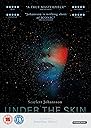
Under The Skin [DVD]
Product ID: 51365591
Details
- ColourColour
- ContributorJessica Mance
- FormatPAL
- LanguageEnglish
- Runtime1 hour and 48
Desertcart purchases this item on your behalf and handles shipping, customs, and support to South Korea.
An alien entity inhabits the earthly form of a seductive young woman who combs the Scottish highways in search of the human prey it is here to plunder. It lures its isolated and forsaken male victims into an otherworldly dimension where they are stripped and consumed. But life in all its complexity starts to change the alien. It begins to see itself as ‘she’, as human, with tragic and terrifying consequences. UNDER THE SKIN is about seeing ourselves through alien eyes. UNDER THE SKIN, starring Scarlett Johansson, is Jonathan Glazer’s critically-acclaimed third feature after Sexy Beast and Birth. Review: An intellectual masterpiece you won't easily forget - In his 2000 debut Sexy Beast, Jonathan Glazer burst onto the scene with all the swagger and verve of a young Tarantino but instead of capitalising on that success, the music video director made only one more movie (2004's underwhelming Birth) in the next decade and a half. However, despite the lack of hands-on practice, his new film is nonetheless marked by the kind of reach and maturity that, back in 2000, we all would've hoped he'd be showing right now. Based on Michael Faber's novel, Under the Skin is a stunning piece of science fiction cinema that lives up to the genre's loftiest promises in the manner 2001: A Space Odyssey, Dark City, and Primer do. It begins with an alien (an extraordinary Scarlett Johansson) assuming the guise of a human female in order to lure lonely men (played by unwitting non-actors who thought they were genuinely being picked up and who the crew filmed with hidden cameras) back to her apartment where human reality and that of her species' morph into a gateway from the former to the latter. The purpose of this seduction is revealed in one remarkable scene that will chill you to the bone - without giving too much away, let's just say it's a process that someone or something else takes care of while Johansson's alien predator goes back out on the prowl. But with each foray into the world of humans and each victim she brings back, something changes within her that causes her to crave a fuller range of human experience. Within this stripped down narrative, Glazer achieves two equally daring and intangible objectives. Primarily, he offers an examination of human existence as an alien construct but within that aim is the ostensibly narrower but infinitely broader goal of pondering the oft-dodged question of what alien consciousness might amount to. He does this not through abstraction or surrealism but through a dramatic realignment of the traditional realism in which movies are shot. It is this regard that comparisons to Stanley Kubrick and Andrei Tarkovsky are warranted. Like Kubrick does in the closing sequence of 2001: A Space Odyssey, Glazer (albeit to a lesser extent) methodically probes what experience might be to a sentient being of an incomprehensible nature (incomprehensible to us). A creature born to and framed by a different reality and vastly different dimensional constraints. This is what so many sci-fi films avoid dealing with because it obtrudes on any traditional notion of narrative. But through Glazer's ability to detach from the standards of character perspective and meticulously frame a new kind of perspective around Faber's vision, an intriguing marriage between the two is achieved. Central to the project's effectiveness however is Johansson's bravery and strength as an actor. She not only carries the film as the only significant character but she builds a character every bit as nuanced as the reality which Glazer gives her to inhabit. A level of technical proficiency is equally crucial here for one misstep along the way and the delicate tangibility of that reality could shatter. Thankfully, that's what we get. There's a stark beauty to Daniel Landin's cinematography that complements the bleakness of the subject matter and Mica Levi's ubiquitous but unobtrusive score provides an appropriately haunting quality. It all adds up to a profound meditation on existence that reaches deep into the psyche. It's cerebral and stimulating but, as is often the case, it's also extremely disturbing. Anything that makes us abandon our archetypes of understanding always is and so anyone looking for a mainstream science fiction movie should be warned away. This is as bleak a film as you'll ever see and so it works less as a piece of entertainment as it does a work of art. Even those who appreciate such an endeavour may not be inclined to revisit it too often, such is the level of discomfort it can generate. Not to worry, though, because Under the Skin isn't a film you'll forget easily. Review: All about Scarlett. - ***Includes spoilers*** This 2013 film from Jonathan Glazer starring Scarlett Johansson, received a great deal of critical acclaim on release. It was compared by some to `The Man Who Fell To Earth', and by others to the work of David Lynch, and even Orson Welles. With all that praise, and the presence of Ms Johansson, I just had to get the DVD. But I waited until it was cheap, so I have only just watched it. Despite the presence of the Hollywood star, it is very much a British film. Special effects are few, and are suitably believable. The locations in and around Glasgow and the Scottish countryside are wet, gloomy, and bleak. In fact, so much of the film is shot in such dim lighting, there were times that it was hard to make out what was happening, at least on a flat-screen TV. Scarlett is wearing her hair short and jet black this time, and it suits her. But then what doesn't suit this incredibly attractive young woman? The whole film hinges on her unnamed character, and the rest of the cast are complete unknowns, enjoying brief appearances on screen. It is established very quickly that her character is not of this world. Seen naked in silhouette, a male `accomplice' delivers the body of a young woman to her. She strips the girl, and puts on her clothes. The man then gives her a van, possibly the only long-wheelbase transit in Scotland with an automatic gearbox. She drives to a local shopping centre, where she watches people buying clothes, and trying on make-up, before buying a new outfit, and some cosmetics. This is just one of a series of scenes and devices establishing her strange other-worldly persona to the viewer. Why didn't the man just bring her some clothes? She is never seen with a handbag or money, yet she has make-up to hand, and doesn't appear to steal from the shops. We never see her eat, (save for an attempt at a slice of cake) drink, sleep, or use a toilet. So we can conclude that her appearance might be human, but she has none of our needs for survival. We never see her wash, and she doesn't change her clothes for the duration of the film. She is also unaffected by cold and wet weather, at least most of the time. The soundtrack adds to the reveal. She hears things at different volumes, picks up conversational snippets, sometimes unintelligible. For the viewer this is as frustrating as it is interesting, with the volume changing from shouts to whispers at will. She drives through crowds of football supporters, stares at old people waiting at bus stops, gazes at passing traffic. She is detached from all around her, an outsider, looking in. OK, I get it. I expected her to suddenly put on a T-shirt bearing the logo `I am an alien', and I began to get a little miffed at the extent of the plot signalling too. But I didn't turn the film off, take it out of the player, and fling it out of the window in Beetley, and for one very good reason. Johannson is captivating to look at. Even when she is sitting motionless behind the wheel of a van, I could watch her all day. She doesn't have much to say, but when she speaks, it is in a surprisingly good, well-spoken English accent. This jars against the harsh language of the Scottish characters, once again setting her apart. (OK, I get it!) She does `vacant' extremely well, and the emotionless nature of her character suits her perfectly. The main action of the bulk of the film centres around her driving aimlessly, in search of young men. She chats to them on the pretext of asking directions, establishing whether or not they live alone, or if someone will miss them if they decide to accept a lift with her. Who wouldn't get into a van with Scarlett Johansson with the implication of sex in the very near future? I know I would be in that seat like a shot. Once back at her house, they might change their minds when they see the boarded-up slum that she invites them into. But one look at her again, and in they go. Inside the house, reality is distorted, as the size inside bears no relation to the external appearance. Mesmerised by her seductive striptease, the men take off their clothes, following her into what seems to be an oily lake. She walks on the surface, they sink slowly to their demise. After we see this happen a few times, we are later shown what goes on beneath the surface, as everything seems to be sucked out of the hapless men, leaving only their complete skins floating in the mire. Everything seems to be harvested through some kind of illuminated portal, going who knows where. As if to really hammer home the point of her complete lack of emotion, there is a scene at a stormy beach. She approaches a potential victim, and as she chats to him, a young child gets into difficulties in the sea. The father dives in to save her, and her young prey goes to help. The child drowns, and the father, at first rescued, goes back in and also drowns. She becomes tired of watching this scene, so just hits the younger man with a rock, and drags him off to her van. A second child, only a baby, is left screaming on the beach. For the umpteenth time, we are shown how cold this character is. After a mishap with a badly-deformed man, (she didn't see the deformity- OK I get it) she heads off alone into the countryside. The film gets much better after this. The bleak scenery is incredibly photogenic. So much so, that I could almost forgive her sudden appearance in a hotel, and her attempt to eat the gateau, all presumably whilst having no money. She is taken in by a kindly local and given shelter. She eventually decides to make love to him, presumably curious as to how this body she inhabits actually functions. It doesn't go well though, and she runs off into the woods, wearing a coat taken from the house, as she now seems to feel the cold, and to be bothered by the rain. The last fifteen minutes of the film will have to be left up to you. All I will say it that they are a very good fifteen minutes. The `accomplices' are searching for her on their motorcycles, and she meets a forestry worker in the conifers. Then it all gets very good indeed.
| ASIN | B00J22YU62 |
| Actors | Jessica Mance, Paul Brannigan, Scarlett Johanssen |
| Aspect Ratio | 16:9 - 1.78:1 |
| Country of origin | United Kingdom |
| Customer reviews | 4.0 4.0 out of 5 stars (4,005) |
| Director | Jonathan Glazer |
| Is discontinued by manufacturer | No |
| Language | English (Dolby Digital 5.1) |
| Manufacturer reference | 5055201823861 |
| Media Format | PAL |
| Number of discs | 1 |
| Product Dimensions | 1.7 x 12 x 16.1 cm; 130 g |
| Release date | 14 July 2014 |
| Run time | 1 hour and 48 minutes |
| Studio | Studiocanal |
D**D
An intellectual masterpiece you won't easily forget
In his 2000 debut Sexy Beast, Jonathan Glazer burst onto the scene with all the swagger and verve of a young Tarantino but instead of capitalising on that success, the music video director made only one more movie (2004's underwhelming Birth) in the next decade and a half. However, despite the lack of hands-on practice, his new film is nonetheless marked by the kind of reach and maturity that, back in 2000, we all would've hoped he'd be showing right now. Based on Michael Faber's novel, Under the Skin is a stunning piece of science fiction cinema that lives up to the genre's loftiest promises in the manner 2001: A Space Odyssey, Dark City, and Primer do. It begins with an alien (an extraordinary Scarlett Johansson) assuming the guise of a human female in order to lure lonely men (played by unwitting non-actors who thought they were genuinely being picked up and who the crew filmed with hidden cameras) back to her apartment where human reality and that of her species' morph into a gateway from the former to the latter. The purpose of this seduction is revealed in one remarkable scene that will chill you to the bone - without giving too much away, let's just say it's a process that someone or something else takes care of while Johansson's alien predator goes back out on the prowl. But with each foray into the world of humans and each victim she brings back, something changes within her that causes her to crave a fuller range of human experience. Within this stripped down narrative, Glazer achieves two equally daring and intangible objectives. Primarily, he offers an examination of human existence as an alien construct but within that aim is the ostensibly narrower but infinitely broader goal of pondering the oft-dodged question of what alien consciousness might amount to. He does this not through abstraction or surrealism but through a dramatic realignment of the traditional realism in which movies are shot. It is this regard that comparisons to Stanley Kubrick and Andrei Tarkovsky are warranted. Like Kubrick does in the closing sequence of 2001: A Space Odyssey, Glazer (albeit to a lesser extent) methodically probes what experience might be to a sentient being of an incomprehensible nature (incomprehensible to us). A creature born to and framed by a different reality and vastly different dimensional constraints. This is what so many sci-fi films avoid dealing with because it obtrudes on any traditional notion of narrative. But through Glazer's ability to detach from the standards of character perspective and meticulously frame a new kind of perspective around Faber's vision, an intriguing marriage between the two is achieved. Central to the project's effectiveness however is Johansson's bravery and strength as an actor. She not only carries the film as the only significant character but she builds a character every bit as nuanced as the reality which Glazer gives her to inhabit. A level of technical proficiency is equally crucial here for one misstep along the way and the delicate tangibility of that reality could shatter. Thankfully, that's what we get. There's a stark beauty to Daniel Landin's cinematography that complements the bleakness of the subject matter and Mica Levi's ubiquitous but unobtrusive score provides an appropriately haunting quality. It all adds up to a profound meditation on existence that reaches deep into the psyche. It's cerebral and stimulating but, as is often the case, it's also extremely disturbing. Anything that makes us abandon our archetypes of understanding always is and so anyone looking for a mainstream science fiction movie should be warned away. This is as bleak a film as you'll ever see and so it works less as a piece of entertainment as it does a work of art. Even those who appreciate such an endeavour may not be inclined to revisit it too often, such is the level of discomfort it can generate. Not to worry, though, because Under the Skin isn't a film you'll forget easily.
B**E
All about Scarlett.
***Includes spoilers*** This 2013 film from Jonathan Glazer starring Scarlett Johansson, received a great deal of critical acclaim on release. It was compared by some to `The Man Who Fell To Earth', and by others to the work of David Lynch, and even Orson Welles. With all that praise, and the presence of Ms Johansson, I just had to get the DVD. But I waited until it was cheap, so I have only just watched it. Despite the presence of the Hollywood star, it is very much a British film. Special effects are few, and are suitably believable. The locations in and around Glasgow and the Scottish countryside are wet, gloomy, and bleak. In fact, so much of the film is shot in such dim lighting, there were times that it was hard to make out what was happening, at least on a flat-screen TV. Scarlett is wearing her hair short and jet black this time, and it suits her. But then what doesn't suit this incredibly attractive young woman? The whole film hinges on her unnamed character, and the rest of the cast are complete unknowns, enjoying brief appearances on screen. It is established very quickly that her character is not of this world. Seen naked in silhouette, a male `accomplice' delivers the body of a young woman to her. She strips the girl, and puts on her clothes. The man then gives her a van, possibly the only long-wheelbase transit in Scotland with an automatic gearbox. She drives to a local shopping centre, where she watches people buying clothes, and trying on make-up, before buying a new outfit, and some cosmetics. This is just one of a series of scenes and devices establishing her strange other-worldly persona to the viewer. Why didn't the man just bring her some clothes? She is never seen with a handbag or money, yet she has make-up to hand, and doesn't appear to steal from the shops. We never see her eat, (save for an attempt at a slice of cake) drink, sleep, or use a toilet. So we can conclude that her appearance might be human, but she has none of our needs for survival. We never see her wash, and she doesn't change her clothes for the duration of the film. She is also unaffected by cold and wet weather, at least most of the time. The soundtrack adds to the reveal. She hears things at different volumes, picks up conversational snippets, sometimes unintelligible. For the viewer this is as frustrating as it is interesting, with the volume changing from shouts to whispers at will. She drives through crowds of football supporters, stares at old people waiting at bus stops, gazes at passing traffic. She is detached from all around her, an outsider, looking in. OK, I get it. I expected her to suddenly put on a T-shirt bearing the logo `I am an alien', and I began to get a little miffed at the extent of the plot signalling too. But I didn't turn the film off, take it out of the player, and fling it out of the window in Beetley, and for one very good reason. Johannson is captivating to look at. Even when she is sitting motionless behind the wheel of a van, I could watch her all day. She doesn't have much to say, but when she speaks, it is in a surprisingly good, well-spoken English accent. This jars against the harsh language of the Scottish characters, once again setting her apart. (OK, I get it!) She does `vacant' extremely well, and the emotionless nature of her character suits her perfectly. The main action of the bulk of the film centres around her driving aimlessly, in search of young men. She chats to them on the pretext of asking directions, establishing whether or not they live alone, or if someone will miss them if they decide to accept a lift with her. Who wouldn't get into a van with Scarlett Johansson with the implication of sex in the very near future? I know I would be in that seat like a shot. Once back at her house, they might change their minds when they see the boarded-up slum that she invites them into. But one look at her again, and in they go. Inside the house, reality is distorted, as the size inside bears no relation to the external appearance. Mesmerised by her seductive striptease, the men take off their clothes, following her into what seems to be an oily lake. She walks on the surface, they sink slowly to their demise. After we see this happen a few times, we are later shown what goes on beneath the surface, as everything seems to be sucked out of the hapless men, leaving only their complete skins floating in the mire. Everything seems to be harvested through some kind of illuminated portal, going who knows where. As if to really hammer home the point of her complete lack of emotion, there is a scene at a stormy beach. She approaches a potential victim, and as she chats to him, a young child gets into difficulties in the sea. The father dives in to save her, and her young prey goes to help. The child drowns, and the father, at first rescued, goes back in and also drowns. She becomes tired of watching this scene, so just hits the younger man with a rock, and drags him off to her van. A second child, only a baby, is left screaming on the beach. For the umpteenth time, we are shown how cold this character is. After a mishap with a badly-deformed man, (she didn't see the deformity- OK I get it) she heads off alone into the countryside. The film gets much better after this. The bleak scenery is incredibly photogenic. So much so, that I could almost forgive her sudden appearance in a hotel, and her attempt to eat the gateau, all presumably whilst having no money. She is taken in by a kindly local and given shelter. She eventually decides to make love to him, presumably curious as to how this body she inhabits actually functions. It doesn't go well though, and she runs off into the woods, wearing a coat taken from the house, as she now seems to feel the cold, and to be bothered by the rain. The last fifteen minutes of the film will have to be left up to you. All I will say it that they are a very good fifteen minutes. The `accomplices' are searching for her on their motorcycles, and she meets a forestry worker in the conifers. Then it all gets very good indeed.
T**N
Bra! Men hade uppskattat om filmen haft rätt aspect ratio som den är inspelad i. På den här Blu ray-utgåvan visas den i 16:9 istället för 1.85:1.
ボ**ブ
劇中にほとんど台詞が無いので、インポート番でも問題ありませんでした。
R**A
NOTE: This is a review of the book AND the movie--sort of a compare contrast deal. One of the most haunting stories I've ever read. It's so creative I can barely believe it. Still, slow-motion nightmarishness. A mix of the philosophic and gruesome blood hash death! It gets the Kelly D. Snuff Maximus Award for nastiness and blood drenched slaughter. If they ever made a movie that followed the book strictly, it'd make John Hurt's chest exploding scene seem like Winnie the Pooh getting his head stuck in a pot of honey. Isserley is an extremely surgically-altered alien female who drives around Northern Scotland in search of fresh meat; alien as in outer space—not from Central America or Syria. Not that she or her peers can eat such meat; earthling/vodsel is a delicacy on her planet. It's far too expensive for her class to purchase. They were allotted the “poorer-quality mince, the necks, offal and extremities.” Lovely. Yeah, Isserley is from an unnamed planet choking on its own runaway pollution. The wealthy, "elite," live their entire lives inside and let the lower classes provide their sustenance and riches. Therefore, obviously, Isserley's is a low-level job, but still considered above the drudgery of working in the "New Estates," located in a hideously overpopulated and claustrophobic underground. It’s a more technologically advanced type of Morlock society, if you will. In the mind’s eye they think of themselves as the civilized society, and humans as the “savages.” However, these aliens actually seem to be physically closer to what vodsels call canine. Michel Faber does a great job of translating their native thoughts and communications into English without being the slightest bit intrusive. Interestingly, there’s a category of space traveling elites from her planet that would be labeled here on earth as “tree-hugging environmentalist whackos.” Isserley hates them. In fact, when one of these alien environmentalists comes to planet earth, “Amlis Vess,” he releases three of the captive vodsels which were being prepared for slaughter. After which, there’s a nightmarish, keystone cops slapstick scene wherein Isserley and a meatpacking laborer have to hunt down the fugitive vodsels before they’re found out! It’s cold, and the naked, grotesquely-fattened-by-space-steroids vodsels are shivering and turning blue; their bodies bloated like Michelin men. Their teeth have been pulled and they're castrated for good measure. They can’t talk and only “moo.” S*** drizzles down their overfed, stammering legs. After this Benny Hill saxophone corralling situation ends, the two exhausted chasers look at each other and start to laugh. Unbelievably hellish hijinks, eh? Isserley knows earthlings far better than the elites do. The elites have only heard rumors that vodsels can communicate with any sophistication. When Isserley tours the vodsel stockyards with Vess, one swollen, mewing vodsel writes out the word “mercy” in the dirt floor of their corral. Vess is curious if it means anything. Isserley says “of course not.” She knows that vodesels can write, however. She's watched enough TV to know that. Nonetheless, she misinterprets the word as “murky.” She does not provide information about vodsels to the nobles because she despises “humans” like Amlis Vess. Isserley is not a happy space camper. Her cynicism runs deep. She thinks vodsels are shallow, empty animals. They lacked “siuwil, mesnishtil, slan, hunshur, hississins, chail and chailsinn. They couldn't siuwil, they couldn't mesnishtil, they had no concept of slan. In their brutishness, they’d never evolved to use hunshur; their communities were so rudimentary that hississins did not exist; nor did these creatures seem to see any need for chail, or even chailsinn.” These terms obviously relate to the intellectual and philosophical depth of her civilization. At the very end of the novel, you get a glimpse of the Buddha-like nature of these elements in her culture. Isserley is brutally raped by a serial murdering vodsel in a scene that made me wanna puke. “His penis was grossly distended, fatter and paler than a human's, with a purplish asymmetrical head. At its tip was a small hole like the imperfectly closed eye of a dead cat.” “After a minute with his urine flavored flesh in her mouth, the knife-blade on her neck was lifted slightly, replaced by hard stubby fingers.” “'Murky,' she pleaded.” Thankfully, she hideously kills this scumbag. This ordeal drives Isserley a bit insane, which manifests itself in a temporary gory-maximus-blood-lust; she brings in a sedated vodsel and demands that she be allowed to watch his grisly, thick gouts of crimson castration. This adds to her already complete and everlasting cynicism. Too bad her revenge-by-proxy is taken out on a genuinely good vodsel. Between the grotesque inequality of her culture, and the barbarism of most of the vodsel males she meets on her travels, it would be bizarre if she was NOT filled with hopeless pessimism. The message is pretty clear, male vodsels blow. I have some problems with the book. For instance, the aliens have to know that vodsels can build cars, planes, and even rocket ships. But they don't know if they can write? What the hell was Faber thinking? What the hell were his editors thinking? Unless I missed something, this is an egregious f-up. I could not blame someone for not liking this book because of that major flaw. But I'm a forgiving reader. My philosophy is that in a fictional world, anything can make sense—even nonsense. In art, sometimes pieces don't fit together “correctly” without the “flaws.” It doesn't “sound right.” “Under the Skin,” the movie, doesn't have this “flaw.” It's even more of a feminist story than the book, and the book is plenty feminist. The book's story telling is extremely loud, whereas the movie's story style is deafeningly quite. The cinematic version is made even more chilling because of the stark contrast between the quiet characters and the in-your-face, roaring sound design and score. Also, the movie is fast, the score is not. Silence is a powerful, POWERFUL tool. A book is wall-to-wall, rock 'n roll movement. Of course, a novel DOES give us a lot of information that we have ponder in solitude, and that's a completely in-your-head sort of silence. The final scene reminded me of the burning dowry deaths of the Middle-East, as well as our burn-the-victim-not-the-rapist culture. Both the book and the movie are brilliant, and they complement each other—weirdly.
M**Y
Je moet eerst even wennen aan deze vreemde SF film. Maar het intrigeert, dus je blijft kijken. En je wilt natuurlijk niet een compleet naakte Scarlett Johansson missen. Moedig van haar.
K**R
liked everything
Trustpilot
3 weeks ago
2 weeks ago