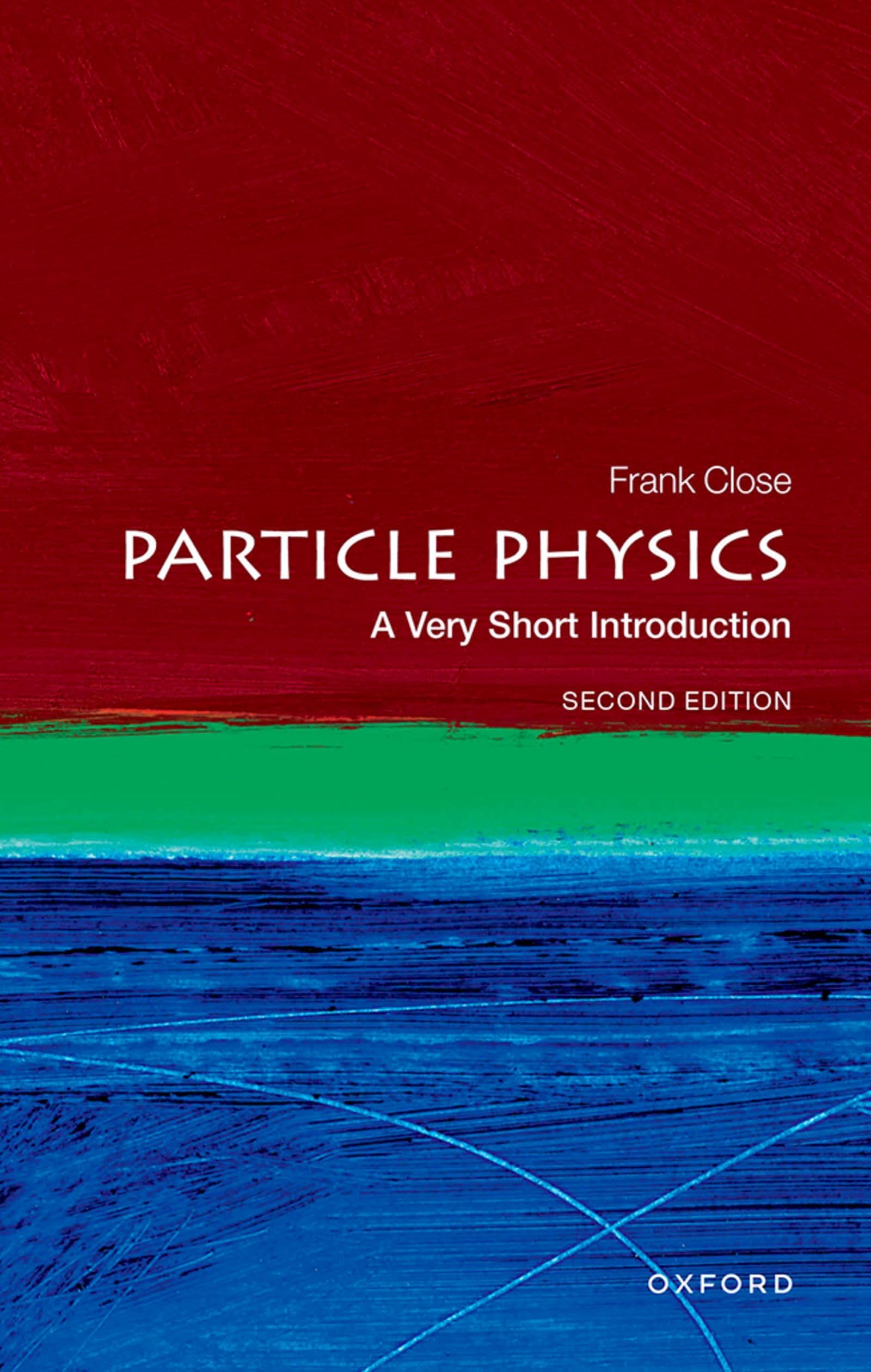

Buy Particle Physics: A Very Short Introduction on desertcart.com ✓ FREE SHIPPING on qualified orders Review: Short, but very informative and well written - This is indeed a very short introduction (129 pages of text), but it is also very informative. The book introduces particle physics from the standpoint of experimental evidence, without recourse to any theory. Thus, there are plenty or bubble chamber photographs, but no mention of group theory or even quantum mechanics. I recommend this book to anyone interested in a highly readable overview of particle physics. What is in the book - The book focuses on the particles, protons, neutrons and electrons that make up our physical world, and the quarks that make up protons and neutrons. The book also covers photons and the different types of neutrinos, plus mesons and muons. While not the focus of the book, it also discusses the forms of matter found at high energies in accelerator experiments – the different types of quarks (the strange and charm, top and bottom) as well as the up and down quarks that make up protons and neutrons. Anti particles are discusses as are the possibilities of supersymmetric particles. There is also a brief mention of the Higgs field and the Higgs Boson. Gluons are mentioned, but not the fact that there are different types of them. The book is divided into 10 chapters as follows: Chapter 1 – Journey to the center of the universe – A general introduction to the atom and the universe at large. Chapter 2 – How big and small are big and small – A discussion of size from the size of quarks inside a proton or neutron as compared to the size of galaxies and the visible universe. Chapter 3 – How we learn what things are made of, and what we found – An introduction to x-ray imaging and particle accelerators. Chapter 4 – The heart of the matter – The constituents that make up atoms – electrons, protons and neutrons and the quarks that make up the protons and neutrons. This chapter also includes a discussion of neutrinos and anti-particles. Chapter 5 – Accelerators: cosmic and man-made. Cosmic rays as a producer of elementary particles and different types of accelerators. Chapter 6 – Detectors: cameras and time machines. The use of film, cloud chambers, bubble chambers and ore modern devices and how they are used to detect particles. Chapter 7 – Forces of nature – A discussion of force particles – photons, W and Z particles, and gluons, plus a mention of the possibility of gravitons. Chapter 8 - Exotic matter and anti-matter – The particles found at higher energies in accelerator experiments. (I found this to be the most difficult chapter and the one that I would have liked to have expanded a bit.) Chapter 9 – Where does matter come from? – A discussion of the creation of hydrogen, helium and heavier elements. Chapter 10 – Questions for the 21st century – Dark matter, Higgs Boson, supersymmetric particles and some questions for the future such as multidimensional space. Review: Frank is a great writer and scientist - Frank is a great writer and scientist. He gives good simple explanations of the subject without resorting to a series of formulas. He starts off by explaining atoms. They are not like what we learned in school as miniature solar systems. They are a cloud of electrons around a very very tiny nucleus, with a tremendous amount of nothing between. He describes in detail Baryons - Protons and Neutrons; Mesons - Quarks and Anti quarks. Later things get a bit heady when he describes Sparticles, Strangeness, Baryon Resonance, Leptons, Rho, Omega Phi, Pion, Etas, and Charm Quarks. (But hang in there, it gets better.) He then goes into how atoms were built up from the big bang. Finally the subjects at the end cover, Super-symmetry, Mass and the Higgs, Quark Gluon Plasma, Antimatter and Matter and Future questions. He truly explains things with understandable language.


| Best Sellers Rank | #299,978 in Books ( See Top 100 in Books ) #23 in Nuclear Physics (Books) #95 in Physics (Books) |
| Customer Reviews | 4.5 4.5 out of 5 stars (478) |
| Dimensions | 6.5 x 0.6 x 4.5 inches |
| Edition | 2nd |
| ISBN-10 | 019287375X |
| ISBN-13 | 978-0192873750 |
| Item Weight | 2.31 pounds |
| Language | English |
| Print length | 176 pages |
| Publication date | February 23, 2024 |
| Publisher | Oxford University Press |
M**T
Short, but very informative and well written
This is indeed a very short introduction (129 pages of text), but it is also very informative. The book introduces particle physics from the standpoint of experimental evidence, without recourse to any theory. Thus, there are plenty or bubble chamber photographs, but no mention of group theory or even quantum mechanics. I recommend this book to anyone interested in a highly readable overview of particle physics. What is in the book - The book focuses on the particles, protons, neutrons and electrons that make up our physical world, and the quarks that make up protons and neutrons. The book also covers photons and the different types of neutrinos, plus mesons and muons. While not the focus of the book, it also discusses the forms of matter found at high energies in accelerator experiments – the different types of quarks (the strange and charm, top and bottom) as well as the up and down quarks that make up protons and neutrons. Anti particles are discusses as are the possibilities of supersymmetric particles. There is also a brief mention of the Higgs field and the Higgs Boson. Gluons are mentioned, but not the fact that there are different types of them. The book is divided into 10 chapters as follows: Chapter 1 – Journey to the center of the universe – A general introduction to the atom and the universe at large. Chapter 2 – How big and small are big and small – A discussion of size from the size of quarks inside a proton or neutron as compared to the size of galaxies and the visible universe. Chapter 3 – How we learn what things are made of, and what we found – An introduction to x-ray imaging and particle accelerators. Chapter 4 – The heart of the matter – The constituents that make up atoms – electrons, protons and neutrons and the quarks that make up the protons and neutrons. This chapter also includes a discussion of neutrinos and anti-particles. Chapter 5 – Accelerators: cosmic and man-made. Cosmic rays as a producer of elementary particles and different types of accelerators. Chapter 6 – Detectors: cameras and time machines. The use of film, cloud chambers, bubble chambers and ore modern devices and how they are used to detect particles. Chapter 7 – Forces of nature – A discussion of force particles – photons, W and Z particles, and gluons, plus a mention of the possibility of gravitons. Chapter 8 - Exotic matter and anti-matter – The particles found at higher energies in accelerator experiments. (I found this to be the most difficult chapter and the one that I would have liked to have expanded a bit.) Chapter 9 – Where does matter come from? – A discussion of the creation of hydrogen, helium and heavier elements. Chapter 10 – Questions for the 21st century – Dark matter, Higgs Boson, supersymmetric particles and some questions for the future such as multidimensional space.
R**R
Frank is a great writer and scientist
Frank is a great writer and scientist. He gives good simple explanations of the subject without resorting to a series of formulas. He starts off by explaining atoms. They are not like what we learned in school as miniature solar systems. They are a cloud of electrons around a very very tiny nucleus, with a tremendous amount of nothing between. He describes in detail Baryons - Protons and Neutrons; Mesons - Quarks and Anti quarks. Later things get a bit heady when he describes Sparticles, Strangeness, Baryon Resonance, Leptons, Rho, Omega Phi, Pion, Etas, and Charm Quarks. (But hang in there, it gets better.) He then goes into how atoms were built up from the big bang. Finally the subjects at the end cover, Super-symmetry, Mass and the Higgs, Quark Gluon Plasma, Antimatter and Matter and Future questions. He truly explains things with understandable language.
A**R
Superb short treatment
We owe a debt of gratitude to Frank Close for writing such a short and comprehensible introduction to a field that, in everyday scientific practice, is as technical and complex as they come. It is a major accomplishment to set out, in under 150 pages, not just the history of particle physics, the scales of time and space being investigated, the development of experimental techniques from Rutherford to the Large Hadron Collider, and the key concepts of the standard model that has dominated particle physics for more than 30 years. Indeed, the neat overview and classification of elementary particles and their interactions in the standard model is sufficient reason to keep this book close at hand. As befits a very short introduction, the book devotes only limited space to more speculative ideas such as supersymmetry, and indeed strings are mentioned only once. Even so, a few authoritative pages dealing with unsolved theoretical and conceptual problems as they relate to particle physics would have been helpful. Close is associated with CERN and an enthusiastic advocate of multi-billion dollar particle accelerators. While these machines are indeed impressive, an outside observer cannot help but wonder whether such a regimented and bureaucratic approach to science has not already reached severely diminishing marginal returns. It will be interesting to look back in a few years' time at whether this heavy investment of taxpayer money has paid the dividends in new knowledge and insight that Close and others like him hope for.
J**S
Not boring to read
This book is excellent for anyone who would like to learn fundamentals of particle physics, or refresh his or her basic knowledge in the area. Particles are on the forefront of physics, with new ones discovered or proven to exist not long ago, with new theories emerging, or old ones confirmed or found inconsistent, chances are what we know about particles today is somewhat different than what you may have learned in school back. Interesting facts and easy to understand comparisons make this book captivating. It explains the structure of atoms, and subatomic particles, as well as methods and instruments used to study them. Sometimes the book is repetitive, but repetition is one of the key aspects of learning. Overall, this very short introduction feels very fresh and light to a reader, and the last chapter that focuses on current high priority theories to be proven, gives an excellent outlook of what may await us in the future, giving this book balanced perspective.
S**Y
particles, electrons, protons, photons and all explained
A well written book on particle physics is easy to read and a lot of information to digest. The basics of the theoretical mechanics, electromechanical, quantum theory are rolled into a standardized model that explains how we all have come into being.
K**R
When I started reading the book, I've already worked in Particle Physics for 8 years. But nevertheless I enjoyed every minute of it. I like the comprehensive way of describing physics and experimental devices used to study it without getting too deep into details. A reader can follow, how the field and instrumentation have evolved. The book will inspire the reader to go deeper and read more about the topic they are interested in. For example, I'm going to read more about CP violation and Chiral Effective Field Theory.
C**E
Excelente libro para una introducción a la física de partículas. No hay matemáticas, se basa en conceptos que una persona con una bachillerato en ciencias puede comprender sin necesidad de recordar instrumentos complejos como el tratamiento matemático implícito. Está escrito en inglés, una persona con nivel intermedio lo puede leer con pocos problemas, si usa Kindle puede activar el significado de palabras y usar el diccionario que permite traducir palabras o más según el modelo (pero es mejor consultar antes las opciones)
S**S
The book contains everything we know about particles and explains it in a very nice way. As a teacher of physics I can recommend it to my pupils.
R**R
Like most books in this series, it is written by an expert and Frank Close is certainly that. MY copy is the second edition. “Let’s take the analogy of the full stop once more. We had to magnify it 100 times to see an atom with the naked eye; to the diameter of the planet to see the nucleus. To reveal the quarks we would need to expand the dot to the size of the Moon and the keep on going another 20 times further. In summary, the underlying structure of the atom is beyond real imagination.” Close takes each item in the Standard Model, provides its history and discovery and the “some more” to elucidate modern particle physics in language which is accessible to a readership outsid PhDs in physics. In Chapter Six, “Detectors, cameras and time machines” he details the history of atomic physics and clarifies the ways in which knowledge of particle physics has advanced and how engineering has combined with physics to create the machines able to detect smaller and smaller particle, e.g. particle accelerators and the Large Hadron Collider. In a pocket-sized book it is not possible to be include all of a subject but, in this text, the writer is very close to achieving that. Recommended.
C**T
The best introduction to particle physics. He book has some detailed images and diagrams for readers. A short book to the amazing side of atoms and physics.
Trustpilot
4 days ago
1 month ago