We remain fully operational. Our teams are working around the clock to ensure your deliveries continue safely.

DOWNLOAD THE APP


Copyright © 2025 Desertcart Holdings Limited
DOWNLOAD THE APP


Buy anything from 5,000+ international stores. One checkout price. No surprise fees. Join 2M+ shoppers on Desertcart.
Desertcart purchases this item on your behalf and handles shipping, customs, and support to South Korea.
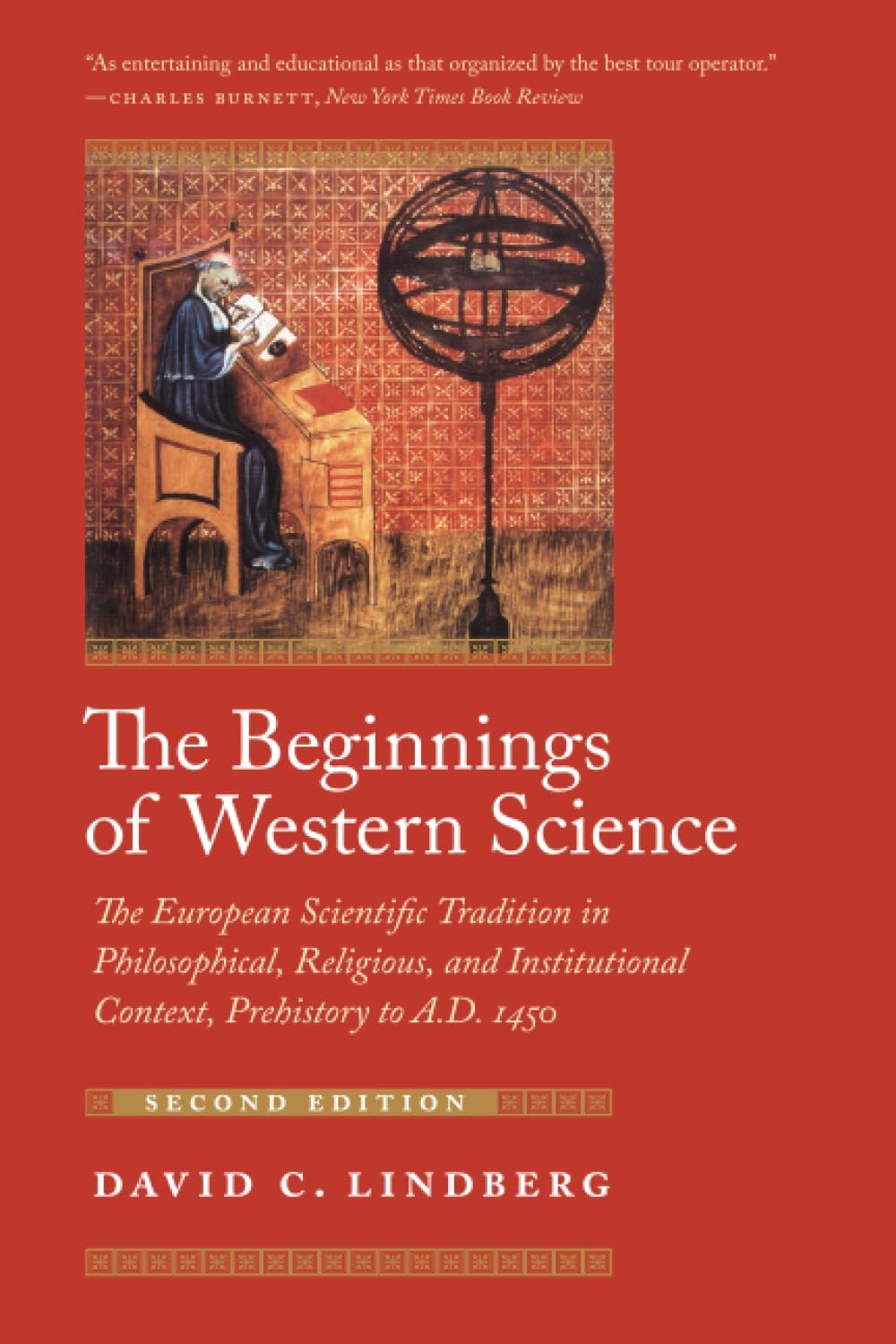
Buy The Beginnings of Western Science: The European Scientific Tradition in Philosophical, Religious, and Institutional Context, Prehistory to A.D. 1450, Second Edition 2 by Lindberg, David C. (ISBN: 9780226482057) from desertcart's Book Store. Everyday low prices and free delivery on eligible orders. Review: Excellent guide to the history of western science - This is a very good guide to western scientific thought up to 1450. The chapters on ancient Greece and the European Middle Ages are very good and give a lot of detailed information about developments during those times. There is however only one Chapter on Arab science, which I felt was not enough. The book does debunk the myth that there was no progress during the Middle Ages, though. All in all, this book can be recommended. Review: Lindberg does an excellent job of tracing the history of the sciences (broadly construed) from prehistory to the late Middle Ages. He covers, physics, optics, medicine, biology, chemistry (in the form of alchemy), astronomy, and astrology with very good contextualization of the knowledge. You learn why smart people in the past would think that astrology makes sense. The author is very careful about explaining why medieval "scientists" thought as they did, and I find this method much more illuminating than comparing against modern ideas directly (although understanding them from the lens of modernity can be useful). I found the writing quite good and witty with plenty of authorial style shining through. If you want to know the history of science until the Scientific Revolution beginning in the 1600s (the title says to 1450), then this is a great book to introduce you to all relevant aspects of philosophy.
| Best Sellers Rank | 698,346 in Books ( See Top 100 in Books ) 1,438 in History of Science (Books) 28,507 in Scientific, Technical & Medical 30,919 in Biological Sciences (Books) |
| Customer reviews | 4.5 4.5 out of 5 stars (138) |
| Dimensions | 3.18 x 15.24 x 22.86 cm |
| Edition | 2nd |
| ISBN-10 | 0226482057 |
| ISBN-13 | 978-0226482057 |
| Item weight | 1.05 kg |
| Language | English |
| Print length | 488 pages |
| Publication date | 1 April 2008 |
| Publisher | University of Chicago Press |
L**R
Excellent guide to the history of western science
This is a very good guide to western scientific thought up to 1450. The chapters on ancient Greece and the European Middle Ages are very good and give a lot of detailed information about developments during those times. There is however only one Chapter on Arab science, which I felt was not enough. The book does debunk the myth that there was no progress during the Middle Ages, though. All in all, this book can be recommended.
K**.
Lindberg does an excellent job of tracing the history of the sciences (broadly construed) from prehistory to the late Middle Ages. He covers, physics, optics, medicine, biology, chemistry (in the form of alchemy), astronomy, and astrology with very good contextualization of the knowledge. You learn why smart people in the past would think that astrology makes sense. The author is very careful about explaining why medieval "scientists" thought as they did, and I find this method much more illuminating than comparing against modern ideas directly (although understanding them from the lens of modernity can be useful). I found the writing quite good and witty with plenty of authorial style shining through. If you want to know the history of science until the Scientific Revolution beginning in the 1600s (the title says to 1450), then this is a great book to introduce you to all relevant aspects of philosophy.
N**T
Das Buch ist eine sehr gute Ideengeschichte zur Entstehung abendlaendischer Wissenschaft, wie es mir in der deutschsprachigen Literatur selten begegnete. Mit Kindle sind englischsprachige Buecher leichter zu deutsche Leser zu lesen. Das ist fuer mich der Hauptvorteil von Kindle.
J**K
This book (2nd ed.) was written by David Lindberg, a well-known professor of the history of science who taught at the U. of Wisconsin (Madison). The book covers pre-Greek (Egyptian, Mesopotomian), Greek, Roman, Islamic, and Medieval science in 14 chapters (367 pp. + notes and bibliog.). The book includes nearly a hundred black&white figures and illustrations, but only 6 maps. I bought the book for personal reading but it has also been used as a text in history of science classes. It includes a chapter on medieval medicine (anatomy, surgery, early hospitals). The book is non-technical (no math equations) but polished and scholarly, and is aimed at general readers who have an interest in both science and history. The bibliography is extensive (48 pages!), providing a wealth of information for those who want to further explore specific topics. Highly recommended as a broad introduction to the history of science up to medieval times. For those interested in medieval science, I also recommend Science in the Middle Ages, edited by Lindberg.
S**S
The material is presented pretty forward. There are sub-chapters within chapter, which at least in my case, makes it a much more tolerable read. Plus, it's $12 dollars cheaper here than at the bookstore.
G**Y
This is one of several books that serve as a corrective to the popular myth that the fall of Rome was followed by the "Dark Ages." In this book, the development of modern science is traced from pre-history through the classical period (Greece and Rome) and afterward. Discoveries and the transmission of learning after the fall of Rome in Islamic lands and in the West is covered in readable detail. Unlike similar books, the author does not wish to address why science withered away in Islam, instead wanting to end that section on a positive note (something to the effect that we should instead be amazed at how long it lasted). It is also rather more detailed tour on the thought and discoveries of the "ancients". For anyone who has been steeped in the mythology that the history of scientific progress was Greece/Rome, the Dark Ages, the Renaissance, and the Enlightenment, this book (and/or the others listed below) should be required reading. That would cover mostly anyone educated in our colleges and high schools in the last fifty years. Other books in this vein worth reading: The Genesis of Science: How the Christian Middle Ages Launched the Scientific Revolution , Intellectual Curiosity and the Scientific Revolution: A Global Perspective , The Foundations of Modern Science in the Middle Ages: Their Religious, Institutional and Intellectual Contexts (Cambridge Studies in the History of Science) .
Trustpilot
1 month ago
1 month ago