

🔋 Never lose power, never miss a moment.
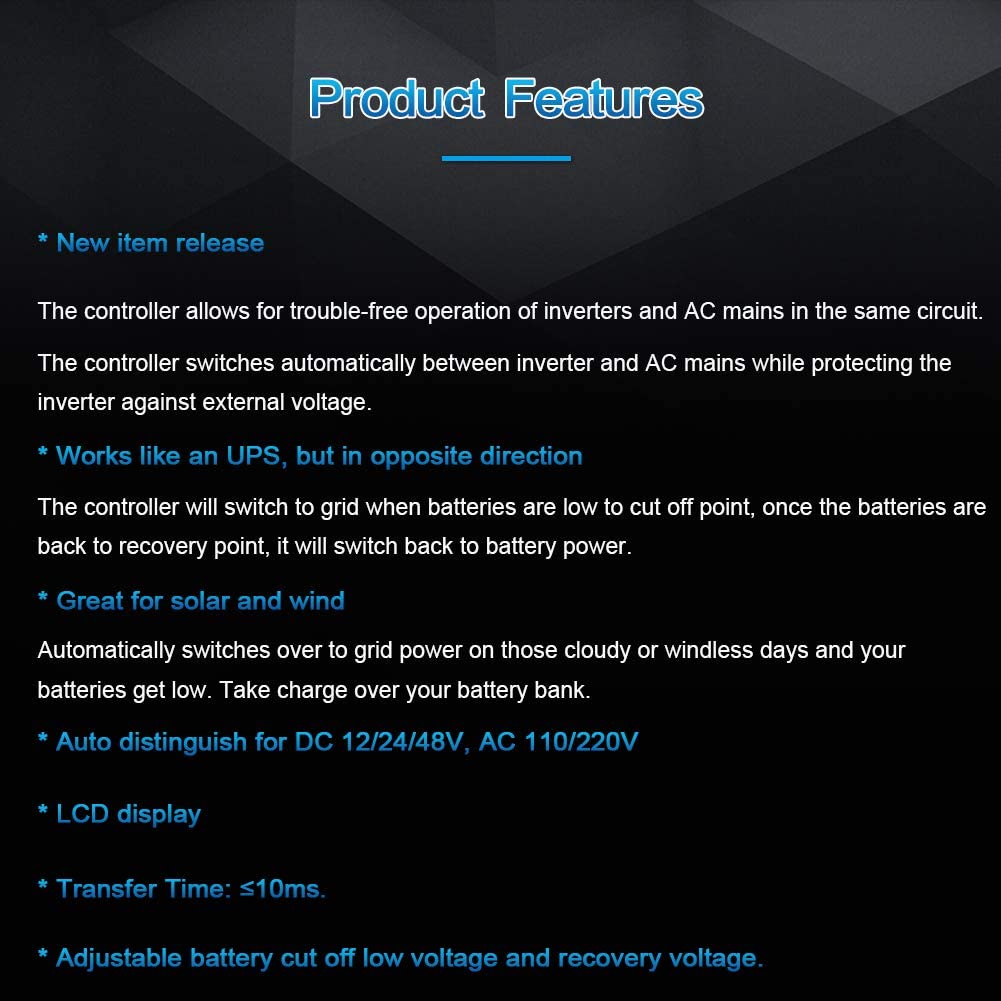
The MOES ATS is a high-capacity automatic transfer switch designed for solar and wind off-grid systems. It intelligently switches between battery and grid power based on customizable voltage thresholds, ensuring uninterrupted power supply. Compatible with multiple DC and AC voltages and various battery types, it features ultra-fast transfer times and a real-time LCD display for monitoring system status. Ideal for maximizing renewable energy use while maintaining reliable backup power.


| Best Sellers Rank | #108,941 in Patio, Lawn & Garden ( See Top 100 in Patio, Lawn & Garden ) #758 in Solar & Wind Power Parts & Accessories |
| Brand | MOES |
| Color | Black |
| Customer Reviews | 4.2 out of 5 stars 1,088 Reviews |
| Display Type | LCD |
| Item Weight | 2.9 Pounds |
| Material | Gel |
| UPC | 741722875483 703931915893 703931915732 |
S**N
If you want to make use of a small solar system you need this!
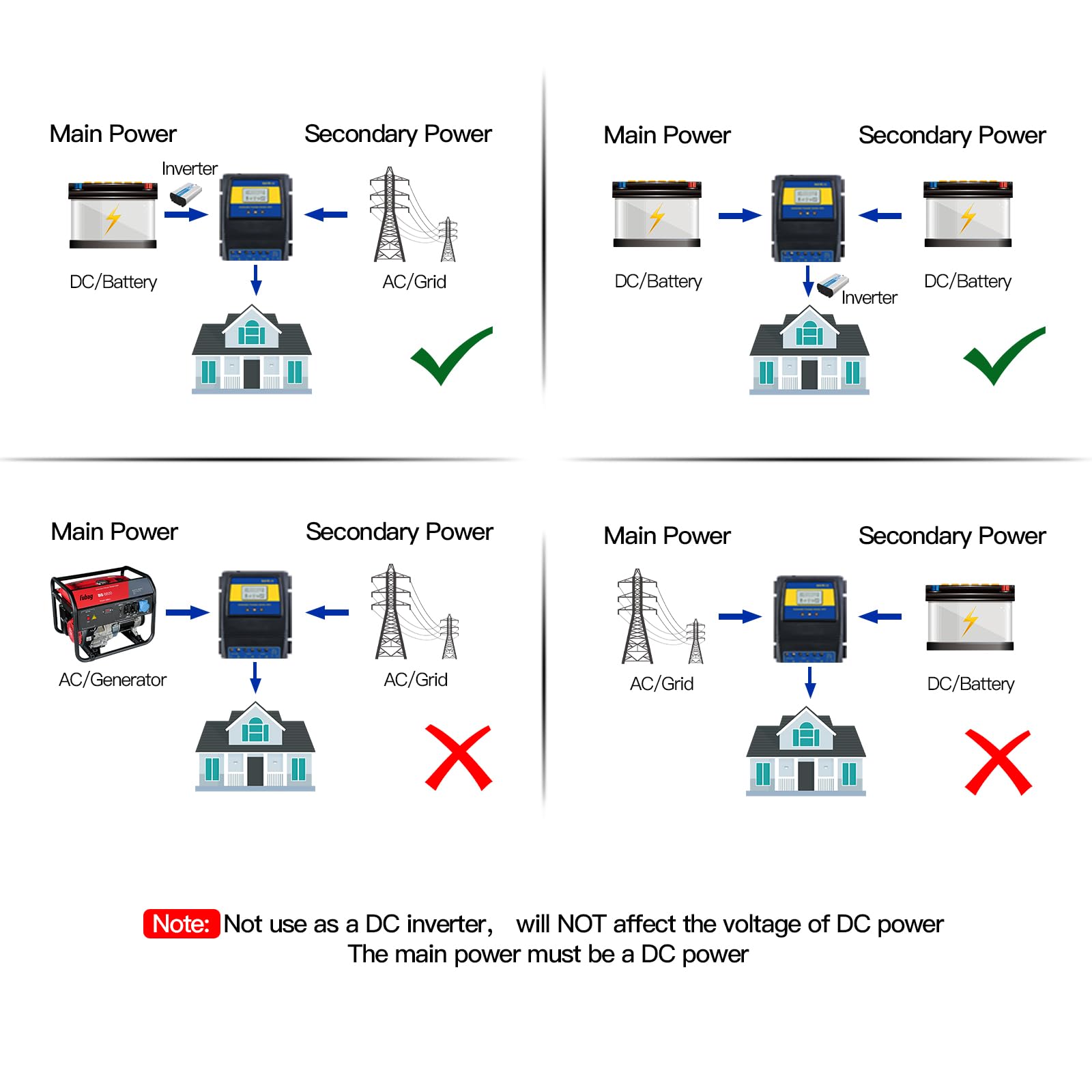
I enjoy experimenting with solar power and I've never had a permanent solar system. The main problem with using solar power as a hobby is that when your battery runs low, your inverter and all the devices connected to your inverter will turn off too. This makes it really difficult to reliably use the power you generate, at least till I learned about this little gem. With this ATS you can connect your grid power, and inverter as an input, a plug (or what ever you decide to use) as an ouput, connect a voltage monitoring cable to your battery (from the ATS), and this device will automatically switch between your inverter and grid power depending on your batteries state of charge without ANY interruption do your devices. If you are watching TV, or gaming on your computer during the switch you will not even notice it. The best part is you get to determine the low voltage at which it changes to grid, and the high voltage when it changes back to your inverter. This means that you can run your devices off your solar panel/battery and then when that power is used up it will swap back to grid power. The next day when the sun comes up and the battery charges, you are back to solar power. This is great way to make permanent use of smaller solar systems. The other exciting thing is that you could (if your batteries can support it) add more and more panels to the system and get usable solar power when the sun is up without having to spend a ton of money on batteries. There is feature i wish this device had, mainly the ability to manually choose if you want to use grid or solar power, but it's not a deal breaker. This device can show an incorrect voltage reading (might be off by .2 volts, but if you hold the up and down arrows for 3 seconds you will be able to adjust the offset. I have used this system for over a week now and it's working flawlessly, i wish i had known about it a long time ago!
J**N
Easy setup and it just works!
From what I can garner, the unit draws 7-8 watts of idle power consumption. The transfer switch worked seamlessly upon initial testing. When I forgot to turn the PV input back on, the unit had already switched to shore power by morning. Since my batteries were run nearly all the way down, with little sun the last few days the Moes unit has worked flawlessly switching back and forth from grid power to battery. Very good and easy setup after tons of research into a solar battery transfer switch. Easy to use, settings are a breeze and it just works!
M**E
Good, but...
Happy for Its been little over two years since I bought it, I dint find anything quite like it. Super easy to install, granted you have a basic understanding of electricity. Extreamly reliable and worry free. Just install and watch the magic of automatic power transfer. Bearly notice the changes. Would have give it a 5 star but I wished it would at leats last 5 years. Any way, im not dissapointed. Great product. I bought at $133.00 Its now $79.00 . I'm defenetly buying another on after I write this review. Still seems to be the best product out there. Other with similar capabilities are a bit more expensive. By the way, what happened to mine is that the output power port died/fried.
P**L
Good concept, just a few missing features
Hi, using this device with my solar power system. Great device for automatically switching from my inverter to utility power. Installation was easy and it worked as it was advertised right away. Because it does work as advertised, I am giving it 5 stars, but I hope for a 2.0 version. There are times though, when when there is going to be more lack of sun days then your system is designed for. I wish they could provide a way of pressing one of the buttons to force it to the opposite source (solar is forced to utility, utility is forced to solar) with disregards to the settings.....a manual override. Then you could press the button to force it back to automatic mode. I sometimes want to keep a little juice in the batteries if I know we will have several stormy days in a row, in case I do need it. Last, as previously pointed out, if your inverter shuts down for some reason, maybe a failure or blown fuse in the inverter, this device will not automatically switch over to utility power. As pointed out, you can manually add a relay, powered by the inverter AC output, to disconnect the battery from the battery input on this device. Having it built in, with an option in the settings, would make it bullet proof.
F**T
Reliable and Versatile
I love that I can program the low/high voltages cutoff/resume to trigger the switching. This ATS puts my inverter on hold while switching to grid when batteries are low, and resume to inverter mode by default. Since I'm not feeding the grid, I do not have to worry about permits nor frying anyone should its power fails. My system is very minimal, using only a 2p4S UPS lead acid batteries each about 18Ah. So at 48VDC I get 32Ah. However, when my 2000W inverter kicks in each mornings, it maintains the batteries charged, while powering 2 fridges rated at 6.5A and 7.1A, some pond pumps at 2A on a timer, and a ceiling fan 2.5A also on a timer. Since these are surge currents, most of the time my inverter is really idling around 3A. So my electricity usage is cut by half because these main loads are working 24/7. This simple setup saves me about 2.5KW each day. Actually I could have put all the loads on a timer and not buy this ATS, but the fridges must stay on at all time. Moreover, in the future I plan to drive some heavier loads like charging some EVs and I will then get some substantial Lithium battery banks. When I do, these programmable voltage cutoffs will come handy. So I kept this ATS... But if you don't need this feature along with the 12,24,48V auto recognition then save 2/3 the cost. Buy instead a cheaper reliable ATS and that should work as well.
M**N
Works but not really a "reverse" UPS, and no relay validation
(update at bottom... had to drop it to one star, no relay validation means the two sources can be cross-linked). The unit works decently well, but I can't give it 5 stars because it isn't really a "reverse" UPS or anything of the sort. It only monitors the battery input voltage to determine when to switch. It does not monitor either of the line inputs at all. This means that if the battery voltage is fine, but the inverter gives up the ghost, this ATS will not switch from inverter to mains. And similarly, if voltage or frequency of the "inverter" input goes out of spec, this unit does not monitor that and will not switch to the mains. It goes strictly by battery voltage. It would be a whole lot more robust if the unit also monitored the "inverter" input. If battery power is lost entirely, the unit powers down, but if the unit had already switched to the mains it will remain on the mains while powered down. However, the unit does not remember its last state when it powers up again so when power comes back the unit will not wait for the battery voltage to reach the recovery voltage. Instead it will switch back to the inverter if the battery voltage is above the low-voltage point, even if it is still lower than the recovery point. I'm not going to dock a star for this behavior but it is worth noting. -- There are a few other quirks. The battery monitoring inputs are high-gauge (small wire) screw terminals, and to be totally safe you not only have to tap-off your battery to go to these inputs, you also need to put a little 2A fuse in-line so those high-gauge wires don't become a line of fire if they happen to short. And, as described in the manual, the unit is powered by the battery input. This is also a bit of a problem if the battery goes completely dead, so you have to make sure that that does not happen. I won't dock it a star on that account, but it would be a whole lot nicer if the unit could power itself from any of the inputs. There are no screw terminals for GND, you have to tie your GNDs together externally. -- I took it apart to check whether there was a relay state validation feedback circuit, which is absolutely required for any sort of automatic transfer switch. There appears to be none. It is articulating the relays in the blind which means that when the unit eventually fails it will likely cause the two power inputs to be cross-linked to each other... which is extremely dangerous. Pictures included. This make the unit a complete non-starter, a failure could cause a fire. Dropped to 1 star
J**N
It works good with a power inverter.
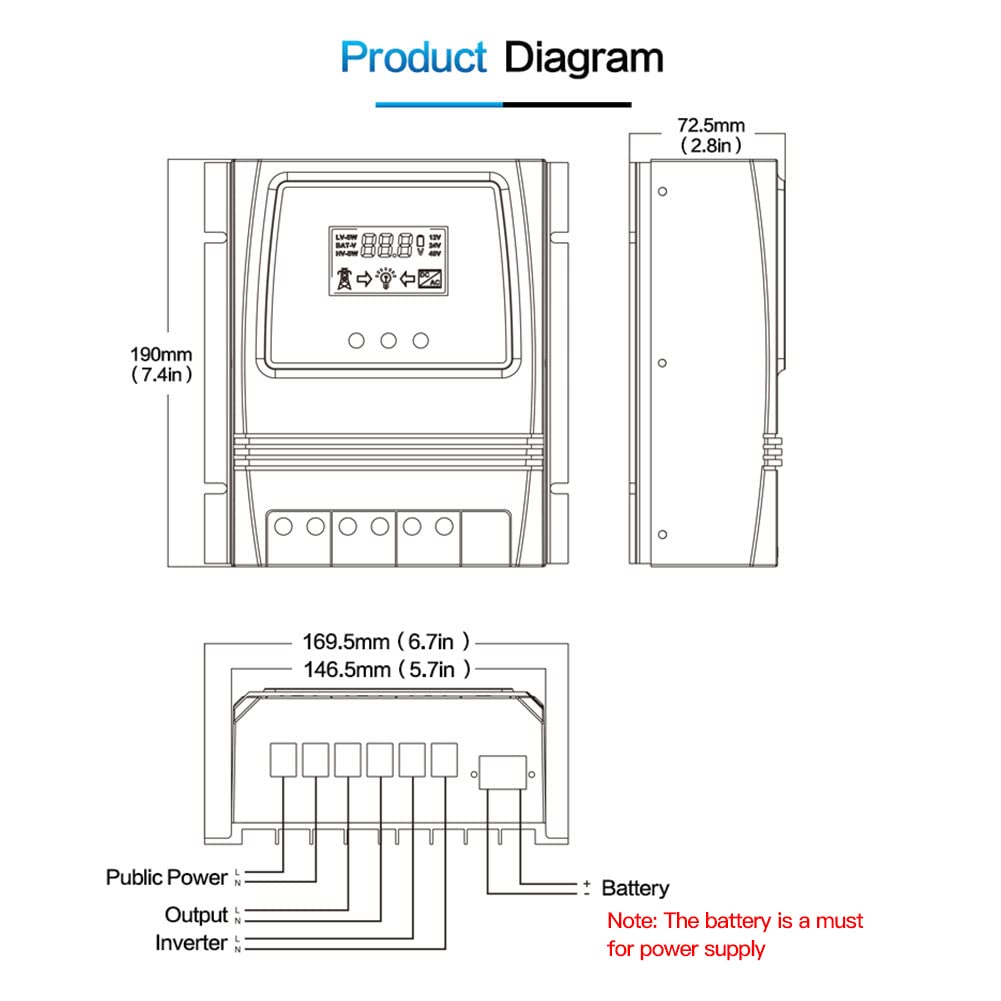
When your solar battery bank gets to a voltage that you select , it will keep your batteries from being over drained and go to the public electric grid automatically from your fuse box and your appliances will keep running on that instead of draining your batteries . Install a outlet near it , then use the plug end of an extension cord and the other end strip the wires and they go to the moes as public power going in to moes then cut another section of extension cord it goes from moes and into the the inverter , then use the other end of the extension cord wire it into moes and what ever you plug into that will run with Moes and the inverter will show you how many watts the appliance you plugged in is using . I used a three way end so I can plug in three appliances . Then you take the green wires and twist them together with a wire nut . The ground will go off the inverter into your ground . I used a long copper spike and have all my grounds going into that from a bus bar . When your batteries charge up to the voltage you choose then it automatically goes to battery power .
L**S
Reputable Seller!
Worked normally for at least 2 days then went haywire...contacted seller and the support team made me do all sorts of test then after a few weeks of troubleshooting they stopped responding to my emails. Useless piece of junk...also note that it does not know if power is ever lost at the Inverter or mains electricity it switches purely based on the battery voltage...The reason I gave 2 stars instead of 1 is due to the fact that they did have some sort of support who tried to assist with the issue...however as previously mentioned stopped responding to emails after I tried all their steps and nothing worked... Edited Review: I was contacted by the seller and the issue was resolved. The seller was courteous and provided me with a satisfactory solution which their support team did not. This I would say is what keeps customers, having a seller who cares!! Mad respect to seller for providing satisfactory solution as it speaks volumes to character in my book!
Trustpilot
3 weeks ago
2 months ago