We remain fully operational. Our teams are working around the clock to ensure your deliveries continue safely.

DOWNLOAD THE APP


Customer Services
Copyright © 2025 Desertcart Holdings Limited
DOWNLOAD THE APP
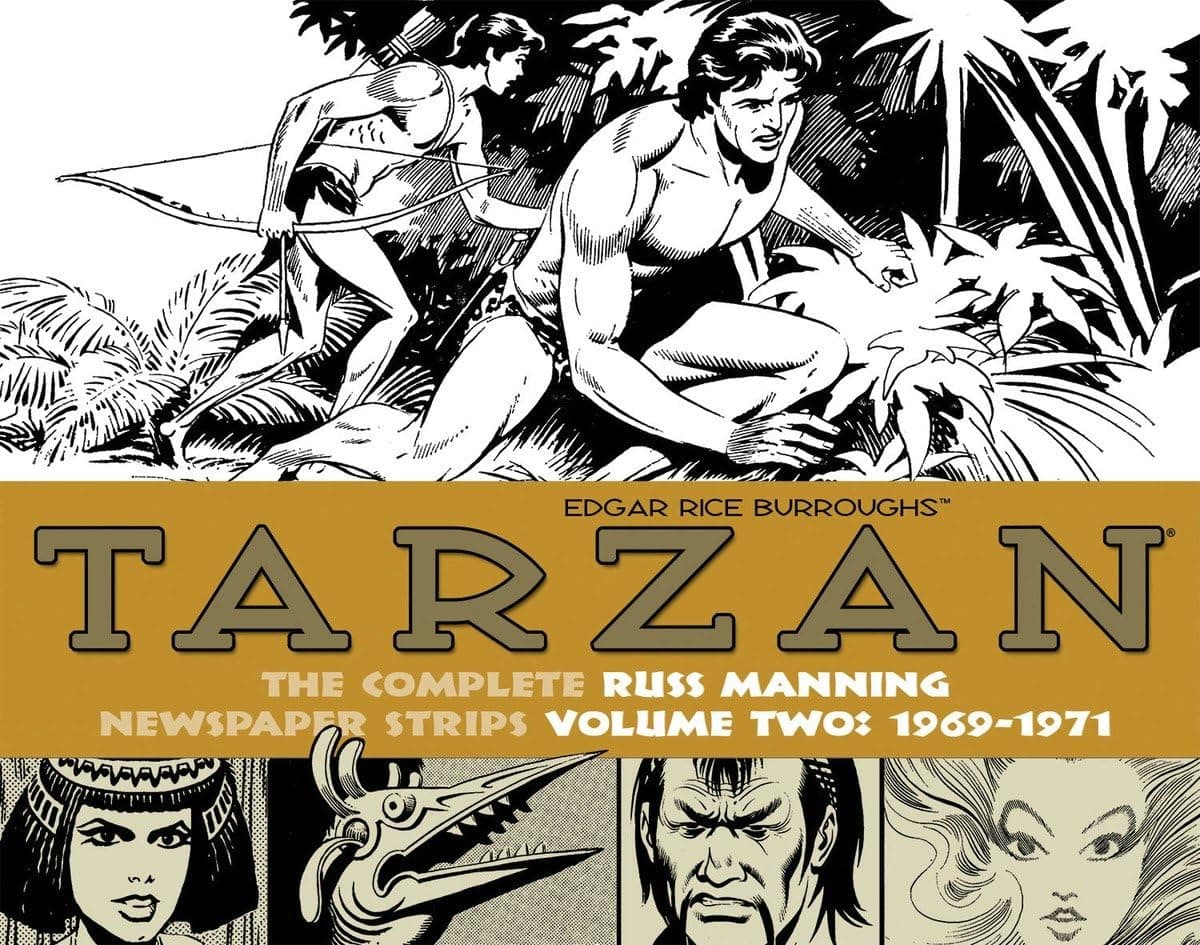

Tarzan: The Complete Russ Manning Newspaper Strips Volume 2 (1969-1971) [Manning, Russ, Manning, Russ] on desertcart.com. *FREE* shipping on qualifying offers. Tarzan: The Complete Russ Manning Newspaper Strips Volume 2 (1969-1971) Review: Russ Manning was brilliant, and his Tarzans were great, part 2 - This is a wonderful, hard-cover collection of daily Tarzan comic strips and Sunday Tarzan comic pages from 1969 to 1971. The daily Tarzan strips start with the hero and Jane finding their son Korak enslaved in a village of tree-dwelling beasts. After escaping, Korak then relates his ill-fated efforts to help a group of young rebels overthrow a religion which practices human sacrifices. After investigating a cult of magicians, Tarzan, Jane, and Korak are separated in the desert. Tarzan encounters a lost ancient Egyptian city while Korak and Jane stumble upon a planned rebellion. The trio reunites and returns to their jungle home, where Tarzan deals with a lost, telepathic, winged dinosaur. The Sunday Tarzan pages feature the hero's adventures in the lost city of Opar and with some slave traders, his wife's and his friend's story of how they met Tarzan, and his son's encounter with a city which steals youth from others. Russ Manning's artistry is brilliant. His portrayal of whimsical lands and their beasts and their people is imaginative. His depictions of Tarzan and his son Korak are classic. I can't wait for volume three. Review: More comic art bliss from Russ Manning - 290 plus pages of Russ Manning comic artistry...it really doesn't get much better than this! The second volume of IDW Publishing's wonderful collection of "Tarzan: The Complete Russ Manning Newspaper Strips (1969-1971)" brings more of the creative magic of this master comic storyteller to readers young and old. Mr. Manning's interpretation of the classic character first imagined by Edgar Rice Burroughs continues to be a majestic figure, who traverses the exotic African jungle of his birth, as well as ancient civilizations and fantastic cultures in thrilling adventures he shares with his beautiful wife Jane, and their brave son Korak. What this reviewer finds so surprising and rewarding while enjoying these stories is the subtle sophistication Mr. Manning shows in his writing of his jungle tales of Tarzan. The book opens with Korak recounting his own solo adventure, "The Gryf Worshippers," a daily strip story that contained good intentions gone wrong, a friendship betrayed and a society nearly lost. This is followed by Tarzan and company's encounter with a band of magicians in "The Magii of Paul-Ul-Don." The black and white strips then showcase "the Lord of the Jungle" with family and friends as they journey across a vast barren dessert where Tarzan discovers a lost city and its inhabitants, the remains of ancient Egypt in modern times: governed by the beautiful Queen Mut-Ophet, her realm is threatened from without and within but most mysteriously by the mighty "Stone Pharoah." Reunited with Jane, Korak, and his friends, Tarzan and his fellow travelers are soon caught in the middle of a rebellion orchestrated by "The Pasha Ronchi." The daily strip adventures climax with Tarzan facing the danger of "The Cult of the Mahar," a dinosaur-like winged creature with frightening mind-bending powers. Like its predecessor in this reprint series, Volume Two of this collection features Mr. Manning's full color Sunday newspaper continuities in the rear of the book. This section begins with "The Safari to Opar," in which Tarzan returns to the last outpost of lost Atlantis to save a band of reckless explorers and again meets the entrancing La, Queen and High Priestess of Opar (Oh my, La!). In "How Tarzan Met Jane," the wife of the King of the Great Apes tells the tale of how she first set eyes on the love of her life. Then in the volume's most fantastical adventure, Tarzan goes on a desperate mission to save his son Korak from the effects of "The River of Time." As the tome reaches a climax, Tarzan meets his first friend from the civilized world, Paul D'Arnot, before going on a quest to save people taken captive by "The Slavers." The loyal comrade to Tarzan ends the reprint collection with his recollection of "How Paul D'Arnot Met Tarzan." All these amazing exploits were written and illustrated by Russ Manning, a comic creator at the peak of his artistic powers. His elegant line work is simply a beautiful sight for the eyes: his vision of Tarzan is heroic, his women are graceful in their feminine beauty, and his landscapes are rich environments that encompass his characters. Yet importantly, Mr. Manning's stories also contain a depth of emotional drama that strengthens their hold on the reader. A specific example of this is his characterization of the lovely Egyptian Queen Mut-Ophet. A noble woman struggling to hold onto her crown as a lady Pharoah, she is torn by her responsibilities as a leader of her people while burdened with the realities of sacrifice she must endure that prevent her heart from finding happiness. Despite her regal persona, the reader is not surprised when she comes to look to Tarzan for strength, support and perhaps, more. Mr. Manning connects her to his great hero and to the reader, who empathizes with her plight. But while she bears similarities to the Burroughs character, La, Queen Mu-Ophet, as written by Mr. Manning, is distinct in her own right. As Tarzan himself reflects: "Queen La is a beautiful, desirable woman...but the blood of centuries of Beastmen is in her veins!" In contrast, Queen Mu-Ophet is depicted as a more stately woman of royalty, a Queen who must keep her emotions in check. When they are revealed, their exposure is that much more dramatic. This characterization of two remarkable women is just an example of Mr. Manning's storytelling skills. His talents as a master of comic art are on full display is this thick tome. With an informative illustrated introductory essay that details Mr. Manning's challenges in "Rejuvenating the Tarzan newspaper strip" by Henry G. Franke III, high quality reproductions of the gifted artist's daily and Sunday strips, this hardcover tribute to the art of Russ Manning comes with this fan's highest recommendation.
| Best Sellers Rank | #2,416,446 in Books ( See Top 100 in Books ) #3,267 in Comic Strips (Books) #29,840 in Superhero Comics & Graphic Novels #126,962 in Fantasy (Books) |
| Customer Reviews | 4.8 4.8 out of 5 stars (65) |
| Dimensions | 8.94 x 1.26 x 11.3 inches |
| Edition | Illustrated |
| ISBN-10 | 1613778201 |
| ISBN-13 | 978-1613778203 |
| Item Weight | 3.75 pounds |
| Language | English |
| Print length | 296 pages |
| Publication date | December 31, 2013 |
| Publisher | IDW Publishing |
| Reading age | 9 - 12 years |
D**N
Russ Manning was brilliant, and his Tarzans were great, part 2
This is a wonderful, hard-cover collection of daily Tarzan comic strips and Sunday Tarzan comic pages from 1969 to 1971. The daily Tarzan strips start with the hero and Jane finding their son Korak enslaved in a village of tree-dwelling beasts. After escaping, Korak then relates his ill-fated efforts to help a group of young rebels overthrow a religion which practices human sacrifices. After investigating a cult of magicians, Tarzan, Jane, and Korak are separated in the desert. Tarzan encounters a lost ancient Egyptian city while Korak and Jane stumble upon a planned rebellion. The trio reunites and returns to their jungle home, where Tarzan deals with a lost, telepathic, winged dinosaur. The Sunday Tarzan pages feature the hero's adventures in the lost city of Opar and with some slave traders, his wife's and his friend's story of how they met Tarzan, and his son's encounter with a city which steals youth from others. Russ Manning's artistry is brilliant. His portrayal of whimsical lands and their beasts and their people is imaginative. His depictions of Tarzan and his son Korak are classic. I can't wait for volume three.
L**T
More comic art bliss from Russ Manning
290 plus pages of Russ Manning comic artistry...it really doesn't get much better than this! The second volume of IDW Publishing's wonderful collection of "Tarzan: The Complete Russ Manning Newspaper Strips (1969-1971)" brings more of the creative magic of this master comic storyteller to readers young and old. Mr. Manning's interpretation of the classic character first imagined by Edgar Rice Burroughs continues to be a majestic figure, who traverses the exotic African jungle of his birth, as well as ancient civilizations and fantastic cultures in thrilling adventures he shares with his beautiful wife Jane, and their brave son Korak. What this reviewer finds so surprising and rewarding while enjoying these stories is the subtle sophistication Mr. Manning shows in his writing of his jungle tales of Tarzan. The book opens with Korak recounting his own solo adventure, "The Gryf Worshippers," a daily strip story that contained good intentions gone wrong, a friendship betrayed and a society nearly lost. This is followed by Tarzan and company's encounter with a band of magicians in "The Magii of Paul-Ul-Don." The black and white strips then showcase "the Lord of the Jungle" with family and friends as they journey across a vast barren dessert where Tarzan discovers a lost city and its inhabitants, the remains of ancient Egypt in modern times: governed by the beautiful Queen Mut-Ophet, her realm is threatened from without and within but most mysteriously by the mighty "Stone Pharoah." Reunited with Jane, Korak, and his friends, Tarzan and his fellow travelers are soon caught in the middle of a rebellion orchestrated by "The Pasha Ronchi." The daily strip adventures climax with Tarzan facing the danger of "The Cult of the Mahar," a dinosaur-like winged creature with frightening mind-bending powers. Like its predecessor in this reprint series, Volume Two of this collection features Mr. Manning's full color Sunday newspaper continuities in the rear of the book. This section begins with "The Safari to Opar," in which Tarzan returns to the last outpost of lost Atlantis to save a band of reckless explorers and again meets the entrancing La, Queen and High Priestess of Opar (Oh my, La!). In "How Tarzan Met Jane," the wife of the King of the Great Apes tells the tale of how she first set eyes on the love of her life. Then in the volume's most fantastical adventure, Tarzan goes on a desperate mission to save his son Korak from the effects of "The River of Time." As the tome reaches a climax, Tarzan meets his first friend from the civilized world, Paul D'Arnot, before going on a quest to save people taken captive by "The Slavers." The loyal comrade to Tarzan ends the reprint collection with his recollection of "How Paul D'Arnot Met Tarzan." All these amazing exploits were written and illustrated by Russ Manning, a comic creator at the peak of his artistic powers. His elegant line work is simply a beautiful sight for the eyes: his vision of Tarzan is heroic, his women are graceful in their feminine beauty, and his landscapes are rich environments that encompass his characters. Yet importantly, Mr. Manning's stories also contain a depth of emotional drama that strengthens their hold on the reader. A specific example of this is his characterization of the lovely Egyptian Queen Mut-Ophet. A noble woman struggling to hold onto her crown as a lady Pharoah, she is torn by her responsibilities as a leader of her people while burdened with the realities of sacrifice she must endure that prevent her heart from finding happiness. Despite her regal persona, the reader is not surprised when she comes to look to Tarzan for strength, support and perhaps, more. Mr. Manning connects her to his great hero and to the reader, who empathizes with her plight. But while she bears similarities to the Burroughs character, La, Queen Mu-Ophet, as written by Mr. Manning, is distinct in her own right. As Tarzan himself reflects: "Queen La is a beautiful, desirable woman...but the blood of centuries of Beastmen is in her veins!" In contrast, Queen Mu-Ophet is depicted as a more stately woman of royalty, a Queen who must keep her emotions in check. When they are revealed, their exposure is that much more dramatic. This characterization of two remarkable women is just an example of Mr. Manning's storytelling skills. His talents as a master of comic art are on full display is this thick tome. With an informative illustrated introductory essay that details Mr. Manning's challenges in "Rejuvenating the Tarzan newspaper strip" by Henry G. Franke III, high quality reproductions of the gifted artist's daily and Sunday strips, this hardcover tribute to the art of Russ Manning comes with this fan's highest recommendation.
R**N
Tarzan
Great stories from the Sunday paper
E**P
Wonderful Russ Manning art!
Russ Manning is among my favorite Tarzan artists. He is up at the top, along with Foster, Hogarth, and Kubert , as my all time best Tarzan comic illustrators. Very nice edition, very informative, nice daily and weekly strip sections. Very nice presentation.
D**T
They don't make newspaper strips like this anymore
Tarzan: The Complete Russ Manning Newspaper Strips, Volume 2, 1969-1971 collects five black and white stories (Korka's Story, The Magii of Pal-Ul-Don, Tarzan and the Stone Pharaoh, Tarzan and the Pashi Rochi, and Tarzan and the Cult of the Mahar) and five color stories (Tarzan and the Safari to Opar, How Tarzan Met Jane, Korak and the River of Time, Tarzan and the Slavers, and How Paul D'Arnot Met Tarzan), all written and drawn by Russ Manning. My journey into the Tarzan newspaper strips continues with this volume. Tarzan returns to Paul-Ul-Don, fights a stone pharaoh in Egypt, slavers, assorted other douche bags, a psychic Pteranodon, two cults, beast men of Opar, and a race that syphons the lifespan of people to add to their own. As with the last volume, these are nonstop adventure tales with fighting, lost cities, and more villains than you can shake a spear at. The stories play fast and loose with African geography but no one reads Tarzan looking for factual accuracy, I hope. Once again, Russ Manning's art is the star of the show. The man is great at quiet scenes as well as fights above molten lava, beast men, lovely ladies, ancient ruins, and animals galore. Even the jungle foliage is well done, though in the intro, Manning said most of it came from his imagination since reference photos were hard to come by. His output was amazing considering how many panels he was knocking out in a week for the dailies and Sunday strips.
U**Y
Tarzan -- as he was meant to be seen in comic-strip form
Next to Hal Foster and Joe Kubert, Russ Manning stands just as tall. His work on Edgar Rice Burroughs' jungle hero is both beautiful to look at and exciting to read!
B**G
brilliance
the master at work russ manning is just a superb artist and it is a pleasure to read these newspaper strips as they were not available in the uk until now.
R**9
Five Stars
Great addition to the collection. Item was received as advertised and on time.
R**D
1 of a great must have set of 4, super read.
C**S
Um tipo de HQ que sempre sonhei que se publicasse no Brasil e nunca se publicou.Livro em preto e branco e colorido com maravilhosos desenhos de Russ Manning (Que considero o melhor desenhista de Tarzan) Indispensável para todos os Fãs do Herói.Recomendo.
A**R
In addition to Jesse Marsh volumes these are the best Tarzan graphic books . And best Russ Manning . Yes it gordonish
S**R
While it was bit costly it was worth every penny. I was apprehensive about the flimsy packaging that typically one sees from Amazon. But this time was really happy to see that the seller packed the book in proper cardboard package safely and securely. The original plastic wrap was intact and there was not much of transit damage to complain of. So very happy. The book and its contents need no review , done by one of the greats of visual storytelling it is a joy to behold.
F**Z
Les bandes quotidiennes (Dailies) de Tarzan parues entre 1969 et 1971 déroulent dans ce second recueil cinq histoires en noir et blanc sur 185 pages ; les planches du dimanche (Sundays) en couleur exposent à la suite cinq aventures sur 87 pages. Le menu, toujours aussi roboratif, est concocté de main de maître par Russ Manning (1929-1981), dessinateur américain prolifique et talentueux. Korak, fils de Tarzan, raconte sa participation à la révolte des rebelles Ho-don dans la ville de Ta-lur. Korak va subir trahison et manipulation de la part de son ami Ab. Pal-ul-don, vallée secrète peuplée de dinosaures et d’hominidés est encore le théâtre d’une opération de sauvetage menée par Tarzan pour extirper des victimes menées au sacrifice par les sorciers de la cité. S’embarquant ensuite sur un radeau à voile pour traverser le désert, Tarzan, Jane, Korak et deux amis sont immobilisés. Tarzan part chercher de l’aide et découvre une reine égyptienne et ses soldats confrontés à un pharaon de pierre. Dans « Les rebelles du désert », Korak narre à Tarzan, les tribulations avec les Touaregs. « Tarzan et le culte du Mahar » voit l’apparition d’un ptérodactyle télépathe asservissant par la pensée un groupe d’humains. Le Mahar introduit le monde de Pellucidar au cœur de la Terre. Les Sundays bénéficient de magnifiques planches en couleur conçues globalement et non plus composées de trois strips assemblés dans les Dailies. L’incidence sur la narration est visible. Les couleurs n’ont pas vieillies et conservent leur lustre magnétique. « Tarzan et le safari à Opar » permet d’envoyer le seigneur de la jungle dans l’antique Atlantide sauver des touristes malmenés par les descendants bestiaux d’Opar. Jane relate ensuite sa première rencontre avec Tarzan jusqu’à ce qu’un vieillard vienne la solliciter. Il s’agirait de Korak, écrasé par le grand âge dont la jeunesse aurait été dérobée dans la rivière du temps. Tarzan, prévenu, va engager une course contre la montre pour retrouver son fils vivant. Enfin Tarzan retrouve l’officier français Paul d’Arnot qui le met sur la piste d’esclavagistes. A la fin, d’Arnot revient sur le passé de Tarzan en évoquant sa première rencontre tragique avec l’homme singe. A travers ce continuum d’aventures fantastiques inspirées par l’univers déployé sans retenue et sans souci de vraisemblance par le père putatif de Tarzan, Edgar Rice Burroughs (1875-1950), tout l’art de Russ Manning peut s’exprimer. Son trait souple et précis, aux hachures millimétrées, couronné de superbes aplats noirs constitue un régal visuel. La lisibilité et l’élégance caractérisent l’art de Manning. Cette belle édition américaine au format à l’italienne maintenant traduite en français propose en introduction un dossier complet sur la méthode de travail de l’auteur et son exigence. Le résultat parle de lui-même.
Trustpilot
1 month ago
1 month ago