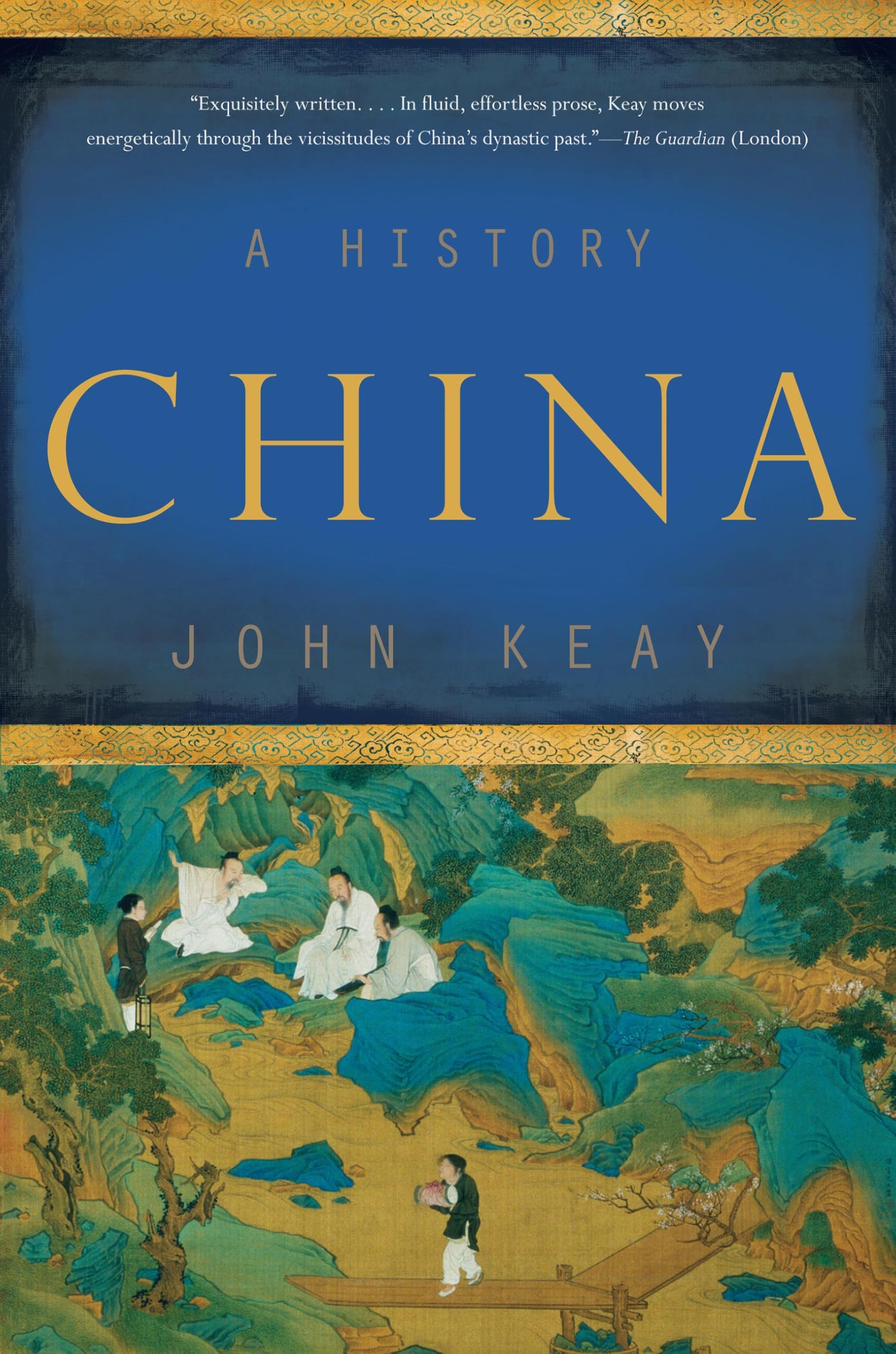

desertcart.com: China: A History: 9780465025183: Keay, John: Books Review: Good introduction - This introduction to Chinese history combines good information with relative brevity. It covers China from the very beginning to current times in a way that is complete yet readable. I come away from it feeling like I have learned enough to have some idea of who the Chinese are and what their core is. It's a fine start to understanding a complex people. Review: China: A History - Perspective of a Curious Layman - 'China: A History' is a dense and all-encompassing effort to capture the entirety of a long Chinese history in less than 600 pages. The author's writing style is pedantic, rigid, sophisticated, and overall meticulous with wordings, facts, and details. Some background: I've always been fascinated by China, but had little to no real understanding of the country. I knew of a couple provinces, and have heard of some of the dynasties, but that's about it. I can imagine that there's others who know little to nothing about China as well, who want to pick up a book and learn. This review is for these kinds of people. I'll start by saying that unfortunately it's not enough to pick up this book and read it from start to finish with the expectation that you will walk away with a pretty solid understanding of Chinese history. Like me, you will quickly be left behind. With that being said, the experience has to be more immersive and you can enjoy this text. That means researching things and getting summaries of what you had just read (or about to read, if you're keen on preparation). For example, it may help to look up a concise bullet-point summary of the Ming Dynasty before reading those chapters. For layman, and those without an eidetic memory, short summaries would have been extremely helpful. I often found myself page flipping when it came to referencing some of the time tables that the author included earlier in a chapter. Also, it's not too often that I have to look up so many words, but in this case I did. Many were items and objects that I had never heard of before. More imagery and explanations could have been helpful here, but it's not that big of a deal. I will give the author his due, as he had tried to prepare readers at the start of the text with some background on the Chinese language, naming customs, geography, and so forth. The more assiduous and less time-sensitive reader would best benefit in occasionally going back and re-reading the "prepatory" introduction. But to go from cover to cover, it just made it very difficult to synthesize that information and take it with you going forward. It's as if starting a journey through Mongolia, you were told orally where to go and all the turns to take, mountains to climb, rivers to cross; when instead you would have been better off just given a map to bring with you and follow. To fellow readers, take this chapter serious because the author will not hold your hand later on. Occasionally, reading the text felt like a drag. The author did have the enormously difficult task of condensing all of Chinese history into one volume. The undertaking could have allowed him to be more justifiably verbose. Interested, non-scholarly readers such as myself should feel a sense of gratitude that this wasn't the case. Though the author doesn’t often express personal views, some thoughtful reflections do appear toward the beginning and end of the book—and in those, you may find some gems of insight. With that, i'll end this review with the following beautifully written quote from the author: “Isolating the significant needs patience and perspective, commodities not available in the heat of the moment, then or now. As history’s stately march breaks into the trot of current affairs, then into the stampede of news stories, scholars are expected to swivel from the reconstruction of a reticent past to the deconstruction of a clamorous present. Hammered by reality, the historian turns annalist, turns journalist.”


| Best Sellers Rank | #70,420 in Books ( See Top 100 in Books ) #27 in Chinese History (Books) #47 in Asian Politics #62 in Japanese History (Books) |
| Customer Reviews | 4.4 4.4 out of 5 stars (972) |
| Dimensions | 6 x 1.63 x 9.25 inches |
| Edition | Illustrated |
| Grade level | 11 and up |
| ISBN-10 | 0465025188 |
| ISBN-13 | 978-0465025183 |
| Item Weight | 1.7 pounds |
| Language | English |
| Print length | 608 pages |
| Publication date | December 6, 2011 |
| Publisher | Basic Books |
| Reading age | 13 years and up |
R**R
Good introduction
This introduction to Chinese history combines good information with relative brevity. It covers China from the very beginning to current times in a way that is complete yet readable. I come away from it feeling like I have learned enough to have some idea of who the Chinese are and what their core is. It's a fine start to understanding a complex people.
M**N
China: A History - Perspective of a Curious Layman
'China: A History' is a dense and all-encompassing effort to capture the entirety of a long Chinese history in less than 600 pages. The author's writing style is pedantic, rigid, sophisticated, and overall meticulous with wordings, facts, and details. Some background: I've always been fascinated by China, but had little to no real understanding of the country. I knew of a couple provinces, and have heard of some of the dynasties, but that's about it. I can imagine that there's others who know little to nothing about China as well, who want to pick up a book and learn. This review is for these kinds of people. I'll start by saying that unfortunately it's not enough to pick up this book and read it from start to finish with the expectation that you will walk away with a pretty solid understanding of Chinese history. Like me, you will quickly be left behind. With that being said, the experience has to be more immersive and you can enjoy this text. That means researching things and getting summaries of what you had just read (or about to read, if you're keen on preparation). For example, it may help to look up a concise bullet-point summary of the Ming Dynasty before reading those chapters. For layman, and those without an eidetic memory, short summaries would have been extremely helpful. I often found myself page flipping when it came to referencing some of the time tables that the author included earlier in a chapter. Also, it's not too often that I have to look up so many words, but in this case I did. Many were items and objects that I had never heard of before. More imagery and explanations could have been helpful here, but it's not that big of a deal. I will give the author his due, as he had tried to prepare readers at the start of the text with some background on the Chinese language, naming customs, geography, and so forth. The more assiduous and less time-sensitive reader would best benefit in occasionally going back and re-reading the "prepatory" introduction. But to go from cover to cover, it just made it very difficult to synthesize that information and take it with you going forward. It's as if starting a journey through Mongolia, you were told orally where to go and all the turns to take, mountains to climb, rivers to cross; when instead you would have been better off just given a map to bring with you and follow. To fellow readers, take this chapter serious because the author will not hold your hand later on. Occasionally, reading the text felt like a drag. The author did have the enormously difficult task of condensing all of Chinese history into one volume. The undertaking could have allowed him to be more justifiably verbose. Interested, non-scholarly readers such as myself should feel a sense of gratitude that this wasn't the case. Though the author doesn’t often express personal views, some thoughtful reflections do appear toward the beginning and end of the book—and in those, you may find some gems of insight. With that, i'll end this review with the following beautifully written quote from the author: “Isolating the significant needs patience and perspective, commodities not available in the heat of the moment, then or now. As history’s stately march breaks into the trot of current affairs, then into the stampede of news stories, scholars are expected to swivel from the reconstruction of a reticent past to the deconstruction of a clamorous present. Hammered by reality, the historian turns annalist, turns journalist.”
J**H
If Only It Hadn’t Been So Boring!
That was quite possibly the longest, most boring book I have ever read. I love history and gobble it up whenever I can, but I’m telling you I don’t think my pulse ever quickened with excitement a single time as I read this. If such a thing as an exciting passage exists, here would be an example of it: Orders to disperse were ignored, and arresting the ringleaders failed to quell the tumult. The protesters now pounded on the throne-room door. They kept it up for much of the day until the emperor, his patience exhausted, ordered his fearsome Embroidered Guard to clear the area by force. No deaths resulted from this operation, but 134 men were taken into custody. All were then heavily sentenced, and of the thirty-seven who were awarded floggings, nineteen died under the lash. It was actually a rod. The offenders were stripped and made to lie on the ground, and the strokes were administered on their bare buttocks, the indignity being exceeded only by the pain, as blood flowed copiously. More likely though, you’ll find a passage that had opportunities to maybe be interesting, instead fizzle out like this, with no further elaboration: At Sanyuanli, a village north of Guangzhou, in May 1839 these irregulars gathered en masse after some of their women were violated by the invading troops; then, amid heavy rainstorms, they engaged and briefly repelled a force of Indo-British infantry, inflicting minor casualties. But the most typical type of experience you get from reading this book is reading paragraph after paragraph after paragraph like this: Other contemporary movements, such as the Red Turbans and the Triads, also opposed the Manchu Qing as alien usurpers; they wanted to set the clock back to 1644 and restore the Ming. But the Taipings opposed the Qing as the last in a long line of heretical alien dynasties; the clock should go back to AD 221. This chimed, as it were, with important strands in recent thought. Eighteenth-century scholars equally unreconciled to the Qing had blamed the failure of the indigenous Ming on the Neo-Confucianism of Zhu Xi (he of the ‘Four Books’ and the text-bound ‘investigation of all things’) or Wang Yangming (and his dangerously malleable ‘innate sense’ of what was right and humane). They too, therefore, had looked back to an earlier tradition and especially to the Han dynasty when the classic texts still retained a pristine quality uncorrupted by later editing. Practising what they called ‘evidential research’, these scholars brought to bear on the classics a more scientific approach in linguistics, geography and astronomy, and so restored a certain vitality to Confucian studies. Here’s an example of the book giving a surprise chuckle: In the process the Summer Palace, a fanciful Louvre designed for the Qianlong emperor by the Jesuits, was looted and burned. Though no great loss to architecture, it was a body blow to Qing prestige. The woman who reads the audiobook did a great job. She was fun to listen to. I still gave the book 5 stars because I mean, come on, how could you not? Every detail of Chinese history for the last 5000 years, no matter how uninteresting, seems to have been included. The truth is, it’s an excellent book. It’s just mind-numbingly boring.
Z**D
very thorough and informing
This was a very enjoyable journey through the history of china from quite ancient to near present day. A must read.
C**N
Un libro fascinante. Excelente libro
E**E
Het boek start veelbelovend, maar jammer genoeg zat het beschadigd in de verpakking... jammer van de kwaliteit.
L**Y
Enjoy reading it. Lots of contents about the lives of individuals and ordinary people. Not the usual history about emperors. Hope he has written more about the years between the end of West Han Dynasty and Tang Dynasty.
J**1
China from the prehistoric to the 20C. A long, slow read, academically well researched. Packed with intricate detail that is clearly explained for the benefit of the layperson. The author’s sense of humour saves it from becoming just a textbook.
A**R
Trustpilot
1 week ago
1 day ago