


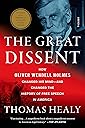
The Great Dissent: How Oliver Wendell Holmes Changed His Mind--and Changed the History of Free Speech in America
Product ID: 8961822
Desertcart purchases this item on your behalf and handles shipping, customs, and support to South Korea.
The Great Dissent: How Oliver Wendell Holmes Changed His Mind-and Changed the History of Free Speech in America [Healy, Thomas] on desertcart.com. *FREE* shipping on qualifying offers. The Great Dissent: How Oliver Wendell Holmes Changed His Mind-and Changed the History of Free Speech in America Review: Justice Holmes reconsiders the First Amendment - I think this is a valuable book for several reasons. First, I love to read books about Justice Holmes and this is a very good one. While there is nothing startlingly new about OWH here, for the reader less familiar with the Justice, this book is a good introduction--especially since the author relies heavily upon Holmes' published and unpublished letters. Second, the book educates us about the very beginnings of First Amendment theory and reminds us how far we have come in protecting free speech since Holmes confronted the issue back in 1919. I also think the book is interesting in that it focuses upon the various personal and professional influences brought to bear on Holmes that, the author suggested, persuaded him to issue his famous "Abrams" dissent which generated a whole line of important decisions protecting free speech. The book begins by recounting a meeting between Holmes and three of his colleagues in which they tried to persuade him, in the wake of World War I and the "Red Scare", not to published his draft dissent in Abrams. This is the only such meeting I can remember which has been discussed publicly; fortunately, it was not successful. Next, we learn about the state of First Amendment theory before Abrams, basically adopting the old Blackstone approach which did not allow prior restraint (i.e., before publication) but tolerated speech being punished after it had been published. Holmes seemingly held to this view; this book is the story of how he was persuaded to adopt a more aggressive position according speech greater protection. Some key personalities make welcome appearances: Justice Brandeis; Judge Learned Hand; Harold Laski; Herbert Croly; Zechariah Chafee; and Felix Frankfurter. The slow "lobbying" campaign engaged in by these folks, the author argues, eventually persuaded Holmes to assume a more aggressive position protecting speech. So we see how Holmes moved from Blackstone and automatic reliance upon jury findings of intent to "clear and present danger" and a bit beyond. This is vital history as regards the development of the first amendment. Particularly conservative attacks on Frankfurter and Laski teaching at Harvard, the author suggests, caused OWH to rethink his position on free speech. Which Holmes did in his own way by focusing upon John Stuart Mill and Adam Smith. It the author is correct in every regard or not, he has recreated the environment in which Holmes issued his influential Abrams dissent. This is a book for the non-lawyer as well as the legally trained. The author writers with clarity and effective organization. His research, reflected in extensive notes, has been exhaustive. A fine bibliography is included. Particularly helpful is an "Epilogue" which discusses later developments and what happened to some of the key players the author has discussed. We are still contesting the reach of the first amendment today, such as the protection it affords "commercial speech. This fine book takes us back to the beginning of this vital development. Review: History is Not What You Were Taught - For those of us who came of age in the seventies, free speech, especially to protest public policy, is a given. We never learned about the Sedition/Espionage Acts passed during World War One. It comes as a shock to discover that the mildest and most elliptical expression of opposition to that war brought severe punishment. It also comes as a shock to find out how much fear and hatred German and Russian immigrants engendered. The Germans were feared and hated because it was assumed that they might be loyal to their former country. The Russians because they might foment a Bolshevik revolt in this country. Anyone and anything that seemed to threaten the war effort was ruthlessly punished. And the end of the war didn't end the prosecution and punishment. So this book is an eye-opening discussion of a rather shameful period in which free speech as we know it today was an invitation to a jail sentence. What happened to change the legal philosophy about the rights American have to disagree vocally as well as in print w/ public policy is a fascinating subject. Mr Healy understands that many people don't understand the circumstances which lead to this change in philosophy and addresses this very well. I found this book to be thoughtful, well-researched, extremely well written and a book I can recommend to anyone. So why did I not give it five stars? I did not see the point of speculation about Justice Holmes's sexual life. It adds nothing to the book. It adds nothing to the topic of free speech. And it seemed petty and unnecessary to include the third-hand gossip on page 34. I expected better.
| Best Sellers Rank | #860,071 in Books ( See Top 100 in Books ) #275 in Lawyer & Judge Biographies #519 in Legal History (Books) #628 in General Constitutional Law |
| Customer Reviews | 4.6 4.6 out of 5 stars (244) |
| Dimensions | 6.19 x 0.85 x 9.21 inches |
| ISBN-10 | 1250058694 |
| ISBN-13 | 978-1250058690 |
| Item Weight | 13.6 ounces |
| Language | English |
| Print length | 352 pages |
| Publication date | September 9, 2014 |
| Publisher | Picador |
R**K
Justice Holmes reconsiders the First Amendment
I think this is a valuable book for several reasons. First, I love to read books about Justice Holmes and this is a very good one. While there is nothing startlingly new about OWH here, for the reader less familiar with the Justice, this book is a good introduction--especially since the author relies heavily upon Holmes' published and unpublished letters. Second, the book educates us about the very beginnings of First Amendment theory and reminds us how far we have come in protecting free speech since Holmes confronted the issue back in 1919. I also think the book is interesting in that it focuses upon the various personal and professional influences brought to bear on Holmes that, the author suggested, persuaded him to issue his famous "Abrams" dissent which generated a whole line of important decisions protecting free speech. The book begins by recounting a meeting between Holmes and three of his colleagues in which they tried to persuade him, in the wake of World War I and the "Red Scare", not to published his draft dissent in Abrams. This is the only such meeting I can remember which has been discussed publicly; fortunately, it was not successful. Next, we learn about the state of First Amendment theory before Abrams, basically adopting the old Blackstone approach which did not allow prior restraint (i.e., before publication) but tolerated speech being punished after it had been published. Holmes seemingly held to this view; this book is the story of how he was persuaded to adopt a more aggressive position according speech greater protection. Some key personalities make welcome appearances: Justice Brandeis; Judge Learned Hand; Harold Laski; Herbert Croly; Zechariah Chafee; and Felix Frankfurter. The slow "lobbying" campaign engaged in by these folks, the author argues, eventually persuaded Holmes to assume a more aggressive position protecting speech. So we see how Holmes moved from Blackstone and automatic reliance upon jury findings of intent to "clear and present danger" and a bit beyond. This is vital history as regards the development of the first amendment. Particularly conservative attacks on Frankfurter and Laski teaching at Harvard, the author suggests, caused OWH to rethink his position on free speech. Which Holmes did in his own way by focusing upon John Stuart Mill and Adam Smith. It the author is correct in every regard or not, he has recreated the environment in which Holmes issued his influential Abrams dissent. This is a book for the non-lawyer as well as the legally trained. The author writers with clarity and effective organization. His research, reflected in extensive notes, has been exhaustive. A fine bibliography is included. Particularly helpful is an "Epilogue" which discusses later developments and what happened to some of the key players the author has discussed. We are still contesting the reach of the first amendment today, such as the protection it affords "commercial speech. This fine book takes us back to the beginning of this vital development.
C**G
History is Not What You Were Taught
For those of us who came of age in the seventies, free speech, especially to protest public policy, is a given. We never learned about the Sedition/Espionage Acts passed during World War One. It comes as a shock to discover that the mildest and most elliptical expression of opposition to that war brought severe punishment. It also comes as a shock to find out how much fear and hatred German and Russian immigrants engendered. The Germans were feared and hated because it was assumed that they might be loyal to their former country. The Russians because they might foment a Bolshevik revolt in this country. Anyone and anything that seemed to threaten the war effort was ruthlessly punished. And the end of the war didn't end the prosecution and punishment. So this book is an eye-opening discussion of a rather shameful period in which free speech as we know it today was an invitation to a jail sentence. What happened to change the legal philosophy about the rights American have to disagree vocally as well as in print w/ public policy is a fascinating subject. Mr Healy understands that many people don't understand the circumstances which lead to this change in philosophy and addresses this very well. I found this book to be thoughtful, well-researched, extremely well written and a book I can recommend to anyone. So why did I not give it five stars? I did not see the point of speculation about Justice Holmes's sexual life. It adds nothing to the book. It adds nothing to the topic of free speech. And it seemed petty and unnecessary to include the third-hand gossip on page 34. I expected better.
R**O
A Change of Head & Heart
It was like a religious conversion—a softening of the heart, a profound altering of thought, a rechartering of course. For justice Oliver Wendell Holmes the conversion came late in life, at age 78. We are speaking about “Abrams v. United States” (1919), a Supreme Court decision involving free speech. Holmes’ dissenting opinion, the result of a significant changing of the mind, is the subject of this fascinating, inspiring and short (250 pages) book by Thomas Healy. Mr. Healy is a graduate of Columbia Law School and a professor of law at Seton Hall Law School, and judging by his prose remarkably free of “legalese.” His writing is clear, direct, and easily understandable. Abraham Lincoln would have approved. Justice Oliver Wendell Holmes was a brilliant and incisive thinker with a gift for coining memorable turns of a phrase in his Court opinions. “Clear and present danger” (from “Schenck v. United States”) is one of them. But he had an inflexible and stubborn streak, too. Civil libertarians were drawn to him because of his progressive dissenting opinions, but were appalled by his First Amendment views, which flew in the face of pluralism and political tolerance. In particular, the free speech cases involving the U.S. government—“Schenck,” “Frohwerk,” and “Debs”—Holmes ruled against the defendants by reasoning that their speeches threatened national security while the nation was at war. The Constitution was quite clear on the issue: “Congress shall make no law . . . abridging the freedom of speech.” But the Supreme Court itself had never ruled in favor of a free speech claim, and lower courts had approved all manner of speech restrictions, including the censorship of books and films, the prohibition of street corners speeches, and assorted bans on labor protests, profanity, even commercial advertising. Holmes was consistent in agreeing with these rulings. He was, after all, an advocate of judicial restraint—the idea that judges should defer to the judgment of elected officials. Enter three individuals determined to change Holmes’ mind: Learned Hand, a federal judge in New York; Harold Laski, an Englishmen and Harvard history professor; and Zechariah Chafee, a Harvard law professor. Over a period of eight months in 1919, they engaged Holmes in person and in letters with what amounted to a series of legal briefs in support of free and unfettered speech as a safeguard of democracy, yes, even in times of war. To support their arguments they quoted from progressive thinkers, notably John Milton and John Stuart Mill. Could their concerted efforts get past Holmes’ stubborn streak and touch his heart? Were their ideas convincing enough to change his mind? They didn’t know for sure until Holmes issued his dissenting opinion in “Abrams,” a case centered on five Russian Jews in New York who had issued leaflets condemning U.S. involvement in World War I. Did their leaflets threatened national security? Seven justices said they did. But Holmes, who was slated to write the Court’s opinion, changed his mind. He found nothing in their leaflets that advocated any violation of law or obstruction of war production, nothing that presented “a clear and present danger” even in time of war. “It is evident from the beginning to the end that the only object of the paper is to help Russia and stop American intervention there against popular government,” Holmes wrote, “not to impede the United States in the war that it was carrying on.” Their words didn’t “so imminently threaten immediate interference” with government’s lawful purpose or programs “that an immediate check is required to save the country.” Holmes then went on to get at the heart of the issue: “(W)hen men have realized that time has upset many fighting faiths, they may come to believe even more than they believe the very foundations of their own conduct that the ultimate good desired is better reached by the free trade in ideas—that the best test of truth is the power of the thought to get itself accepted in the competition of the market, and that truth is the only ground upon which their wishes safely can be carried out. That at any rate is the theory of our Constitution. It is an experiment, as all life is an experiment.” Further on he wrote: “While that experiment is part of our system I think we should be eternally vigilant against attempts to check the expression of opinions that we loathe and believe to be fraught with death, unless they so imminently threaten immediate interference with the lawful and pressing purpose of the law that an immediate check is required to save the country.” Except for Justice Louis Brandeis, who sided with Holmes, the other justices of the Court never embraced Holmes’ dissenting opinion. But as John Stuart Mill pointed out, opinions change. What passed for truth 1000 or even as recent as 100 years ago, can seem silly today. Supreme Court opinions, however "legal" and well-reasoned, are merely that--opinions. Like Holmes, the Court would undergo a change of opinion—in 50 years. In a 1969 case involving a Ku Klux Klan member who advocated violence against the civil rights movement, the Court held that advocacy of violence or unlawful conduct is protected by the First Amendment “except where such advocacy is directed to inciting or producing imminent lawless action and is likely to incite or produce such action.” This rule is a direct descendant of Holmes’ test and remains the governing standard today. “Holmes’ dissent in ‘Abrams’ marked not just a personal transformation but the start of a national transformation as well,” writes the author. “The power of his words and the force of his personality gave his opinions an authority far beyond the normal judicial dissent. Civil libertarians immediately embraced it as an article of faith, and Holmes’ tribute to the ‘free trade in ideas,’ along with his concept of ‘clear and present danger’ became not only cultural catchphrases but, in time, the law of the land. Indeed, it is no exaggeration to say that Holmes’ dissent—the most important minority opinion in American legal history—gave birth to the modern era of the First Amendment, in which the freedom to express oneself is our preeminent constitutional value and a defining national trait.”
A**R
Great Justice's Great Dissent's
D**D
C'est l'avènement du "free speech" sous la houlette de Holmes qui n'en vint pas tout seul, loin s'en faut, à changer d'avis pour livrer une conception inaugurale dont on connaît désormais la vitalité et le renom. Cet ouvrage retrace toute l'histoire de l'encadrement de la liberté d'expression et l'évolution personnelle du plus réputé magistrat US. Il s'achève sur le seuil de ce que nous les modernes en feront. Il marque l'inflexion majeure qu'à admis, non sans peine ni mal, la pensée normative de la Cour suprême sur la liberté la plus importante (en démocratie). Si vous lisez l'anglais et souhaitez lire un unique livre juridique : que ce soit celui-là ! Car la question de la liberté d'expression n'est pas un donné comme on peu le supposer, pour reprendre Gény, mais un construit. Et Healy divulgue ici les arcanes d'un cheminement laborieux qui n'était pas gagné d'avance.
G**U
Liked it.
Trustpilot
1 month ago
2 months ago