Buy anything from 5,000+ international stores. One checkout price. No surprise fees. Join 2M+ shoppers on Desertcart.
Desertcart purchases this item on your behalf and handles shipping, customs, and support to South Korea.
🔆 Power your future with precision — never miss a watt!
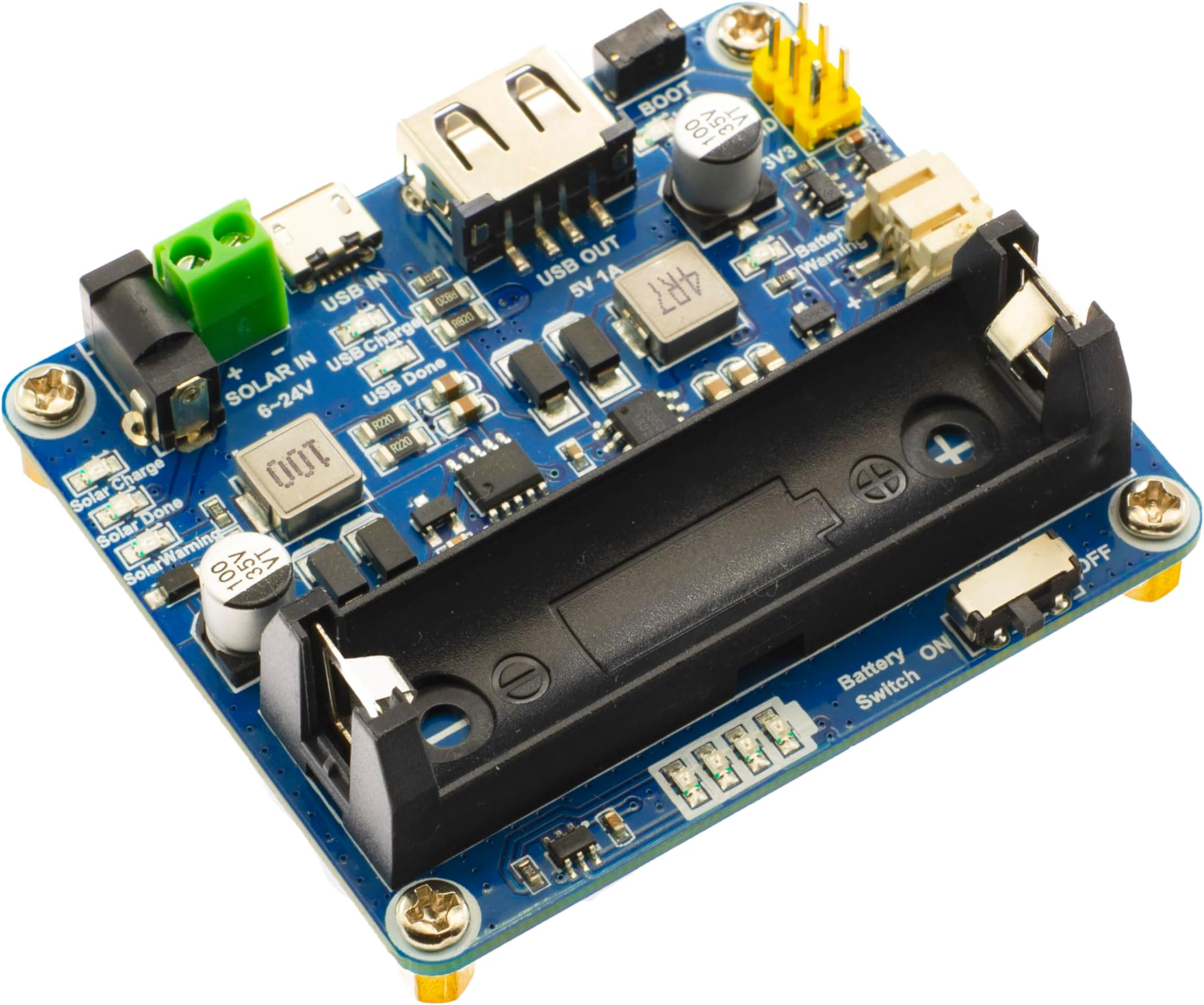
The Waveshare Solar Power Management Module is a compact, high-efficiency controller designed for 6V to 24V solar panels. Featuring MPPT technology, dual 5V outputs (USB and pinheader), and comprehensive multi-protection circuits, it ensures optimal battery charging and device powering with real-time LED status indicators. Ideal for low-power IoT and environmental projects, it delivers stable, ripple-free performance with versatile input options and robust safety features.
| ASIN | B07PBRK8KG |
| Best Sellers Rank | #181,954 in Patio, Lawn & Garden ( See Top 100 in Patio, Lawn & Garden ) #155 in Renewable Energy Controllers |
| Brand | waveshare |
| Brand Name | waveshare |
| Color | Blue |
| Customer Reviews | 4.2 out of 5 stars 85 Reviews |
| Display Type | LED |
| Item Dimensions L x W x H | 2.57"L x 2.21"W x 0.9"H |
| Item Weight | 0.17 Kilograms |
| Manufacturer | Waveshare |
| Material | Aluminum, Ceramic |
| Material Type | Aluminum,Ceramic |
| Model | Solar Power Manager (EN) |
| Part Number | Solar Power Manager (EN) |
| Product Dimensions | 2.57"L x 2.21"W x 0.9"H |
| Smart Home Compatibility | Not Smart Home Compatible |
| UPC | 614591448167 681413755550 682228908988 |
| Unit Count | 1.0 Count |
A**R
Nice unit for small solar projects
This unit seems to do it all. Manages the battery, solar panel and the load. I'm using this to operate moisture sensors out at my garden. The solar/battery are powering a Wemos D1 mini microcontroller over the usb connection which then transmits the data to a server. It has all the needed indicators to show the status of the solar and the battery. Although the on-board holder is for a different lithium battery, there is an independent connector that can be used to attach an 18650. In fact, it's pretty simple to remove the holder and replace it with a holder for an 18650. It would be slightly longer than the board, but could be attached using some double sided adhesive, making it self contained. Or, the 18650 can be mounted separately inside the same housing as the Solar Management module and the microcontroller, leaving only the external connections to the sensor and solar panel.
R**N
Does what it says
Use these for outdoor whatsits in the summer and attach panels. Works a treat. Wish it was an 18650 tho
A**R
versatile in and out put storage pc
versatile solar input; going to put a 250-350mAH 12v pv on it to keep its footprint small; reusing (have to reverse leads on connector) li-ion 2.77Wh icr14500 750mAh 3.7v from just dead just out of warranty Biolite personal solar lights (batteries are ok; charging circuit on all 5 never worked failed all withing 3 months of each other). may desolder battery holder and hotglue the 14500 in place; the connector is correct after reversing leads and plugs into socket on the pc board; first one charged using usb connector; output was ok to recharge other usb devices. Align on board jumpers to make close match to solar input.
I**S
6v-24v?
If it had a true 5v/1amp up-converter, it would have been nice. Would not push 5v @ 500mah with a 12v/900mah panel and 12v battery. Maybe a wiring schematic misprint. Still playing with them.
C**V
Very complete controller, yet still 1.0a charge rate
The details (and mfgr documents) are lacking on details of this charger. I'll fill in my observations that the mfgr left out. Notables: - The flexibility is nice, you can use most any voltage of panel with the dip switches on the bottom. - The solar input barrel jack isn't standard 5.5mm. Not sure what it is, but if you plan on using it you will need a male plug to fit. - Max charge rate: 1amp (yes, it is printed on the board). Remember this is charge rate at the battery, not at the panel. For example, if you are for some reason using a 24v panel, the panel would only supply about ~0.125a. (based on 3w) - Max recommended panel: no more than 5-10w. Any larger and the rest of power is wasted by MPPT regulation. - If this is placed in a sealed location, you will have to open it to hit the 'boot' button if it ever turns off. - Can direct solar power to device load. For example, if you have more than 1a incoming, the controller will regulate voltage so that only 1a is supplied to the charge circuit. If you have a device that uses 0.250mah @ 5v, it will down regulate voltage to supply 1a(battery) + 250mah(device). Practical example is this: I have a 10w "12v" solar panel with open circuit voltage is ~20v. That results in the panel voltage when charging w/o load at ~17-18.5v to supply ~2-2.5w of power to the battery. When I have a device connected that takes ~250mah, the controller will push the panel voltage down (voltage depends on battery charge state) to supply ~3.5-4w power to both battery and device. Not all controllers can do this. This minimizes power scrubbing through heat, and is a feature of MPPT chargers. The charge and management circuitry is more advanced, as mentioned above.. but I’m not sure the point and if it's a worthy trade-off for the size of the board or the charge rate. You can find smaller PWM based that can charge up your little lithium IoT battery just as well. Basically, too many 'features' for such a small use-case. With the 1a charge rate, the device(s) you will hook up will need to be low-powered(500mAh or below). The charge rate is prohibitive for a larger battery and device unless you plan on massive reserve power to be slow charged over multiple days. In this case you'd need an even less power hungry device so that you can make up for cloudy days. The Take-Away: While flexibility in panel voltage is nice, the charger is really only good for small IoT devices with the 1a charge rate. Using a higher voltage panel is negated by not being able to use it's strength of higher power output. If they were to up the charge rate to 2a it would have a much wider use case. Multiple devices for example. With 1a, they are competing with other charge boards that are smaller but do the exact same thing in the end. Perhaps it’s possible to change a resistor for a higher charge rate if it's worth your time. But Waveshare should up the charge rate or publish how to do this to differentiate the product. It’s very interesting, and a very complete charge unit, but the completeness is lost w/o being able to use the power to charge or supply something greater than 1a.
S**T
Great backup for low voltage microcontrollers.
It's not difficult to find a battery to fit in the main chamber. 3.7v. but it also has a secondary battery connection for a wired 3.7v battery, doubling the life. The options for multiple solar hookups is convenient, and the ability to switch the power intake for solar is convenient. There's indicator LEDs for charging, overcharge warning LEDs, and can outboard into a third battery via USB. The pins are extremely convenient for direct connection to VIN/G on Arduino. Highly recommend.
R**A
Maybe I got a faulty module…
Barely pulls power from 6v 6w solar panel that’s directly facing the sun. The solar charger from the WisBlock charges way better than the Waveshare. The module micro USB charger (input) works great, as well as the USB A output charger.
S**G
works as designed
use it for my solar mesh repeater and it has been working great!
Trustpilot
2 weeks ago
2 weeks ago