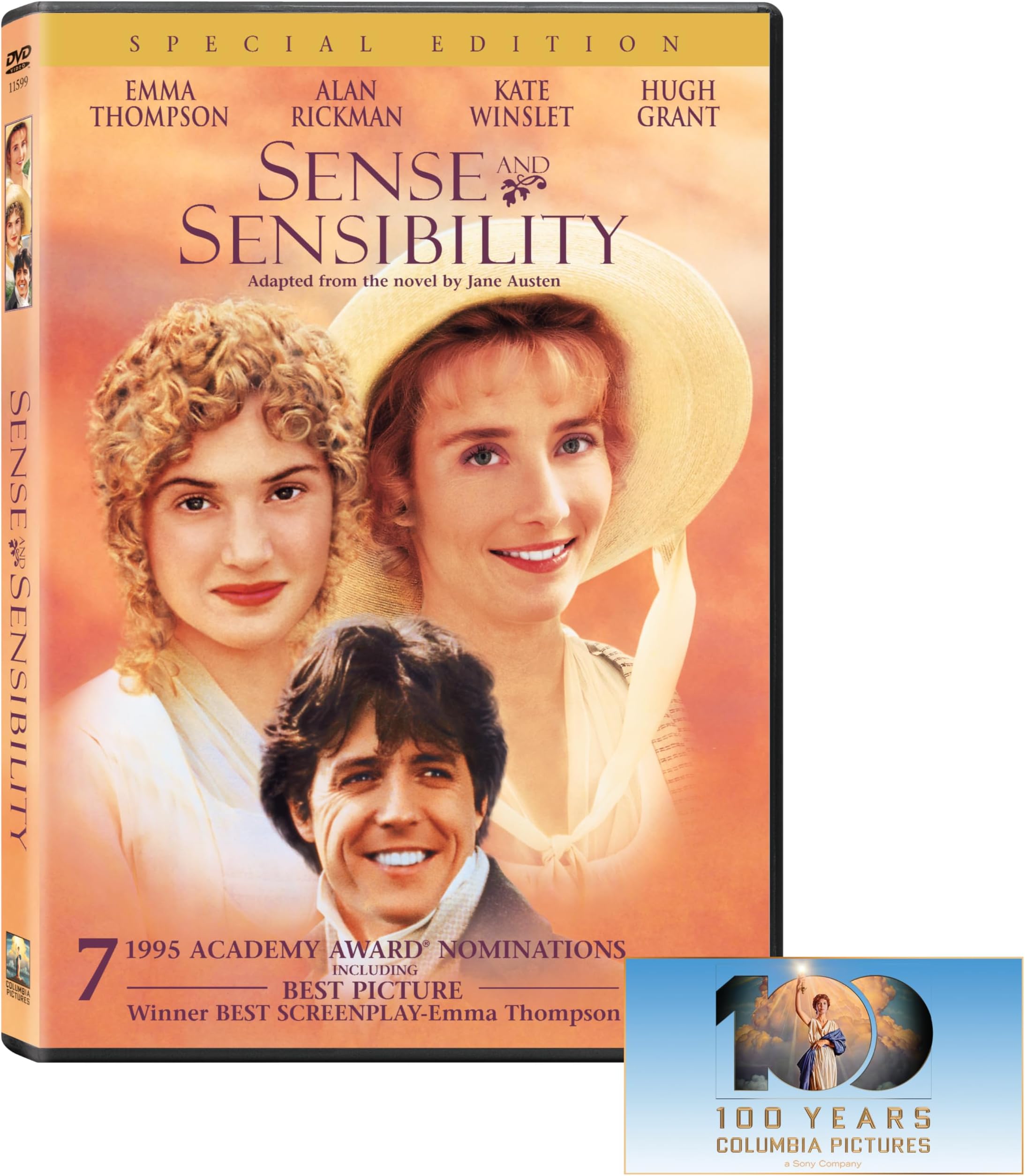

Emma Thompson stars in the captivating romance based on Jane Austen's classic novel of two sisters' search for love amid the strict rules of society. Review: English Romance At Its Finest - Jane Austen is a fine writer, but her wordiness tends to drain the life from many of her characters. Thankfully, Emma Thompson recognized the limitations of the novel and adapted her screenplay accordingly, enhancing the humor of the original story and heightening drama to make the film more captivating. A cast was then chosen, made up of very talented thespians, including Miss Thompson herself. Add to that splendid English landscapes, excellent directing, haunting music, and superb cinematography, and what emerges is a modern masterpiece. This is no movie for action fans; it is far too cerebral and requires a serious attention span. For those who enjoy a good love story well told, this film delivers. The characters are three-dimensional and their dilemmas full of human drama, bound as they are by the morals and manners of the times. Three sisters and their mother are left virtually penniless by the stricture against females inheriting property then in place in English law. The half-brother to the Dashwood women receives it all, but his selfish wife talks him out of helping his stepmother and half-sisters. It is up to the two older girls---sensible Elinor and passionate Marianne---to seek their fortunes in romance while lacking a dowry to help them. Elinor finds her soulmate in shy, retiring Edward Ferrars, brother of the selfish sister-in-law, a man lacking in the usual Victorian ambitions. Her budding romance is shelved when his sister makes it clear that Elinor is "unsuitable" for Edward. The sisters and their mother then go to stay in a cottage owned by a kindly relative, Sir John, and his mother-in-law, the irrepressible Mrs. Jennings. The old woman is a confirmed gossip and matchmaker, bound to see one of the two sisters hitched up to Colonel Brandon, the most eligible bachelor in the area. Brandon first sees Marianne singing a melancholy song and is incurably smitten. She in turn loses her heart to a dashing young man named Willoughby, who is her ideal of a Victorian-era gentleman, complete with a pocket book of sonnets. Brandon, who loves her more than his own happiness, steps aside and even encourages their relationship, despite his dislike for the handsome rogue. Things take an unexpected turn for the worse for both sisters---Willoughby abruptly drops Marianne and flees to London with no explanation and Elinor discovers that Edward is engaged to a shallow young woman named Lucy Steele. The ensuing twists and turns in the plot make this film both agonizing and entertaining to watch. Mercifully, everyone winds up happy at the end wedded to the right person. The whole film is solidly done, but it is the acting that really shines. Thompson is perfect for the role of the calmer sister, while Winslett is brilliant as the mercurial Marianne. Grant is endearing as the gentle Edward; Rickman finally gets to display his considerable ability to act the part of a very good and unselfish man. The rest of the cast keeps pace with the leads, and Hugh Laurie is indescribably funny as the sarcastic Mr. Palmer. One very beautiful aspect of this movie, along with the tendency to get drawn into the story, is the evocative musical score that tugs at the heartstrings. All in all, this is a wonderful example of a film genre that is so often overlooked in today's world---period romance. More movies like this one desperately need to be produced. Buy this one today because it's a gem, perfect for an afternoon of inclement weather with your own soulmate. Review: A riveting portrait of human relationships & a telling social commentary - I have watched this adaptation of Jane Austen's Sense & Sensibility more than a dozen times since it was released, and it never fails to enthrall me. It has everything one would expect of a classic movie - a good plot[ thanks in large part to Emma Thompson's excellent screenplay], stellar casting, gorgeous sets, costumes and lush scenery of the entrancing English countryside. The story of Sense & Sensibility is at heart a warm and insightful portrait of two sisters and their relationship to each other, as well as their romantic interests and a powerful social commentary of society in regency England. Those who are familiar with Jane Austen's works will appreciate how perceptive an observer she was of society at large and remarkable in her capability to capture powerful human emotions on paper. The plot of Sense & Sensibility the movie revolves around the Dashwood sisters, Elinor & Marianne, who upon the death of their beloved father are forced to move [together with their mother and younger sister] to a cottage in the English countryside and live on a paltry 500 pounds a year [due to English law at the time where property passes down through the male line]. Elinor [played excellently by the talented Emma Thompson] is the older, and more wise [sensible] sister, who tries not to let her emotions rule her, in direct contrast to her younger, feisty sister Marianne [a gorgeous English rose, Kate Winslet] who is passionate, outspoken and open in displaying her emotions. Elinor falls for Edward Ferrars [an awkward yet deferential & handsome Hugh Grant] who due to a youthful indiscretion is unable to follow through on his attachment to Elinor. Marianne, on the other hand falls hard for dashing rogue Willoughby [Greg Wise], ignoring propriety and openly displaying her affections. The rest of the story deals with how the Dashwood sisters resolve their plight, and the story is made even more compelling by the other characters, who may be deemed minor roles, certainly add to the depth of the storytelling - Colonel Brandon, a retired officer, who though much older, harbors a deep affection for Marianne [played by pre-Severus Snape Alan Rickman], the callous sis-in-law Fanny Dashwood [Harriet Waller], the scheming Lucy Steele [Imogen Stubbs]and numerous other characters, who though secondary to the plot, are certainly memorable. Taiwanese director Ang Lee [of Eat Drink, Man Woman & Wedding Banquet fame] certainly proves his mettle here and manages to flesh out amazing performances from his cast, and delivers a gem of a movie, and a true classic.

| Customer Reviews | 4.8 out of 5 stars 3,076 Reviews |
D**X
English Romance At Its Finest
Jane Austen is a fine writer, but her wordiness tends to drain the life from many of her characters. Thankfully, Emma Thompson recognized the limitations of the novel and adapted her screenplay accordingly, enhancing the humor of the original story and heightening drama to make the film more captivating. A cast was then chosen, made up of very talented thespians, including Miss Thompson herself. Add to that splendid English landscapes, excellent directing, haunting music, and superb cinematography, and what emerges is a modern masterpiece. This is no movie for action fans; it is far too cerebral and requires a serious attention span. For those who enjoy a good love story well told, this film delivers. The characters are three-dimensional and their dilemmas full of human drama, bound as they are by the morals and manners of the times. Three sisters and their mother are left virtually penniless by the stricture against females inheriting property then in place in English law. The half-brother to the Dashwood women receives it all, but his selfish wife talks him out of helping his stepmother and half-sisters. It is up to the two older girls---sensible Elinor and passionate Marianne---to seek their fortunes in romance while lacking a dowry to help them. Elinor finds her soulmate in shy, retiring Edward Ferrars, brother of the selfish sister-in-law, a man lacking in the usual Victorian ambitions. Her budding romance is shelved when his sister makes it clear that Elinor is "unsuitable" for Edward. The sisters and their mother then go to stay in a cottage owned by a kindly relative, Sir John, and his mother-in-law, the irrepressible Mrs. Jennings. The old woman is a confirmed gossip and matchmaker, bound to see one of the two sisters hitched up to Colonel Brandon, the most eligible bachelor in the area. Brandon first sees Marianne singing a melancholy song and is incurably smitten. She in turn loses her heart to a dashing young man named Willoughby, who is her ideal of a Victorian-era gentleman, complete with a pocket book of sonnets. Brandon, who loves her more than his own happiness, steps aside and even encourages their relationship, despite his dislike for the handsome rogue. Things take an unexpected turn for the worse for both sisters---Willoughby abruptly drops Marianne and flees to London with no explanation and Elinor discovers that Edward is engaged to a shallow young woman named Lucy Steele. The ensuing twists and turns in the plot make this film both agonizing and entertaining to watch. Mercifully, everyone winds up happy at the end wedded to the right person. The whole film is solidly done, but it is the acting that really shines. Thompson is perfect for the role of the calmer sister, while Winslett is brilliant as the mercurial Marianne. Grant is endearing as the gentle Edward; Rickman finally gets to display his considerable ability to act the part of a very good and unselfish man. The rest of the cast keeps pace with the leads, and Hugh Laurie is indescribably funny as the sarcastic Mr. Palmer. One very beautiful aspect of this movie, along with the tendency to get drawn into the story, is the evocative musical score that tugs at the heartstrings. All in all, this is a wonderful example of a film genre that is so often overlooked in today's world---period romance. More movies like this one desperately need to be produced. Buy this one today because it's a gem, perfect for an afternoon of inclement weather with your own soulmate.
Z**S
A riveting portrait of human relationships & a telling social commentary
I have watched this adaptation of Jane Austen's Sense & Sensibility more than a dozen times since it was released, and it never fails to enthrall me. It has everything one would expect of a classic movie - a good plot[ thanks in large part to Emma Thompson's excellent screenplay], stellar casting, gorgeous sets, costumes and lush scenery of the entrancing English countryside. The story of Sense & Sensibility is at heart a warm and insightful portrait of two sisters and their relationship to each other, as well as their romantic interests and a powerful social commentary of society in regency England. Those who are familiar with Jane Austen's works will appreciate how perceptive an observer she was of society at large and remarkable in her capability to capture powerful human emotions on paper. The plot of Sense & Sensibility the movie revolves around the Dashwood sisters, Elinor & Marianne, who upon the death of their beloved father are forced to move [together with their mother and younger sister] to a cottage in the English countryside and live on a paltry 500 pounds a year [due to English law at the time where property passes down through the male line]. Elinor [played excellently by the talented Emma Thompson] is the older, and more wise [sensible] sister, who tries not to let her emotions rule her, in direct contrast to her younger, feisty sister Marianne [a gorgeous English rose, Kate Winslet] who is passionate, outspoken and open in displaying her emotions. Elinor falls for Edward Ferrars [an awkward yet deferential & handsome Hugh Grant] who due to a youthful indiscretion is unable to follow through on his attachment to Elinor. Marianne, on the other hand falls hard for dashing rogue Willoughby [Greg Wise], ignoring propriety and openly displaying her affections. The rest of the story deals with how the Dashwood sisters resolve their plight, and the story is made even more compelling by the other characters, who may be deemed minor roles, certainly add to the depth of the storytelling - Colonel Brandon, a retired officer, who though much older, harbors a deep affection for Marianne [played by pre-Severus Snape Alan Rickman], the callous sis-in-law Fanny Dashwood [Harriet Waller], the scheming Lucy Steele [Imogen Stubbs]and numerous other characters, who though secondary to the plot, are certainly memorable. Taiwanese director Ang Lee [of Eat Drink, Man Woman & Wedding Banquet fame] certainly proves his mettle here and manages to flesh out amazing performances from his cast, and delivers a gem of a movie, and a true classic.
C**N
A perfect adaptation of a novel to the screen
This is the story of three sisters (two of marriageable age) and their mother who find themselves suffering a reversal of fortune. At the death of their father, their half-brother and his wife turn them out (in the most polite way, of course!) to make their own way on a paltry saving. The sisters proceed to fall in love and the story is of the trials and tribulations of those relationships, set in late 18th century England. Sense and Sensibility is normally regarded as one of Austin's weaker efforts, but it's still highly entertaining. This film is entirely faithful to the original story, yet rearranged and adapted in a fresh and fun way. Emma Thompson does double-duty as the screenwriter and as the main character, Elinor (the sister with "sense"). The cast is impeccably chosen, from Kate Winslet as the "sensibility" sister Marianne (no one does spoiled impetuousity better) and Hugh Grant as Elinor's suitor (no one does shy romantic better) to the lesser known actors. Those who only know Alan Rickman as hammy bad-guys in Die Hard and Robin Hood will be pleasantly surprised by his range of talents. Ang Lee lends a sure hand in direction, similar to his work in Eat Drink Man Woman. The movie looks good. Thompson's screenplay is entirely faithful to the book in spirit, while introducing a great many changes. Elinor, as played by Thompson, is obviously not 19 years old, Hugh Grant is not "plain," and several characters are dropped completely, such as Lucy Steele's sister. In addition, the dialogue is heavily rearranged and edited, scenes are added that don't appear in the book, etc. In spite of this, the film is probably the truest adaptation I have ever seen in a 2-hour studio film. The new scenes and additional dialogue are generally adapted from Austin's editorial comments, and so are "true" to the original story, even if they aren't explicitly in the novel as filmed. The DVD has a few extras, including an audio commentary and deleted scenes. Oddly, there are only two deleted scenes included, although many more are mentioned in the commentary as being filmed and then being cut. I, for one, would like to see the duel between Col. Brandon and Willoughby, but alas, it is not included. Thus, the DVD is pretty humdrum, except for the fact that it looks very good. I think Lee's films should always be seen in widescreen, as the setting is important to many of his shots. Therefore, this disc gets 5/5 on the strength of the film itself, with little value added from the DVD extras.
W**2
One of the most perfect movies of all time
Even though this version does not follow the book precisely, it is my favorite of all of the Jane Austen movies. Alan Rickman's performance is a tour de force. Emma Thompson and Kate Winslet are also amazing, as is Hugh Grant. The soundtrack is so gorgeous. It's such a satisfying ending as well, but all Jane Austen books have happy endings, even though they seem impossible to end happily. The casting is so spot on that I can hardly describe it. I can't think of anyone else playing Colonel Brandon, or Elinor, especially. I have seen other versions, and they pale in comparison. This has been one of my favorite movies since the first time I saw it almost 30 years ago. And, by the way, Emma Thompson wrote the script and won best screenplay for it.
D**R
Bewitched Mind, Ensnared Sense and Sensibility
After having had my mind bewitched and my senses ensnared by Alan Rickman after watching him in the Harry Potter movies I started looking up Rickman clips on YouTube and then I decided that I needed my own collection of Alan Rickman movies. Sense and Sensibility is the first AR film I've purchased. It is glorious and beautiful and most likely the most perfect example of a Rickman movie, save for Harry Potter. The whole movie is wonderful and I've watched it several times already. Emma Thompson and Ang Lee did everything so perfectly that I cannot find fault with this movie. It is everything a romantic English drama should be and all of the actors were perfectly cast. Of course my favorite is Alan Rickman, but I loved the chemistry and dynamics between all of the principals. Hugh Grant is really sweet and gorgeous in this movie too and Emma Thompson is beyond reproach. Probably the best scene in this movie is at the end between Emma Thompson and Hugh Grant, but I won't describe it just in case you have not yet seen this movie. It was awesome and it made me cry. Kate Winslet was great too, although her character is kind of a pain in the neck. This film is what a great romantic story is all about, unlike Titanic in which I thought the script and the dialogue were ridiculous and dreadful and there was a total lack of chemistry between Kate Winslet and Leo DiCaprio, which is too bad, because Winslet is a fabulous actor. Now for the question all us romantics have asked ourselves: Why would anyone choose Willoughby over Alan Rickman??? Here's another thought for all the Harry Potter fans. Wouldn't it be great to see a whole movie about Severus Snape in heaven with Lily, played by Kate Winslet?
L**N
Great movie!
Good movie good quality disc. My favorite movie!
J**F
One of the finest Austen adaptations on film.
“Sense and Sensibility” (1995) is one of the best film adaptations of Jane Austen, well scripted, well directed and well acted. But superficially at least, it had all the makings of a potential disaster. It was the idea of producer Lindsay Doran, who had developed a love for Austen and particularly this novel when she lived in England in the early 1970s. An Austen adaptation had not been filmed since 1940’s “Pride and Prejudice” and there was no current vogue for the author. I suspect her just being hired as a new producer at Sidney Pollack’s independent production company, Mirage Enterprises enabled its greenlighting. The screenplay was entrusted to an actress who had never written a screenplay. The chosen director had never heard of Jane Austen and his three films had been about Chinese and Chinese-American life and filmed mostly in the Chinese language. Fortunately the screenwriter was Emma Thompson, who was able to bridge the actor-screenwriter divide and create a script true to Austen’s world while making the usual adjustments that translation to the time limit of films demands. It took over four years to write it. She remains the only person ever to win an Academy Award in both writing and acting categories, the acting award being for “Howard’s End”. Choosing Ang Lee was taking a bigger chance, but Doran and Thompson saw understanding of family life and both warmth and humor in his films and hired him. Austen had a great sense of humor about her society and I think it was important that both the producer and screenwriter had begun in comedy and would not have allowed a stiff, humorless adaptation. The film has the usual demands that any Austen film makes. There are many characters, often related to each other and these relationships need to be understood to understand fully, what’s going on. Fortunately here, there are but five primary characters with the rest more peripheral but still affecting the plot in important ways. The two Dashwood sisters, Elinor (Emma Thompson) and Marianne (Kate Winslet), represent sense and sensibility. Though seemingly interchangeable now, the latter term meant a prizing of emotion and feelings over rationality. In this way it was the early stirrings of Romanticism, which would become full blown by the 1820s. Austen was suspicious of sensibility and here illustrates how it often leads to problems. Thompson had to be convinced to play Elinor, who is only nineteen in the novel, but I think the wisdom of her character would have seemed odd coming from an appropriately aged actress and suits Thomson perfectly. This was only Winslet’s second film, but her Marianne is just right. Thompson and Winslet play the Dashwoods similarly enough to be sisters and their differences in temperament enough to be unalike, but not so much as to become characures. At a certain moment, Elinore shows Marianne that she feels things as deeply as she, but understands the need for rules of conduct. (The third sister, a child, appears only rarely). The three male leads each woo the sisters to one degree or another. Hugh Grant had recently broken out internationally in “Four Weddings and a Funeral” and further developed his handsome and charming but reticent and occasionally stammering character here as Edward Ferrars. Edward instantly understands the seriousness of the Dashwood’s situation and is compassionate. He makes a good impression despite being absent from the screen for long stretches. Alan Rickman had been wanting to break away from the villainous roles in which he had been typecast since “Die Hard” and succeeded in creating a devoted, honorable man in Colonel Brandon. Greg Wise plays John Willoughby, an uncommonly handsome fellow who drives a fast carriage and carries a pocket volume of Shakespeare’s Sonnets on him at all times, the very portrait of a Romantic hero. Actor Greg Wise is perfect for the part (and also began a relationship with Thompson that resulted in their long marriage). Most of the supporting characters are done for comic effect, especially Mrs. Jennings (Elizabeth Spriggs) who with her son in law, Sir John Middleton (Robert Hardy) are the gossips and matchmakers of Devonshire. Harriet Walter is absolutely wicked in her snobbishness as Fanny Dashwood but hilarious when she receives a sudden shock. If you’re at all inclined, Jane Austen’s characters can be looked up online and I’m certain it would help sort them out and make it a more valuable experience, but be careful, some of them delve into the plot too much. The second problem is in understanding the intricacies of the Regency Period legal system. Austen wasn’t writing just comedies of manners but had a serious purpose in describing the effects of the legal system, especially on women. It’s virtually the theme of “Sense and Sensibility” where everyone is very subject to it. I can’t do justice to it here so here are the briefest points. Inheritance law generally bestowed a large estate on the eldest male heir. Even his younger brothers had to do with minor sums of money and often went into the military or clergy. This was a strong custom but could be overruled (think of Lady Catherine de Bourgh in “Pride and Prejudice”) but that was a rare thing. Women could inherit money as Emma Woodhouse had, making her much more independent than the usual Austen heroine. This is what makes Austen so serious. At any given time a chasm could open up under anyone due to the laws of inheritance. Such a situation happens here where the female Dashwoods lose Norland Park, the very epitome of an English Estate and are fortunate to get use of a cottage from a distant relation. Mrs. Dashwood (Gemma Jones) was his second wife and his father had made his will to keep the estate in the male line by allowing Mr. Dashwood the use but not the ownership of the estate; he died before he could make much of this. (This is the first scene in the film so I’m not really giving anything away). It could almost be as bad on the men. Both Edward Ferrars and John Willoughby find themselves unable to do as they would really wish due to these laws and customs. Having an “Understanding” is also an important thing here. In this case it means an actual proposal of marriage, not an assumption. A proposal had legal standing and the force of law and breaking it could lead to scandal and a breach of promise lawsuit. Back to the film, at last. The film is shot in cool colors, often soft greens and grays, which help ground it in reality. A temptation would be to make it too pretty with storybook colors - which actually worked in Emma (1996) but that was done purely as a light comedy. Here the cool tones make everything very real looking, emphasizing that the consequences at stake here are serious. The clothing is perfect for the period, even the country dresses at the London ball. It has always perplexed me that women were so wise to throw away all those confining eighteenth century hairstyles and dresses and were finally comfortable, only to throw it away not long after for corsets and framework. The music is by Patrick Doyle, who had scored some of Kenneth Branagh’s films and is a good and never overwhelming accompaniment to the film. He wrote his own music entirely for the film, even the songs and dance music, where most film composers would have used actual music of the day, perhaps from “The Apollonian Harmony” or John Playford’s “The English Dancing Master”. But, likely as a challenge, he wrote convincing period music. This fills the first part of the film, but from Elinor and Marianne’s serious discussion onward, the music becomes Romantic influenced film score music. Overall this film wins on every count and ends just as Austen’s did (though it seems a bit tacked on here because there simply wasn’t time to add more development). Even if you are not an Austen fan the film is easy enough to understand and dramatically paced enough to make its two hours move quickly. The DVD is rather deluxe with audio commentary by director Ang Lee and Emma Thompson, deleted scenes and trailers.
S**R
Jane Austin Classic...
We really enjoyed watching this version of the movie, "Sense & Sensibility". The actors did a great job and brought the story to life. Grab some popcorn and enjoy!
E**H
I love this more every time I watch it
I'm a Jane Austen fan, and this is turning into my favourite film of all time. It is beautifully cast, and delivered, bringing the original book to full life, but showing a detailed and sensitive understanding of the original text, so that the result is both true and impacting. I didn't understand why this book was Jane Austen's favourite before owning this film. Now I can see it is about second chances at love, that seemed like second choices to me before - like settling, and compromising, which was sad - but they don't seem so now. Alan Rickman, Kate Winslett, and Emma Thompson play their parts perfectly, and their work is deeply touching in all the right places.
A**S
Absicht?
Für Kauf-DVDs gibt es Regionalcodes. Für Europa ist es die 2. Die gesendete DVD hat Code 1,3,4 und kann in Deutschland nicht abgespielt werden. Man müsste ein Rip-Verfahren anwenden, was aber illegal ist.
C**N
Great movie, I'll never get tired of re-watching it.
It's one of my most favourite movies. It was great 15 years ago, and it is same wonderful now.
T**C
Still wonderful upon repeated viewing
I wanted to watch it again after Alan Rickman died. I loved it even more on repeat viewing--noticed a few things I'd missed, like Hugh Laurie looking at Emma Thompson as it became clear to him what life would be like with a woman who was the complete opposite of his silly wife. Also noteworthy was Alan Rickman's grin and uniform in the wedding scene: suddenly he showed himself as the military man he was and instantly turned into a romantic hero, conjuring up all the girls who were a pushover for those soldiers in red coats. In other words, I approve of the director's modifications and additions to the original story, including the fleshing out Edward Ferrars' character by his interaction with Eleanor's and Marianne's little sister, who was invisible in the novel. Hugh Grant playing against type was marvelous. But the heart and soul of it were the fine performances by Emma Thompson and Kate Winslet.
M**N
not compatible with my dvd player
Despite the blurb stating that this DVD was compatible for UK and Europe, my DVD player rejected it as incompatible. I love this film. It's a shame I can't watch it!
Trustpilot
1 week ago
3 weeks ago