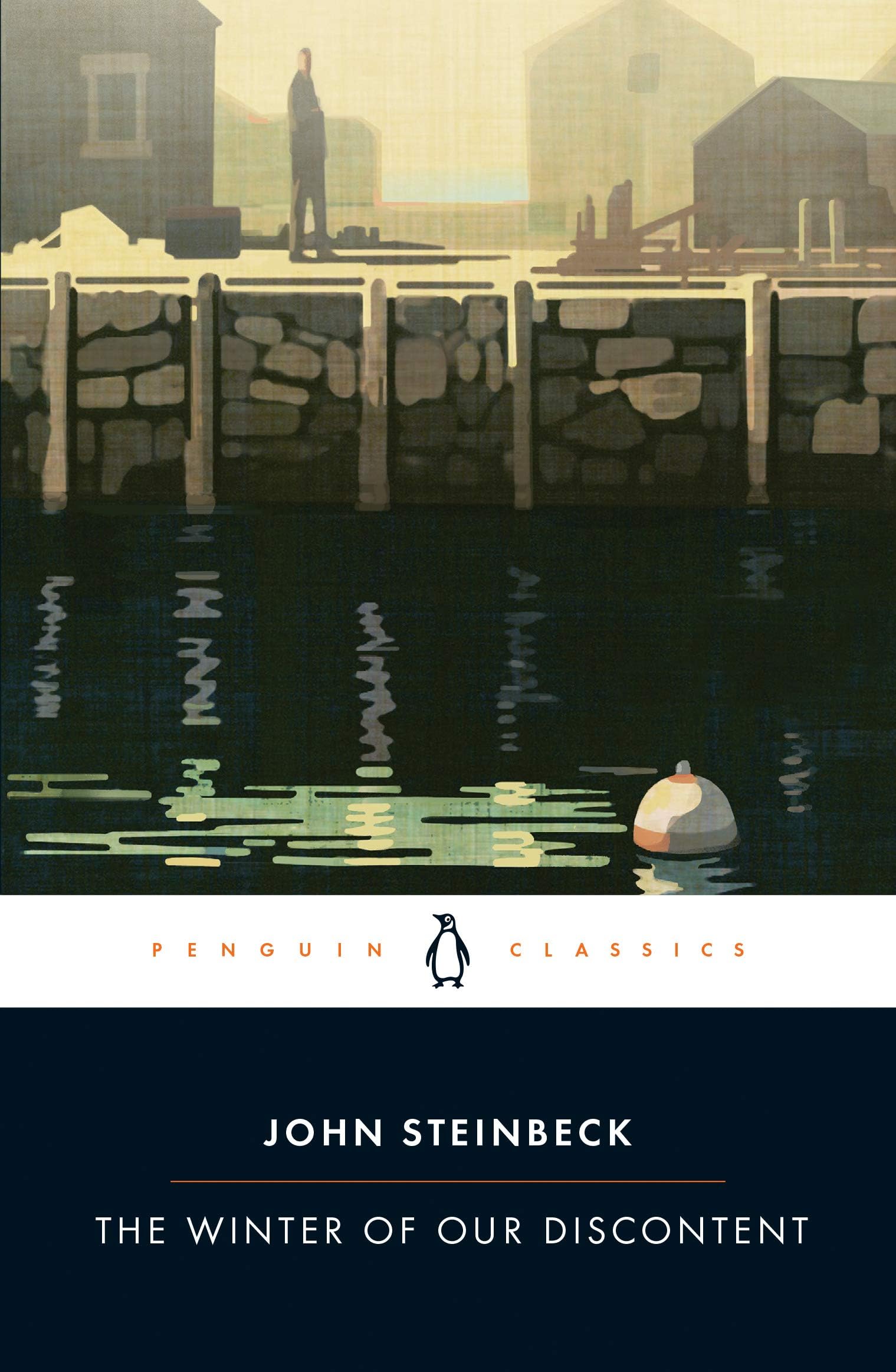
The Winter of Our Discontent (Penguin Classics)
Product ID: 128967836
The final novel of one of America’s most beloved writers—a tale of degeneration, corruption, and spiritual crisis A Penguin Classic In awarding John Steinbeck the 1962 Nobel Prize in Literature, the Nobel committee stated that with The Winter of Our Discontent , he had “resumed his position as an independent expounder of the truth, with an unbiased instinct for what is genuinely American.” Ethan Allen Hawley, the protagonist of Steinbeck’s last novel, works as a clerk in a grocery store that his family once owned. With Ethan no longer a member of Long Island’s aristocratic class, his wife is restless, and his teenage children are hungry for the tantalizing material comforts he cannot provide. Then one day, in a moment of moral crisis, Ethan decides to take a holiday from his own scrupulous standards. Set in Steinbeck’s contemporary 1960 America, the novel explores the tenuous line between private and public honesty, and today ranks alongside his most acclaimed works of penetrating insight into the American condition. This Penguin Classics edition features an introduction and notes by leading Steinbeck scholar Susan Shillinglaw. For more than seventy years, Penguin has been the leading publisher of classic literature in the English-speaking world. With more than 1,700 titles, Penguin Classics represents a global bookshelf of the best works throughout history and across genres and disciplines. Readers trust the series to provide authoritative texts enhanced by introductions and notes by distinguished scholars and contemporary authors, as well as up-to-date translations by award-winning translators. Review: A conflict without resolution - I have read most of Steinbeck’s novels and this is, without a doubt, one of my favorites. It is bleak, but so is the world today at many levels. What I like most, however, is the literary honesty of not attempting to reconcile the conflicting narratives of who we are and who we want to be (or pretend to be). It is noted in the introduction that Carlos Baker’s review for “The New York Times” noted with dissatisfaction that “This is a problem novel whose central problem is never fully solved, an internal conflict novel in which the central issue between nobility and expediency, while it is joined, is never satisfactorily resolved.” Expediency, you will find, is really a euphemism for immorality and dishonesty. Not the immorality that rises to the level of murder perhaps, but a willingness to bend the rules of fairness and personal obligation to society at large in the interest of naked self-interest. The whole point of the novel, as I read it, is that the conflict between nobility and the pursuit of self-interest at any cost can never be resolved. Or will never, depending on the generosity of your judgment. And history has certainly proven that to be true. The New Baytown of 1960 lives on today, the only difference being that no one today is making any attempt to hide the conflict. Self-interest is no longer to be suspected or hidden, it is to be celebrated as the most noble of human attributes. Certainly it is to be worn on the sleeve as a badge of strength, ingenuity, and cunning. As the author himself notes prior to the book’s opening paragraph, “Readers seeking to identify the fictional people and places here described would do better to inspect their own communities and search their own hearts, for this book is about a large part of America today.” For Steinbeck, the introduction goes on to say, in reference to the Cold War, raging at the time, “his real fear for his country centered not on Sputnik and Russian armament but on a ‘creeping, all-pervading, nerve gas of immorality which starts in the nursery and does not stop before it reaches the highest offices, both corporate and governmental.’ “ Is this the America of 1960 or 2021? If I sound morally indignant or attempting to claim some higher moral ground, I am not. Like Hawley, in the end, I have settled into a kind of acceptance. I do what I can but accept what I can’t. Life, like the universe, always has two sides and is optimized when it is in balance. It is a short distance from one end of the spectrum to the other, as so many self-proclaimed paragons of nobility and morality have demonstrated through the centuries. The unending conflict, as it were, is as fixed as the Law of Entropy. In the right hands, however, as is the case here, its study can be enlightening. And enlightenment is almost always entertaining and educational. For this work Steinbeck certainly deserved the 1962 Nobel Prize for Literature he received. Review: "Man is our greatest hazard and our only hope" - "In business and politics a man must carve and maul his way through men to get to be King of the Mountain. Once there, he can be great and kind - but he must get there first." The title of this book is a link to Shakespeare's Richard III - which opens with "Now is the winter of our discontent made glorious summer by this son of York; and all the clouds that lowered upon our house in the deep bosom of the ocean buried." This is (future king) Richard celebrating an upturn in his family's fortunes - basically saying that our dark days are behind us (winter) and the future is now turning bright. It begins his accession to the throne, which he briefly attains, through murder, manipulation, and treachery. The Winter of Our Discontent's main character, Ethan Allen Hawley, makes a similar shift to achieve material desires. At the start of the novel, Ethan is a moralistic, but ordinary, man. Like his father and grandfather before him, Ethan is fair and honest in a world that has increasingly become materialistic and corrupt. He is married with two kids, working as a clerk at a grocery store his family used to own. He failed early at business - losing the grocery store and what was left of his family's land in the town (except his house) - which created a chip on his shoulder that everyone in town seems to want to wedge deeper. His family harps on him about their lack of money and status in the town. The town banker questions what Ethan is doing working as a clerk. Ethan's boss stresses business prowess and the need to "look after number one." A local vender even offers a bribe and kickback to Ethan for some business, as "everybody's got a right to make a buck." Ethan is an outlier in the town his family essentially founded - as the old is constantly being moved out for the new, and Ethan is stuck looking into the past. Ethan begins to tire of being the town doormat - and like most of the town before him, begins to break down and rationalize that morality is relative. He asks if "the eaters (are) more immoral than the eaten? In the end all are eaten - all - gobbled up by the earth, even the fiercest and the most crafty." He questions what one gains by being a moral individual, when we all share the same fate. With the help of an opportunistic amateur fortune-teller, Ethan rebuilds himself in efforts to capture the respect of and successes of those around him - like a snake "changing its skin, part dusty and ragged and part fresh and new." He falls in line with those around him - letting his animalistic nature control his behavior. He is able to make this change naturally, and he gains success and wealth outwardly but finds that he has morally depleted himself in the process. He manipulates his childhood friend, now a drunk, into giving Ethan his (very valuable) land in exchange for enough money to drink himself to death. He reports his boss (the grocery store owner) to the government as an illegal immigrant, so he can take back ownership of the store. He even contemplates robbing a bank before fate intercedes. All these actions are rationalized by Ethan, as "all men are moral, only their neighbors are not." These actions let him achieve the wealth and status that he feels he's been missing, but he finds it unsatisfying given what he had to give up. Ethan realizes that even in a relative world, there are still acceptable and unacceptable moral standards for oneself. Ethan is finally both taken over the edge and then brought back by the future - his children. His son, Allen, has inherited the same moral standards of those around him, having plagiarized his essay in an essay contest. Ethan is disgusted - and at this point realizes his hypocrisy - that while he has justified immorality within himself (due to relative moralism), he finds the same behavior in others detestable. His daughter, Ellen, saves Ethan by representing moralistic hope in the future - a light that has not gone out, and in the end, Ethan puts his own needs aside in order to provide hope for the next generation. A good story that underlines what Steinbeck considered the "moral flabbiness" spreading from corporate America to everyday American life during the 50s (and 60s). Through Ethan we experience the collapsing of a moral man into the relative morals that has overtaken everyday life. The message Steinbeck is sending is a relevant one - that no matter what relevant morals are prevalent in society, it is up to the individual not to fall into a relative moral trap, but to be guided by a constant set of absolute morals. The weakness of the novel is in its characters and relationships, which are lacking in my opinion. The novel's characters, beyond Ethan, are trivial and not well developed - seeming to only be there to prove a certain point. Part of this probably stems from the fact that most of the book is told from Ethan's point of view - but even he appears to be lacking something, specifically in his relationships. His only connection is with his past - he has no connection with his wife or his kids - their interactions seem contrived. The only connection he makes is at the end - through the talisman, with his daughter - but it seems like a reach given their prior lack of depth. The relationships lacked to me - maybe this was how Steinbeck envisioned Ethan, but I thought his character (and others) could have been filled out better. A lot of criticism of this book also stems from comparing it to his other works (mainly Grapes of Wrath) - which I have not read, but now plan to. I think that is a little unfair though - this book stands on its own, depicting its period with universal moral themes, and delivers its intended message.
| Best Sellers Rank | #90,136 in Kindle Store ( See Top 100 in Kindle Store ) #158 in Teen & Young Adult Classic Literature #176 in Literary Satire Fiction #187 in Classic American Fiction |
G**R
A conflict without resolution
I have read most of Steinbeck’s novels and this is, without a doubt, one of my favorites. It is bleak, but so is the world today at many levels. What I like most, however, is the literary honesty of not attempting to reconcile the conflicting narratives of who we are and who we want to be (or pretend to be). It is noted in the introduction that Carlos Baker’s review for “The New York Times” noted with dissatisfaction that “This is a problem novel whose central problem is never fully solved, an internal conflict novel in which the central issue between nobility and expediency, while it is joined, is never satisfactorily resolved.” Expediency, you will find, is really a euphemism for immorality and dishonesty. Not the immorality that rises to the level of murder perhaps, but a willingness to bend the rules of fairness and personal obligation to society at large in the interest of naked self-interest. The whole point of the novel, as I read it, is that the conflict between nobility and the pursuit of self-interest at any cost can never be resolved. Or will never, depending on the generosity of your judgment. And history has certainly proven that to be true. The New Baytown of 1960 lives on today, the only difference being that no one today is making any attempt to hide the conflict. Self-interest is no longer to be suspected or hidden, it is to be celebrated as the most noble of human attributes. Certainly it is to be worn on the sleeve as a badge of strength, ingenuity, and cunning. As the author himself notes prior to the book’s opening paragraph, “Readers seeking to identify the fictional people and places here described would do better to inspect their own communities and search their own hearts, for this book is about a large part of America today.” For Steinbeck, the introduction goes on to say, in reference to the Cold War, raging at the time, “his real fear for his country centered not on Sputnik and Russian armament but on a ‘creeping, all-pervading, nerve gas of immorality which starts in the nursery and does not stop before it reaches the highest offices, both corporate and governmental.’ “ Is this the America of 1960 or 2021? If I sound morally indignant or attempting to claim some higher moral ground, I am not. Like Hawley, in the end, I have settled into a kind of acceptance. I do what I can but accept what I can’t. Life, like the universe, always has two sides and is optimized when it is in balance. It is a short distance from one end of the spectrum to the other, as so many self-proclaimed paragons of nobility and morality have demonstrated through the centuries. The unending conflict, as it were, is as fixed as the Law of Entropy. In the right hands, however, as is the case here, its study can be enlightening. And enlightenment is almost always entertaining and educational. For this work Steinbeck certainly deserved the 1962 Nobel Prize for Literature he received.
K**N
"Man is our greatest hazard and our only hope"
"In business and politics a man must carve and maul his way through men to get to be King of the Mountain. Once there, he can be great and kind - but he must get there first." The title of this book is a link to Shakespeare's Richard III - which opens with "Now is the winter of our discontent made glorious summer by this son of York; and all the clouds that lowered upon our house in the deep bosom of the ocean buried." This is (future king) Richard celebrating an upturn in his family's fortunes - basically saying that our dark days are behind us (winter) and the future is now turning bright. It begins his accession to the throne, which he briefly attains, through murder, manipulation, and treachery. The Winter of Our Discontent's main character, Ethan Allen Hawley, makes a similar shift to achieve material desires. At the start of the novel, Ethan is a moralistic, but ordinary, man. Like his father and grandfather before him, Ethan is fair and honest in a world that has increasingly become materialistic and corrupt. He is married with two kids, working as a clerk at a grocery store his family used to own. He failed early at business - losing the grocery store and what was left of his family's land in the town (except his house) - which created a chip on his shoulder that everyone in town seems to want to wedge deeper. His family harps on him about their lack of money and status in the town. The town banker questions what Ethan is doing working as a clerk. Ethan's boss stresses business prowess and the need to "look after number one." A local vender even offers a bribe and kickback to Ethan for some business, as "everybody's got a right to make a buck." Ethan is an outlier in the town his family essentially founded - as the old is constantly being moved out for the new, and Ethan is stuck looking into the past. Ethan begins to tire of being the town doormat - and like most of the town before him, begins to break down and rationalize that morality is relative. He asks if "the eaters (are) more immoral than the eaten? In the end all are eaten - all - gobbled up by the earth, even the fiercest and the most crafty." He questions what one gains by being a moral individual, when we all share the same fate. With the help of an opportunistic amateur fortune-teller, Ethan rebuilds himself in efforts to capture the respect of and successes of those around him - like a snake "changing its skin, part dusty and ragged and part fresh and new." He falls in line with those around him - letting his animalistic nature control his behavior. He is able to make this change naturally, and he gains success and wealth outwardly but finds that he has morally depleted himself in the process. He manipulates his childhood friend, now a drunk, into giving Ethan his (very valuable) land in exchange for enough money to drink himself to death. He reports his boss (the grocery store owner) to the government as an illegal immigrant, so he can take back ownership of the store. He even contemplates robbing a bank before fate intercedes. All these actions are rationalized by Ethan, as "all men are moral, only their neighbors are not." These actions let him achieve the wealth and status that he feels he's been missing, but he finds it unsatisfying given what he had to give up. Ethan realizes that even in a relative world, there are still acceptable and unacceptable moral standards for oneself. Ethan is finally both taken over the edge and then brought back by the future - his children. His son, Allen, has inherited the same moral standards of those around him, having plagiarized his essay in an essay contest. Ethan is disgusted - and at this point realizes his hypocrisy - that while he has justified immorality within himself (due to relative moralism), he finds the same behavior in others detestable. His daughter, Ellen, saves Ethan by representing moralistic hope in the future - a light that has not gone out, and in the end, Ethan puts his own needs aside in order to provide hope for the next generation. A good story that underlines what Steinbeck considered the "moral flabbiness" spreading from corporate America to everyday American life during the 50s (and 60s). Through Ethan we experience the collapsing of a moral man into the relative morals that has overtaken everyday life. The message Steinbeck is sending is a relevant one - that no matter what relevant morals are prevalent in society, it is up to the individual not to fall into a relative moral trap, but to be guided by a constant set of absolute morals. The weakness of the novel is in its characters and relationships, which are lacking in my opinion. The novel's characters, beyond Ethan, are trivial and not well developed - seeming to only be there to prove a certain point. Part of this probably stems from the fact that most of the book is told from Ethan's point of view - but even he appears to be lacking something, specifically in his relationships. His only connection is with his past - he has no connection with his wife or his kids - their interactions seem contrived. The only connection he makes is at the end - through the talisman, with his daughter - but it seems like a reach given their prior lack of depth. The relationships lacked to me - maybe this was how Steinbeck envisioned Ethan, but I thought his character (and others) could have been filled out better. A lot of criticism of this book also stems from comparing it to his other works (mainly Grapes of Wrath) - which I have not read, but now plan to. I think that is a little unfair though - this book stands on its own, depicting its period with universal moral themes, and delivers its intended message.
J**Y
Excellent
Interesting take on how one’s values often clash with the moral disregard and lack of trust/empathy it can take to obtain high financial status. Ending was very well written. One of my favorite Steinbeck books I’ve read so far (I’ve read quite a few). Still incredibly relevant like most great books.
P**O
Winter of Our Discontent / Steinbeck
Interesting last fiction book that John Steinbeck wrote. He wrote "Travels with Charley," later, which was his last book. He died some 8 years after writing "Winter..." Written when Steinbeck lived in Sag Harbor, it is a fictional adaptation of the Sag Harbor of the '70s, with fictionalized characters that resemble the community at the time. Interesting to those who live there and are interested in Sag Harbor. It is structured interestingly, from the third person in the first section and the first person in the 2nd section. I didn't find the "narrator" very likable, but that was perhaps my take on it. The recent edition includes an analytic,comprehensive study of both the book and of John Steinbeck's writing.. Worth reading before you read the book. Steinbeck includes many, many quotes from all well-known works, to a fault, in my opinion. There are notes at the end with sources of the quotes. Worth reading if you know Sag Harbor, NY, are familiar with John Steinbeck's writing, and if you are interested in the "art" of writing, but a bit disappointing as a steinbeck novel. .
R**O
The Nobel Prize winning novel examines this question...
The Nobel Prize winning novel (1962) examines this question: Can one take a respite from good morals, do things totally out of character, and then switch back to good? That is the dilemma our protagonist, Ethan Allen Hawley, faces as he struggles to regain past family wealth and prominence. Published in 1961, this was the last novel that John Steinbeck finished. As with most of his novels, he was initially criticized for `making a mountain out of a molehill.' Steinbeck stated that he wanted to expose "the moral degeneration of American culture." He was later exonerated when the details of Watergate and Richard Nixon proved his point. This is the writer that also wrote 'The Grapes of Wrath' (1939), displaying capitalism in a negative way and 'Of Mice and Men' (1937), emphasizing man's inhumanity to one another. If you haven't read a Steinbeck novel...start with this one. The novel's time period is from Easter to the Fourth of July (1960) in the fictional town of Baytown, NY. Steinbeck fashioned this town out of his own hometown of Sag Harbor, NY. We find ex-GI, Ethan Allen Hawley, working as a clerk in Marullo's Fruit and Fancy Groceries. While Ethan was fighting overseas in World War II, his father lost all the family's wealth via wild wartime investments. The language of the times is sometimes offensive, such as, Ethan referring to his boss as the guinea, wop, or dago. Two other families of prominence in the novel are heading in different directions. Mr. Baker is the town's banker and future political power, while Danny Taylor (from a good family) is now the town drunk. Ethan's wife, Mary (of many cutesy names), has been putting pressure on Ethan to improve the family's position. His children, Allen and Mary Ellen, have entered a `I love America' essay contest and also champion for a better life. Mary's friend, Margie Young- Hunt, has read her fortune cards and states that Ethan is going to be rich. Does Margie have a crush on Ethan? Mr. Baker wants Ethan to start investing in the town, and Ethan's friend Joey Morphy (a bank teller) informs Ethan how the perfect bank robbery could be done. Ethan learns that Marullo might have come to the USA without papers (thus the term WOP). Can he get the store for himself, if he `rats out' Marullo? Should he follow Mr. Baker's seemingly wrong and nefarious advice. Are the kids writing their essays on the up and up? Why is Mr. Baker bribing Danny Taylor with booze and what is that paper he wants Danny to sign? Is Ethan contemplating a bank robbery? Since this is a story of the decline in American morality, there are many flaws in the eight main characters. Ethan is not the only one with morality issues, but he is the only one with a guilty conscious. On page 201, Ethan thinks to himself, "Temporarily I traded a habit of conduct and attitude for comfort and dignity and a cushion of security." He thinks he can change back to a good guy, since he killed people during the war and didn't become a murderer when he was discharged. The only shortcoming I found with this novel was that too much was packed into the last 59 pages. If he could have added a hundred pages, or so, the reader would have time to savor the many twist and turns that come at you one after another. The title of this classic comes from William Shakespeare's 'Richard III' . On page 264, Ethan toasted his son by saying, "Now is the winter of our discontent made glorious summer by this son of York." He will think different in a few pages. All in all, this is a marvelous story, so typical of a John Steinbeck novel.
D**S
Later Steinbeck remains interesting and fresh
John Steinbeck's early novels, particularly "The Grapes of Wrath" are well known for packing a walloping emotional punch. Over time Steinbeck style and tone evolved. His move from California to Sag Harbor, Long Island probably had as much effect as age, experience and changing times. His last novel, "The Winter of Our Discontent" shows Steinbeck continues to have strong views on America's social currents and his writing reflects the more subtle corruption of society that he sees around him. As the books are so different that had I not known ahead of time that this was a Steinbeck novel I would not have guessed it. Gone is the heavy use of vernacular and voice of the oppressed underclass unable to catch a break. In its place is Ethan Allen Hawley, the grocery clerk from the 11th generation of a once proud and wealthy family. Hawley is smart, glib, somewhat superficial growing cynical of his increasingly trapped middle age. Steinbeck sees Hawley's small town is perhaps a metaphor of the American society was so worrying to him. Businessmen are double dealing. Elected officials take a little bit on the side. And everywhere is the potential for a little shoplifting or infidelity. Through humor and wit much of this is glossed over but as the portraitures grew deeper it's more apparent that few in Steinbeck's world are capable of doing right. Their moral failings are central to his story. Overall the book was worthwhile, The characters are interesting and original and for social criticism this is ahead of its time. I found Hawley to be a strangely inconsistent character. He quotes latin, sites verse in Old English and in other ways is presented as potentially a deep and reflective person. But he is unaffected by his war years unnaturally detached from his wife and children using way too much humor. It contradicts with his later motives and actions which ultimately lead to a series of plot resolutions that seem to fall a bit short but I would say these are minor flaws for a story that illuminates its time with originality and freshness that remains for the modern reader. NOTE: Susan Shillinglaw's forward is quite helpful but I'd suggest it as an afterward as the plot giveaways were more than I would have liked.
R**D
One way or another, you pay
In "The Winter of Our Discontent", Steinbeck has us step into the shoes of an individual that I would guess is of a pretty rare breed: someone whose immediate ancestors had wealth, significance, & pedigree but all of which was recently lost, reducing this person to scratching out a living paycheck to paycheck. Ethan Hawley spends a lot of time deliberating on the greatness of his heritage and its contrast with his current situation as a grocery store clerk barely making ends meet for his wife and two children. In the course of the novel, Hawley devises a way to augment his finances even though by so doing he must justify a breach of his high moral standards. But as we learn, there's a price for everything... This is a really well written book that reads quickly. It has a more profound impact than its length of under 300 pages would indicate. I read this a couple months ago and the details are already fading, but certain scenes will remain with me I'm sure. The sad ending of course. The no-nonsense banker / businessman Mr. Baker discovering Ethan's plan. Ethan's last meeting with his drunkard old friend Danny. Ethan's foiled bank heist. A few others. In truth I'd give this 4.5 stars, if only because Ethan himself is a pretty annoying character since one can never tell if he's joking or serious. Everything else, very well done. Highly recommended. This is a serious book for adults, not light reading for kids or teens.
J**E
Oddly interesting
I love John Steinbeck but to be honest this was not my favorite book. It was kind of difficult to follow the story line, but it kept me reading because it was oddly interesting.
L**Z
Interesante
No es la mejor novela de John Steinbeck, pero los amantes de este escritor disfrutarán de su lectura. Muy recomendable.
L**A
Another Steinbeck Masterpiece
I read this one three times as I felt I needed to extract all the juice it had to give. I have read other novels and short stories by Steinbeck, and I rate him as one of my favourite writers. He has such wonderful turns of phrase. Some reviewers do not think this his best work although he wrote it late in his writing career. It is a story that is strongly character- driven and I would class it as psychological drama. It is deftly developed. Perhaps not to everyone’s taste, but it unfolded like a Shakespearean tragedy: Macbeth comes to mind although it’s title refers to Richard the Third. Chilling how predatory and ruthless the main character becomes to achieve his aims. A must-read for those who like to delve beneath the surface or character and situation. His writing is simple but highly evocative.
J**V
le falló mucho a la psicología del personaje,
A Johny le falló mucho a la psicología del personaje, lo acabó convirtiendo en una persona egoista y de pocas luces. Lo convirtió en una persona derrotista y desesperada de ser redimida. No concuerda el final con su manera de pensar y reaccionar. Ante el amor hacia su mujer, simplemente lo borra como si nunca hubiera existido. Mal final. No supo que hacer con su novela y su personaje principal. Desesperó.
R**E
Libri in edizione economica
Warehouse amazon: è nuovissimo😉
P**T
A brilliant and complex page turner
The story of Ethan Hawley, working behind the counter of a grocery shop owned by an Italian immigrant in a town the Hawleys used to partly own. Upright and scrupulously honest, to the sometime frustration of his otherwise loving wife and his acquisitive children. In a town where petty corruption is so deeply embedded it is no longer seen as corruption honesty doesn't get anyone anywhere. But is Ethan's moral rectitude and apparent lack of ambition down to laziness, as he himself ponders, or even a form of cowardice? When he starts down the slippery path it is partly by chance and partly by stealth, until it leads him to a very dark place. Some of the plot jarred, to me: that a man like Ethan would contemplate a heist, and the fact he did not suspect his son's deception from the start (as I did). Always complex, always ambiguous - the ending not least - this is Steinbeck at his best. Powerful, poetic, funny, humane, unexpected, as gripping as a thriller. So totally engrossed I found myself uttering 'Don't do it Ethan!' more than once. A mesmerising page turner.
Trustpilot
1 day ago
1 month ago