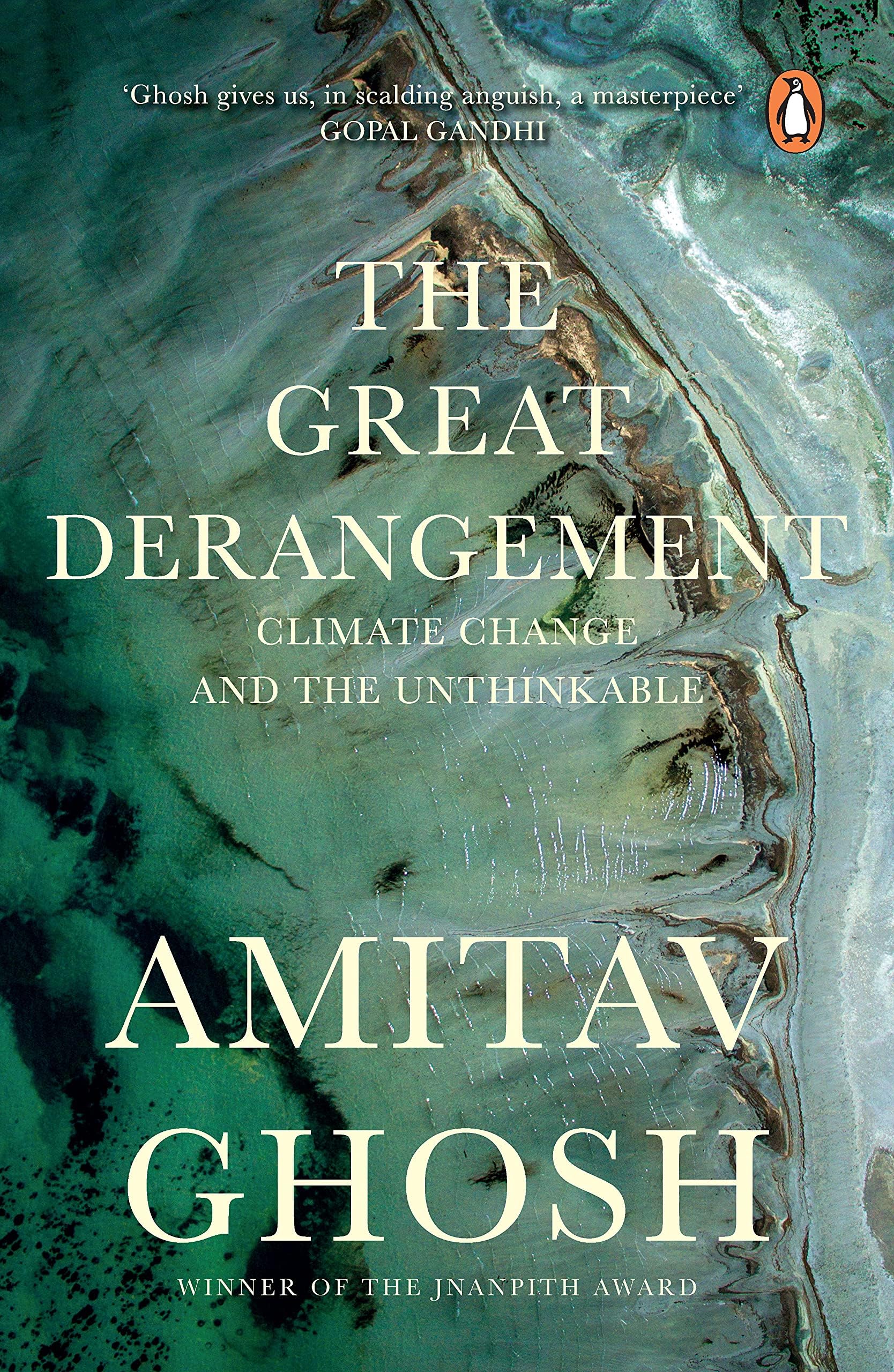
The Great Derangement: From bestselling author and winner of the 2018 Jnanpith Award: Climate Change and the Unthinkable
Product ID: 149040200
Buy anything from 5,000+ international stores. One checkout price. No surprise fees. Join 2M+ shoppers on Desertcart.
Desertcart purchases this item on your behalf and handles shipping, customs, and support to South Korea.
From the Publisher Review: Brilliant - There is no denying that Amitav Ghosh is a brilliant writer. I have had many moments of amazement on this book, each necessitating a re-read of the portion. Of course, the re-read is often also necessary to understand what is being said. Ghosh is not for lazy readers; he demands that you make the effort to engage with his work constantly. No distraction and skipping of lines is possible. If your mind strays, as it sometimes will, the writing requires you to start over. With Ghosh, there is rarely half-hearted reading. It’s pretty much all or nothing. Of course, it should be that way, given you have the privilege to read not just a wordsmith but also someone who is immensely well-read himself. The Great Derangement references writing genres as varied as philosophy, climate change, literature, literary theory, evolutionary theory, cultural theory, anthropology, and more. There are even references to movies. There is, of course, as a result, a certain exclusion inherent. The book is divided into three sections—Stories, History, and Politics. Stories with its play on words and contemplation on the absence of climate change in serious literature might not be for everyone. It is too much like literary theory to engender universal appeal. With History and Politics, he discusses at length the reality, political negotiation, and the reportage of climate change and his anecdotes, brilliantly rendered as usual, are more widely appealing. After I finished the book, I looked for a Preface but couldn’t find one. Ghosh dives right in to what he wants to say. The Acknowledgements, however, told me what I wanted to know. The book has grown from a series of lectures delivered at the University of Chicago. It explains the intellectual exclusivity, the seemingly meandering form. A climate change primer it is not. However, for someone like me who has never read anything other than the odd news article or two (and what he has to say about media makes this all the more appalling), this offers much food for thought and is of course, a marvelous example of some fine writing. Review: Informative and Engaging - This is a book everyone should read.


| Best Sellers Rank | #9,344 in Books ( See Top 100 in Books ) #14 in Environment & Nature #31 in Political Theory #32 in Essays (Books) |
| Customer Reviews | 4.3 out of 5 stars 1,377 Reviews |
R**C
Brilliant
There is no denying that Amitav Ghosh is a brilliant writer. I have had many moments of amazement on this book, each necessitating a re-read of the portion. Of course, the re-read is often also necessary to understand what is being said. Ghosh is not for lazy readers; he demands that you make the effort to engage with his work constantly. No distraction and skipping of lines is possible. If your mind strays, as it sometimes will, the writing requires you to start over. With Ghosh, there is rarely half-hearted reading. It’s pretty much all or nothing. Of course, it should be that way, given you have the privilege to read not just a wordsmith but also someone who is immensely well-read himself. The Great Derangement references writing genres as varied as philosophy, climate change, literature, literary theory, evolutionary theory, cultural theory, anthropology, and more. There are even references to movies. There is, of course, as a result, a certain exclusion inherent. The book is divided into three sections—Stories, History, and Politics. Stories with its play on words and contemplation on the absence of climate change in serious literature might not be for everyone. It is too much like literary theory to engender universal appeal. With History and Politics, he discusses at length the reality, political negotiation, and the reportage of climate change and his anecdotes, brilliantly rendered as usual, are more widely appealing. After I finished the book, I looked for a Preface but couldn’t find one. Ghosh dives right in to what he wants to say. The Acknowledgements, however, told me what I wanted to know. The book has grown from a series of lectures delivered at the University of Chicago. It explains the intellectual exclusivity, the seemingly meandering form. A climate change primer it is not. However, for someone like me who has never read anything other than the odd news article or two (and what he has to say about media makes this all the more appalling), this offers much food for thought and is of course, a marvelous example of some fine writing.
A**K
Informative and Engaging
This is a book everyone should read.
V**R
Good Book
Very interesting Book on climate change
S**N
Make it a mandatory read for every educational and public institutions!
This book should made a must read in all public institutions and policy circles, so that we can gain some visibility into the collective derangement that has trapped us all together. Its an amazing book, biting searingly into the "individual imaginary" which could easily imagine the end of world than the end of this derangement , and traces it back into literature and finds the authors of the previous century (including himself) guilty of cultivating and nurturing this individual imaginary , and repression of the collective. This "individual moral development" is an imaginary trap , which according to Ghosh has trapped us by way of a partial truth to hide the True of the Nature. The unimaginable is this disaster due to this moral journey, which is also unthinkable in the current popular discourse. If climate change is leading us into impending disasters one after the other, then it could only be possible that we are living in a great derangement where we do not want to face this situation as a collective. There are signs of dealing with Heideggerian thinking, Timothy Morton features in the book, and so do many other names, and Amitava Ghosh has delivered a marvel of a non-fiction here.
R**J
Climate change and literary fiction
In his book The Great Derangement, Amitav Ghosh examines ‘climate change’ in the context of literary novel. Why is it, Ghosh asks, that such a serious topic has been completely banished from literary fiction? Why does a novel that deals with gigantic catastrophes, immediately gets labelled ‘science fiction’ or ‘fantasy’? And why it is that these genres are not considered elite enough to be included under the sacred umbrella of literary fiction? These are not easy questions and Ghosh delves into the history of modern novel, starting from Gustave Flobert and nineteenth century Bengali novelist Bankim Chandra Chatterjee who sought to bring the European-style realist fiction to India. In the novels that followed this realist tradition, depicting extreme conditions occurring in Nature was frowned upon. Instead, Nature was this mild and moderate entity that was so harmless that it receded into the background. ‘Improbable’ was something that the modern novel never dealt with because it clashed with the realist sensibilities. Descriptions of terrifying seas or howling winds that eventually cause a cyclone were not serious literature. Such outbursts were banished from the elite kingdom with labels such as ‘the melodrama’, ‘science fiction’ or ‘fantasy’. What caused the separation of science fiction from literary fiction? In his brilliant analysis, Ghosh shows how the change came about gradually, how Nature was consigned to sciences, remaining off-limits from Culture. With western artists propagating this literary tradition, those in Asia and Africa were always trying hard to catch up with every new iteration of modernity, the new ‘isms’ that kept on appearing with increasing regularity. We have devastating effects of climate change occurring at a frightening pace and yet, serious literature seems to be blissfully ignorant of it. “In this regard”, says Ghosh, “the avant-garde, far from being ‘ahead’, was clearly a laggard”. There are many aspects to the complex issue of climate change. It is no coincidence that the carbon economy in developing nations started with end of the British Empire. This is closely related to the much debated issue of sharing of responsibility to cut emissions between the developed and developing nations. For all the jubilation made over the Paris Agreement on climate change, it offers very little in terms of immediate effective action. It takes no cognizance of our behaviour that has put the planet in grave danger. What is remarkable about The Great Derangement is the forthrightness in its analysis. Many climate change essays assume an ideal world and propose solutions. The Great Derangement goes beyond the feel-good press statements and climate agreements. It deals with the effects of the tainted era of imperialism and the dirty politics played behind doors when such agreements are signed. “The might of carbon-intensive economy cannot be fought with a politics of sincerity” – is one of the book’s blunt conclusions.
S**M
Read it if you care for our world; if you don't, read it nonetheless.
I have always enjoyed his writing. His quest to describe the human condition in consonance with the immaterial, the mineral and the 'other' is remarkable. Even more so, when you consider the lucidity of his vision and expression. Our derangement has been captured within this book, and with it the primary fear of his, that the future will look back to us with disdain can be laid to rest. This book will be a beacon of awesome brilliance describing our apathy to our own world, and the crookedness of the path we seem to be sticking to with an unhinged avarice towards a deeply uncertain future. This will be that crumb that will lead them back to the time when there was one who saw through our guise for development and found the folly at its core. Within the context of his work's genealogy and without, this book is, for me, one of the best that i have ever read.
C**I
A complex thought experiment on climate change
Amitav Ghosh's 'The Great Derangement' is an argument against our collective denial of climate change as a species. Spread across three sections - Literature, History, and Politics, it covers how each of these spheres have failed/are failing in understanding the magnitude of the problem. Despite the well-funded efforts of certain lobbies to deny it, climate change has accelerated in recent years. From Pope Francis to Environmental Agencies to the US military, all have started to act upon it in their own way. What Ghosh argues here is that the narrative of it being a sudden change that was unforeseen, is a deranged fiction that we have concocted for ourselves. Through systematic erasure of climate as a plot point in literature, industrialization as an antidote to colonialism, and an intentional collective silence from our political leaders, we have all been complicit in our delayed response. Ghosh further argues that the political unwillingness to tackle the problem is intentional because response to climate change will likely upturn power imbalance within countries, and will impact the 'deep state' i.e. the nexus of corporates, industries and other big-wigs in cahoots with the government behind the scenes. Thus, it is a 'wicked' problem and is far more complicated than a country's willingness to preserve nature's sanctity. I thought I was getting into a book on climate change and what I ended up reading was not what I was expecting. I wanted more 'concrete' climate change writing and this was more like a thought experiment on the mechanisms behind climate change as a social/cultural/historical/literary phenomena. It took me a while to get into the rhythm of Ghosh's writing. At times it felt articulate but at other times, it was pretentious and jargon-esque. Even so, some of his points were thought-provoking and approached Climate change with a lens I could not have imagined. I can't endorse it to the extent that you MUST pick it up but if you can spare time, you may check it out.
A**R
A great read on climate change
Mr Ghosh has written an incisive book on global warming and climate changing looking at it through modern literature as well as the angle of colonialism. GHosh weaves in his own story into the narrative as well as references scholars who have studied or analysed climate change. I would recommend this book not only for lay readers and students but also those in social and economic policy. A must read. I found it very inspiring.
Trustpilot
2 weeks ago
2 months ago