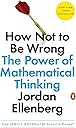
How Not to Be Wrong: The Power of Mathematical Thinking
Product ID: 15102478
📊Real-world math insights
📚Engaging storytelling
🧠Boosts critical thinking
Desertcart purchases this item on your behalf and handles shipping, customs, and support to South Korea.
📐 Master the math behind the madness — don’t just live life, calculate it!
How Not to Be Wrong by Jordan Ellenberg transforms math from dry rules into a powerful lens for understanding the world. Blending history, humor, and real-life examples, it equips readers with mathematical tools to think critically, make smarter decisions, and see the hidden structures beneath everyday chaos. A must-read for professionals eager to elevate their reasoning and join a community of sharp, informed thinkers.
| Best Sellers Rank | #20,335 in Books ( See Top 100 in Books ) #6 in Philosophy of Logic & Language #7 in Mathematics History #19 in Applied Mathematics (Books) |
| Customer Reviews | 4.4 out of 5 stars 5,060 Reviews |
J**Y
You Simply Won't Believe How Much This Book Will Change Your Life
I've already been recommending this book to family and friends, so I thought I'd take a few moments to recommend it to strangers on the internet, too. This book, as anyone who is familiar with Jordan Ellenberg's writing (or speaking!) would expect, is written in an entertaining, witty, and engaging style. Each chapter of the book is framed by one or two major, motivating questions, such as: - What parts of military aircraft should get the most armor? - Is it ever a good idea to play the lottery? - How should votes be counted in a democracy? The answers that mathematical thinking asks you to accept are often surprising and unintuitive, but Jordan guides the reader through the fog of potentially-complicated arguments with a conversational style rife with clear, succinct examples and amusing historical anecdotes. In the hands of other writers, the mathematics in this book may be dull, or technical and complicated, or all of these things; but with How Not To Be Wrong, Jordan has instead created a book that you will eagerly and (mostly) effortlessly consume. To put it another way: Steven Pinker said that "assumption of equality between writer and reader makes the reader feel like a genius, [while] bad writing makes the reader feel like a dunce." Jordan Ellenberg makes the reader feel like a genius. Finally, regarding another reviewer's comments about the author's "liberal bias", I'd like to point out that I had the exact opposite impression while reading this book. Whenever politics were considered, I thought Jordan was even-handed and stuck to the mathematics at hand without wading into any political commentary. While I have liberal political ideals, and I avoid talking about politics with the more conservative members of my family, I would not feel uncomfortable recommending or gifting this book to any of them. This simply is not a book about politics, and I'm surprised that anyone would would have their political feathers ruffled when reading it.
K**R
Interesting but difficult to read
The book is full of interesting mathematical concepts which, according to the author, can be applied in the everyday life. The author enriches the content by adding comprehensive examples and historical accounts of the brilliant mathematicians behind the theories discussed. That makes the book very interesting. However, the book makes one common mistake found in many books about mathematics: the explanation of the mathematical concepts are too short and incomplete to provide a good understanding of them. Maybe, that was the intent of the author. But, that makes the reading very difficult. I've sometime found myself reading some parts of the book over and over, trying to get a minimum understanding of some theories. Anyway, the book has some useful advices about how mathematics can help you not to be wrong in some very important subjects. That by itself makes it worth reading.
P**Z
An Acquired Taste, So Don't Give Up Too Soon!
You'll start reading this book thinking there will be a lot of juicy math on odds vs. utility functions in decision theory, then toss it out in disgust when you find you're reading a snail-paced "lives of the Saints in Probability..." BUT IF you toss it, you'd be WRONG just like the book's title! Ok, I'm with George Box that all models are wrong but some are useful, so in all humility, even if our thinking is n-dimensional and nonlinear, our headlights still don't go out centuries, and the law of unintended consequences will inevitably rear it's fearsome head. So yes, I know I'm gunna be wrong more than right even reading this gem of a book. It gets FUN! As you read on, Jord gets into deeper and deeper math, and most significantly, starts to COMBINE stats, geometry, differential equations, etc. in eclectic, multi-disciplinary fields, which are much more like real life than academic exercises. It is not only math that has a new twist every hour these days, it is the combinations of fields (as in vocations and disciplines, not quantum fields) that is making math more and more relevant. I'm not one to discount the gut, heart, tradition or even intuition, but it really is enlightening to take a little more quant view at our normal evaluations of everyday spin. Yes, the author does have a bit of a left bent, but heck, those are just examples, and you'd have to be pretty emotion driven not to see how easily his logic applies to ANY "position." I see a LOT of tongue in cheek in this book and a LOT of both wonder and just plain great story telling-- please don't pass on this book if you're bright but not necessarily a policy wonk! I've been in school board meetings where one group or another wants to add social justice at the expense of STEM and math, and I just scratch my head. I've seen left proposals to take out intelligent design while adding Islam (??) and right proposals to remove Islam, Darwin and Linear Algebra to add family social values. Hmmm. The folks that criticize this author for being a little too green might consider that he is clearly for adding back a LOT more math in the curricula! Hey, I'm a geek, and only anti-geeks can argue with that! I guarantee that even if you are way right, but smart, you'll thoroughly enjoy this book, and it applies just as clearly to one cause or position as another, and tries to avoid being "dumb" about ANY linear thinking. I'm more into enjoying what you buy here than getting into politics, but because of some of Jordan's controversy, just thought I'd add my 2c that this is well worth reading regardless of your politics, as it is fun and smart. Just give it a chance, it gets better and better faster and faster-- second derivative + -- jounce, jolt, surge etc. stuff. ;=) Enjoy...
B**B
"Mathematics is the extension of common sense by other means."
I run across a lot of books that I add to my to-be-read list and then forget about until after their publication dates or I stumble upon the book in the library or bookstore. How Not to Be Wrong was initially one of those books, but it sounded so good that I found myself obsessively thinking about it and started a search for a pre-publication copy. Since I'm not a librarian, didn't win a copy via First Reads, and don't have friends at Penguin Press, it took some time and effort, but having procured a copy and read it, I can say that it was well worth my time and $6.00. How Not to Be Wrong is a catchy title, but for me, this book is really about the subtitle, The Power of Mathematical Thinking. Ellenberg deftly explains why mathematics is important, gives the reader myriad examples applicable to our own lives, and also tells us what math can't do. He writes, “Mathematics is the extension of common sense by other means”, and proceeds to expound upon an incredible number of interesting subjects and how mathematics can help us better understand these topics, such as obesity, economics, reproducibility, the lottery, error-correcting codes, and the existence (or not) of God. He writes in a compelling, explanatory way that I think anyone with an interest in mathematics and/or simply understanding things more completely will be able to grasp. Ellenberg writes “Do the Math” for Slate, and it's evident in his column and this book that he knows how to explain mathematical ideas to non-mathematicians, and even more so, seems to enjoy doing so with great enthusiasm. I won't pretend that I understood everything discussed in this book, but it's such an excellent book that I also bought the hardcover (so I have an index which my pre-pub copy does not), and reread the book so I do have a much more thorough understanding. I've wished for a book like this for a long time, and I'd like to thank Jordan Ellenberg for writing it for me!
D**L
How Not To Be Wrong has tons of jargon, math (obviously), and logic, with not much attractive revelation.
I fell for the marketing trick (there probably is a math lesson there somewhere) that said How Not To Be Wrong was the Freakonmics (a book I loved) of math, so my expectations were high. The book isn’t bad, it just fell short of its promises and the frequent “Aha!” moments I enjoyed while reading Dubner and Levitt’s book. Jordan Ellenberg attempts (and succeeds) to reveal how math permeates every single facet of life, even the most arcane places that you would never think of, and illustrates math’s utility through frequent examples and historical accounts of how certain theories developed. The stated aim is to give the reader a new lens to view data (and the world) in order to better discern the hidden truths lurking in the background. Oftentimes, reality is actually a story different than what the layperson thinks the numbers tell. Generally speaking, each chapter tends to highlight a classic mathematical concept, theorem, or idea, and a brief history of how said ideas were developed are given. Next, the concepts are applied to some contemporary issue both grand and small, ranging from an attempt to calculate the probability that God exists, the problems in statistical analysis and medical studies, or using Bayer’s theorem to calculate your biases about a coin toss. I found the chapter on public opinion (aggregate opinions are inconsistent) quite interesting and intriguing, and it will certainly make you think twice the next time you read an opinion poll. To anybody who is not a math person, despite its claim that it doesn’t get too technical, the book does in fact get very technical, complete with frequent equations and diagrams in order to illustrate mathematical points. The author also frequently employs historical stories and anecdotes, but sometimes the stories can divert away from the main point he is trying to make. In my opinion, the frequent diversions can also be somewhat excessive and drag on. As Mr. Ellenberg intelligently describes, math is “an atomic-powered prosthesis that you attach to your common sense, vastly multiplying its reach and strength.” The problem is that I felt so bogged down with mathematical gobbledygook, that I often lost track of how all these lessons can have value in real, everyday life for a non-mathematician.
A**S
A good by if you want a more accurate view of the world!
This book is wonderful, albeit a bit dense. It's a long read but it's invaluable if you want to be knowledgeable about mathematical reasoning and statistics. I've always prided myself on making sure that I have an accurate picture of the world and the information that I'm being given. Not having a vast knowledge of statistics makes that difficult, especially when people tend to throw them around to "prove" their points. This book tells you how to verify the authenticity of the stats and how those stats can and should be used along with what they can actually prove. Without this knowledge, you're pretty much at the mercy of any random misrepresented statistic. E.g. I recently watched the documentary "What the Health" and I was stricken by the statistic that eating a lot of processed meats increased your potential for colon cancer by 20% but after looking into the statistic I realized that it only increased your "absolute" rate of cancer by 1% (from 5% to 6%), which would constitute a 20% increase 1 being 20% of 5, but vastly misleading in the way that it was presented. The only drawback to the book is that it's so dense and you can tell it was written by a mathematician. It's a good book to make your way through gradually.
U**N
Wonderful
This is a wonderful book. I thoroughly enjoyed it. I learned Mathematical, historical and cultural jewels that I very much look forward to contemplating further or delving into. The author is refreshingly forthright in exploring the impediments to Mathematics Education and its appreciation in society at large. He does this from the position of a working Mathematician and educator. A broad array of concepts are covered and their exposition are an intricate weaving of historical events and individuals with current events and instructive toy examples. Wald, Fisher, Pascal, Shannon, Galton, Hilbert and many more appear at varying times. These insights into these individuals was remarkably more complex for the amount of words: strengths and weaknesses of their contributions (and the positions, e.g Galton and eugenics). One of the greatest joys of this book is the discussions are neither superficial nor simplistic. The author starts from the simple and when you think you have digested what is at hand, he add another wrinke and another and enriches your understanding. He supports his case that Mathematics is the extension of common sense. Particularly informative were the discussions of the law of large numbers, lotteries, the concept of regression to the mean. The importance of the role of uncertaintuy in our lives, acknowledging its existence and the value of quantifying marries well with Nate Silvers "The Signal and The Noise" (Silver also discussed in the book). The author discusses the "cult of genius" and the obstacle it creates to recruitment and retention of Mathematicians and the enrichment of other disciplines by Mathematics. This was compelling and struck me and derived from the insights of one who had negotiated the journey (though admittedly a prodigy) as well as tasked with guiding and supporting others through it. There is a lot in this book. It is, however, more than content. It is a challenge to think more deeply about everyday life, about culture, about history and the seeing the "unreasonable effectiveness of Mathematics".
J**S
Among the most engaging, entertaining, and enlightening non-fiction books I've read
As someone who took a lot of math courses in college (not always doing very well, but always being intrigued), this book was absolutely in my wheelhouse and even better, it was more engaging than many novels that I've read. I was constantly chuckling and snickering at the many revelations and stories that were shared. I thought the majority of it was easy to understand (perhaps not always easy to accept) but I suspect some will lack the self confidence to read it - I hope these folks are not put off. At the end he has a brief section on the many people who abandon mathematics because they think they are not "gifted" or "genius" enough, and pleads the case that we all need to be mathematicians. So I guess I am exonerated. There are several stories of people who pursued a question for their life, only to have it advanced by the next generation. So interesting that many of these questions arose from real world questions and concerns and not so much from abstract noodling. I agree to an extent with some reviews that for a serious mathematician who might read textbooks, this isn't as systematic and direct as it might be, but on the other hand, I thought the writing was among the best and most engaging for non-fiction that I've seen. If you might fit in this picture and are willing to open up your imagination a bit, I think you'll find this book as entertaining and enlightening as I did.
A**D
Slightly torn cover and slightly turned pages.
Slightly torn cover and slightly turned pages.
N**S
A really well written mathematical book - This is the kind of books teenagers should be reading at school!
The book is written well enough for everyone (not only Maths prodigy) to understand it. There are no formulas - only explanation of concepts, mathematical laws of the universe, great examples and few mentions of how teachers lie to us at school (I knew it!!!). As a classic scientist who lies to read in bullet points I found there was a bit too much side story and introduction to the "idea" (each chapter is about a different mathematical idea). But I guess those introductions are the reasons why someone like my mum, who cannot comprehend numbers, is interested in this book. I would advise this book for everyone - especially younger adults as trust me THIS BOOK WILL CHANGE HOW YOU SEE THE WORLD. It will make you understand economics and political bullpoo much better. It will improve your ability to understand complex concepts and interaction as that what is obvious is not always correct. It will improve your ability to judge based on facts and to estimate the value of those facts (yes, facts may be misleading - it's all in the book). This is the kind of books teenagers should be reading at school!
S**T
Book delivery by amazon
Good book to read
F**R
GREAT !
It's a very funny book and you don't need very hard knowledge to have fun with it. It is very clear and dealing with various topics from old maths (like pYthagora's theorem) to very early developpments in financial theories. It's very easy to read even for non native English talking people like me. Just buy it !
A**R
Very good book
This book is very well written and you get stuck on it because of the things explained. As an Italian reader I cannot say it is an easy reading , nevertheless I would recommend it.
Trustpilot
2 weeks ago
2 weeks ago