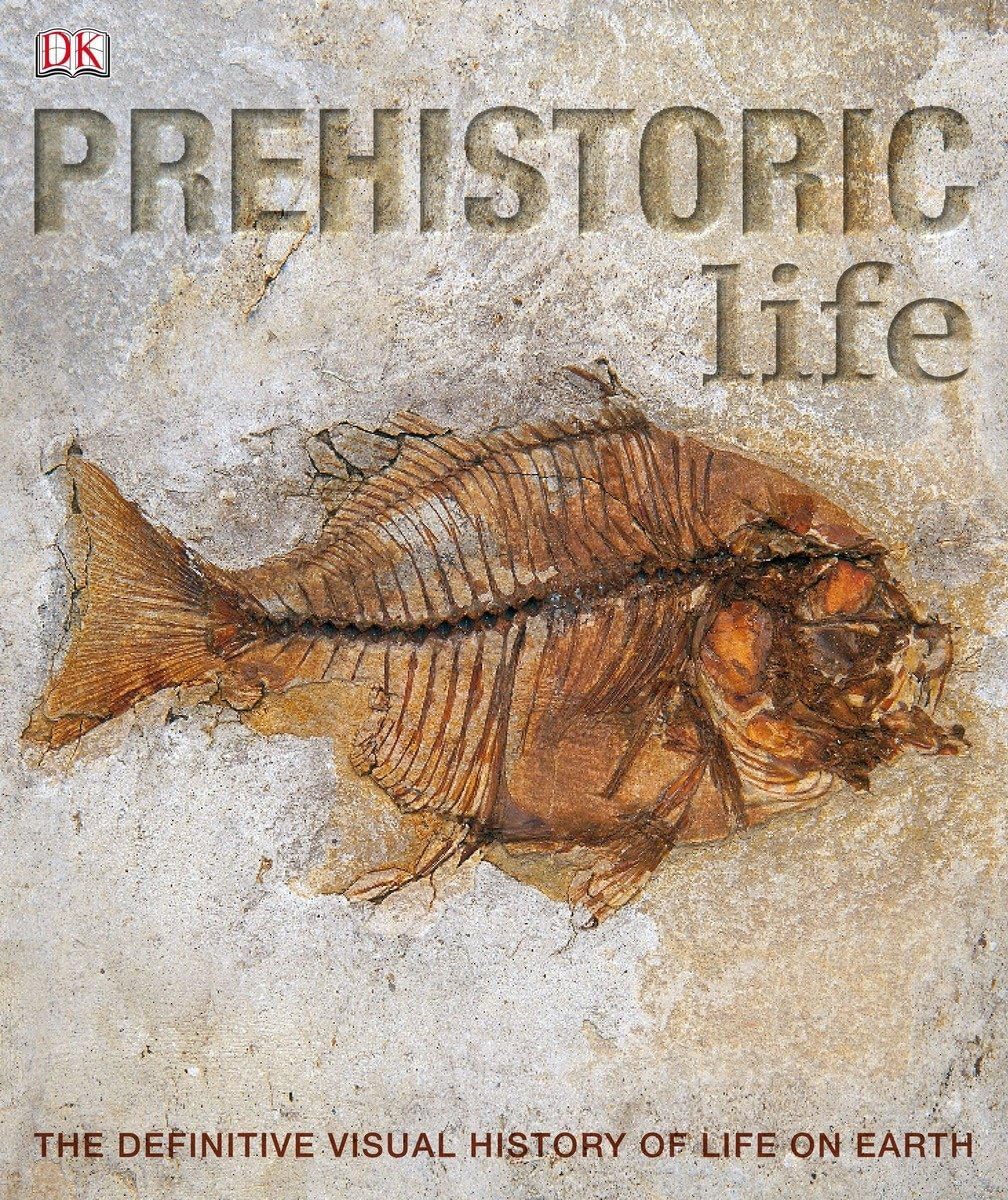
Prehistoric Life: The Definitive Visual History of Life on Earth
Product ID: 1525348
Buy anything from 5,000+ international stores. One checkout price. No surprise fees. Join 2M+ shoppers on Desertcart.
Desertcart purchases this item on your behalf and handles shipping, customs, and support to South Korea.
With an extensive catalog at its heart, Prehistoric Life profiles hundreds of fascinating species in incredible detail. The story starts in earnest 3.8 billion years ago, with the earliest-known form of life on Earth, a bacteria that still exists today, and journeys through action-packed millennia, charting the appearance of new life forms as well as devastating extinction events. Of course, the ever-popular and endlessly intriguing dinosaurs feature large, but Prehistoric Life gives you the whole picture, and the plants, invertebrates, amphibians, birds, reptiles, and mammals that are the ancestors of today's species also populate its pages, making this book unprecedented in its coverage of prehistory. Specially commissioned artworks use cutting-edge technology to render species in breathtakingly realistic fashion, with astonishing images of prehistoric remains, such as skeletons and fossils, to complete the story. To put all the evidence in context, the concept of geological time is explored, as is the classification of species and how the evidence for their evolution is preserved and can be deciphered. Review: A Sumptuous and Learned Stimulus to the Sense of Wonder - Prehistoric Life: The Definitive Visual History of Life on Earth This is a sumptuous and learned book. But it is also unreadable. It serves as a visually beautiful reference book, and a thick-volume to be thumbed through, read in parts, consulted, and used as a stimulus to the sense of wonder. “Prehistoric Life” consists of about 500 richly illustrated colored pages that include many explanatory units of boxed-in text. The book starts with the origin of the Earth, and has separate sections for each of the geological time periods, starting with the Archean, four billion years ago, and ending with the history of our species, Homo sapiens. Every page you open to is colorful and filled with images of fossils, plants, animals or artistic reproductions of life forms, and every page has scientific text amplifying each separate picture. The scope of this book and the level of knowledge that it contains is astounding and leaves the reader struck with both the artistry of book-making and the rigor of science that is involved with the creation of this text. There is no single author, and as is usual with DK Books, there are many authors, scientific consultants, editors, designers, illustrators, and photographers who had to cooperate to make this rich compendium. Unfortunately, as again is usually true with DK Books, the reader does not know which author or authority wrote the particular prose passage that one is reading. The acknowledgments alone take up three pages of four columns each. Partly because of the encyclopedic information that is discussed, and partly because of the use of text to accompany illustrations, rather than the creation of a continuous single author narrative, this book can be read only in a halting, jumping, discontinuous manner. “Prehistoric Life” contains many excellent features beyond its lush beauty and its factual depth. Every section of geologic history begins with its own map of the globe at that point in time, with a clear time chart, and with a discussion of how the continents and oceans were behaving in continental drift, and what the climate was like. Therefore the reader is not simply guided to pictures of plants and animals, but is constantly reminded of the interactions between geology, climatology, and the evolution of plants and animals. The overall impact of this book is thrilling. It puts the individual reader’s life into the perspective of our planet’s life. It makes us grateful for the accumulation of scientific knowledge, the vast majority of which is less than 200 years old. Both the topic and the minds that clarified it are radiant additions to one’s sense of who one is and how human life has come to be. The information content seems up to date and impeccable. In a book that covers almost everything, 500 glossy pages is not too long, so obviously there is an arbitrary selection of what is included and what is short changed. For example, the stunningly beautiful forty pages on human evolution show the photographs of the exact skulls that have been used to define the earlier species of humankind. Many books discuss the issue of human evolution but few illustrate it with such high color photography. On the other hand, you may find that your favorite dinosaur, or your favorite Pleistocene megafauna has not been included even though there was space enough for the editors to give many pages to something as obscure as carboniferous invertebrates. Pouring over this book has been a delightful, sobering, incomprehensible, and exhilarating experience for me. It is the perfect complement to a book on the sense of wonder. Reviewed by Paul R. Fleischman author of "Wonder: When and Why the World Appears Radiant Review: Glorious! - Exactly as described and much more comprehensive than I expected. Deep, thorough listings of so many creatures I hadn't heard of and most, if not all of the ones I was familiar with, even obscure ones. Unfortunately a few of the absent ones are favorites, I could not find Utahraptor in there because groups like raptors got only two or three representative species as opposed to the several famous species that they really did. The illustrations surprised me because I didn't read the fine print. I expected a variety of paleo-art in different styles or one or two artists dominating. Instead, it's lush and photo-heavy with gorgeous computer created, realistic images. Most of them are photographic and natural looking, as if you had a camera you sent throughout the past. A few look obviously digital-painted but many are so well crafted they might as well be good nature photography. Poses, textures, lighting, color harmony, light physics, it's all very real. Very few have unnatural hard edges to give it away. In addition there are many good photos of fossils, skeletal mounts and museum reconstructions, occasional taxidermy photos if a species was extant recently enough to have taxidermy in museums. The text is concise but information packed and engaging. This is most of all a wonderful reference book. . It's well indexed and bound. Thick, heavy and intense but an easy read. It's laid out so that it's easy to look up something specific by its time period and it covers the plants and ecology as well as the animals. I am a writer, what I wanted in a reference book, this is the best one yet. With the detailed descriptions and fossils of undersea life and botany as well as land animals, it's easier to get a feel for the entire period on something I've looked up. When I set a story or novel in Earth's evolutionary past, this is the book that gives me enough detail I'm less likely to make huge blunders like putting in Jurassic grass. I bought this to replace a rather old Encyclopedia of Prehistoric Life which had mostly line drawings but was comprehensive and covered all the major periods and groups of animals. I found myself turning to it more often than denser books because of how well it was organized and that it covered more than the Mesozoic. This one is bigger. Its large size gives room for more text and the blocks of text are often in relatively small type,often white on black. I wear magnifying glasses to read the text sometimes but it's always worth reading and goes into just that step more depth to make everything fall together well. It's nicely up to date, lushly illustrated and tremendously handy. I can't recommend it enough to the interested layman and it might even be useful to scientists and fossil hunters too with its wonderful breadth.
































| Best Sellers Rank | #436,405 in Books ( See Top 100 in Books ) #85 in Biology of Dinosaurs #91 in Biology of Fossils #3,951 in Encyclopedias & Subject Guides |
| Customer Reviews | 4.8 out of 5 stars 449 Reviews |
P**.
A Sumptuous and Learned Stimulus to the Sense of Wonder
Prehistoric Life: The Definitive Visual History of Life on Earth This is a sumptuous and learned book. But it is also unreadable. It serves as a visually beautiful reference book, and a thick-volume to be thumbed through, read in parts, consulted, and used as a stimulus to the sense of wonder. “Prehistoric Life” consists of about 500 richly illustrated colored pages that include many explanatory units of boxed-in text. The book starts with the origin of the Earth, and has separate sections for each of the geological time periods, starting with the Archean, four billion years ago, and ending with the history of our species, Homo sapiens. Every page you open to is colorful and filled with images of fossils, plants, animals or artistic reproductions of life forms, and every page has scientific text amplifying each separate picture. The scope of this book and the level of knowledge that it contains is astounding and leaves the reader struck with both the artistry of book-making and the rigor of science that is involved with the creation of this text. There is no single author, and as is usual with DK Books, there are many authors, scientific consultants, editors, designers, illustrators, and photographers who had to cooperate to make this rich compendium. Unfortunately, as again is usually true with DK Books, the reader does not know which author or authority wrote the particular prose passage that one is reading. The acknowledgments alone take up three pages of four columns each. Partly because of the encyclopedic information that is discussed, and partly because of the use of text to accompany illustrations, rather than the creation of a continuous single author narrative, this book can be read only in a halting, jumping, discontinuous manner. “Prehistoric Life” contains many excellent features beyond its lush beauty and its factual depth. Every section of geologic history begins with its own map of the globe at that point in time, with a clear time chart, and with a discussion of how the continents and oceans were behaving in continental drift, and what the climate was like. Therefore the reader is not simply guided to pictures of plants and animals, but is constantly reminded of the interactions between geology, climatology, and the evolution of plants and animals. The overall impact of this book is thrilling. It puts the individual reader’s life into the perspective of our planet’s life. It makes us grateful for the accumulation of scientific knowledge, the vast majority of which is less than 200 years old. Both the topic and the minds that clarified it are radiant additions to one’s sense of who one is and how human life has come to be. The information content seems up to date and impeccable. In a book that covers almost everything, 500 glossy pages is not too long, so obviously there is an arbitrary selection of what is included and what is short changed. For example, the stunningly beautiful forty pages on human evolution show the photographs of the exact skulls that have been used to define the earlier species of humankind. Many books discuss the issue of human evolution but few illustrate it with such high color photography. On the other hand, you may find that your favorite dinosaur, or your favorite Pleistocene megafauna has not been included even though there was space enough for the editors to give many pages to something as obscure as carboniferous invertebrates. Pouring over this book has been a delightful, sobering, incomprehensible, and exhilarating experience for me. It is the perfect complement to a book on the sense of wonder. Reviewed by Paul R. Fleischman author of "Wonder: When and Why the World Appears Radiant
R**N
Glorious!
Exactly as described and much more comprehensive than I expected. Deep, thorough listings of so many creatures I hadn't heard of and most, if not all of the ones I was familiar with, even obscure ones. Unfortunately a few of the absent ones are favorites, I could not find Utahraptor in there because groups like raptors got only two or three representative species as opposed to the several famous species that they really did. The illustrations surprised me because I didn't read the fine print. I expected a variety of paleo-art in different styles or one or two artists dominating. Instead, it's lush and photo-heavy with gorgeous computer created, realistic images. Most of them are photographic and natural looking, as if you had a camera you sent throughout the past. A few look obviously digital-painted but many are so well crafted they might as well be good nature photography. Poses, textures, lighting, color harmony, light physics, it's all very real. Very few have unnatural hard edges to give it away. In addition there are many good photos of fossils, skeletal mounts and museum reconstructions, occasional taxidermy photos if a species was extant recently enough to have taxidermy in museums. The text is concise but information packed and engaging. This is most of all a wonderful reference book. . It's well indexed and bound. Thick, heavy and intense but an easy read. It's laid out so that it's easy to look up something specific by its time period and it covers the plants and ecology as well as the animals. I am a writer, what I wanted in a reference book, this is the best one yet. With the detailed descriptions and fossils of undersea life and botany as well as land animals, it's easier to get a feel for the entire period on something I've looked up. When I set a story or novel in Earth's evolutionary past, this is the book that gives me enough detail I'm less likely to make huge blunders like putting in Jurassic grass. I bought this to replace a rather old Encyclopedia of Prehistoric Life which had mostly line drawings but was comprehensive and covered all the major periods and groups of animals. I found myself turning to it more often than denser books because of how well it was organized and that it covered more than the Mesozoic. This one is bigger. Its large size gives room for more text and the blocks of text are often in relatively small type,often white on black. I wear magnifying glasses to read the text sometimes but it's always worth reading and goes into just that step more depth to make everything fall together well. It's nicely up to date, lushly illustrated and tremendously handy. I can't recommend it enough to the interested layman and it might even be useful to scientists and fossil hunters too with its wonderful breadth.
D**T
Fossil evidence for evolution
This is a fantastic book, even used, available for a low price. It appears to contain a comprehensive fossil record of the entire panorama of life on Earth. All of the major representative fossils are shown, along with computer-generated artists' renditions of the life forms and habitats represented by the fossils. Not only is the formation of the Earth about 4.56 billion years ago illustrated, but also the formation of our entire solar system. Visuals tell most of the story, but they are accompanied by brief but succinct verbal notes and comments along the way. At the end are a glossary, a thorough index, and an apparently comprehensive list of at least most of the dinosaurs. This book presents an understandable, mostly visual, fossil record of life on Earth, and as such it could be used to support the teaching of Darwinian evolution, even with modern modifications, such as "punctuated equilibrium." I recommend it for anyone interested in biology, or as a gift for a student in high school or higher. One more thing: while presenting a thorough sampling of the empirical evidence, it also discusses competing theories about various phenomena, and acknowledges what is NOT known, as well as what is known.
T**G
My son loves it
This book covers the earth being made all the way to the evolution of humans. It shows how the study of fossils have given us insight into how life evolved on earth. This book is a tough read for children. If buying for a child you will really want to read it with them and explain each subject. It is very colorful and each page is full of great visuals. Along with the wonderful illustrations there is tons of info covering the evolution of our planet. This book is also not a good read for someone who believes in creation. We have no problems there because we are Buddhist, but others might. If using this as a book for a child in the education of our evolving planet you might want to break out the white out board and draw some illustrations of your own. My son is very interested in paleontology. This book has become a great tool for teaching him so much more then just dinosaurs. He has found that the earths creation alone is fascinating. He also has discovered he loves plant fossils due to their uniqueness. Great book and a must have for anyone who enjoys science.
Z**E
Best Paleontology Reference Yet!
This was recommended to me by a female friend of mine who is a huge dinosaur buff and can spot a bad dinosaur product a mile away. She said this was a great reference and as a struggling geology and zoology student that I would love it. And she was right! It's a general access book for all ages. I'm 20 and I love. My 40-year-old mother loves it, my 14-year-old brother loves it, and my baby cousin would probably love it too. It doesn't have every single detail about ancient earth (and why would a single book do that), but it does cover ever major geologic era, from the Archean to modern day. Unfortunately, fans of the Hadean era will be disappointed because it still isn't scientific cannon and will not appear in this book. But what is great is that this book isn't just a dino book! There are dinosaurs, but also paleo-plants, insects, sea life, and environmental conditions. There are also maps of what scientists speculate the geography would be on the earth as well. It even takes a non-controversial approach to the evolution of modern humans in its last chapter, taking a brief look at the primates we supposedly came from. The illustrations in this book are also a plus. They are full color, big, vibrant, scientifically accurate, and just plain fun to look at!
D**N
Very Good But Not The 'Definitive'
In general I agree with many of the other reviewers. It's a well-illustrated book, discussing each time period, with beautiful photographs of fossils. I also enjoyed how plants were featured, a vital component of any environment, which are frequently shortchanged in these sorts of tomes. There was also detailed information about featured lifeforms, as opposed to the 'Evolution: Story of Life' book, which this has been compared to. However, unlike others I was not impressed with the CGI illustrations. Few seem very lifelike, some barely 'adequate', and many are in static poses on an unremarkable backdrop (i.e. blue water, green grass, ect). Additionally, there's far too much emphasis on small fossils in the photographs. The giant arthropods of the Paleozoic are barely even mentioned. I suppose it's easier to prominently photograph a half-inch long trilobite rather than a six-foot eurypterid, but to fail to include these remarkable creatures even in CGI reconstruction? Hardly 'definitive'. Despite these shortcomings, it IS a wonderful book, especially for the pricetag. However, I recommend 'Evolution: Story of Life' as a companion book, as it's better for full environment reconstructions. I purchased both, and the two compliment one another very well.
R**N
Past Lives
I gave this book five stars because it is easily one of the best books on prehistoric life that I have seen. It is not as comprehensive as some would believe. Where for example, is that giant dragonfly that is rarely ever omitted from a Carboniferous diorama? There is no mention that the mass extinction at the end of the Ordovician period was likely caused by radiation from a star in our part of the galaxy going nova. A little more historical geology would be helpful in understanding the extinctions and the remaining species diversifing into new species to fill the suddenly open niches. This book is primarly as the cover flap says, a catalog of prehistoric life. Since it is a reference book, I don't have a strong desire to read it cover to cover. It is arranged mostly in geologic time rather than encyclopedia style so it could be read that way if desired. After having read Stephen Jay Gould's "Wonderful Life" and Donald Johanson's "Lucy", I find myself flipping this book between the bizarre arthropods of the Cambrian and the hominin timeline. Since the state I call home boasts one of the best series of Paleozoic strata on earth, I'm glad this isn't just a dinosaur book. Prehistoric Life, is as some other reviewers said, a reference book that is suitable as a coffee-table book. It is something to flip through during commercials or when you suddenly realize that you saw that show before or for your guest to flip through during an otherwise awkward moment when you go to fetch coffee.
E**H
A Very Good Book!
Prehistoric Life is an excellent pictorial book in the area of paleontology. It is filled to overflowing with illustrations, charts, etc., but don't let the "Visual History" (part of the subtitle) fool you. The book is also inundated with plenty of good text - both technically informative for the serious student, yet very readable for the interested enthusiast. The book is written from the typical evolutionary perspective. It is organized in chronological accordance with the standard geologic timescale. The lay-out makes it very easy to follow. Please note that this work is quite comprehensive in its subject matter. Despite the title, it deals with much more than just the successive appearances of organic life; it also deals with such matters as plate tectonics, climatology, etc. The book does an excellent job of showing the standard uniformitarian interpretation of Earth history from the planet's beginning up to the present time of humanity. This product is highly recommended. It's just a good book to have around as both a quick reference and/or a tome for extended study.
H**H
Top of my favorite books
Only fraction of price in Germany. Superb photographies of fossils. Enormous enrichment of private paleology studies.
R**G
Probably the most beautiful book ever printed
English only book. Not available in French This book is stunning. Simpy stunning. Far surpassed my expectations. It's superbly organised and the layout and photos are really superb. The amount of infomation is complete and detailed. I honestly think it could be the most beautiful book ever made, providing you are interested in dinosaurs, space, the planet, rocks etc. Take the hardback, this is a book you'll want to keep. Dorling Kindersley are always good but they have really surpassed themselves this time. Pity the delivery guy threw it over the wall and damaged the corner- Amazon were good about it though.
F**A
Extraordinariamente recomendable
Aunque no estoy demasiado acostumbrado a leer en inglés, me parece bastante ameno. Además, es muy completo: abarca fósiles de toda la historia de la Tierra, centrándose en el Fanerozoico (obviamente) pero sin perder de vista el Precámbrico. La introducción (con la formación de la Tierra, la Tectónica de Placas, los distintos procesos de fosilización...), los apartados de los fósiles y los mapas de la Tierra (muy visuales) y el capítulo de la Evolución Humana, hacen de ésta una imprescindible guía de fósiles.
K**N
It is a great comprehensive visual look at history of life on earth ...
Members of our Thompson-Nicola Paleontological Society (TNPS) in Kamloops, B.C. ,Canada have examined PREHISTORIC LIFE and most of of them wish to own one. It is a great comprehensive visual look at history of life on earth with great scientific text to explain the many beautiful illustrations,charts and geological ages. It is a superb reference book for paleontologists. Kenneth Dickinson Member of the TNPS
E**G
ÓTIMO LIVRO !
O livro é , extremamente interessante , completo e bem ilustrado , está na lingua inglesa . Porém sei um pouco sobre inglês , e acabo aprendendo um pouco mais , e ''junto ''com paleontologia , paleoantropologia e paleobotânica , assuntos que me interesso e acaba que fica ainda mais interessante , o livro abrange o PRÉ - CAMBRIANO , CAMBRIANO , NEOGENE , PALEOGNE /? , MESOZOICO , PALEOLITICO E 7 MYA á 10.000 (aa) . Livro completo , abrangente e para interessados e especialistas , não me surpreendi quando descobri que era o mais importado .
Trustpilot
2 months ago
2 weeks ago