Buy anything from 5,000+ international stores. One checkout price. No surprise fees. Join 2M+ shoppers on Desertcart.
Desertcart purchases this item on your behalf and handles shipping, customs, and support to South Korea.
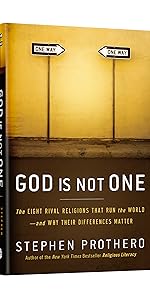
In God is Not One: The Eight Rival Religions That Run the World , New York Times bestselling author of Religious Literacy and religion scholar Stephen Prothero argues that persistent attempts in modern theology to portray all religions as different paths to the same God overlook the distinct problem that each tradition seeks to solve. Delving into the different problems and solutions that eight major world religions like Islam, Christianity, Buddhism, Judaism, Confucianism, Yoruba Religion, Daoism and Atheism strive to combat, God is Not One is an indispensable guide to the questions human beings have asked for millennia—and to the disparate paths we are taking to answer them today. A necessary book for anyone interested in the future of interfaith dialogue, readers of Huston Smith and Karen Armstrong will find much to ponder in God is Not One . In this essential work of religious studies, Prothero dismantles the myth of religious unity to reveal what truly defines each of the world's great spiritual traditions: A New Framework for Understanding: Go beyond superficial similarities and analyze each religion based on the unique problem it seeks to solve―from sin in Christianity to suffering in Buddhism. Why Religious Differences Matter: Understand why the stark distinctions in doctrine, ritual, and end goals between religions like Islam and Christianity are not minor details but are instead powerful, world-shaping forces. Comparative Religion in Action: Journey through the core beliefs and practices of eight global traditions, including not only major faiths like Judaism and Islam but also Confucianism, Yoruba Religion, and Daoism. A Challenge to Modern "Godthink": A powerful counterargument to the popular but misleading idea that all faiths are simply different paths up the same mountain, aimed squarely at readers of Huston Smith and Karen Armstrong. Review: Good book to know about the seven world religions - Honestly it’s a really good book if you’re into other religions and unlike other religious books, this one grabs your attention with relatable scenarios and information. Review: educación nísperos tirón and perhaps a bit of transformation - If you are a person that loves to learn and grow and therefore contribute more in life. Then this book will not only equip you but empower you too. This book tries and succeeds in reporting and describing the different religions in a factual adoring way. In how they are similar and different. In how they all have extremes and extremist and how they all have the mystical and ephemeral aspect. He dos a marvelous job talking about the values and beliefs, way of being exemplars in each one in a compare and contrast format but also in a high light manner as this book would be way too long otherwise. He succeeds in dice ting the different religions in terms of these term eloquently. He also points out that heaven, for some, is in the here and now and being human and doing human is the end goal. But also points to what some religions emphasize that here and now only matter to get to a different place. R that good conduct, social behavior, is in itself the key. There is a religious way of talking about religions which in a late night conversation at a bar can turn into a fight and then there is the secular an reporting way which this book exemplifies that allows one to not only experience and learn but also to question and evolve. Stephen is articulate and witty through out the book. I would highly recommend this book to only those that care about humanity and want to explore. Thank you for the brilliant book Jorge Henriquez Mexico City


| Best Sellers Rank | #31,092 in Books ( See Top 100 in Books ) #24 in Comparative Religion (Books) #25 in Religion Encyclopedias #29 in Religion & Philosophy (Books) |
| Customer Reviews | 4.4 out of 5 stars 1,368 Reviews |
P**A
Good book to know about the seven world religions
Honestly it’s a really good book if you’re into other religions and unlike other religious books, this one grabs your attention with relatable scenarios and information.
J**Y
educación nísperos tirón and perhaps a bit of transformation
If you are a person that loves to learn and grow and therefore contribute more in life. Then this book will not only equip you but empower you too. This book tries and succeeds in reporting and describing the different religions in a factual adoring way. In how they are similar and different. In how they all have extremes and extremist and how they all have the mystical and ephemeral aspect. He dos a marvelous job talking about the values and beliefs, way of being exemplars in each one in a compare and contrast format but also in a high light manner as this book would be way too long otherwise. He succeeds in dice ting the different religions in terms of these term eloquently. He also points out that heaven, for some, is in the here and now and being human and doing human is the end goal. But also points to what some religions emphasize that here and now only matter to get to a different place. R that good conduct, social behavior, is in itself the key. There is a religious way of talking about religions which in a late night conversation at a bar can turn into a fight and then there is the secular an reporting way which this book exemplifies that allows one to not only experience and learn but also to question and evolve. Stephen is articulate and witty through out the book. I would highly recommend this book to only those that care about humanity and want to explore. Thank you for the brilliant book Jorge Henriquez Mexico City
M**L
Great overview of the eight religions, poor attack on atheism
The thesis of this book is to argue against perennialism. The author claims that each religion diagnoses the human condition with its own problem, and offers a unique solution. And that missing this fact by conflating them all as the same is to fail to respect their individual contributions. The majority of the book is short introductory chapters on each of what he considers the eight "great" religions. I found each of these chapters to be quite informative, given how short they are. I especially appreciated the chapters on Daoism and Yoruba religion. Most english language introductions to Daoism are very shallow and hardly go past the first line of the Daodejing, but this one was very informative and went into the history, different schools and the pantheon of Daoism. Yoruba I had never even heard of before reading this book, so I appreciate that he even included it at all. I have to subtract a star for a few reasons. One is that he manages to end the book with one of the most poorly argued polemics against atheism I've ever read. He considers atheism just another religion, and spends the majority of the chapter talking about what he calls "angry atheists" (i.e. the "New Atheists"). His reasons for categorizing atheism as a religion are very weak in my opinion. But leaving that aside if he's going to consider atheism a religion, I wish he would treat it with the same respect and charitability that he treats other religions with. He spends much more time focusing on Hitchens and Dawkins in the atheism chapters than he does on fundamentalists in the other chapters. The second reason I'm subtracting a star is that he doesn't address what I think is a primary form of perennialism. That is the belief, not that all religions are somehow equally true, but that the mystical experiences of the various contemplatives in those religions are the same experience. Maybe it was my fault for coming with bad assumptions, but this is the form of perennialism I was expecting him to argue against and it's not addressed at all in the book. Overall I would still recommend it as an enjoyable and accessible introduction to the eight religions he discusses.
F**I
Great book on religions as a whole
I highly recommend this book to anyone who has an interest in religions, but i especially recommend it to anyone who has a hatred of any religion or anyone who thinks that their religion is the "one true religion". Atheists and Christians alike should check this one out. This book debunks the common misconception that "all religions are different paths leading to the same place". The author does his best to remain unbiased and does not place any one religion as more "right" than any other. Stephen Prothero's simple, easy to read, matter of fact approach simply seeks to inform readers about the goals and solutions of the top eight religions of the world, while at the same time acknowledging that there are good and bad things that come from religion. Overall, I think this book helps to promote understanding about religions as a whole and as a result promotes religious tolerance.
D**N
Helpful resource
The main point of this book is that different religions are, in fact, different. They are seeking different goals. They may share certain ethical ideas such as variations on the Golden Rule, but there is much more to them than ethics. This point has often been lost in an era of political correctness that suggests that all religions are essentially the same. It is difficult to truly capture the essence of a religion from the outside, but Prothero makes a valiant effort. As a Christian there are some things about Christianity that I felt were not accurately described, but other Christians would likely disagree with me. That same kind of issue probably holds for the other religions he discusses. Many comparative religion books seem dull to plow through. God Is Not One is very readable and engaging.
D**O
The case for professors of religious studies
Prothero seems confused. He argues that New Atheists and Perennialists make the same mistake, reducing religions to caricatures, all boiled down into a mush of utter evil or banal compassion. "In relationships and religions," he says, "denying differences is a recipe for disaster." Denying differences, though, is not the same as emphasizing similarity. We can agree that we are essentially the same, while simultaneously recognizing aspects that make us unique. If we took Prothero's argument to its logical extreme, we would be reduced to majorities no greater than one. Perhaps Prothero and his wife talk mostly about their differences. I and mine usually focus on activities and interests we share. Recognizing differences is of course important, but it is commonalities that allow us to comfortably explore differences. Compassion and empathy, cornerstones in all religious traditions, are based on the realization that we are essentially the same, that our suffering is not unique. Prothero even gives an example that counters his own argument, the Chicago-based Interfaith Youth Core, which prohibits its members from discussing politics or theology. They discuss instead "how their very different traditions impel them toward a shared commitment to service." (p336) Prothero concedes that all religions share the same ethical principles and the same function, that of transforming the individual, making him or her more complete, more whole, more genuinely human. Each tradition is an expression of an impulse found in people of all cultures of every age, to practice some form of religion. In fact, not every expression of this impulse need include God, as is the case with Buddhism, Confucianism, Daoism, and atheism. It is without question helpful for international policymakers or businessmen to know something about the culture and beliefs of the people with whom they interact. We don't wish to cause offense. We wish to please. We want to do business. We want peaceful relations. And at the end of the day we can achieve these things because no matter how different we may appear on the surface, we are fundamentally the same - creatures of temporal existence driven by desires not of our making, keen on seeking patterns in experience. About the only reason to insist that religions are more different than alike is to argue for the need of specialists like Prothero. If you need an overview of eight of the world's religions, this is a great place to start. Prothero knows his stuff and he writes well. If you want to read the thesis, borrow this from your library and stick to the introduction and conclusion, which together account for 34 of the manuscript's 341 pages. For evidence of the countervailing thesis, that awakening to our nature is not a process or experience bound by culture or theology, see One: Essential Writings on Nonduality . #
D**Y
Outstanding
Stephen Prothero's "God is Not One" clearly lays out the key factors, development, and affects of each of the major religions in the world, including a brief note on Atheism. As a lapsed catholic constantly seeking understanding of different faiths both for personal and academic reasons, this book has been the most helpful I've read. Before reading, I had a fairly firm grasp of most Monotheistic religions and a beginners understanding of far eastern practices (mostly from "Tao of Pooh" and videos of the Dali Lama). This book stated as clearly as possible what divides and defines each of these religions and how they each interact with one another and affect our global relations. While extremely informative, it read much like a novel and everything was delivered in a flowing manner that was easy to follow which kept me turning the pages. I highly recommend this book to anyone with any interest in theology out of academic curiosity or personal spiritual development.
B**S
It's About TIME!!!
God is NOT one! Not all religions are striving for the same thing! Religious tolerance has condensed all of religious ideology into one format, and it has wrongly assumed that we are all climbing some imaginary mountain but taking different paths. The trouble is that we aren't all striving for the same goal. We aren't taking different paths to the same end! We are climbing different mountains! Prothero acknowledges that religions are DIFFERENT. Hallelujah! If there is going to be understanding and cohabitation, we need to grasp the fundamental differences in our world views and in what we believe happens at the end of life. That has everything to do with how we live, and how we live alongside others. This is a well-written book with very few biases. Where Prothero has opinions he openly states his self-perceived biases. It's easy reading and well, well worth the time.
J**K
Schnelle Lieferung aus US, inhaltlich wertvoll.
Die Lieferung erfolgte aus New Jersey, US, innerhalb von 6 Tagen. Das Buch war ein Geschenk an meine Freundin, die sehr glücklich darüber ist. Ihrer Aussage nach hat das Buch so einiges zu bieten. Wer ein Buch sucht, welches sich kritisch mit den verschiedensten Religionen unserer Welt auseinandersetzt, um sich über jene zu bilden, der scheint hier an der richtigen Stelle. Auch optisch macht das Buch etwas her. Im Umschlag ist es ein wirklich schöner Blickfänger, den man gerne im Bücherregal präsentiert und im bloßen Hardcover-Einband kommt es elegant und unauffällig daher. Für den Stil eines jeden Bücherregals findet sich hier also das passende Gewand.
A**R
It's an amazing book; I use it as an aid to ...
It's an amazing book; I use it as an aid to teach my world religion lessons in my high school.
加**藤
アメリカを代表する宗教学者の傑作
宗教見取り図!分かりやすいです。
N**S
A good book but very thick so hard to read all ...
A good book but very thick so hard to read all in one go. I have taken to reading just the sections I want at the time I need to and going from there.
B**A
Eye-Opener
Für das Thema interessieren sich viele Menschen. Deshalb ist dieses aufschlussreiche Buch so wichtig. Es bringt in verständlicher Sprache umfassende Einblicke in die Ausrichtung und Ziele aller Hauptreligionen. Es rückt jeden Kuschelkurs, jede naive Einstellung zurecht und gibt Ausblicke, auf das was möglich ist und realistischer Weise erwartet werden kann - oder eben auch nicht.
Trustpilot
3 weeks ago
1 month ago