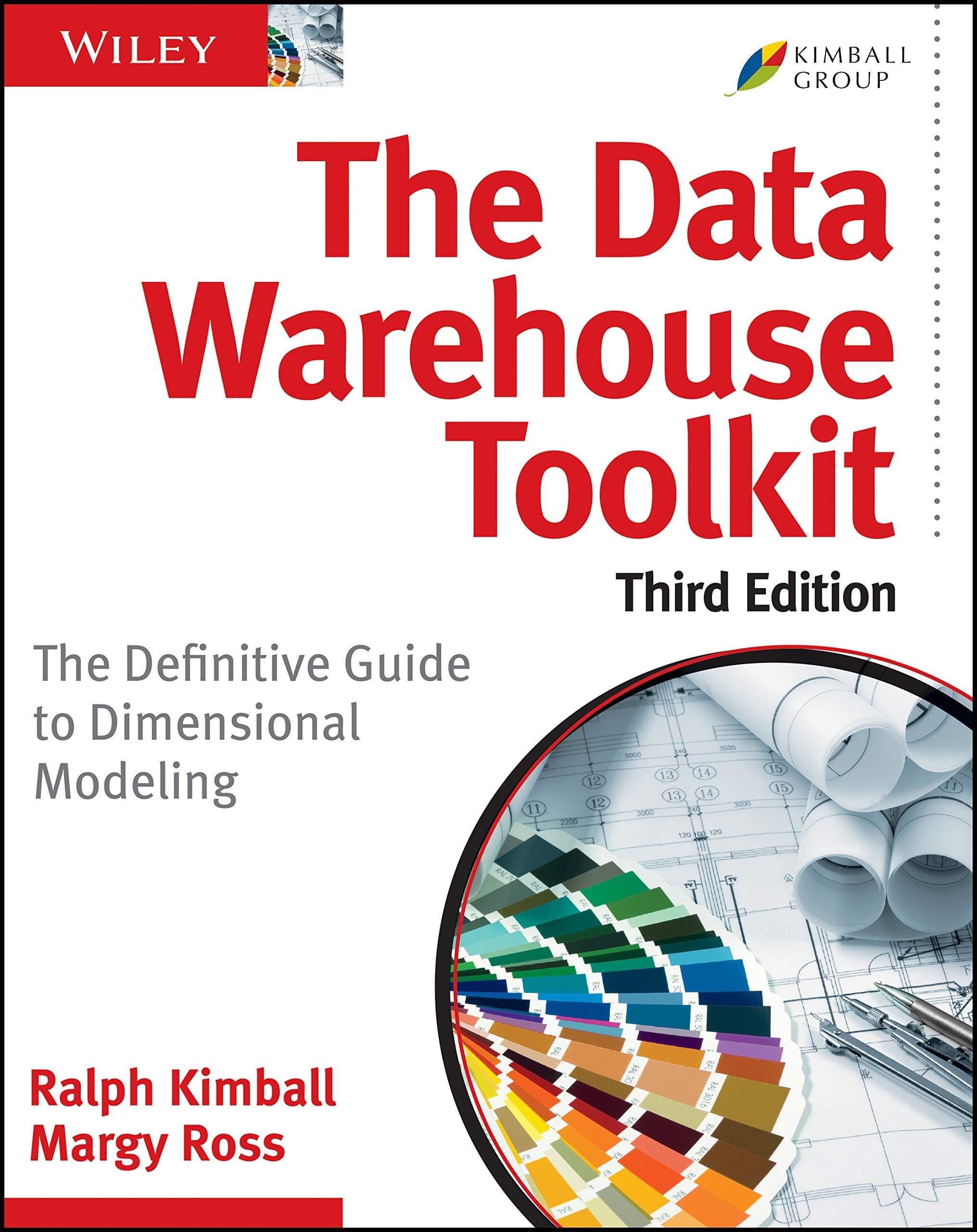
The Data Warehouse Toolkit: The Definitive Guide to Dimensional Modeling
Product ID: 1704284
Buy anything from 5,000+ international stores. One checkout price. No surprise fees. Join 2M+ shoppers on Desertcart.
Desertcart purchases this item on your behalf and handles shipping, customs, and support to South Korea.
Updated new edition of Ralph Kimball's groundbreaking book on dimensional modeling for data warehousing and business intelligence! The first edition of Ralph Kimball's The Data Warehouse Toolkit introduced the industry to dimensional modeling,and now his books are considered the most authoritative guides in this space. This new third edition is a complete library of updated dimensional modeling techniques, the most comprehensive collection ever. It covers new and enhanced star schema dimensional modeling patterns, adds two new chapters on ETL techniques, includes new and expanded business matrices for 12 case studies, and more. Authored by Ralph Kimball and Margy Ross, known worldwide as educators, consultants, and influential thought leaders in data warehousing and business intelligence Begins with fundamental design recommendations and progresses through increasingly complex scenarios Presents unique modeling techniques for business applications such as inventory management, procurement, invoicing, accounting,customer relationship management, big data analytics, and more Draws real-world case studies from a variety of industries,including retail sales, financial services, telecommunications,education, health care, insurance, e-commerce, and more Design dimensional databases that are easy to understand and provide fast query response with The Data Warehouse Toolkit: The Definitive Guide to Dimensional Modeling, 3rd Edition . Review: Great intro/crash course on EDW theory & practice - I'm the "tech guy" for a startup -- we need something done/built, but don't have anyone who knows how to do it? Yep, that means I'll be doing it... Knowing *nothing* about dimensional modeling, I was asked to lead the team that's now building our data warehouse. This book (described as "the book on EDW" by the one exec at the company who's done this before) didn't make me an expert or anything, but it provided a solid foundation of the high-level concepts and some of the major low-level issues that only come up when you're actually trying to build and maintain a data warehouse. Put another way, it didn't answer all my questions, but I was at least asking the right questions after going through it. (Ex: "Should we handle this as an SCD-Type 1 or -Type 2 dimension?"*, rather than "Wait, what's an SCD?") I now spend most of my day talking and thinking about data warehouses, and I still find myself reaching for this book on a weekly basis. Take some time to read it through all the way, then keep it nearby, since it's a helpful reference guide for major concepts. (But not for any specific platform or vendor. If you want something specific to SSIS, for example, get another book. Better yet, get this one AND another book!) If you're looking for more ETL-specific information, there's another book by Ralph Kimball (and a different co-author. Joe Caserta) called "The Data Warehouse ETL Toolkit"). It's useful, but not nearly as useful as this one. *Answer: neither, and both. We actually ended up using a Type 6 approach! Review: Gold Standard - This is one of the best technical books I've read on any subject. The author doesn't waste any time on tedious introductions, but jumps right into the meat of the topic, which is something I appreciate. The book spends a reasonable amount of time on theory, then dives into a bunch of case studies showing how to apply the theory to common scenarios. This is good instructional technique. The authors are opinionated, but in a good way. They express views on how things ought to be done, based on long experience, and this helps moves the novice along the learning curve. I've seen a few critiques in other reviews that the authors are repetitive or make a big deal out of obvious things. This actually is good instructional technique; if you want to shape the behavior of a student, you need to repeat things over and over, because no one gets it the first time. As for what is obvious or not, that varies among students. Even when a practice is obvious to a particular student, it doesn't mean that he will actually conform to that practice in real life. People are often lazy and undisciplined, and don't do the things they were taught in kindergarten. It never hurts to reinforce the obvious.




| Best Sellers Rank | #28,496 in Books ( See Top 100 in Books ) #1 in Database Storage & Design #3 in Data Warehousing (Books) #38 in Networking & Cloud Computing |
| Customer Reviews | 4.7 out of 5 stars 767 Reviews |
M**.
Great intro/crash course on EDW theory & practice
I'm the "tech guy" for a startup -- we need something done/built, but don't have anyone who knows how to do it? Yep, that means I'll be doing it... Knowing *nothing* about dimensional modeling, I was asked to lead the team that's now building our data warehouse. This book (described as "the book on EDW" by the one exec at the company who's done this before) didn't make me an expert or anything, but it provided a solid foundation of the high-level concepts and some of the major low-level issues that only come up when you're actually trying to build and maintain a data warehouse. Put another way, it didn't answer all my questions, but I was at least asking the right questions after going through it. (Ex: "Should we handle this as an SCD-Type 1 or -Type 2 dimension?"*, rather than "Wait, what's an SCD?") I now spend most of my day talking and thinking about data warehouses, and I still find myself reaching for this book on a weekly basis. Take some time to read it through all the way, then keep it nearby, since it's a helpful reference guide for major concepts. (But not for any specific platform or vendor. If you want something specific to SSIS, for example, get another book. Better yet, get this one AND another book!) If you're looking for more ETL-specific information, there's another book by Ralph Kimball (and a different co-author. Joe Caserta) called "The Data Warehouse ETL Toolkit"). It's useful, but not nearly as useful as this one. *Answer: neither, and both. We actually ended up using a Type 6 approach!
N**R
Gold Standard
This is one of the best technical books I've read on any subject. The author doesn't waste any time on tedious introductions, but jumps right into the meat of the topic, which is something I appreciate. The book spends a reasonable amount of time on theory, then dives into a bunch of case studies showing how to apply the theory to common scenarios. This is good instructional technique. The authors are opinionated, but in a good way. They express views on how things ought to be done, based on long experience, and this helps moves the novice along the learning curve. I've seen a few critiques in other reviews that the authors are repetitive or make a big deal out of obvious things. This actually is good instructional technique; if you want to shape the behavior of a student, you need to repeat things over and over, because no one gets it the first time. As for what is obvious or not, that varies among students. Even when a practice is obvious to a particular student, it doesn't mean that he will actually conform to that practice in real life. People are often lazy and undisciplined, and don't do the things they were taught in kindergarten. It never hurts to reinforce the obvious.
B**L
A must for Data Analyst practitioners
Great book that captures a history that is often overlooked about data dimension modeling. Especially, the terms mentioned early in the book that help place context and perspective for many past projects that I have worked on. Thank you.
W**F
Excellent Resource for Data Warehousing course
Other than the Ralph Kimball cheerleading section in the first couple of chapters, this is a great book for understanding how data warehouses work. The authors use several read-world examples and the text flows well. Good organization, starting with basic DW tables, moving to design concepts, variations on ETL architecture, and closing out with DW life cycle planning. With 21 chapters, covering many disciplines such as accounting, supply chain, marketing, operations, and others. I recommend this to anyone trying to understand the basics of data warehousing and analytics.
B**R
Data Warehouse Essential Reading
Avoid Data Vault at all costs, just use this book as your guide to building a data warehouse.
J**X
Great conceptual framework
I do a fair amount of work in data warehousing, analytics and business intelligence. The data warehousing component is always something that I have lagged on as the conceptual components of data warehousing are only really skimmed during a lot of BI or analytic training. The Data Warehouse Kit is something I have really enjoyed reading through and expanding my knowledge on data warehousing. Concepts are good, I like the layout as well and the fact that updates and revisions have good additional content is a plus.
T**S
Very Good Source
I learned a lot of things I did not know about dimensional modeling reading this book. I recommend reading it in its entirety. I wish it had code examples for creating the SCD's and Keys but even without it, its a great read.
L**S
Useful data warehousing book
This is an informative data warehousing reference by an expert. I am giving this book 3 stars since it contains too much repetition and unnecessary wordiness. The information could have been condensed to less than one-third of the size of this book while maintaining its utility.
N**N
La biblia del modelado de datos
Este libro se le considera como la "biblia" del modelado de datos, al fin y al cabo, Kimball fue el padre del modelo de datos dimensional. Tiene unos capitulos introductorios donde se explican los conceptos básicos del modelado en general, para despues explicar los diferentes elementos del modelo dimensional y sus diferentes tipos. Ya más adelante, cada capítulo se centra en un área de negocio y presenta diferentes técnicas que se pueden aplicar a cada una de éstas áreas, con ejemplos de modelos y tal. También da consejos sobre que hacer y que no hacer en determinadas situaciones. El libro tiene su tiempo y algunos conceptos pueden estar un poco anticuados, pero siguen siendo uno de los pilares fundamentales del modelado de datos. Obviamente, el libro está en ingles y es necesario dominar el idioma para sacarle partido. Si quieres trabajar de modelador de datos, tienes alguna oferta de trabajo, o quieres profundizar en el tema, éste es tú libro.
A**I
Sempre il numero uno
Passano gli anni (Ralph Kimball ne ha quasi settanta e la prima edizione del libro è del 1996), ma questa nuova edizione è ancora un esempio di come dovrebbere essere scritto un libro di computer (o qualsiasi altro testo tecnico). Come per la seconda edizione, anche per questa terza non si tratta solo di un’operazione cosmetica: il testo contiene molti aggiornamenti, capitoli nuovi e reingegnerizzazioni che lo rendono ancora più valido e leggibile. Ad esempio, i tipi di slowly changing dimension descritti sono arrivati a 7 (dai 3 della prima edizione). Altra aggiunta utilissima il capitolo 2, che raccoglie un elenco di tutte le tecniche contenute nel libro con i concetti base e i rimandi alle trattazioni dettagliate. Quindi, riassumendo: fin dalla prima edizione questo era il testo di riferimento per chiunque volesse imparare come si progetta un data warehouse, adesso dopo 16 anni lo è ancora di più, essendo molto migliorato ed essendo nel frattempo le tecniche dimensionali diventate uno standard a livello globale. Chi voglia approfondire le tecniche dimensionali con altri esempi e ottime spiegazioni lo può eventualmente complementare con “Star schema: the complete reference” di Chris Adamson.
N**C
A must for data modelers!
Come on, it's Kimball! If you are a data architect/modeler, this is more than a must-read!
L**S
Livro de cabeceira para o profissional de BI.
Este livro tem uma leitura de fácil compreensão, o autor explica os conceitos do Data Warehouse e modelagem de dados dimensional de uma forma didática e com estudos de casos do mundo real, para tornar a experiência real e o mais aplicável possível. Esta é bíblia do BI, pois, a modelagem de Data Warehouse do Ralph Kimble é o mais bem aceito e usado internacionalmente, então, isto torna essencial a todo profissional de BI. A única crítica que faço desta obra é que o escritor se torna meio redundante ou prolixo na explicação de alguns conceitos, mas nada que tire o alto valor do livro.
A**A
Must have for data analysts
The book is a must have for anyone working with databases and particularly data warehousing. Lot of examples and strong exposure to data warehouse theory. The most recent edition I know about.
Trustpilot
2 days ago
1 week ago