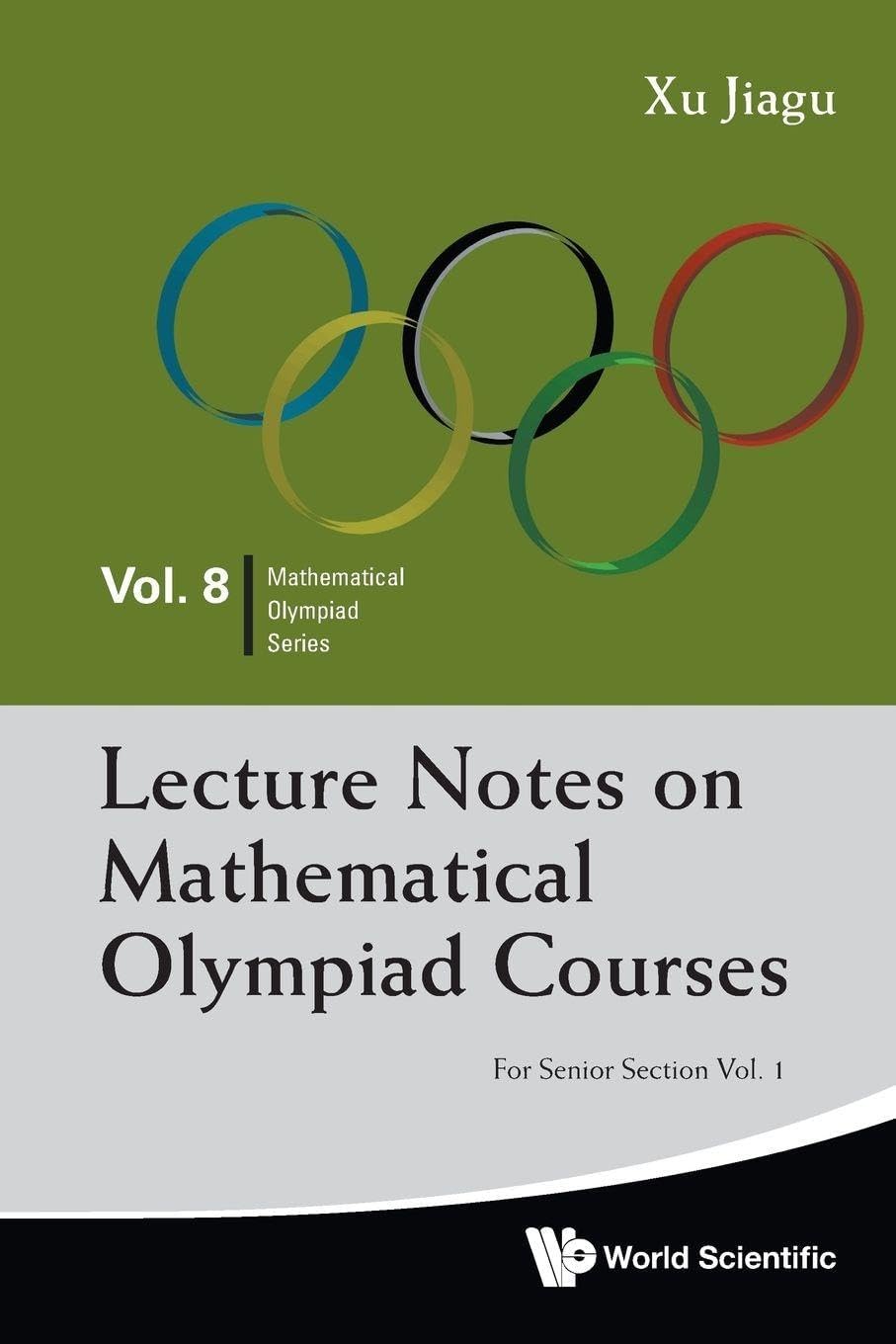
Lecture Notes On Mathematical Olympiad Courses: For Senior Section - Volume 1
Product ID: 18036735
Buy anything from 5,000+ international stores. One checkout price. No surprise fees. Join 2M+ shoppers on Desertcart.
Desertcart purchases this item on your behalf and handles shipping, customs, and support to South Korea.
Olympiad mathematics is not a collection of techniques of solving mathematical problems but a system for advancing mathematical education. This book is based on the lecture notes of the mathematical Olympiad training courses conducted by the author in Singapore. Its scope and depth not only covers and beyond the usual syllabus, but introduces a variety of concepts and methods in modern mathematics as well. In each lecture, the concepts, theories and methods are taken as the core. The examples serve to explain and enrich their intentions and to indicate their applications. Besides, appropriate number of test questions is available for the readers' practice and testing purpose. Their detailed solutions are also conveniently provided. The examples are not very complicated so readers can easily understand. There are many real competition questions included which students can use to verify their abilities. These test questions originate from many countries all over the world. This book will serve as a useful textbook of mathematical Olympiad courses, a self-study lecture notes for students, or as a reference book for related teachers and researchers. Review: Singapore math at the Olympiad level - This is a no-nonsense 4-volume set (2 volumes for the junior section, and 2 for the senior section) for students progressing beyond the Singapore math curriculum in middle school and high schools. The author is a former professor of mathematics at Fudan University in Shanghai, China. The books are organized into short lectures on various topics, with a page or two of definition and summary of key techniques, followed by about 8-10 examples of Olympiad-type short problems, plus concise but clear solutions. The rest of each lecture is populated by about 10-15 actual Olympiad problems from contests held in various countries; less common sources of questions from China, India, Russia, Romania, Poland, Hungary, Japan, UK, Vietnam, Singapore and Australia are included, besides the familiar ones from US competitions. The problems have full solutions provided. The 4 books cover a lot of material in condensed form and have a kind of take-no-prisoners conciseness tailored to strong students. It takes a motivated student with a lot of discipline to use these books for self-study. Students needing lots of hand-holding should probably look elsewhere for gentler and slower-pace material (such as the introductory & intermediate series of books from ArtofProblemSolving). That being said, strong students can expect to get up to speed quickly - if they study the examples in depth, diligently work on the manageably small number of 15 questions per topic, and emulate the approaches in the provided solutions. Review: Good - Good book
| Best Sellers Rank | #3,114,119 in Books ( See Top 100 in Books ) #572 in Elementary Algebra (Books) #1,917 in Algebra & Trigonometry #8,060 in Applied Mathematics (Books) |
| Customer Reviews | 4.6 out of 5 stars 12 Reviews |
S**F
Singapore math at the Olympiad level
This is a no-nonsense 4-volume set (2 volumes for the junior section, and 2 for the senior section) for students progressing beyond the Singapore math curriculum in middle school and high schools. The author is a former professor of mathematics at Fudan University in Shanghai, China. The books are organized into short lectures on various topics, with a page or two of definition and summary of key techniques, followed by about 8-10 examples of Olympiad-type short problems, plus concise but clear solutions. The rest of each lecture is populated by about 10-15 actual Olympiad problems from contests held in various countries; less common sources of questions from China, India, Russia, Romania, Poland, Hungary, Japan, UK, Vietnam, Singapore and Australia are included, besides the familiar ones from US competitions. The problems have full solutions provided. The 4 books cover a lot of material in condensed form and have a kind of take-no-prisoners conciseness tailored to strong students. It takes a motivated student with a lot of discipline to use these books for self-study. Students needing lots of hand-holding should probably look elsewhere for gentler and slower-pace material (such as the introductory & intermediate series of books from ArtofProblemSolving). That being said, strong students can expect to get up to speed quickly - if they study the examples in depth, diligently work on the manageably small number of 15 questions per topic, and emulate the approaches in the provided solutions.
A**A
Good
Good book
Trustpilot
2 weeks ago
2 weeks ago