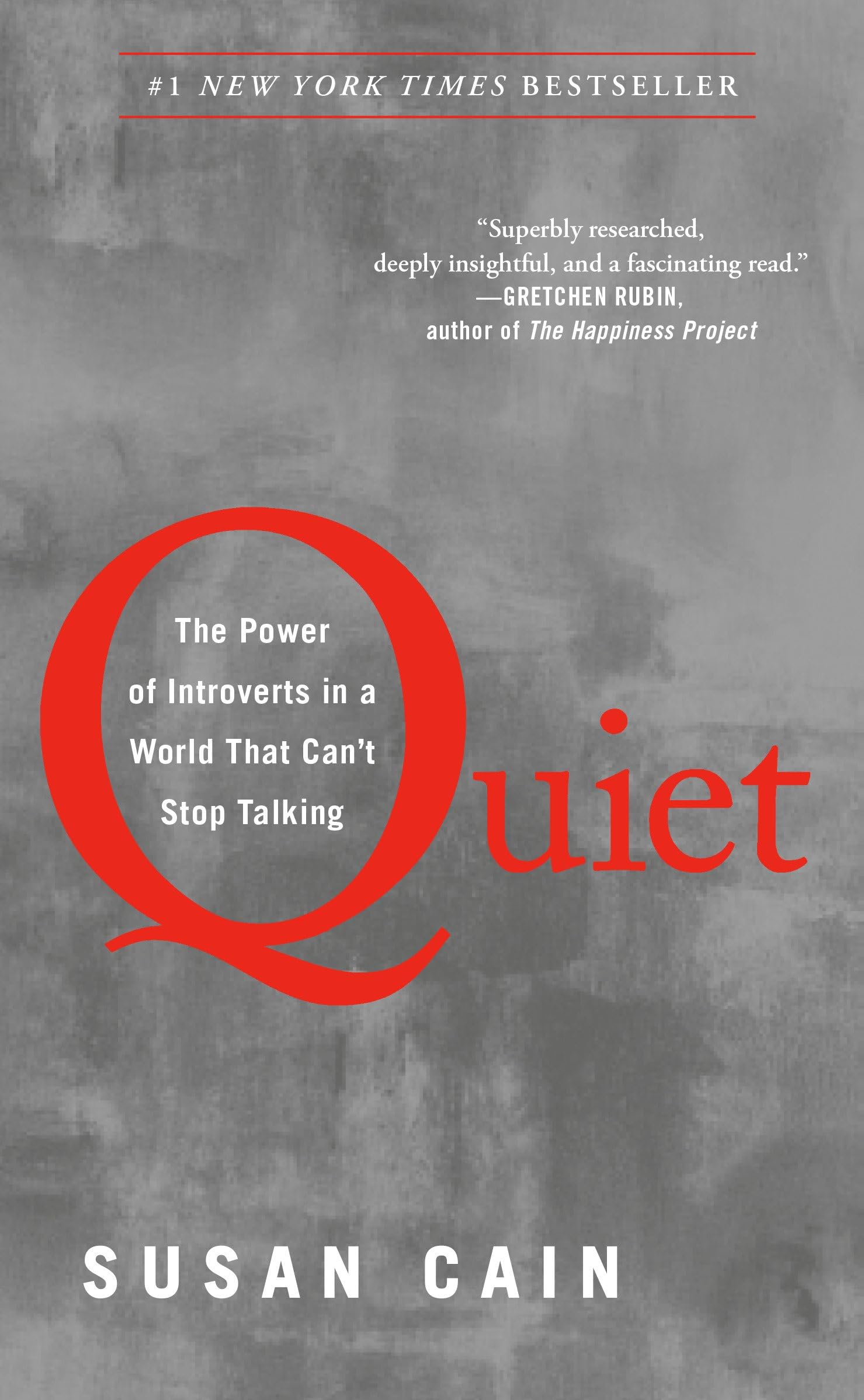
Quiet: The Power of Introverts in a World That Can't Stop Talking
Product ID: 215336
Buy anything from 5,000+ international stores. One checkout price. No surprise fees. Join 2M+ shoppers on Desertcart.
Desertcart purchases this item on your behalf and handles shipping, customs, and support to South Korea.
#1 NEW YORK TIMES BESTSELLER • Experience the book that started the Quiet Movement and revolutionized how the world sees introverts—and how introverts see themselves—by offering validation, inclusion, and inspiration “Superbly researched, deeply insightful, and a fascinating read, Quiet is an indispensable resource for anyone who wants to understand the gifts of the introverted half of the population.”—Gretchen Rubin, author of The Happiness Project NAMED ONE OF THE BEST BOOKS OF THE YEAR BY People • O: The Oprah Magazine • Christian Science Monitor • Inc. • Library Journal • Kirkus Reviews What are the advantages of being an introvert? They make up at least one-third of the people we know. They are the ones who prefer listening to speaking; who innovate and create but dislike self-promotion; who favor working on their own over working in teams. It is to introverts—Rosa Parks, Chopin, Dr. Seuss, Steve Wozniak—that we owe many of the great contributions to society. In Quiet , Susan Cain argues that we dramatically undervalue introverts and shows how much we lose in doing so. She charts the rise of the Extrovert Ideal throughout the twentieth century and explores how deeply it has come to permeate our culture. She also introduces us to successful introverts—from a witty, high-octane public speaker who recharges in solitude after his talks, to a record-breaking salesman who quietly taps into the power of questions. Passionately argued, impeccably researched, and filled with indelible stories of real people, Quiet has the power to permanently change how you see yourself. Now with Extra Libris material, including a reader’s guide and bonus content Review: This Book Saved My Life. Not An Exaggeration. - I believe this book saved my life. I'm not prone to melodrama, or to such excessively long reviews, but this is true, and so important to me, I have to say it. I've been working for years in an extremely busy law office. It's been growing harder and harder throughout the years for me to handle this job. Two months ago my boss fired my coworker, and I've since had to take on two people's work plus train multiple new people (as the first two didn't stay), all with constant, all day long interruptions, high-intensity demands, and a high level of multitasking. This has happened many times before, and while it was dreadful, I managed, but for some reason this time I just couldn't handle it. My entire life has been on hold since this started, I get home from work too exhausted to do anything except veg out for a couple hours and go to bed, and even weekends aren't much better. I was taking terrible care of myself and my life was falling apart. I did, in fact, feel like I was killing myself with this lifestyle, but I simply did not have the energy to fix any of it, or for that matter have any idea how to fix it. I blamed myself - there must be something `wrong with me' because I can't handle the job. I wanted to leave, but thought, if I can't handle this job, how am I going to handle a new job? It'll probably be more of the same. I thought I was just getting soft because I was getting older (I'm in my late 40s). I've always known I was introverted, but I didn't realize just what all that entailed - I thought it mostly meant `shy' or that I didn't like social settings. This book taught me more about myself than I've ever known. It read like my biography. Almost every page had a new insight into why I think and feel the way I do. Throughout the book I saw my very own self described in new and empowering ways. I learned that the job situation I'm currently in - the non-stop deadline demands, interruptions, never being able to work quietly or alone no matter how difficult a project was, phones ringing incessantly, people in my face all day long, etc. - especially when it's work that I actually don't care anything about personally - those are the exact circumstances that trip every one of a strong introvert's triggers. And I was subjecting myself to it 40 hours a week, for months. It's no wonder I was so miserable and completely exhausted all the time. And as enlightening as it was to learn how many of the traits I've beat myself up for over the years are just a product of my introverted temperament (being highly sensitive, shutting down when subjected to stimulation overload, preferring to think a thing through before I speak - something I never get to do at work, as if it takes me more than 5 seconds to say something, I get interrupted and cut off), the most important thing I got from this book is that it's okay to be myself, it's okay to feel the way I do. There is not something `wrong with me' that I have to `fix.' I am not weak or a failure because I don't feel or behave like my extremely extroverted boss (who thrives in high-energy crisis mode, and is bored unless he's doing 10 things at once - and expects the rest of us to keep up). And far from it being an age-related `going soft,' what's probably in fact going on is that as I get older, it is becoming increasingly vital to me to be truer to myself. I also found the information on the history of the "rise of the Culture of Personality" completely fascinating, it really gave me a new insight as to just exactly how we 'grew' this tendency to value extroversion over introversion. It makes so much more sense now. This book gave me the courage I needed to start taking the steps to fix my work situation. Not only the courage, but the `permission' and the understanding - because I now know there isn't something wrong with me, but instead this is what I need to do to be my best self, and stop killing myself with stress. That I probably can find a place of value in the world by being myself, not trying to force myself to be something I'm not. I know I will meet resistance from my boss (I'd love for him to read this book, but unfortunately I know he won't), and I know I won't instantly fix everything in one day, and that I'll probably always need to be able to stretch myself a bit to do things that are not ideal for me ... but this book taught me that there are ways to make that work, too, if you understand and honor the need for recharging around such tasks, instead of trying to force yourself to do them 8 hours a day with no break. It doesn't have to be all or nothing, in either direction. Basically, I'm not out of the woods yet, but I now see the path out, and I have hope. I think every introvert should read this book, because it will help you understand why you are who you are, and why that's a beautiful thing, not a character flaw. And I think everyone who knows an introvert should read this book, and quit trying to "fix us." Which means pretty much the entire country (or world) should read this book. The wealth of information and insights in this book cannot be overstated - especially if you are an introverted type of person who has always felt there was something not quite right about you, or that you somehow needed to change to fit in or succeed. This book will give you back yourself, and in my case, my life. Thank you, Susan Cain, from the bottom of my heart (which is finally beating at a more normal speed because I'm not panicked about going to work for the first time in months). Edited 11-13-14: It worked! I'm now working half-days at the office and half-days at home, and in a few weeks will transition to working from home full time. I never imagined that could happen. It's amazing what becomes possible when you finally realize you deserve what you already knew you needed. Review: A travel guide through the intimate geography of the introvert's inner landscape - In Quiet... self-professed introvert Susan Cain explores the American cultural veneration of the extrovert ideal and how extrovert-worship may be hurting American individuals, education, business and society at large. Cain delves deep into biological and psychological explanations for introverted personality characteristics (which she defines extremely broadly as "the man of contemplation"), cataloging myriad ways that introversion is linked to superior analysis, innovation and relationships. As pragmatic as she is passionate, Cain's goal is to make the world better by rebalancing power between extroverts and introverts. Quiet... delivers specific suggestions about how to cultivate equilibrium and compelling arguments about why we must. In the first section of Quiet Cain discusses how the industrialization of America and the rise of the marketing industry shifted American culture from one that valued character to a culture that worships personality. In a culture of character, admired people display cultivatable qualities like citizenship, manners and honor. In a culture of personality, society values characteristics like charm, magnetism and attractiveness. While these characteristics are associated with extroverts, they have no relationship to better relationships, greater intelligence, higher quality decision-making or job performance. According to Cain, this cultural trend has accelerated leaving up to half the population feeling exhausted, marginalized and discriminated against as team work, open office plans, presentations, hype and schmooze become ubiquitous in both schools and businesses. Moreover, ample research has demonstrated that solitude and concentration beget innovation and the best ideas--so to ignore the needs of introverts is to, in fact, truncate human potential. Cain goes on to explore various biological explanations for introversion and extroversion. She describes several studies suggesting deep biological differences in sensitivity to stimulus as well as one suggesting extroverts process dopamine differently than introverts, making them more prone to finding pleasure through the thrill of risk-taking. Cain briefly explores the cultural relativity of the Extrovert Ideal, contrasting American culture with certain East Asian cultures, concluding that introversion is valued more in certain cultures. On a personal level, I found the book to be quite interesting. It was impeccably researched, entertaining and lovingly written, though I was often distracted by Cain's deliberately broad use of the word "introvert." I have used the Myers-Briggs personality framework (which defines introversion more narrowly) extensively, and have found it to be invaluable in guiding my management decisions and interpersonal relationships. Perhaps my discomfort was driven by the effort of fitting myself into the framework, but at times I felt Cain stretched the term so that it would appropriate positive characteristics that I would not necessarily ascribe to introverts alone. The "catch all" definition that she admits to using made me feel at times as if Cain was mixing cultural orientation dimensions, desirable character traits and personality preferences, which I believe to be separate, if interdependent, dimensions. For example, Cain demonstrates that many East Asian societies do not share the American cultural veneration of the extrovert. She hypothesizes that appreciation of introversion is correlated with a greater cultural valuing of social cohesion, or a collectivist cultural orientation. However, in my 13+ years of living in sub-saharan African countries, I have found that extroversion and expressiveness can greatly support a collectivist cultural orientation and promote social harmony. Moreover, I know many extrovert who are truly caring, thoughtful and deeply loving individuals, qualities that Cain seems to assign to Team Introvert. However, in spite of these minor issues (which were more points of reflection than flaws for me) the book gives voice to a giant portion of the population that is increasingly "marginalized," by a cultural value that is already becoming detrimental to society--would the financial crisis have been so bad had more introverts been in decision-making positions? According to Cain, no, and her reasoning is hard to deny. I also appreciated her pragmatism. At heart Quiet is a travel guide through the intimate geography of the introvert's inner landscape. Cain is intent on helping introverts understand and accept themselves, as she guides all of us to increase our consciousness of introversion and extroversion and confront our extrovert bias head on. She wants us to be more sensitive to the introverts around us: after all, they are our co-workers, friends and lovers and children. Her tips are simple, but have the potential to be transformative: 1. Regulate your level of stimulation to avoid becoming over- or under-whelmed, 2. Create private spaces for reflection, concentration and synthesis--everybody needs these things to innovate, 3. Recognize that the world requires a certain level of extroversion--use your passion to fuel periodic excursions into the behaviors of extroversion (and get training and coaching to make you more comfortable in those behaviors), 4. Reformulate team work to allow both independent and group interaction: throwing a team at every problem is likely to result in inferior groupthink, 5. Shape your environment to meet your unique needs (e.g., negotiate days of working from home, schedule alone time after extended periods of extroversion, configure social situations to allow for quiet one-on-one and boisterous group interactions, etc.) 6. Recognize that both introverts and extroverts long for connection and intimacy, but they often express these needs--and handle conflict--differently. Finally, Susan Cain's overarching message is to both know and embrace who you are, recognizing that both extroversion and introversion have formidable strengths and powers, and that they complete each other. In all, Cain makes a compelling case for equal respect and increased effort to accommodate both introverts and extroverts for the good of all.


| Best Sellers Rank | #2,800 in Books ( See Top 100 in Books ) #8 in Popular Psychology Personality Study #16 in Interpersonal Relations (Books) #55 in Leadership & Motivation |
| Customer Reviews | 4.5 out of 5 stars 35,541 Reviews |
K**L
This Book Saved My Life. Not An Exaggeration.
I believe this book saved my life. I'm not prone to melodrama, or to such excessively long reviews, but this is true, and so important to me, I have to say it. I've been working for years in an extremely busy law office. It's been growing harder and harder throughout the years for me to handle this job. Two months ago my boss fired my coworker, and I've since had to take on two people's work plus train multiple new people (as the first two didn't stay), all with constant, all day long interruptions, high-intensity demands, and a high level of multitasking. This has happened many times before, and while it was dreadful, I managed, but for some reason this time I just couldn't handle it. My entire life has been on hold since this started, I get home from work too exhausted to do anything except veg out for a couple hours and go to bed, and even weekends aren't much better. I was taking terrible care of myself and my life was falling apart. I did, in fact, feel like I was killing myself with this lifestyle, but I simply did not have the energy to fix any of it, or for that matter have any idea how to fix it. I blamed myself - there must be something `wrong with me' because I can't handle the job. I wanted to leave, but thought, if I can't handle this job, how am I going to handle a new job? It'll probably be more of the same. I thought I was just getting soft because I was getting older (I'm in my late 40s). I've always known I was introverted, but I didn't realize just what all that entailed - I thought it mostly meant `shy' or that I didn't like social settings. This book taught me more about myself than I've ever known. It read like my biography. Almost every page had a new insight into why I think and feel the way I do. Throughout the book I saw my very own self described in new and empowering ways. I learned that the job situation I'm currently in - the non-stop deadline demands, interruptions, never being able to work quietly or alone no matter how difficult a project was, phones ringing incessantly, people in my face all day long, etc. - especially when it's work that I actually don't care anything about personally - those are the exact circumstances that trip every one of a strong introvert's triggers. And I was subjecting myself to it 40 hours a week, for months. It's no wonder I was so miserable and completely exhausted all the time. And as enlightening as it was to learn how many of the traits I've beat myself up for over the years are just a product of my introverted temperament (being highly sensitive, shutting down when subjected to stimulation overload, preferring to think a thing through before I speak - something I never get to do at work, as if it takes me more than 5 seconds to say something, I get interrupted and cut off), the most important thing I got from this book is that it's okay to be myself, it's okay to feel the way I do. There is not something `wrong with me' that I have to `fix.' I am not weak or a failure because I don't feel or behave like my extremely extroverted boss (who thrives in high-energy crisis mode, and is bored unless he's doing 10 things at once - and expects the rest of us to keep up). And far from it being an age-related `going soft,' what's probably in fact going on is that as I get older, it is becoming increasingly vital to me to be truer to myself. I also found the information on the history of the "rise of the Culture of Personality" completely fascinating, it really gave me a new insight as to just exactly how we 'grew' this tendency to value extroversion over introversion. It makes so much more sense now. This book gave me the courage I needed to start taking the steps to fix my work situation. Not only the courage, but the `permission' and the understanding - because I now know there isn't something wrong with me, but instead this is what I need to do to be my best self, and stop killing myself with stress. That I probably can find a place of value in the world by being myself, not trying to force myself to be something I'm not. I know I will meet resistance from my boss (I'd love for him to read this book, but unfortunately I know he won't), and I know I won't instantly fix everything in one day, and that I'll probably always need to be able to stretch myself a bit to do things that are not ideal for me ... but this book taught me that there are ways to make that work, too, if you understand and honor the need for recharging around such tasks, instead of trying to force yourself to do them 8 hours a day with no break. It doesn't have to be all or nothing, in either direction. Basically, I'm not out of the woods yet, but I now see the path out, and I have hope. I think every introvert should read this book, because it will help you understand why you are who you are, and why that's a beautiful thing, not a character flaw. And I think everyone who knows an introvert should read this book, and quit trying to "fix us." Which means pretty much the entire country (or world) should read this book. The wealth of information and insights in this book cannot be overstated - especially if you are an introverted type of person who has always felt there was something not quite right about you, or that you somehow needed to change to fit in or succeed. This book will give you back yourself, and in my case, my life. Thank you, Susan Cain, from the bottom of my heart (which is finally beating at a more normal speed because I'm not panicked about going to work for the first time in months). Edited 11-13-14: It worked! I'm now working half-days at the office and half-days at home, and in a few weeks will transition to working from home full time. I never imagined that could happen. It's amazing what becomes possible when you finally realize you deserve what you already knew you needed.
S**A
A travel guide through the intimate geography of the introvert's inner landscape
In Quiet... self-professed introvert Susan Cain explores the American cultural veneration of the extrovert ideal and how extrovert-worship may be hurting American individuals, education, business and society at large. Cain delves deep into biological and psychological explanations for introverted personality characteristics (which she defines extremely broadly as "the man of contemplation"), cataloging myriad ways that introversion is linked to superior analysis, innovation and relationships. As pragmatic as she is passionate, Cain's goal is to make the world better by rebalancing power between extroverts and introverts. Quiet... delivers specific suggestions about how to cultivate equilibrium and compelling arguments about why we must. In the first section of Quiet Cain discusses how the industrialization of America and the rise of the marketing industry shifted American culture from one that valued character to a culture that worships personality. In a culture of character, admired people display cultivatable qualities like citizenship, manners and honor. In a culture of personality, society values characteristics like charm, magnetism and attractiveness. While these characteristics are associated with extroverts, they have no relationship to better relationships, greater intelligence, higher quality decision-making or job performance. According to Cain, this cultural trend has accelerated leaving up to half the population feeling exhausted, marginalized and discriminated against as team work, open office plans, presentations, hype and schmooze become ubiquitous in both schools and businesses. Moreover, ample research has demonstrated that solitude and concentration beget innovation and the best ideas--so to ignore the needs of introverts is to, in fact, truncate human potential. Cain goes on to explore various biological explanations for introversion and extroversion. She describes several studies suggesting deep biological differences in sensitivity to stimulus as well as one suggesting extroverts process dopamine differently than introverts, making them more prone to finding pleasure through the thrill of risk-taking. Cain briefly explores the cultural relativity of the Extrovert Ideal, contrasting American culture with certain East Asian cultures, concluding that introversion is valued more in certain cultures. On a personal level, I found the book to be quite interesting. It was impeccably researched, entertaining and lovingly written, though I was often distracted by Cain's deliberately broad use of the word "introvert." I have used the Myers-Briggs personality framework (which defines introversion more narrowly) extensively, and have found it to be invaluable in guiding my management decisions and interpersonal relationships. Perhaps my discomfort was driven by the effort of fitting myself into the framework, but at times I felt Cain stretched the term so that it would appropriate positive characteristics that I would not necessarily ascribe to introverts alone. The "catch all" definition that she admits to using made me feel at times as if Cain was mixing cultural orientation dimensions, desirable character traits and personality preferences, which I believe to be separate, if interdependent, dimensions. For example, Cain demonstrates that many East Asian societies do not share the American cultural veneration of the extrovert. She hypothesizes that appreciation of introversion is correlated with a greater cultural valuing of social cohesion, or a collectivist cultural orientation. However, in my 13+ years of living in sub-saharan African countries, I have found that extroversion and expressiveness can greatly support a collectivist cultural orientation and promote social harmony. Moreover, I know many extrovert who are truly caring, thoughtful and deeply loving individuals, qualities that Cain seems to assign to Team Introvert. However, in spite of these minor issues (which were more points of reflection than flaws for me) the book gives voice to a giant portion of the population that is increasingly "marginalized," by a cultural value that is already becoming detrimental to society--would the financial crisis have been so bad had more introverts been in decision-making positions? According to Cain, no, and her reasoning is hard to deny. I also appreciated her pragmatism. At heart Quiet is a travel guide through the intimate geography of the introvert's inner landscape. Cain is intent on helping introverts understand and accept themselves, as she guides all of us to increase our consciousness of introversion and extroversion and confront our extrovert bias head on. She wants us to be more sensitive to the introverts around us: after all, they are our co-workers, friends and lovers and children. Her tips are simple, but have the potential to be transformative: 1. Regulate your level of stimulation to avoid becoming over- or under-whelmed, 2. Create private spaces for reflection, concentration and synthesis--everybody needs these things to innovate, 3. Recognize that the world requires a certain level of extroversion--use your passion to fuel periodic excursions into the behaviors of extroversion (and get training and coaching to make you more comfortable in those behaviors), 4. Reformulate team work to allow both independent and group interaction: throwing a team at every problem is likely to result in inferior groupthink, 5. Shape your environment to meet your unique needs (e.g., negotiate days of working from home, schedule alone time after extended periods of extroversion, configure social situations to allow for quiet one-on-one and boisterous group interactions, etc.) 6. Recognize that both introverts and extroverts long for connection and intimacy, but they often express these needs--and handle conflict--differently. Finally, Susan Cain's overarching message is to both know and embrace who you are, recognizing that both extroversion and introversion have formidable strengths and powers, and that they complete each other. In all, Cain makes a compelling case for equal respect and increased effort to accommodate both introverts and extroverts for the good of all.
J**.
Changed how I view myself and others
Quiet changed how I view introverts and made me realize how many biases there are against them. Our society values people who are outgoing and people who are shy are considered to have some sort of flaw even though that is their natural personality. I had never thought about or even realized how our society values a very “narrow range of personality styles. (pg. 3)” As an introverted person, I didn’t think I would have any biases against people who are labeled as shy. Was I wrong. Many shy people are encouraged to be social and change which gives them a feeling that something is wrong with them instead of them just having a different personality. Introversion— along with its cousins sensitivity, seriousness, and shyness— is now a second-class personality trait, somewhere between a disappointment and a pathology. Introverts living under the Extrovert Ideal are like women in a man’s world, discounted because of a trait that goes to the core of who they are. -Susan Cain, Quiet: The Power of Introverts in a World That Can’t Stop Talking (p. 4) My favorite thing about this book was how it showed that introverts have strengths just by being who they naturally are. An example she used was Rosa Parks who was “shy and courageous (pg. 2).” Susan Cain points out that the Civil Rights movement wouldn’t have gotten started if Rosa Parks had been an outgoing and loud person. It succeeded because she was a quiet, well respected person and the fact that she stood up for herself gained more attention because it was easier for people to realize the huge injustice of it since she was acting against her personality. Here are a few of the strengths that an introverted person naturally has: Function well without sleep (pg. 3) Good at negotiating because their mild-mannered disposition allows them to take strong/aggressive positions and be accepted more easily (pg. 8) Think before they speak or act (pg. 8, 168) Prepare more for speeches and negotiations (pg. 8) Asks lots of questions and listens intently to answers that leads to strong negotiation skills (pg. 8) Work slowly and deliberately (pg. 11) Ability to focus intently on one task and high abilities of concentration (pg. 11) Relatively immune to the temptation of wealth or fame (pg. 11) Able to delay gratification (pg. 163) Don’t give up easily (pg. 168) Leadership style that wins people over (pg. 197) Work independently which can lead to innovation (pg. 74) I loved hearing the definition of an introverted person that wasn’t framed in a negative way compared to an extroverted person. An introverted person enjoys less stimulation which is why they tend to like things like reading. They recharge by being alone while extroverted people recharge by socializing. All introverted people are not necessarily shy. I really liked Susan’s illustration of how shyness and introversion were two different things. Shyness is the fear of social disapproval or humiliation, while introversion is a preference for environments that are not overstimulating. Shyness is inherently painful; introversion is not. - Susan Cain, Quiet: The Power of Introverts in a World That Can’t Stop Talking (p. 12) There’s a quiz in the book to see which end of the spectrum of introversion/extroversion you fall on. She states several times that no one is completely extroverted or introverted. I did get 15/20 on the test which means I fall heavily on the introverted side. So this book felt very relevant to me. But even if you don’t feel like an introverted person, this book has so much value because it’s pretty much guaranteed that you know or are related to someone introverted and it can help you understand and relate to them. One epiphany I had about myself was learning that some introverted people are sensitive. There’s a study in the book about babies who had personality assessments when they were babies and again when they had grown up. They found the babies who were sensitive, who cried at loud noises and bad smells more easily turned out to be mellow, introverted adults. The babies who were easy going and didn’t react much to new things grew up to be more outgoing. It seems like it should be the other way around, but it makes sense. If an introverted baby is overwhelmed by stimulation, they choose to be around less stimulation as they become adults. I immediately called my mom when I read this study because I will never live down the stories of being the baby who was scared of the orange rug every time I sat on it, the lamp from just looking at it, and my aunt’s braces when she smiled. And when Susan Cain is talking about sensitivity she is using the psychological term. Many introverts are also “highly sensitive,” which sounds poetic, but is actually a technical term in psychology. If you are a sensitive sort, then you’re more apt than the average person to feel pleasantly overwhelmed by Beethoven’s “Moonlight Sonata” or a well-turned phrase or an act of extraordinary kindness. You may be quicker than others to feel sickened by violence and ugliness, and you likely have a very strong conscience. -Susan Cain, Quiet: The Power of Introverts in a World That Can’t Stop Talking (p. 14) It’s as if, like Eleanor Roosevelt, they can’t help but feel what others feel. -Susan Cain, Quiet: The Power of Introverts in a World That Can’t Stop Talking (p. 138) I wasn’t expecting this book to help me think about what I really want to do with my life. Introverts are more likely to ignore their own preferences for career choices. The author talks about her career choice as a lawyer and even though she was good at it, she didn’t enjoy or even want to do it. She listed three steps to finding out what you love to do. First, think back to what you loved to do when you were a child. (pg. 218) Second, pay attention to the work you gravitate to. (pg. 218) Finally, pay attention to what you envy. Jealousy is an ugly emotion, but it tells the truth. You mostly envy those who have what you desire. (pg. 218) When I went through these steps I realized that I love reading and reviewing books. Go figure after studying music and then finance in college that I would eventually come back to reading which I have loved doing since elementary school. Blogging about books has been such a great outlet and way for me to write which I also loved doing. I had to giggle when I came across this quote because my husband can’t believe some of the things I post on my blog for the world to see sometimes. Studies have shown that, indeed, introverts are more likely than extroverts to express intimate facts about themselves online that their family and friends would be surprised to read… -Susan Cain, Quiet: The Power of Introverts in a World That Can’t Stop Talking (p. 63) If being introverted is so great, why isn’t it valued in our society? There’s an entire chapter that talks about the shift in American culture to over-emphasize the value of extroverted people that led to a devaluing of introverted people. It was very interesting. It involves industrial change, work force changes, and even parenting changes. She compares other cultures to America’s (like China) and shows how their value of extroversion is not as strong or even the opposite and how that affects their culture. The biggest thing that contributed to extroversion being over-valued has to do with the business world. Loud, fast talking people are seen as leaders even if it negatively affects others. Harvard Business School teaches that true leaders have quick and assertive answers which might have led to many of the financial crises since the slow and cautious decision makers were mostly dismissed. There was a study in the book that questioned whether extroverted people are always the best leaders. It turns out they are excellent leaders if their employees are very passive, but in a work environment where the employees are more proactive an introverted leader is actually more efficient at utilizing the knowledge and experience of their employees. You would think that as an introverted person it would be easy to parent an introverted child. That’s not necessarily true and I enjoyed the parenting tips in the book. I need to remember that my child is just sensitive to things that are new in general and not to label him as shy or anti-social. I feel like I know myself a little better after reading Quiet. I can recognize now when I’m feeling overwhelmed from stimulation and I make it a point to take time to myself to read or spend time on my own. It’s made me a lot happier. I also have been standing up for myself more, but in my own way by asking lots of questions and not being afraid to speak my mind just because I’m not a loud person. It also made me realize the social pressures I had been putting on myself and my kids. I always felt guilty for not having “enough” play dates and social time. And by “enough” I mean daily play dates. I realize now that the pace of a few times a week makes both my and my kids happy. I don’t feel pressure to have them constantly doing something with other kids anymore. Most of all it helped me realize that I am not an anti-social person. Now that I’m aware that going out with lots of friends or to parties will drain me, I make time to wind down afterwards and I no longer turn down social invitations since I understand my personality better. I feel like for me, this book accomplished what Susan Cain wanted it to. If there is only one insight you take away from this book, though, I hope it’s a newfound sense of entitlement to be yourself. -Susan Cain, Quiet: The Power of Introverts in a World That Can’t Stop Talking (p. 16) Overall, Quiet shifted my perspective on what it means to be introverted and I learned a lot about myself in the process. I highly recommend this book.
V**R
Importance on par with such library staples as the Bible
I typically don't write a whole lot of reviews but I have got to admit that this is one of those books that I wish the whole world could read. I would argue its importance is on the scale of such religious texts such as the bible when it comes to understanding/treating our fellow men. Maybe its a bit of hyperbole but I don't back down from such a comparison. Its that good. I will admit that I would consider myself an introvert and as such may have a certain bias for such a book that promotes the value of the introvert personality as this book so does. I would also like to point out that the author is also a self-proclaimed introvert and will have the same kind of bias toward introversion hence why she would write a book on the topic. Those 2 points being made lets dive into it. Part one of the book is designed to set the stage so to speak. She introduces the terminologies of introversion/extroversion in the introduction and explains how she will use the two terms throughout the rest of the book. Its pretty straightforward and easy to understand. To be honest the average individual probably understands and uses the two terms just as she does but its always good to start a serious discussion (I consider this book pretty close to a giant discussion of ideas and principles between reader and author) with a common understanding of terms in order to avoid misunderstandings. I will be clear that here is when things get boiled down to the simple extrovert vs introvert argument. It may seem overly simple and stereotypical to pigeonhole someone as one of these classes but for the sake of discussion it makes things much easier and she makes that distinction clear that most people are not as black and white as introvert vs extrovert yet more of a blend of the two. But once again for the sake of discussion the basic introvert vs extrovert is outlined and defined After that she dives into how today's society has evolved into an "extrovert" society. She spends a solid 3 chapters just on establishing how things have grown and evolved ever since the early 1900s. For example, she highlights how today's culture thrives around the bold, outspoken, extrovert of an individual. Look around at any collection of celebrities and count how many are the prototypical "extrovert". The ideal person is outgoing, friendly, loud, charismatic, and charming, certainly not qualities that your average introvert posses and as such get put down for. As an introvert I couldn't help myself from falling in love with her points because all my life I had lived through the EXACT same scenarios she used. Over and over I found myself saying yes, that is me. Yes, that is me. YES! All those times where I would have much preferred to read instead of go to a party or be by myself as opposed to surrounded by people. Before I understood that it was a fault. That my shyness was a weakness to overcome. So literally ALL my life I struggled to fit into what I never was destined to be. Now that I read the book I understand that I had a certain understanding of what she deems "the extrovert ideal" but had never really grasped it until now. I just always felt like something was wrong with me and that I had to change but she really opened to my eyes to understand that there never was anything wrong with me its just that society is built to cater to the extroverted person. I will confess as well that I often caught myself feeling a sense of justified anger as she made subtle jabs at the extrovert ideal and acknowledged the positives of the introvert way of doing things. For the first time in my life I felt someone understood me and was back-talking the system that held me down. So, even as an introvert I must say that this first section of the book may come across as offensive to the extrovert reader. She definitely vents a little as she describes the rise of the extrovert and putting down of the introvert like herself. By the time I got to the third chapter I was actually getting tired of the constant bombardment toward extroverts (she slams Harvard and the general ivy league system of education) and puffing up of the introvert personality. Right then is where she switches gears and you get a fresh breath of air. Having established the extremes on both sides of the scale she begins to fill in the middle. This is where she really shines. She starts off by including a chapter to help you identify which extreme you lean toward naturally and then goes on to how you can adapt. She explains how/why one extreme can and should take on qualities of the opposite extreme. For example, she highlights how introverts are naturally terrible at public speaking but can overcome it and infuse a little of extroversion into their personality. So just by reading part one you would think she doesn't care for balance but here is where she really advocates and highlights that each extreme has its place. Its our duty to acknowledge which one we are and then learn how to adapt when the situation needs it. It's absolutely beautiful. So much so that it ought to inspire every reader to analyze their own lives and become better, well rounded individuals. She argues the point that the wall street crash was due to an imbalance of personality extremes in the high level management of banking for example. Joining the major themes from part one and two she illustrates how the extrovert ideal riddled management to the point where everyone was bold and more eager to take risks than sit down and ponder outcomes like an introvert would have done. So the extrovert ideal took over and made risks to great that introversion would have kept in check were it allowed to be there. She makes it very clear that the two extremes need each other. She uses numerous other examples (She uses a lot of married couples) to illustrate the need for introverts to keep the extroverts from going off the deep end and how the introverts need the extroverts to get them off the ground and alive. That naturally leads into parts three and four. These deal with how the two sides can treat other better to fulfill this ideal balance of personalities. This is where the rubber hits the road so to speak. She spent all of the previous pages explaining the theory. The how each personality behaves, and the how each one responds, and how each one is suited for certain scenarios. But here is where she has suggestions on how you can use that knowledge in everyday life to enhance your relationships with your spouse, family, kids, coworkers, and fellow man. The more I think about the concept of introversion and extroversion I cant help but acknowledge how the vast majority of social issues and problems stem from the simple, often misunderstood differences in each extreme. Introversion/extroversion is literally the base of how we act and what we say in just about every scenario. I am absolutely fascinated by how much life revolves around these two ideals. I'm grateful she has opened my eyes to the importance of such a topic. If everyone could understand this better then the world would be a much better place. I can't emphasize that enough. This book will change your life if you willing to sacrifice the time to read it.
J**B
Quiet Please: Introverts Being Validated
Self-described introvert Susan Cain speaks out to bring us Quiet: The Power of Introverts in a World That Can’t Stop Talking (Random House; ISBN 0307352153, ASIN B004J4WNL2), a tome that resonates with and validates introverts. Describing the rise of the “Extrovert Ideal”, Cain also defines these two oft-misunderstood psychological terms, and asks how and from where such fundamental character traits arise, and what they are likely to do for—and to—their possessor. Cain briefly examines introversion across cultures, and finishes with some illuminating helps for intertype communication, along with ways introverts can best harness their unique gifts. As a deep introvert myself, I found the book quite fascinating, and many of its concepts resonating strongly with me. I’ve read some other works on personality types before, but this is the first major book of which I’m aware that sticks strictly to introversion and that is targeted at a popular audience. While I’m not sure that it is likely to appeal to extroverts as much as it is to those of us who appreciate the validation it gives, I found there to be some interesting ideas in terms of how the two types of people can better communicate, including, for example, specific suggestions for introverts at work and for the extrovert parents of introvert children. Nevertheless I’m conscious that some of the introvert cheerleading could be interpreted as extrovert bashing, and as such would be very interested to hear how extroverts perceive this work—there is value to it for such people, for as Cain argues, “if you’re not an introvert yourself, you are surely raising, managing, married to, or coupled with one.” Cain covers several of the numerous definitions for introversion before settling on a fairly standard working one for the rest of the book. But while part of this is a careful explanation that introversion and shyness are not the same, this fact sometimes seems forgotten throughout Quiet, which appears to set successful public speaking as the highest ideal to which introverts should aspire. I first recognized myself as an introvert when I heard a University of Utah psychologist suggest that such a person may actually be very competent in social situations, but will also be mentally or emotionally drained by their stimulation, and require solitude to recharge again. This is the essence of Cain’s working definition, and while it is definitely me, I am not shy and I really enjoy public speaking. With this perspective in mind however, I derive from Quiet that introversion is not a one-dimensional characteristic, or even one end of a personality spectrum: it is different things to different people, each of whom must take his own approach in adapting to the extroverted society in which Cain persuasively argues we live. Her term for this is the “Extrovert Ideal”, which she argues grew up in the early 1900s as the “man of action” became more prized than the “man of contemplation”, initially through the efforts of public-speaking icons like Dale Carnegie and others who held that “all talking is selling and all selling involves talking.” As Cain readily admits, this ideal is particularly prevalent in the US, and while she gives a high-level contrast with a generic Asian culture that she says still prefers quiet contemplation, this is one area of the book I felt could have used some expansion. For example, when citing studies that reveal one in two or three Americans is actually introverted, Cain somewhat reasonably concludes that “Given that the United States is among the most extroverted of nations, the number must be at least as high in other parts of the world.” Though Americans are the prime audience for Quiet, I would have liked to read more about the breakdown in other parts of the world, and would have liked more than just the chapter about Asian-Americans in Part Three, “Do All Cultures Have an Extrovert Ideal?” Indeed, as a current student of global negotiations, I read this book in part seeking insight on best practices among cultures for integrating introverts. Nevertheless, I found several interesting takeaways that could be applied in a negotiating context. One such recurring theme in the book is learning to harness just what the subtitle indicates: the power of introverts, which is obviously substantial. Introverts should be aware of their own strengths, and while most American introverts have already developed sophisticated mechanisms for faking extroversion (a necessity in a society that so values open office plans—which “have been found to reduce productivity and impair memory”—glad handing, and backslapping), others will want to be able at least to promote their particular abilities to those superiors who choose the members of a negotiating team. For example, Cain tells of a Harvard Business School student who, when playing the group-oriented “Survival Game”, a B-school rite of passage, allowed his extensive knowledge of survival to go to waste by not speaking up forcefully enough in a group of brash would-be leaders looking to make an impression; his group had a dismal finish. Cain also tells of her own experience as a young lawyer in a negotiation across the table from a group of hard-charging lawyers and executives: after the initial shock to her system of this overstimulating environment, she silently coached herself to play to her strengths: listening and asking intelligent questions to achieve understanding. Where bluster had previously failed to make headway, Cain’s quiet perseverance reminded me of the important concept of mindfulness in negotiations, which requires a high level of focus on pre-identified goals, and a persistent mental “presence” at the table, made possible through unusual levels of concentration and focus. Indeed, real understanding at a deep level can be key to successful negotiations of all types, from the purely distributive, or zero-sum kind, to more cooperative, expand-the-pie type mediations. In the first case, paying careful attention to the signals given by the other party during, and perhaps especially before, the negotiation itself, can give great insight on the most appropriate strategies to pursue. While it makes intuitive sense that an extrovert full of bluff and bluster would be best positioned to do well in this type of negotiation, the careful observations of an introvert could be invaluable, as could the patience that often comes along with this personality type. At the other end of the negotiation spectrum, each party’s ability to gain more from working together to arrive at a solution than they could get either going it alone or to the law relies in great measure on developing a solid understanding of the other party’s perspective, from its perception of the underlying issue to its goals for resolution. So while I regret that Quiet won’t likely do much to slow the relentless march of the Extrovert Ideal, there is much here for both introverts and extroverts, whether involved in formal negotiations or just those we all encounter in daily life. For introverts in particular, the validation Cain gives is valuable, and the advice, split infinitives notwithstanding, is worth remembering: “your biggest challenge may be to fully harness your strengths… You have the power of persistence, the tenacity to solve complex problems, and the clear-sightedness to avoid pitfalls that trip others up.”
O**H
Leadership at any Decibel Level!
Below are key excerpts from the books that I found particularly insightful: 1- "It makes sense that so many introverts hide even from themselves. We live with a value system that I call the Extrovert Ideal—the omnipresent belief that the ideal self is gregarious, alpha, and comfortable in the spotlight. The archetypal extrovert prefers action to contemplation, risk-taking to heed-taking, certainty to doubt. He favors quick decisions, even at the risk of being wrong. She works well in teams and socializes in groups. We like to think that we value individuality, but all too often we admire one type of individual—the kind who's comfortable "putting himself out there." Sure, we allow technologically gifted loners who launch companies in garages to have any personality they please, but they are the exceptions, not the rule, and our tolerance extends mainly to those who get fabulously wealthy or hold the promise of doing so. Introversion—along with its cousins sensitivity, seriousness, and shyness—is now a second-class personality trait, somewhere between a disappointment and a pathology. Introverts living under the Extrovert Ideal are like women in a man's world, discounted because of a trait that goes to the core of who they are. Extroversion is an enormously appealing personality style, but we've turned it into an oppressive standard to which most of us feel we must conform." 2- "What exactly do I mean when I say that Laura is an introvert When 1 started writing this book, the first thing I wanted to find out was precisely how researchers define introversion and extroversion. I knew that in 1921 the influential psychologist Carl Jung had published a bombshell off a book, Psychological Types, popularizing the terms introvert and extrovert as the central building blocks of personality. Introverts are drawn to the inner world of thought and feeling, said Jung, extroverts to the external life of people and activities. Introverts focus on the meaning they make of the events swirling around them; extroverts plunge into the even themselves. Introverts recharge their batteries by being alone; extroverts need to recharge when they don't socialize enough." 3- "Nor are introverts necessarily shy. Shyness is the fear of social disapproval or humiliation, while introversion is a preference for environments that are not overstimulating. Shyness is inherently painful; introversion is not. One reason that people confuse the two concepts is that they sometimes overlap (though psychologists debate to what it degree). Some psychologists map the two tendencies on vertical and horizontal axes, with the introvert-extrovert spectrum on the horizontal ax and the anxious-stable spectrum on the vertical. With this model,, you end up with four quadrants of personality types: calm extroverts, anxious (or impulsive) extroverts, calm introverts, and anxious introverts." 4- "If there is only one insight you take away from this book, though. I hope it's a new found sense of entitlement to be yourself I can vouch personally for the life-transforming effects of this outlook." 5- "At the onset of the Culture of Personality, we were urged to develop an extroverted personality for frankly selfish reasons—as a way off outshining the crowd in a newly anonymous and competitive society. But nowadays we tend to think that becoming more extroverted not only makes us more successful, but also makes us better people. We see salesmanship as a way of sharing one's gifts with the world." 6- "If we assume that quiet and loud people have roughly the same number of good (and bad) ideas, then we should worry if the louder and more forceful people always carry the day. This would mean that an awful lot of bad ideas prevail while good ones get squashed. Yet studies in group dynamics suggest that this is exactly what happens. We perceive talkers as smarter than quiet types—even though grade-point averages and SAT and intelligence test scores reveal this perception to be inaccurate." 7- ""Among the most effective leaders I have encountered and worked with in half a century," the management guru Peter Drucker has written, "some locked themselves into their office and others were ultra-gregarious. Some were quick and impulsive, while others studied the situation and took forever to come to a decision.... The one and only personality trait the effective ones I have encountered did have in common was something they did not have: they had little or no 'charisma' and little use either for the term or what it signifies."" 8- "It's impossible to say. No one has ever run these studies, as far as I know—which is a shame. It's understandable that the HBS model of leadership places such a high premium on confidence and quick decision-making. If assertive people tend to get their way, then it's a useful skill for leaders whose work depends on influencing others. Decisiveness inspires confidence, while wavering (or even appearing to waver) can threaten morale. But one can take these truths too far; in some circumstances quiet, modest styles of leadership may be equally or more effective." 9- "...I wonder whether students like the young safety officer would be better off if we appreciated that not everyone aspires to be a leader in the conventional sense of the word—that some people wish to fit harmoniously into the group, others to be independent of it. Often the most highly creative people are in the latter category." 10- "A mountain of recent data on open-plan offices from many different industries corroborates the results of the games. Open-plan offices have been found to reduce productivity and impair memory. They're associated with high staff turnover. They make people sick, hostile, unmotivated, and insecure. Open-plan workers are more likely to suffer from high blood pressure and elevated stress levels and to get the flu; they argue more with their colleagues; they worry about coworkers eavesdropping on their phone calls and spying on their computer screens. They have fewer personal and confidential conversations with colleagues. They're often subject to loud and uncontrollable noise, which raises heart rates; releases Cortisol, the body's fight-or-flight "stress" hormone; and makes people socially distant, quick to anger, aggressive, and slow to help others." 11- "Psychologists usually offer three explanations for the failure of group brainstorming. The first is social loafing: in a group, some individuals tend to sit back and let others do the work. The second is production blocking: only one person can talk or produce an idea at once, while the other group members are forced to sit passively. And the third is evaluation apprehension, meaning the fear of looking stupid in front of one's peers." 12- "The way forward, I'm suggesting, is not to stop collaborating face-to-face, but to refine the way we do it. For one thing, we should actively seek out symbiotic introvert-extrovert relationships, in which leadership and other tasks are divided according to people's natural strengths and temperaments. The most effective teams are composed of a healthy mix of introverts and extroverts, studies show, and so are many leadership structures." 13- "Psychologists often discuss the difference between "temperament" and "personality." Temperament refers to inborn, biologically based behavioral and emotional patterns that are observable in infancy and early childhood; personality is the complex brew that emerges after cultural influence and personal experience are thrown into the mix. Some say that temperament is the foundation, and personality is the building. Kagan's work helped link certain infant temperaments with adolescent personality styles like those of Tom and Ralph." 14- "When combined with Kagan's findings on high reactivity, this line of studies offers a very empowering lens through which to view your personality. Once you understand introversion and extroversion as preferences for certain levels of stimulation, you can begin consciously trying to situate yourself in environments favorable to your own personality—neither overstimulating nor under-stimulating, neither boring nor anxiety-making. You can organize your life in terms of what personality psychologists rail "optimal levels of arousal" and what I call "sweet spots," and by doing so feel more energetic and alive than before." 15- "Dom has observed that her extroverted clients are more likely to be highly reward-sensitive, while the introverts are more likely to pay attention to warning signals. They're more successful at regulating their feelings of desire or excitement. They protect themselves better from the downside." 16- "When I first met Mike Wei, the Stanford student who wished he was as uninhibited as his classmates, he said that there was no such thing quiet leader. "How can you let people know you have conviction if you're quiet about it?" he asked. I reassured him that this wasn't so, but Mike had so much quiet conviction about the inability of quiet people to convey conviction that deep down I'd wondered whether he had a point. But that was before I heard Professor Ni talk about Asian-style soft power, before I read Gandhi on satyagraha, before I contemplated Tiffany's bright future as a journalist. Conviction is conviction, the kids from Cupertino taught me, at whatever decibel level it's expressed." 17- "But the most interesting part of Thorne's experiment was how much the two types appreciated each other. Introverts talking to extroverts chose cheerier topics, reported making conversation more easily, and described conversing with extroverts as a "breath of fresh air." In contrast, the extroverts felt that they could relax more with introvert partners and were freer to confide their problems. They didn't feel pressure to be falsely upbeat. These are useful pieces of social information. Introverts and extroverts sometimes feel mutually put off, but Thorne's research suggests how much each has to offer the other. Extroverts need to know that introverts—who often seem to disdain the superficial—may be only too happy to be tugged along to a more lighthearted place; and introverts. who sometimes feel as if their propensity for problem talk makes them a drag, should know that they make it safe for others to get serious."
F**T
Well written, informative
I gave this as a gift a while back, but I just received feedback recently that it was well written and powerful. I did not read it, but the recipient spoke very highly of this book.
C**H
Important book yet a disappointment
Quiet: The Power of Introverts in a World That Can't Stop Talking by Susan Cain is a compelling read that is difficult to put down, but in the end it is a disappointing book. Quiet offers a soothing place of solace for introverts attempting to cope with the realities of workplace structures that are increasingly characterized by their extroverted underpinnings. The book is largely premised on the author's review and interpretation of existing research, but it is also sprinkled with pleasant anecdotes and a small sample of personal interviews. The topic matter is well researched with the findings presented in a highly accessible manner. As a result, most like-minded introverts will find Quiet to be an easy, gentle, and reassuring read. While there are enticing components to Cain's book, it should not be construed as a self-help book as it has limited practical value. For introverts, reading this book will not change the realities of their daily lives. But it does serve as a reminder to introverts that it is very important for them to take regular breaks from socially noisy environments and make space for self-rejuvenation. For the (cherished few) open-minded supervisors, human resource personnel, managers, and business owners who have the temerity to look beyond current views of preferred employee personality profiles, reading this book will supply them with a worthwhile alternative perspective. In these respects, Quiet is an important book. Nonetheless, Cain's book does have significant shortcomings that are best expressed in terms of what it does not do. Quiet is presented in an emotionally regulated fashion with an overriding avoidance of the raw emotional aspects of introversion. Perhaps this emotionally regulated approach to the book is a reflection of Cain's personal interaction style. But, the author's quiet approach to overriding attitudes towards introverts within the workplace is of particular concern. The author, who is also a former lawyer, fails to let her readers know that it is unacceptable for introverts to be overlooked, excluded, disregarded, and devalued on the premise of their personality profile. Cain expresses admiration for the quiet Rosa Parks who softly but firmly said "no" to being treated differently by a bus driver whose conduct was premised solely on the basis of her race. Yet Cain, herself, lacked the courage to say "no" to being denied the same opportunities that extroverted personalities enjoy. Instead, she abandoned her law career in favour of the quiet pursuit of writing. She even recommends that introverts take similar steps to remove themselves from workplace environments that are wrong for them and enter ventures that are more suited for the introverted personality type. Contrary to Cain's premise, not all introverts can or should strive to start their own businesses or make a transition into another occupation solely in order to control the amount of social stimulation they encounter. This is unrealistic, impractical, and unwise. The reality remains that introverts are frequently overlooked as suitable job candidates. Yet, Cain fails to take a stand let on behalf of all her introverted readers. The commonplace Western preference for extroverted job candidates and the selection of same through interview questions that are designed to weed out applicants with introverted personality types, smacks of exclusionary practices. Employers that claim to be "equal opportunity employers" but simultaneously rely on personality profiling as part of their candidate screening process are merely paying lip service to such claims. Yet the author makes no mention of this and consequently neglects to address the ramifications of reduced employment opportunities to introverts. Problematically, Cain also restricts her book to a narrow demographic of the introverted profile. Little attention is divested in the realities of single introverted (young) adults and even less to mature single adults. Furthermore, the unacknowledged and untold voice of introverted seniors in Quiet is of particular concern. The author unfortunately examines the introverted personality profile through a restricted lens. Cain merely touches upon the subject of "bitter introverts" (l. 896) - the troubled souls that have repeatedly experienced the ramifications of their introversion straight on. Being overlooked and undervalued because of one's disposition can over time take a serious toll on the individual: something that "bitter introverts" know all too well. There is an element of avoidance on Cain's part to address the defiant side of introverts who suffer deeply from living in a dismissive society. The outcome of Cain's emotionally controlled soft approach to the topic of introversion is a lost opportunity to create meaningful change for the realities that introverts - who do not have the luxury of wrapping themselves in a socially protected bubble - presently endure. For such introverts the ramifications of possessing such a personality type continue to be passed over, devalued, and disrespected. Creating a publication worthy book is an achievement. But, in this instance, Quiet is a disappointment not for what it accomplishes, but for what it does not.
J**A
Fantastic book
There are some advice to understand so many in the real life and how we act on usually. I loved it
A**K
A rallying cry for the introverts of this world - somewhat surprising but convincingly argued
The author - a self professed introvert - has done what few of her kind attempted previously, namely written a well argued and empirically supported defence of why a world bereft of introverts would be a decidedly suboptimal place. While the introversion / extroversion spectrum has been the focus of much debate and a significant body of research in psychology, the introversion part of the equation generally tended to receive much less notice than its 'more in tune with the times' extrovert counterpart in the management / general interest literature. The book in many ways reads like a Malcolm Gladwell one (i.e. Outliers: The Story of Success , The Tipping Point: How Little Things Can Make a Big Difference ) and I mean this in a positive way. The author combines personal experience, with a rich tapestry composed of case studies (some of which she compiled on her own) and academic research to shed a light on the issue from many perspectives and to thereby give the subject both the comprehensive treatment it deserves, and delivering it in a sufficiently easy to digest way for a wide audience to be interested. Going from motivational speakers, to door to door salesmen, from politicians to religious celebrities, the author leaves (almost) no walk of life untouched in her quest to both describe the current, extroversion focused world, as well as to demonstrate the actual power of a more balanced approach, and the advantages that introverts bring to the table. It may very well provide some of the 'closet introvert' readers with a new resolve to be more honest with themselves and the odd relationship between an introvert and an extrovert with successful coping strategies. What it definitely has the potential to do, though, is to open the eyes of the business world to the kinds of opportunities they have either been overlooking, or improperly harnessing for the past 50 or so years. Another advantage of the book is that the author does not go overboard in the other direction - she argues for a good distribution and for utilizing the advantages of both personality types, rather than for a pendulum swing towards an introvert oriented alternative future. Whether you are personally an introvert or not, there is value in reading this book for it will give a broader understanding of a very important personality parameter that defines both us and our relationships, be that at work or outside. The fact that the author has made it approachable and very readable, obviously helps, too.
J**N
Brilliant
Brilliantly written. Thought provoking. Never a dry moment
H**L
A great book!
One of the best reads!
Z**M
Absolutely breathtaking
This book completely fascinated me. It was interesting from the beginning to the end and I could relate to so much of what is written. It is intelligent, well written. The different points Mrs. Cain makes throughout the book come across perfectly clear and she also presents a very wide and interesting range of sources. This book should be required reading for every person interested in what happens in their inner world. The only downside I can potentially see with some readers is that this book might be understood as an ego boost to justify the "status" of introvert and not taking any action related to the difficulties and setbacks that always come with being an introvert. This book is meant to expand the reader's vision, not narrow it. Unfortunately, I know some people that use such information as a shield and an excuse to not solve their problem and I do think many more will see it that way.
Trustpilot
1 day ago
3 weeks ago