Buy anything from 5,000+ international stores. One checkout price. No surprise fees. Join 2M+ shoppers on Desertcart.
Desertcart purchases this item on your behalf and handles shipping, customs, and support to South Korea.
⚡ Never dig blind again—track, trace, and troubleshoot like a pro!
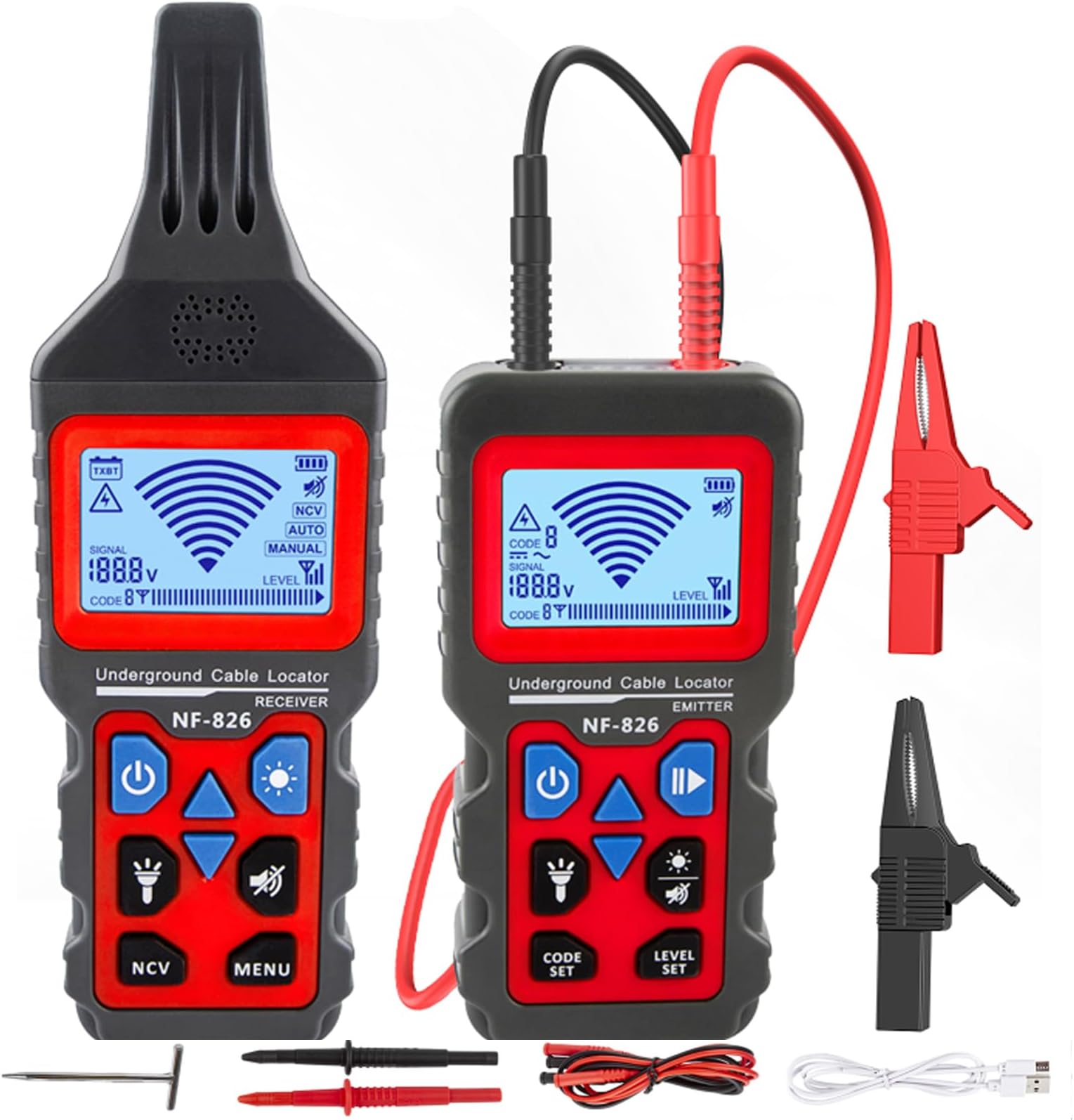
The NOYAFA NF-826 is a professional-grade underground cable locator and wire tracker designed for precise detection of buried cables, pipelines, and metal pipes up to 4 feet deep and 2000 feet long. Featuring adjustable sensitivity, silent operation, and an integrated circuit breaker finder, it supports AC/DC voltage measurement from 12 to 400V. Powered by a rechargeable 1400mAh lithium battery, it offers 6-10 hours of runtime, making it an indispensable tool for electricians, network installers, and DIY professionals aiming to save time and avoid costly damage.


| ASIN | B08CKFKX7N |
| Best Sellers Rank | #8,794 in Industrial & Scientific ( See Top 100 in Industrial & Scientific ) #12 in Network & Cable Testers |
| Brand Name | NOYAFA |
| Color | Black, Red |
| Customer Reviews | 4.3 4.3 out of 5 stars (1,193) |
| Included Components | NF-826 |
| Item Dimensions | 1.77 x 1.3 x 4.72 inches |
| Item Weight | 1 Pounds |
| Manufacturer | noyafa |
| Measurement Type | Voltmeter |
| Minimum Operating Voltage | 12 |
| Model | NF-826 |
| Part Number | NOYAFA |
| Power Source | Battery Powered |
| Specification Met | CE |
| Style Name | portable |
| Unit Count | 1.0 Count |
| Upper Temperature Rating | 40 Degrees Celsius |
W**.
Works to locate galvanized water pipes, but there is a caveat.
I don't have a locator wire on my galvanized water pipes, and unfortunately, a pipe sheared off in an area that would cost thousands of dollars to open up and fix. So I wanted to trace the pipe with this locator. I pushed the included ground rod into the moist sand near the pipe, clamped the black clamp to the ground and the red clamp to the pipe itself (used sandpaper to ensure a good connection). I turned on the transmitter, pressed the transmit button, then walked around using the receiver to try to find where the pipe went. Nope—didn't work at all. I was disappointed and considered returning it. I then looked over the settings of the transmitter itself and noticed it had a code set button. What are these mysterious codes, you ask? I searched the manual and was still dumbfounded because I didn't find a single reference to what that code set button did. I suspect it sends out a different type of signal—different frequency, different waveform, etc.—because once I changed the code from A to E, Bob's your uncle, the receiver started beeping like a Star Wars robot, telling me where the pipe was. I found that when the pipe is over 3 ft deep, the number displayed will be something like 59, and moving to the left or right, this number will drop, and there is a change in tone. It was well worth the price to me; I just wish they had a better manual.
P**R
Works like it should.
This is actually a great product for the price. I needed to find my sprinkler wires and this worked like I hoped it would. The noise it makes is very irritating but I can deal with it. Read the directions and practice with an extension cord.
A**V
Worked really well! Very Happy with it.
This system does work quite well, and worth it for repairing our dog fence. A few things I figured out helped me a lot to use it. 1. Read the manual. I do have some experience with electronics, but I did find the diagrams to be a little small to see clearly. The text we pretty good, however. 2. The quity of the electrical connection to the buried wire is critical to its operation. Can't say this enough. Sloppy or loose connections won't do! The alligator clips supplied are suprisingly good quality, but even so, just wiggling the clip connection produced a wide range of signal quality. My fix was to eliminate the supplied alligator clips and cables, and just make short adapter wires with banana plugs to plug directly into the source device and the system ground and the two fence wires where they connect to the control box. So much better!! You can buy banna plugs for a few $ on Amazon, Parts Express, etc. I had a few false starts until I did this. 3. I plugged the transmitter into a charger to be sure I always had a strong signal. Set the output to its maximum, and start the transmitter (there are two actions, one to turn on power, and one to transmit!) 4. Tape the receiver to a piece of wood, broomstick, etc. so you can walk with it and keep the antenna very close to the ground. The Antenna 'snout' seems to most sensitive in the direction its pointed, so point it at the ground, don't waive it in the air. For precisse location, point it vertically at the ground. The signal strength meter and audio DOES work well, and it reads highest when nearerst the wire underground. 5. Keep the sensitivity on the receiver just high enough to receive the signal reliably. This is the most accurate. If you are searching for something when you have no idea where to start, then increase the sensitivity. 6. First, check that the pair of wires leading from the control box to the perimter re intact. To do this,connect the source to one of the wires leaving the control box (and the ground of course), and trace the wire to the fence perimeter looking for breaks. If none are found, THEN connect the device to the OTHER wire and check that. For me, these wires were intact and I could see that one went right, and one went left around the yard. Start nearest the source - If you can see the wire exit the house, start there. The receiver would be responding strongly there, if it isn't, stop and check the connections and that the transmitter is transmitting. 7. I decided to keep them both connected, and traced the wire's path around the yard. If there was only one break, I would not have detected it, as I have the transmitter conncted to both ends of the loop (so both sides of the break would have had a signal). If that happened, I would have just connected the transmitter to one of the loop wires and started again. I know we had or yard aerated twice, so I guessed there might have been more than one break so I just made my way around the loop. 8. I detected and located one break with this setup (both wires powered), which meant thatere must be another! So I apprached the area from the other side where I had signal and found another dead spot, indicating a break. The two breaks were about 20 ft apart and under our garden (hmmm..). We decided to re-route the wire in this area, as we put in a larger garden, so the repair was straightforward using some new 14 gage stranded wire and waterproof wire nuts. Total detection time was about an hour including making come test cables. Next project is figuring our where some wires go in our house...
M**I
Time saver
This thing saved me so much time, it worked perfectly as described
M**D
It works, found my sprinkler valves!.. Update, and more!
I purchased a home 14 yrs ago and have been looking for my sprinkler valves ever since. I was skeptical about making this purchase based on some of the reviews. This tool works! It took some trial and error but once I had a good understanding on how to use it (about 2 hours of fiddling arourd in my yard), it was just a matter of minutes before I located the valves. They were buried in my flower bed about 18 to 20 inches deep under a rose bush.. Power went out in several rooms in my home. I determined I had an open neutral. After ruling out a loose connection or a bad outlet/ switch I used the tracer to find a break in a neutral wire behind the wall. Again, it took some time and research but once I had an understanding of how to approach using this tool it pinpointed the broken wire
C**2
Works well on an open short.
Works pretty good, but won't show a short to ground unless the wire is completely broken. Will not show a short to ground that is tripping a GFI unless the wire is completely burned to open circuit
Y**V
Not working in underground cable
S**E
Does what it claims. I located an important TV Trunk cable in no time at all. Clamped on to the outer shield of the Trunk and earthed the other with earth stake and was able to trace cable thru 2 completely covered pits a total of about 600 meters. Add TV cable locating to its list of uses!
A**F
Ganz hervorragendes Ortungsgerät. Der Verlauf von Stromleitungen im Garten konnte mit dem Gerät sehr gut festgestellt werden.
J**E
Parfait pour détecter une coupure de fil souterrain de guidage pour robot tondeuse. A condition de pouvoir connecter une extrémité à l'appareil émetteur. Beau matériel, manuel traduit en Français presque intelligible.
O**R
Alors contrairement à certains commentaires, il y'a bien une notice en français et le câble d'alimentation est fourni. J'ai utilisé ce produit afin de retrouver un câble d'alimentation de portail électrique enterré à environ 30 cm sous terre. La détection est précise, l'intensité du signal n'est pas seulement sonore mais aussi chiffrée de 0 à 250 ce qui facilite beaucoup la localisation et de rapidement suivre les virages pris par le câble. En même pas 5 minutes, j'ai pu me rendre compte que contrairement à ce que je pensais, mon câble d'alimentation n'arrivait pas dans mon garage mais dans une boite de dérivation dans mon salon. Petite remarque tout de même mais qui est liée à la technologie utilisée, l'appareil est perturbé par tout ce qui est métallique, la distance de détection s'effondre alors du fait de la perturbation électro-magnétique de ces pièces.
Trustpilot
3 weeks ago
5 days ago