Buy anything from 5,000+ international stores. One checkout price. No surprise fees. Join 2M+ shoppers on Desertcart.
Desertcart purchases this item on your behalf and handles shipping, customs, and support to South Korea.
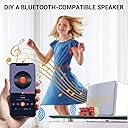
🎵 Upgrade your sound game—wireless freedom meets DIY brilliance!
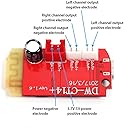
The IS Icstation Bluetooth 4.2 Stereo Audio Receiver Board is a compact, high-performance DIY amplifier module that converts wired speakers into wireless Bluetooth 5.0-enabled audio systems. Featuring dual 5W stereo output, a 15-meter transmission range, and smart power-saving functions, it supports 3.7-5V lithium batteries and USB charging. Ideal for millennial makers seeking customizable, portable sound solutions with plug-and-play convenience and crisp audio quality.


| ASIN | B0796TJ9FT |
| Brand Name | IS |
| Customer Reviews | 4.3 4.3 out of 5 stars (312) |
| Item Dimensions | 40 x 20 x 10 millimeters |
| Manufacturer | Icstation |
| Maximum Supply Voltage | 5 Volts |
| Minimum Supply Voltage | 3.7 Volts |
| Model | 1307901 |
| Mounting Type | Surface Mount |
| Number of Channels | 2 |
| Output Power | 10 Watts |
| Package Type Name | Plastic Bag |
| Specification Met | CE |
| Voltage | 5 Volts |
H**C
Summary: Great value for a dual mode, USB + Bluetooth audio module. Good performance of output power versus distortion. Bluetooth pairs and maintains connection well with both Android and iOS sources, and presents good wireless performance in crowded RF airspace and distances of at least 40 feet of line of sight. Packaging and included parts: The module comes in a static-safe bag, with supplied connectors for left and right speaker, and a battery. On all 3 connectors, one side is a JST 2-pin plug, and the other is bare wire, intended to be soldered on to a battery and speaker terminals. Given the height of the plastic connectors, and a relatively large electrolytic capacitor (not surface-mount), I would have liked to see some crush/impact cushion like foam or bubble-wrap. However, since Amazon usually ships with their own impact cushioning envelopes or box filling, I don’t see this as a big negative (though I would encourage the vendor to add some packaging to err on the side of caution) The bare wire and connectors are fairly flexible and robust, and I had no trouble soldering them to terminals Components and physical board: The module consists of some passive components and 3 main ICs: * JL AC19AP1R101 - Zhuhai Jieli Technology Co., Ltd Bluetooth IC There is not much data about this chip online. It does seem to be a popular BT IC found in many Chinese manufacturer’s products * (2x). NS4165B - 5W Mono, AB/D Class Dual mode audio amplifier This one has a full data sheet available online. The board itself appears well laid out with appropriate grounding and solder connections, especially on the connectors, were solid. There was no sign that the connector solder points were cold/loose or prone to breakage even with moderate pulling force applied to the connectors. The module claims to support a Li-Ion/Li-poly battery, directly connected to the battery terminals on the module, and that it can charge that battery when itself is connected via USB. Performance: For the purposes of evaluation, the module was connected to two general purpose (wide-range) 4 inch speakers, 4 Ohms and about 10W maximum power handling. Power was provided by the computer in the USB Audio case, and a USB battery pack (capable of 2+ Amp output) in the Bluetooth case. No Li-Ion battery was attached directly. * USB Audio The module enumerates itself as a generic audio device, with the name “JieLi BR21”. Querying capabilities shows support for a single playback mode, 16-bit, 48000HZ. Playback from various applications within Windows 10 was trouble free without stuttering. Varying volume was smooth and linear across both channels. Multiple plug/unplug was without issues. * Bluetooth Bluetooth functionality was tested with (1) an iPhone running iOS 13.1.3, and an a OnePlus 5 (Android) phone running Android 9. Both phones paired immediately with the module. Connection was stable in an environment with 6 different 2.4 Ghz channels in moderate use (WiFi). I tried it at line of sight distances up to 40 ft., and a single wall obstruction at around 30 ft. In both cases, playback continued without noticeable stutter or disconnections. Disconnecting the module from power and reconnecting - causing a BT reconnect - also worked flawlessly from both phones. On the downside, the module doesn’t seem to support APTX (the protocol for high def. audio over Bluetooth); I have used the OnePlus 5 with APTX compatible receivers and can confirm it supports it; it was unable to make the same type of connection with this module. However, I won’t consider this as a negative since it was never advertised as supported, and really it would be incredible for a module in this price bracket to support it (I believe Qualcomm charges fees for the use of APTX) * Audio output Sound presentation was clean using music with a wide spectrum. There was some clipping at the upper end of the volume range, but well within expectation for this type of module (and the amplifier used), and it is difficult - with my test setup - to attribute how much the speakers themselves contributed. The module is fairly sensitive to noise; Switching from a USB battery pack to a standard “USB charger” (the kind you plug into the wall to charge a phone), resulted in considerable noise to the output. On an oscilloscope, intermittent spikes of up to 200 mV were seen, when input was clamped to 0v. On clean power from the USB battery pack, noise spikes were less than 50 mV, and spurious (not periodic). This is fairly respectable for a module in this class. (Audibly, this was imperceptible on my test speakers) Playing back pure sine and square waves yielded fairly accurate waveforms on the scope, even at high output levels; the remained relatively consistent as power varied. There was some overshoot and distortion, but again it’s well within what I expect from this class/price-bracket of audio module. And again, in practice, the sound of the music used as test source was very clean and more than acceptable for most things one would use this module. Other notes: * The audio outputs are independent and do not share common signals; do not attempt to tie the negative (-) terminals together, in order for example, to connect to a set of speakers using a 3.5 mm Tip-Ring-Sleve (with a common ground; these usually feed into an amplifier anyways, and the signal in this case is amplified already). * Current draw from the USB port went beyond 1 Amp at high volume levels, but even with several minutes of playing, the 2 amplifier ICs remained only moderately warm. * I did NOT have a chance to test the Li-Ion battery connector/source, nor the charging capabilities of the module. VERDICT: 5 Stars.
E**B
Fantastic little cheap easy solution for decent sound. Had a pair of old computer speakers that the amp inside was bad, 4ohm 4 watt from 2004 per label on them. Decided to try this to make the speakers useful, repurpose if you will. Ingredients: using one of those cheap portable battery chargers for cell phones from local w-mart and this adaptor with the speakers, some thin wire, a single pole switch and soldering iron and hot glue for the project. Pretty straight forward, solder the power line to pins 1 and 4 on the portable battery usb type A output, this is your 5 volt dc and ground if unsure which pins look it up on web very straight forward. Took the 5 volt side from battery to switch. Other side of switch to the adaptor. (Your on off) You could go fancy here with a switch that lights up or a separate led to indicate on / off but the blue light on the adaptor is bright enough that if you mount it right you can see its on. (Tip, flexible clear plastic would direct this light to speaker cover with a pin hole to let it shine thru just glue in place, its what I did- think fiber optic) Solder the left and right speakers for positive and negative. I would not use common ground (shared negative) because I don’t think this amp is biased for that setup. Used tape to hold inside speaker then hot glued in place. Mounted the battery pack so can plug in to charge by cutting a hole backside bottom. Sounds great on my iPad, paired right up. Volume is controlled in your device. Loud enough I usually set at about 60%. Battery says 2200mah, I get about 4-5 hours per charge so very satisfied. This all said a few comments: soldering is easy enough with the proper gear. Your going to struggle if you use a cheap iron with a big tip or poor solder. I used a rather simple 60 watt adjustable temp pencil type with a rather fine point and standard 60/40 tin/lead solder. (About 30-40$ on amazon for a kit) Wire go stranded/braided not solid but keep it thin say 16-18 gauge. This not high powered and no need for heavy wire nor room to connect it. Most of the cheap on the go battery packs will work that are designed to give you extra juice for cell phone. Usually the big USB port (type A) is power out to charge your phone and the smaller mini is to recharge the battery pack. So if you go this route like I did just keep in mind the size vs what your putting it in. Have fun, great little project, took me about 2 hours making it all look like “off the shelf”.
R**S
I play around a lot with electronic modules and it’s nice to run into one that does everything it says it can. This Bluetooth amp is small, only 20mm by 40mm. It has a Bluetooth 5.2 transceiver chip and two NS4165 audio amplifier chips. Just about any speaker should work with it. It comes with 3 pair of wires with connectors, one for power and two for speakers. It has a bright blue LED to show the connection status. It blinks rapidly when searching and slowly once connected. There is also a single tone from the speakers when connection is made. It calls for a 3.7 to 5 volts power source, but is really designed to work with a single lithium battery. You need to use a protected battery or add a protection board to the circuit. If the unit powers down you need to break the power connection for a few seconds then reconnect to power on again. A switch in the circuit will do that. The board has a micro USB connector that can be used to power it and also to charge the battery. My setup was a protected 18650 battery, a power switch, and two 100 watt 8 ohm shelf speakers. In testing I used it continuously for two days. For sources I used my laptop, a Nook Android tablet, and my phone. All three paired quickly. I had no problem keeping the tablet or phone paired from 50 feet away. If the source is also Bluetooth 5 compatible, which my phone was, it also reports the battery percentage charge. Sound quality is excellent. Listening to YouTube videos or playing music the frequency response was nice and even within my hearing range. There was no change in audio level within the 3.7 to 5 volt input range. Power consumption is extremely low. Standby is less than 10ma and the unit will power down after 10 minutes of silence. Starting with a fully charged battery, at 4.2 volts, the voltage only dropped to 4 volts after 8 hours of continuous operation. Using USB power a power meter showed about 20 mah consumption. This would make it ideal to use a small flat battery if you wanted to make a miniature Bluetooth speaker project. No components got warm with with battery power or when the USB was connected charging the battery. In my opinion this is an ideal module to base any Bluetooth speaker project on. Excellent product!!
A**R
If you try to just connect the Bluetooth module to your headphones, you will quickly realize that this module's amplifier is too powerful for use with headphones. A comfortable volume for a pair of headphones from one source is extremely loud when used with Bluetooth through this module. Setting one's source to a lower volume does not resolve the issue, as then you begin to hear noise from the amplifier and the audio begins to cut out at low source volumes. However, there is a simple fix. All you need is two 1kΩ resistors. Solder them in series on your signal lines (one between left+ and your headphone's left ear input and one between right+ and your headphone's right ear input) All this does is increase the impedance of your headphones, so to the amplifier it's like running 5 watt speakers. Now you can play at normal volumes from the source and you eliminate all noise issues. After the fix, the module works wonderfully. The range is long, the sound quality sounds no worse than my phone's or computer's sound cards. The sound is noticeably bassier compared to just plugging in, but not extremely so. If the bass is a point for concern then a simple equalizer at the source would fix the issue. I didn't do anything and enjoy the bass as is. Also, the module stops sending audio when the source isn't sending, so the first millisecond of audio is cut when starting from silence. Ultimately I highly recommend this module for anyone with headphones. Using this, you can turn any wired headphones into Bluetooth headphones for around $20 In the picture is the Bluetooth module, a TP4056 charging module, and a 1.5A battery taped together and mounted using Velcro on a pair of Sennheiser HD598 SE (50Ω impedance).
S**S
I have mixed feelings about this unit... I would say the build quality is good... But the sound quality in not up to the standard... I have built many projects with similar tiny boards and have some experience what to expect. After pairing, it will automatically connects to the device seamlessly everytime. But the issue is volume is maxed out always. This bring many issue with distorted sound, power etc... I'm using this on self charging ( solar ) Bluetooth speaker build.... Apart from issues I mentioned above system works perfectly... I recommend this minding the annoyance you might have to live with.
Trustpilot
4 days ago
3 days ago