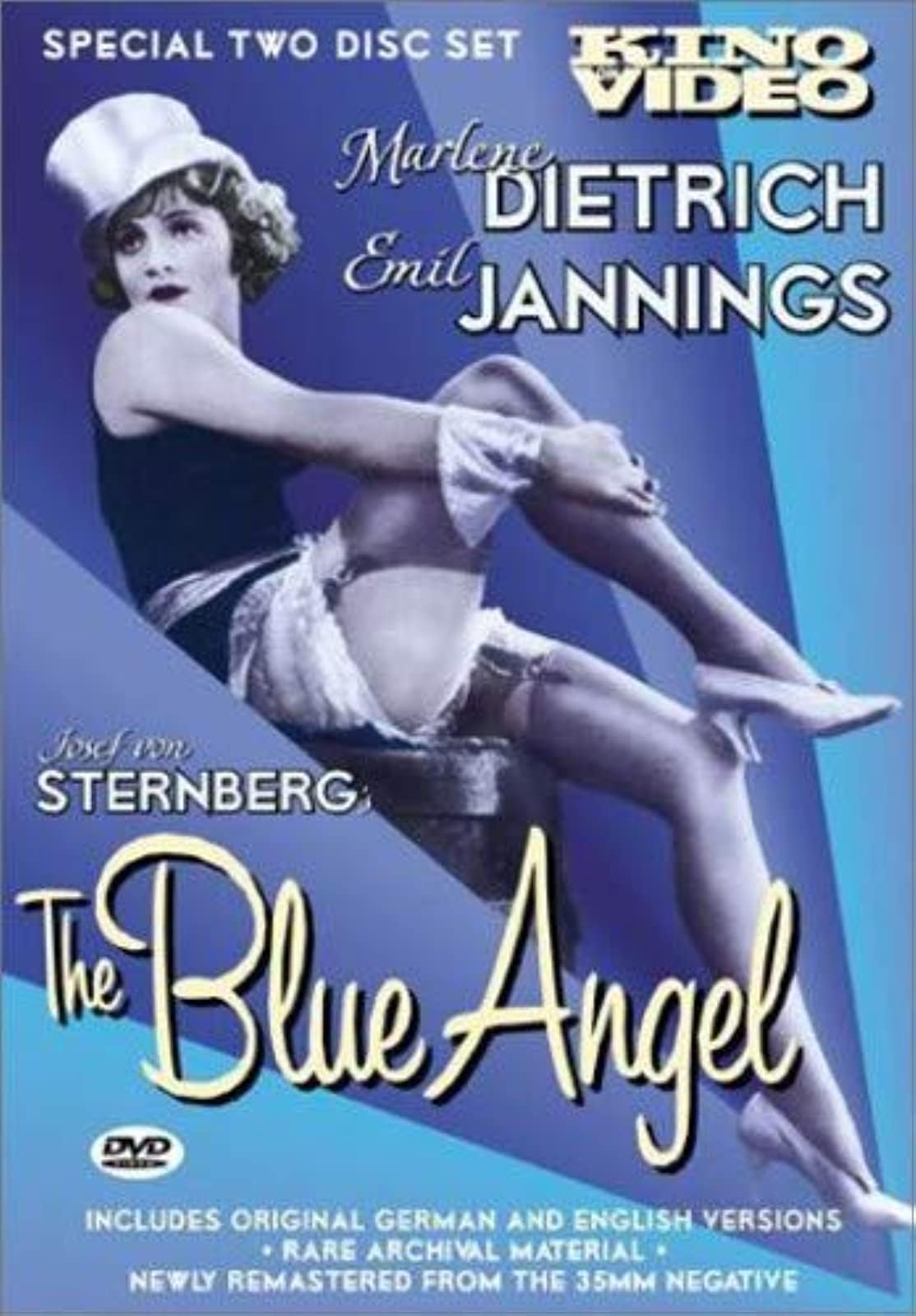
The Blue Angel
Product ID: 2989847
Details
- FormatBlack & White
- GenreDrama
- LanguageGerman
- Runtime2 hours and 4
Desertcart purchases this item on your behalf and handles shipping, customs, and support to South Korea.
The crowning achievement of Weimar cinema, the Blue Angel is an exquisite parable of one man's fall from respectability, presented in both the newly-restored German and English-language versions. Emil Jannings, the quintessential German expressionist actor, stars as Professor Immanuel Rath, the sexually-repressed instructor of a boys prep school. After learning of the pupils' infatuation with French postcards depicting a local nightclub songstress, he decides to personally investigate the source of such indecency. But as soon as he enters the shadowy Blue Angel nightclub and steals one glimpse of the smoldering Lola-Lola (Marlene Dietrich), commanding the stage in a top hat, stockings and bare thighs, Rath's self-righteous piety is crushed. He finds himself fatefully seduced by the throaty voice of the vulgar siren, singing, "Falling in Love Again." Consumed by desire and tormented by his rigid propriety, Professor Rath allows himself to be dragged down a path of personal degradation. Lola's unrestrained sexuality was a revelation to turn-of-the-decade moviegoers, thrusting Dietrich to the forefront of the sultry international leading ladies, such as Greta Garbo, who were challenging the limits of screen sexuality. Review: FALLING IN LOVE AGAIN: THE BLUE ANGEL ON BLU - I love the work of Josef von Sternberg, and the seven films he made with Marlene Dietrich rank, in my opinion, among the masterpieces of the cinema. With THE BLUE ANGEL, released by UFA in 1930, von Sternberg set the general pattern: the meticulously designed mis en scene, the brilliant use of light and shadow, the nuanced performances, and of course, the potent eroticism of his leading lady. This remarkable work was followed by six more, all released by Paramount, all superb examples of cinematic art - MOROCCO (1930), DISHONORED (1931), SHANGHAI EXPRESS (1932), BLONDE VENUS (1932), THE SCARLET EMPRESS (1934), and THE DEVIL IS A WOMAN (1935). They're unique in that they tie into each other thematically and have certain psychological and motivational aspects in common. Together, the six Hollywood films form an arc containing a distinctly personal style and sophistication to such a degree, that in order to fully appreciate one, a viewing of the other five is essential. And yet, unlike a sequel, each can stand fully on its own. Although it started the professional collaboration between its director and star, THE BLUE ANGEL is a film that stands somewhat apart from the six that came after it. For one thing, it had a prior source having been based on Heinrich Mann's 1905 novel, "Professor Unrat". It was also produced in Germany by the UFA Studios as that country's first major sound release, which lent it considerable prestige. Every aspect about the production was given UFA's first class treatment. The great Emil Jannings starred in the role of a respectable but stuffy prep school professor brought to shame and disgrace because of his infatuation with a callous cabaret performer known as Lola Lola, played to perfection by Marlene Dietrich. Her languidly erotic rendition of "Falling in Love Again" whilst sitting provocatively on a barrel, her shapely legs sheathed in stockings, is one of the most instantly recognizable images in screen history. Mann was recruited to adapt the screenplay from his novel, sharing credit with Carl Zuckmayer and Karl Vollmoller. Assigned to direct was Josef von Sternberg, an artistic genius who had a string of successes back in America at Paramount with UNDERWORLD (1927), THE LAST COMMAND (1928, also with Jannings), and DOCKS OF NEW YORK (1928) - films still regarded as being among the greatest of silent cinema. Not surprisingly, THE BLUE ANGEL made Dietrich a major star overnight, winning her a seven year contract with Paramount, and launching her on a carreer that solidified her as one of the most legendary of all Hollywood actresses. Several years ago Kino released an excellent two-disc DVD set of the film, which includes the alternately filmed English language version and an array of bonus material. This latest Blu-ray release from Kino/Lorber contains only the original German version, but scanned at 1080p resolution it edges out the DVD overall. It must be appreciated that an 83 year old film as popular as THE BLUE ANGEL comes with some minor compromises when transferred to HD. The fact that it was in demand over the decades means the camera negative got worn out long ago in making prints, and subsequently even pristine prints became rare. That said, the newly remastered Blu-ray, transferred from archival 35mm elements by the Friedrich-Wilhelm-Murnau-Stiftung, looks fantastic. The sharpness and contrast levels are consistent, with a pleasing grain configuration that, thankfully, hasn't been digitally erased. The disc thus retains a visual integrity to its source, and the movie now looks as good as it's ever likely to look. THE BLUE ANGEL is among the iconic classics of world cinema and one that I personally cherish. For connoiseurs of this film there's no question to buy the Blu-ray upgrade, however keep the two-disc set for the English version. My highest recommendation. Review: Blue Angel nearly a 100 years ago. - It is the first German sound movie.
| ASIN | B00005QW59 |
| Actors | Emil Jannings, Hans Albers, Kurt Gerron, Marlene Dietrich, Rosa Valetti |
| Aspect Ratio | 1.33:1 |
| Best Sellers Rank | #101,280 in Movies & TV ( See Top 100 in Movies & TV ) #1,010 in Foreign Films (Movies & TV) #15,784 in Drama DVDs |
| Customer Reviews | 4.5 4.5 out of 5 stars (453) |
| Director | Josef von Sternberg |
| Is Discontinued By Manufacturer | No |
| Item model number | 2254707 |
| Language | German (Dolby Digital 2.0 Stereo) |
| MPAA rating | Unrated (Not Rated) |
| Media Format | Black & White, DVD, Multiple Formats, NTSC, Silent, Subtitled |
| Number of discs | 1 |
| Product Dimensions | 0.7 x 7.5 x 5.4 inches; 5.44 ounces |
| Release date | November 13, 2001 |
| Run time | 2 hours and 4 minutes |
| Studio | Kino Lorber |
| Subtitles: | English |
| Writers | Carl Zuckmayer, Heinrich Mann, Josef von Sternberg, Karl Vollmller, Robert Liebmann |
A**H
FALLING IN LOVE AGAIN: THE BLUE ANGEL ON BLU
I love the work of Josef von Sternberg, and the seven films he made with Marlene Dietrich rank, in my opinion, among the masterpieces of the cinema. With THE BLUE ANGEL, released by UFA in 1930, von Sternberg set the general pattern: the meticulously designed mis en scene, the brilliant use of light and shadow, the nuanced performances, and of course, the potent eroticism of his leading lady. This remarkable work was followed by six more, all released by Paramount, all superb examples of cinematic art - MOROCCO (1930), DISHONORED (1931), SHANGHAI EXPRESS (1932), BLONDE VENUS (1932), THE SCARLET EMPRESS (1934), and THE DEVIL IS A WOMAN (1935). They're unique in that they tie into each other thematically and have certain psychological and motivational aspects in common. Together, the six Hollywood films form an arc containing a distinctly personal style and sophistication to such a degree, that in order to fully appreciate one, a viewing of the other five is essential. And yet, unlike a sequel, each can stand fully on its own. Although it started the professional collaboration between its director and star, THE BLUE ANGEL is a film that stands somewhat apart from the six that came after it. For one thing, it had a prior source having been based on Heinrich Mann's 1905 novel, "Professor Unrat". It was also produced in Germany by the UFA Studios as that country's first major sound release, which lent it considerable prestige. Every aspect about the production was given UFA's first class treatment. The great Emil Jannings starred in the role of a respectable but stuffy prep school professor brought to shame and disgrace because of his infatuation with a callous cabaret performer known as Lola Lola, played to perfection by Marlene Dietrich. Her languidly erotic rendition of "Falling in Love Again" whilst sitting provocatively on a barrel, her shapely legs sheathed in stockings, is one of the most instantly recognizable images in screen history. Mann was recruited to adapt the screenplay from his novel, sharing credit with Carl Zuckmayer and Karl Vollmoller. Assigned to direct was Josef von Sternberg, an artistic genius who had a string of successes back in America at Paramount with UNDERWORLD (1927), THE LAST COMMAND (1928, also with Jannings), and DOCKS OF NEW YORK (1928) - films still regarded as being among the greatest of silent cinema. Not surprisingly, THE BLUE ANGEL made Dietrich a major star overnight, winning her a seven year contract with Paramount, and launching her on a carreer that solidified her as one of the most legendary of all Hollywood actresses. Several years ago Kino released an excellent two-disc DVD set of the film, which includes the alternately filmed English language version and an array of bonus material. This latest Blu-ray release from Kino/Lorber contains only the original German version, but scanned at 1080p resolution it edges out the DVD overall. It must be appreciated that an 83 year old film as popular as THE BLUE ANGEL comes with some minor compromises when transferred to HD. The fact that it was in demand over the decades means the camera negative got worn out long ago in making prints, and subsequently even pristine prints became rare. That said, the newly remastered Blu-ray, transferred from archival 35mm elements by the Friedrich-Wilhelm-Murnau-Stiftung, looks fantastic. The sharpness and contrast levels are consistent, with a pleasing grain configuration that, thankfully, hasn't been digitally erased. The disc thus retains a visual integrity to its source, and the movie now looks as good as it's ever likely to look. THE BLUE ANGEL is among the iconic classics of world cinema and one that I personally cherish. For connoiseurs of this film there's no question to buy the Blu-ray upgrade, however keep the two-disc set for the English version. My highest recommendation.
F**R
Blue Angel nearly a 100 years ago.
It is the first German sound movie.
K**Y
A wonderful collaboration between Dietrich and von Sternberg! A Wonderful classic!
For director Josef von Sternberg, he would be known for silent films such as "Underworld", "The Last Command" and "The Docks of New York", but for this Austrian-American film director, like many filmmakers who worked in the silent era, his career would be in question with the coming of the talkies. It was when he was invited to make a film in Germany that his life would change forever. In 1929, Sternberg would create a film known as "Der blaue Engel" (The Blue Angel) and he would later have a muse who would become one of the greatest actresses of all time... Marlene Dietrich. A film that is loosely based on Heinrich Mann's 1905 novel, "Professor Unrat" (Professor Garbage). As von Sternberg would return to America, Dietrich would follow as she would have a U.S. contract with Paramount Pictures and as Greta Garbo was the Swedish sensation, Dietrich would be the German sensation and together, she and von Sternberg would work on films such as "Morocco", "Dishonored", "Shanghai Express", "Blonde Venus", "The Scarlett Empress" and "The Devil is a Woman". But before she would excel in the later films with von Sternberg, it was her very first film with him "The Blue Angel" that would make her a movie star and a singer. Interesting enough, while a German version was filmed, von Sternberg also created an English version simultaneously but the latter would require refilming of certain scenes much later. While the English-language version has been released in the U.S. courtesy of Kino Video in its regular format and also included in the "Glamour Girls" DVD set, the German version is available only in "The Blue Angel: Special Two Disc Set". It is important to note that while "The Blue Angel" is known to many as a Marlene Dietrich film but even Dietrich herself was known to remind people that she was on the bottom of the list at the time and not top-billed because the actress was not known at the time. The film's star was Emil Jannings, the popular silent star who was in the 1922 film "Othello" and F.W. Murnau's "The Last Laugh", "Herr Tartuff" and in "Faust". The actor would be the first person to receive an Oscar which he won in 1929 for "The Way of All Flesh" (1927) and the 1928 film "The Last Command" (the only year when multiple awards were issued). But it was Marlene Dietrich would win people with her performance as Lola and would cement her career as a lead actress. "The Blue Angel" revolves around Prof. Immanuel Rath (played by Emil Jannings), a professor at a local college in Germany. He is very strict and his wily students are known to make fun of him quite often. But it is when he catches the students with photographs from the beautiful Lola that angers him. Why would his students be wasting their time at a cabaret? When he goes to the cabaret one night to catch his students in the act, he runs into Lola Lola (played by Marlene Dietrich). Accidentally entering her changing room, some of the students are hiding and watching Lola Lola's interaction with the professor, as they see him as a sexually repressed man. The next thing you know, the Prof. is calmed around the cabaret singer. As Lola Lola is changing, she throws her undies out in which one of the students grab it and put it inside the Rath's front pocket. When Rath returns home, wiping off his sweat, he accidentally wipes uses her undies. Feeling ashamed that he may taken her undergarment back home with him, he returns back to the cabaret. But when people that work with Lola, especially Kiepert the magician (played by Kurt Gerron) feel that an esteemed professor has come to the Blue Angel, they give him the red carpet in hopes that they can attract other well-known people to their club. As for Rath, he has fallen in love with Lola Lola and no matter how badly the students tease him and make fun of him, he does not care. The students become such a distraction at the school that a fellow colleague tries to tell him that a person of his stature should not be with a woman like Lola but it is too late. Rath is in love, he wants to marry Lola and he could care less what anyone else thinks. And sure enough, Lola and Rath get married...but then we start to see the Prof. Rath's life crumble professionally and personally and see how people including Lola react around him. How a man's morality is lured to the life of immorality and is led to ruin and ridicule. VIDEO & AUDIO: Before I review this DVD for its PQ and AQ, I want to remind everyone that this is an older DVD released back in 2001. With that being said, considering "The Blue Angel" is a film that is over 80-years-old, I was pretty surprised to see this 1930 film in good condition. Considering that many 1920's nitrate films did not survive, many early talkie films did not survive and because of their bad audio, not many paid attention to those movies at all. But in the case of "The Blue Angel", sure you have dust and speckles, sure you have lines and occasional flickering but the fact that the complete film is intact and still manages to look quite good for a 2001 DVD is impressive. Granted, if Kino Lorber was to release this film today, with a better remastering, especially on Blu-ray, I don't think anyone will complain. The film looks very good on DVD and I can think of any newer remastering with a higher bitrate to be a positive. As for the audio, audio is clear and heard no major warbling or hiss for both films. Audio is presented in Dolby Digital 2.0 and once again, if this film was released with a lossless soundtrack on Blu-ray, I would be impressed. But for now, the soundtrack on both DVD's are good. It's important to mention that although both soundtracks are clear for both version of the films and the good news is that the English version features a redub by Dietrich, as both films were shot simultaneously, as opposed to having different actors dubbing the main characters. But as mentioned, I hope that Kino Lorber will release this title on Blu-ray, especially since it is one of the few early talkies that is complete and in very good condition. SPECIAL FEATURES: "The Blue Angel: Special Two Disc Set" comes with the following special features: - Audio Commentary by Film Historian Werner Sudendorf - The audio commentary features Werner Sudendorf talking about the differences between the English and German versions of the film, the music and various shots and what happened to some of the talent and crew after the movie. Please note, there is long stretches of silence. - Scene Comparison - (3:18) Screen comparisons of a single scene between the German and the English version of the film and their differences and similarities. - Screen Test - (3:38) A screen test made of Marlene Dietrich in the Babelsberger Studios back in Oct. 1929. - Marlene Interview - (1:25) A 1971 interview with Marlene Dietrich in Stockholm in regards to "The Blue Angel". - Marlene Performances- (3:30) Featuring Marlene Dietrich performing "Falling in Love Again" (3:26) from a concert back in 1963 in Stockholm and a performance of "You're the Cream in My Coffee" (3:30) and "Lola" (2:14) recorded in London in 1972 as part of her "I Wish You Love" performance. - Trailers - Two theatrical trailers for "The Blue Angel". One from the '30s (3:42) and the other from the '60s (2:59). - Photo Gallery - Featuring still photographs and production stills for "The Blue Angel". - The Chronicles - A chronicle of the film being made through April 1929 through December 1930. Includes a few photos. - Facts & Dates - Text based production dates and credits. - Cast & Crew - Featuring images of the cast and crew which you can view via using your remote to go through various images. JUDGMENT CALL: "The Blue Angel" is a fantastic pre-code film in which filmmaker Josef von Sternberg combines German Expressionism but also utilizing Western sensibility in his film. And like many German films of the era, there is an air of darkness, moral descent and while it may seem as the film contains the banality of what has been done in German films, rarely do these films showcase a beautiful woman, a woman who is literally not wearing much (which definitely sent conservatives up in a tizzy) and as it was a von Sternberg film, its the unknown actress who has won the hearts of many viewers worldwide. That actress is Marlene Dietrich who didn't stick around to find out how the film would do in the box office. She packed up and left to America to embark on a career which she would be signed by Paramount and would headline many more films after "The Blue Angel". First, the performance by Emil Jannings is wonderful. As Dr. Immanuel Rath, he is your professor that is always strict and one who will not put up with anyone's guff. He is an intellectual and he is proud of his role as a professor at the local college. And as someone would think that Jannings is a man who is so strict and possibly sexually repressed, he is a man afterall and that is where is naivety gets the best of him. For an intelligent man, he has made a bad/desperate decision to go after a woman who probably has been around the block many times and a woman who literally offers nothing to him intellectually but perhaps only sexually. If not sexually, just a woman who appears to accept him for how he is and a man who has dropped his guard for the sake of companionship. As a viewer, you can sympathize with his decision. Many of the young men can only dream of being with Lola, but now this man is with the beautiful Lola. And it is Marelene Dietrich who is able to take the role of Lola Lola and give us a sense of intense sexuality and domination. From the moment Dr. Rath proposes to Lola and you hear this devious laugh, it is like the snake who has convinced Eden to take a bite of the apple, but in this case, it is Dr. Rath who chose to go the path of Lola, despite being warned and now she will take him on this journey to moral descent and over the years, we see this distinguished professor go from a strict intellectual to a ridiculous clown. No money, no respect and even lost any sympathy from Lola and those around him. And this is where Josef von Sternberg is able to capture with efficacy, the destruction of a man, all decency stripped and you can only watch and realized that this man, blinded by his love of wanting to be loved, wanting to find a beautiful companion, has literally thrown everything in his life that is decent, away. While the collaboration between Sternberg and Dietrich would lead to bigger things and better films, "The Blue Angel" is special for the fact that it introduced Dietrich to the world, it was an early German and English talkie but it is a film that was able to capture German filmmaking but with a filmmaker from America. "The Blue Angel" does have cinematic important and while loosely based on the more darker "Professor Unrat" novel by Heinrich Mann, the film was a big success in the box office and most of all, Paramount knew that having both von Sternberg and Dietrich together will continually bring home box office gold! And the fact that you do get both films on one DVD is awesome! It's one thing for Kino to push the English version of the film in its "Glamour Girls" DVD Box Set but for anyone who really wants to experience this film, those extra 10-12 minutes in the German version, do make a difference and you get the best of both worlds with having both German and English versions. Also, you get a release with audio commentary and special features! I can't emphasize that if anyone wants to see "The Blue Angel", the version to buy is this special two disc set. And until this release gets mentioned for a Blu-ray release, make no doubt about it, this is the definitive version of "The Blue Angel" to own. Highly recommended!
E**E
Un professeur de lycée autoritaire Herr Rath (Emil Jannings), vieux célibataire endurci, est terriblement détesté par ses élèves. Ceux-ci fréquentent souvent une taverne "L'ange bleu" où se produisent des artistes féminines un peu lestes. Il les suit pour les morigéner et tombe sous le charme de la chanteuse sur scène : Lola Lola (Marlene Dietrich). Elle interprète en tenue légère "ich bin von Kopf bis Fusz auf Liebe eingestellt" (je suis faite pour l'amour de la tête aux pieds). Dès lors le vénérable professeur, fou amoureux, va changer de vie. Révoqué de son lycée, il épouse Lola Lola et tente de devenir clown pour la suivre dans ses tournées. Il suit une véritable descente aux enfers, de lui-même, et se complait dans sa déchéance. Fou de jalousie, voyant son épouse succomber aux avances d'un gommeux français (Hans Albers), il s'enfuit dans la nuit et se réfugie dans son lycée pour y mourir. A l'origine, la véritable vedette de ce film tourné en 1930 à l'UFA de Babelsberg, devait être bien ce premier rôle tenu par Jannings, mais l'impact de la présence de Marlene fut tel que ce fut le véritable point de départ de sa carrière. Elle a alors 28 ans et va devenir une sorte de sex-symbole pour cette génération. Le réalisateur Josef Von Sternberg est juif et farouchement antinazi. Il va emmener sa vedette avec lui aux USA et tourner avec elle encore six autres films. Il faut dire que la société Paramount qui les engagea cherchait une rivale à Greta Garbo. Il est aussi à noter que Marlene toucha 40 fois moins que Jannings pour ce film. Ce dernier d'ailleurs ne l'appréciait pas énormément. La copie proposée a été restaurée, l'image est donc correcte. C'est une VO en allemand avec sous-titres en français. En bonus une fiche historique bien intéressante et des filmographies. Ce film doit absolument faire partie d'une DVDthèque idéale.
F**O
Bel doppio DVD e con in più l'introvabile versione tedesca (girata in contemporanea a quella inglese ) del film. consigliato
J**Y
...Excellent quality and great to have both versions of this great classic. This movie excels in historical significance in so many ways...shooting a German language and an English language version at the same time...Marlene Dietrich becoming a great star who would move to America as the Nazi's were rapidly gaining power and thinking it would end badly...Emil Jannings was a star too but stayed and would be in 3rd Reich era German movies until the coming war was lost...the German cabaret scene of the time...etc. You could probably make a university course on this movie.
A**R
This film is fascinating for many reasons but certain adjustments are necessary, first it was one of the first “talkies” and that accounts for the constricted sound quality, the limited but acceptable quality of the film, and directing style in transition from silent to talkie. Blue Angel was filmed twice concurrently, once in English and once in German, this review applies to the German (considered the best version) with sub titles. However with minimal adjustment for social morals of the late twenties and the film is thoroughly engrossing. Emil Jannings as the tentative Professor Rath teaching at a boy’s prep school, pathetically guarding his authority as a teacher is a beautifully acted portrait of a man descending into degradation and despair. Lola as acted by Marlene Dietrich in her first and most unforgettable talking role is to my mind a wilful and thoughtless young woman. There is more of Sally Bowles (Cabaret) than manipulative dominatrix. Marlene Dietrich’s screen test is fascinating as she sings “You are the cream in my coffee” sounding very like the adorable Annette Hanshawe who was at the height of her fame in 1929 (check out the CDs). Also the songs filmed in 1972 show the astonishing beauty of the actress at the age of 71, almost more striking than her more plump appearance in 1929. Don‘t be put off by the 1929 date, this film is timeless.
H**S
Great quality movie and sound considering age of film. Also nice to have English subtitle option. Blue Ray format also great.
Trustpilot
4 days ago
5 days ago