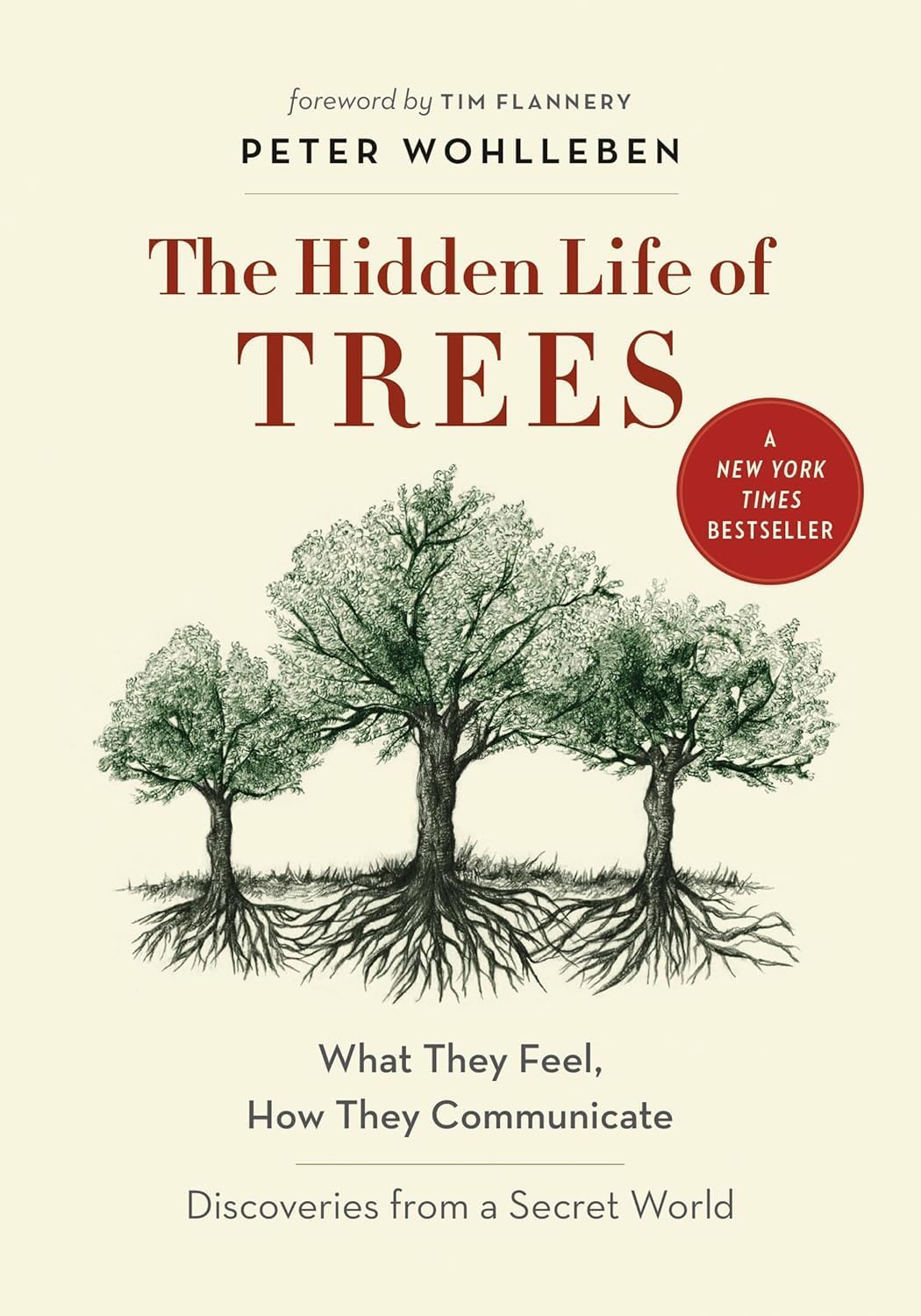
The Hidden Life of Trees: What They Feel, How They Communicate―Discoveries from A Secret World (The Mysteries of Nature, 1)
Product ID: 33324963
🌳Nature's Network
📚Knowledge Hub
🔍Insightful Discoveries
Buy anything from 5,000+ international stores. One checkout price. No surprise fees. Join 2M+ shoppers on Desertcart.
Desertcart purchases this item on your behalf and handles shipping, customs, and support to South Korea.
🌲 Discover the Unseen: Nature's Whispering Giants Await!
The Hidden Life of Trees unveils the intricate relationships and communication methods of trees, blending scientific research with captivating storytelling. This hardcover edition, published on September 13, 2016, invites readers to explore the secret world of forests and understand the vital role trees play in our ecosystem.


| Best Sellers Rank | #4,185 in Books ( See Top 100 in Books ) #1 in Trees in Biological Sciences #2 in Environmental Science (Books) #3 in Nature Writing & Essays |
| Customer Reviews | 4.7 out of 5 stars 13,641 Reviews |
R**)
Perfect Excellent Unforgettable
As a young lad in Germany, Peter Wohlleben loved nature. He went to forestry school, and became a wood ranger. At this job, he was expected to produce as many high quality saw logs as possible, with maximum efficiency, by any means necessary. His tool kit included heavy machinery and pesticides. This was forest mining, an enterprise that ravaged the forest ecosystem and had no long-term future. He oversaw a plantation of trees lined up in straight rows, evenly spaced. It was a concentration camp for tree people. Wohlleben is a smart and sensitive man, and over the course of decades he got to know the tree people very well. Eventually, his job became unbearable. Luckily, he made friends in the community of Hümmel, and was given permission to manage their forest in a less destructive manner. There is no more clear-cutting, and logs are removed by horse teams, not machines. In one portion of the forest, old trees are leased as living gravestones, where families can bury the ashes of kin. In this way, the forest generates income without murdering trees. Wohlleben wrote The Hidden Life of Trees, a smash hit in Germany. It will be translated into 19 languages. The book is built on a foundation of reputable science, but it reads like grandpa chatting at fireside. He’s a gentle old storyteller explaining the wondrous magic of beautiful forests to befuddled space aliens from a crazy planet named Consume. He teaches readers about the family of life, a subject typically neglected in schools. Evergreen trees have been around for 170 million years, and trees with leaves are 100 million years old. Until recently, trees lived very well without the assistance of a single professional forest manager. I’m serious! Forests are communities of tree people. Their root systems intermingle, allowing them to send nutrients to their hungry children, and to ailing neighbors. When a Douglas fir is struck by lightning, several of its close neighbors might also die, because of their underground connections. A tribe of tree people can create a beneficial local climate for the community. Also underground are mycelium, the largest organisms yet discovered. One in Oregon weighs 660 tons, covers 2,000 acres (800 ha), and is 2,400 years old. They are fungi that send threads throughout the forest soil. The threads penetrate and wrap around tree roots. They provide trees with water, nitrogen, and phosphorus, in exchange for sugar and other carbohydrates. They discourage attacks from harmful fungi and bacteria, and they filter out heavy metals. When a limb breaks off, unwelcome fungal spores arrive minutes later. If the tree can close off the open wound in less than five years, the fungi won’t survive. If the wound is too large, the fungi can cause destructive rot, possibly killing the tree. When a gang of badass beetles invades, the tree secretes toxic compounds, and sends warnings to other trees via scent messages, and underground electrical signals. Woodpeckers and friendly beetles attack the troublemakers. Forests exist in a state of continuous change, but this is hard for us to see, because trees live much slower than we do. They almost appear to be frozen in time. Humans zoom through life like hamsters frantically galloping on treadmill, and we blink out in just a few decades. In Sweden, scientists studied a spruce that appeared to be about 500 years old. They were surprised to learn that it was growing from a root system that was 9,550 years old. In Switzerland, construction workers uncovered stumps of trees that didn’t look very old. Scientists examined them and discovered that they belonged to pines that lived 14,000 years ago. Analyzing the rings of their trunks, they learned that the pines that survived a climate that warmed 42°F, and then cooled about the same amount — in a period of just 30 years! This is the equivalent of our worst-case projections today. Dinosaurs still exist in the form of birds, winged creatures that can quickly escape from hostile conditions. Trees can’t fly, but they can migrate, slowly. When the climate cools, they move south. When it warms, they go north, like they are today — because of global warming, and because they continue to adapt to the end of the last ice age. A strong wind can carry winged seeds a mile. Birds can carry seeds several miles. A beech tree tribe can advance about a quarter mile per year (0.4 km). Compared to trees, the human genome has little variation. We are like seven-point-something billion Barbie and Ken dolls. Tree genomes are extremely diverse, and this is key for their survival. Some trees are more drought tolerant, others are better with cold or moisture. So change that kills some is less likely to kill all. Wohlleben suspects that his beech forest will survive, as long as forest miners don’t wreck its soil or microclimate. (Far more questionable is the future of corn, wheat, and rice, whose genetic diversity has been sharply reduced by the seed sellers of industrial agriculture.) Trees have amazing adaptations to avoid inbreeding. Winds and bees deliver pollen from distant trees. The ovaries of bird cherry trees reject pollen from male blossoms on the same tree. Willows have separate male trees and female trees. Spruces have male and female blossoms, but they open several days apart. Boars and deer love to devour acorns and beechnuts. Feasting on nuts allows them to put on fat for the winter. To avoid turning these animals into habitual parasites, nuts are not produced every year. This limits the population of chubby nutters, and ensures that some seeds will survive and germinate. If a beech lives 400 years, it will drop 1.8 million nuts. On deciduous trees, leaves are solar panels. They unfold in the spring, capture sunlight, and for several months manufacture sugar, cellulose, and other carbohydrates. When the tree can store no more sugar, or when the first hard frost arrives, the solar panels are no longer needed. Their chlorophyll is drained, and will be recycled next spring. Leaves fall to the ground and return to humus. The tree goes into hibernation, spending the winter surviving on stored sugar. Now, with bare branches, the tree is far less vulnerable to damage from strong winds, heavy wet snows, and ice storms. In addition to rotting leaves, a wild forest also transforms fallen branches and trunks into carbon rich humus. Year after year, the topsoil becomes deeper, healthier, and more fertile. Tree plantations, on the other hand, send the trunks to saw mills. So, every year, tons of precious biomass are shipped away, to planet Consume. This depletes soil fertility, and encourages erosion. Plantation trees are more vulnerable to insects and diseases. Because their root systems never develop normally, the trees are more likely to blow down. From cover to cover, the book presents fascinating observations. By the end, readers are likely to imagine that undisturbed forests are vastly more intelligent than severely disturbed communities of radicalized consumers. More and more, scientists are muttering and snarling, as the imaginary gulf between the plant and animal worlds fades away. Wohlleben is not a vegetarian, because experience has taught him that plants are no less alive, intelligent, and sacred than animals. It’s a wonderful book. I’m serious!
#**E
My life is forever changed
Wow, one of the most fascinating introductions EVER. Facts and science are woven into a narrative that captivates the heck outta me. The eco-dynamic system of connection with each other and nature, the world of trees is magical to me in The Hidden Life of Trees: What They Feel, How They Communicate―Discoveries from A Secret World (The Mysteries of Nature, 1), by Peter Wohllebe because it's so unreal yet scientifically facts. Living through Derecho 140 mph wind storm in the midwest included generations of trees. Over 60% of the city’s trees are either gone or dying and require removal. The undertaking to plant more is enormous to begin developing a new canopy over many many years. I was attracted to this book imagining there might be something I could learn to relate to the worst land storm in history's death wind through so many trees especially. This book taught me trees are so incredibly intelligent that they will release extra seeds in the tomb of a crisis like ours to repopulate. They'll strategize the entire regrowth. They talk to one another. Yes, they communicate. Not the loner street trees. Sad for the Right of Way variety after reading this book. But, the wild trees. I'm amazed at the dynamic existence of so many varieties. I recollect people saying to me, adults when I was small, don't pull off leaves. How would you feel if someone did that to you? Now, this makes total sense. One of my best friends is a tree expert. Even has a small tree farm in his backyard. Grows special variety over several years and finds homes for them. Like at arboretum or parks. Not even John knows some of these incredible facts. I’m excited for you him to read and discuss. What you can expect from this book is not only facts and details, but the truth about nature having a sense of community and animation in ways that will truly amaze you. Finding out trees can cause their leaves to become toxic when Giraffes eat them was a little freaky. And, the scent omitted informs other trees downwind. So they do similarly. And, the Giraffes know what up so they seek unsuspecting ignorant trees upwind who will be oblivious... Crazy right? This book is so fantastic on audio I didn't make it past the introduction before ordering a hardcover via Amazon. Borrowed on the Overdrive app from the library, but can not resist adding this to my library collection to share for years to come. My life’s been dedicated to stewardship of nature. Reusing resources to help keep things from landfills. Creating less waste. Conserving resources. Enjoying. Learning and being a part of. Like, created Pollinator gardens. SO many bees visit, plus butterflies and other insects. Never have I ever experienced nature in the same way as in this book. The added depth of perspective will help me nurture trees newly, as well as my gardens. Find new ways to nurture stewardship. I've been trying to figure out why this book is so fascinating to me. I think knowing trees are alive, but not an insect or animal or any number of creatures. I know they live, but until this book had no relation to them as communal, bright, interesting, intelligent, and creatively complex communicator beings. I like the essence of a wild tree is deliberate, paced slowly, determined, and communal. I think we can all use friends and family like this who support us. Human being's identity of what intelligence is confronts, for me, intelligent design at a whole new level upon reading this book. The section I recollect on communities fostering trees in ways that invite them to thrive communally provided incredibly touching information that made me wanna foster similar outcomes. Read the book how you can, too :) With human beings requiring so much of the earth's resources for wood, we have surrendered qualities for generations to come and will miss out on them except in what's affectionately named vintage items. Or repurposed furniture to homes. Remembering as a child being able to access materials like mahogany and cherry easily. Now, it's specialty order or limited supply. Particleboard and pressed wood are skyrocketing in price. With new developments in technology and the ability to 3D print homes, I predict the future of trees is uncertain. The ability to change the trajectory of our future with evidence laid out in scientific facts like these could provide the ideas we need to thrive with our three friends together in ways that build a better future together, in my opinion. ⭐️⭐️⭐️⭐️⭐️💯
D**.
Cute and Informative
This book gives a good overview of interactions among trees and between trees and other organisms in Central European forests. It is well written and easily readable. The author gets his points across without getting bogged down in scientific jargon. It is a good, relaxing read that will help you understand his forests. To me, it was particularly interesting how parent trees limit the rate of growth of their children and how trees can feed other trees, even if they are just stumps. Having said that, a potential buyer should be aware of a few things when making a decision: The types of forests described in this book are somewhat limited. It describes forests with relatively few species of (mostly deciduous) trees, such as are common in northern Europe and northern North America. For example, I read a book about tropical forests before a trip to Costa Rica. Unlike forests described in this book, tropical forests have many, many more species of trees in a given area. The young are most successful when they grow as far from their parents as possible, so there is likely no direct interaction after the seed is released. And, interactions between organisms don't seem as amicable. Such as, a strangler fig will use another tree to start its life, and then it kills the original tree, leaving the fig tree looking like it is on stilts. I think this book should have been called the "Hidden Life of Deciduous Trees (and some conifers)" to be clear, or at least mentioned in the subtitle. It doesn't make it a bad book, it just should be clearly specified. Also, the author often attributes emotions to trees. I think the reader should be careful here. I recently read "How Emotions are Made," by Lisa Feldman Barrett. I took a couple relevant things from that book. First, it is really important to define what is meant by emotions, different people define emotions very differently. Based on Dr. Barrett's definition of emotions, trees would not experience emotions, because they would not have developed the concept of specific emotions. But, even if one uses a broader definition of emotion than hers, there is another problem. That is, second, it is unwise to assume the emotions of another organism based simply on observing behavior. Just because a particular emotion would sometimes be expressed in a certain way in you or me, doesn't mean another is expressing that same emotion just because we observe similar behavior in them. I think the greatest benefit that the emotional descriptions in this book offer are that they give us readers emotional concepts, which we can then use when we visit a forest, so we can appreciate the forests more. And, I think that is plenty. So, I recommend reading the book, just be aware of what to expect, so you will appreciate it.
D**N
Study
Great read! Changed my perspective of trees and how they are intelligent species! Looking at a tree won’t be the same. Makes you understand and appreciate trees for their knowledge retaining systems, family orientation, and their survival tactics!
R**G
Trees Communicate
Why people have to give a book one star only because it's "above their understanding" is beyond me. That one star should go to the reviewer, not to the book. Then, about five people gave this book rave reviews accompanied by two stars. ????? And then there were reviewers who first cited their multiple PhD's, BS's and Masters degrees, to show they are REAL scientists, and then went on to say that that is why they are all rattled and horrified by the simplicity and anthropomorphism of Wohlleben's approach. Let's please grow up. A grey and dour, soulless "scientific" approach to a subject will not engage average mortals, and those are the ones who need to know. The wish for such an approach doesn't identify you as a scientist either; it identifies you as a grey and dour, soulless person with no interest in mystery. This book is not written for you. This book is written for normal people, who are interested in trees and nature and not afraid of learning facts that upset their worldview, and who are willing to accept that there are things we cannot, yet or fully, explain. This relatively recent field, of the interconnectedness of trees and of the forest as a giant organism, is unbelievably interesting and will, no, must, have far reaching consequences for our thinking about the environment, and by extension for our thinking about ourselves. I am not a scientist, and I don't care for a purely scientific approach to life. I am also not afraid of anthropomorphism - it is a valuable tool for us humans (anthropoi) to understand the world around us. Already 2,500 years ago Protagoras revolutionized philosophical thinking by positing that "man is the measure of all things". For most of us, that will remain the norm for a long time to come. Also, trees are not aliens, they are more like us than we think. There is a lot in the trees' behavior that they share with us. The need to survive powerfully and procreate is common between man and tree. Wohlleben writes beautifully and lyrically. That is not a sin and doesn't take away from his being a consummate scientist. One can be a scientist and at the same time be in awe of mystery. In a very recent interview with The Guardian, Wohlleben said "scientists over the last 200 years have taught us that nature works without soul.” This book successfully discredits that approach, which has been ready for the scrap heap for too long. This is a terrific book that can be fascinating to scientists and non-scientists alike. It has enough footnotes to allow for wider study of the subject for the intellectually adventurous. The collaboration of Wohlleben and Dr Suzanne Simard of the University of British Columbia in Vancouver, Canada has led to a TV documentary on the subject, "Intelligent Trees". The DVD is available on Amazon.
M**M
Fact. Trees network. They are alive. They have an electrical impulse that passes through the roots.
I am truly loving this book, even becoming emotional knowing I’ve always had this connection to trees, knowing they are alive. I’ve always been able to feel their energy touching them. Becoming more educated with facts on trees is something I feel everyone should know and understand. Only at the beginning of the book and already impressed. A spruce in Sweden is more than 9500 years old. A giraffe starts eating an African acacia the tree releases a chemical into the air that signals that a threat is at hand as the chemical drifts through the air and reaches other trees. They smell it and are warned of the danger even before the giraffe reaches them. The electrical impulses that passed through the roots of trees move at the slow rate of 1/3 of an inch per second trees 🍃 communicate and electrical impulses are just one of their many means of communication.
D**R
Fascinating Book
I picked this book up from my local library, and rapidly discovered that it was a remarkable book and a joy to read. From Peter Wohllenben’s discussion of the “Wood Wide Web”, to his explanations of the amazing processes of life, death, regeneration, and of course, communication, this book is truly a paradigm-smashing work of interest to anyone with an interest in trees, whether as a forester (as is the author), or as a landscaper, or anyone who just enjoys walks in the woods. It may strike some as odd, to discuss the “feelings” of trees, but after reading this book the reader can have no doubt trees can, indeed, feel, and they express those feelings in many different ways. The author, Peter Wohlleben, is a German forester, and that may also seem an odd occupation for the author of a book about tree communication, but Wohlleben clearly has strong feelings for trees, and his work with trees has led to a much greater understanding of their “inner life” than is held by the casual tree observer. The book is beautifully written, and though translated from the original German, the descriptions of trees are truly enchanting. After reading this book, enchanted forests such as the ones in the Lord of the Rings, where the trees can see and hear and communicate with one another, do not seem so far-fetched. As Wohlleben points out, trees are not well-understood by humans due to the fact that trees live on a completely different time scale than humans. Some trees may live over 100 times as long as the average human lifespan, and for them, transmitting information can occur very slowly, at 1/3 of an inch per second for the electrical impulses that pass through the roots of trees, versus milliseconds for the electrical impulses in humans and other animals. A human being can be born, live a long and full life, and die when old, while a tree that begins at the same time is still experiencing its childhood or early adolescence. But trees communicate in many different ways, not just by electrical impulses. They may use the senses of taste and smell by releasing chemicals into the air. This may be done to warn other nearby trees to be prepared for a pest invasion, or to attract other predators that will feed on particular leaf-eating insects that may have found a particular tree attractive. Also of interest is Wohlleben’s description of trees as social beings, and he makes it clear that most trees require the presence of other trees of the same species to live a healthy and productive life. These trees, in a forest, provide nurturing of the young, and provide protections for one another. It is in the forest that tree communication is at its best. This book is truly enchanting, and will be loved and appreciated by anyone who enjoys a walk in the woods.
J**F
You'll never think of trees the same way after reading this book.
I live literally a stone's throw from thousands of acres of forest lands filled primarily with Douglas Fir and Western Red Cedar as well as Cottonwood, Birch, even the occasional Madrone trees. Before I listened to this book (then read it, and now plan to listen to it again), I thought of them simply as tall, majestic things that surround me as I engage in two of my favorite past times: trail running and hiking. Now, I can't help butfret over the trees planted along the street, with their roots trying to make their way through over-compacted soil in cramped quarters. I worry about the future of the bent, warped, not-growing perfectly straight to the sky trees because I know that they are more likely to be brought down in a wind storm than their straighter neighbors. I think about the bark beetle. I feel a little bit sad about the pitch dripping down the damaged trunks, the black on the bark from root rot. I think about the birds that I love damaging the bark of trees and allowing fungus and/or other organisms in that might hurt the trees. Truly: I think of them as human-like, super slow growing organisms. And I like thinking about them like that, even though I question the idea that trees can think. Author Peter Wohlleben loves trees. What I've learned from reading his book has made me love them too. I especially enjoyed learning about the super slow rate of growth of trees, how mother trees provide little light and protect the small trees (her babies!) until one day...she dies (falls down dead), giving them a chance to, even they don't dawdle as youngsters tend to do, grow in the available sunlight that will soon, once neighboring trees fill in the empty space by extending their branches. I loved learning about the many diseases and other problems that can kill trees, the amazing skills they possess (putting out chemicals to make creatures that eat their leaves leave) and every bit about the way they help trees of the same species thrive. I could go on and on, but what I most want to say about this book: it's one of my all-time favorite non-fiction books about nature. It has made me appreciate trees more than I ever would have had I not read it. It has made me love trees! Also excellent: Tides by Jonathan White, Gathering Moss by Robin Wall Kimmerer and The Giving Tree by Shel Silverstein.
E**H
Really, how can trees have hidden lives?
This book is a fantastic read. Written in a very easy, matter of fact style and packed full of amazing observations and scientific facts. It has given me a new, stronger understanding and respect for these sentient beings and a desire to help them which in turn will help us and this little rock of ours, 3 down from the sun.
K**R
It's was a grateful reading. I hope to work with trees one day, and it was inspiring read this book.
It's was a grateful reading. I hope to work with trees one day, and it was inspiring read this book.
K**R
Beautiful insights, Uplifting
Much of this information I've known for many years as an organic Gardener. That our species connections to the web of life is critical to our health and development continues to gain understanding and acceptance. Thank you Peter Wohllebens for your courage to diverge from the typical, limited forestry mindset that focuses on maximizing harvest revenues. Your discoveries have gained traction and enabled a growing understanding of our interdependence with nature.
R**R
Great book for the interested
I have read around 50 pages so far. It is perfect for people interested in forests trees and nature. It is very easy to read with chapters each around 4-5 pages and gives very interesting facts about trees and forests. Minus points for amazon sticking two ugly stickers to the book sleeve
N**H
This is a must read, highly recommend.
This book I guess would have been perfect read in German language but in few places lost essence in English translation. 5* for the facts and science 2.5* for writing. But still this is a must read, highly recommended. This book emotionally connects us with underestimated creatures, trees. You will never view trees the same way again after reading this book. This book is about how trees communicate, nurture, and help each other when ill or upset. Trees not only try to protect themselves from the distress but warn other nearby trees about the respective attack. Neighbouring trees release chemical signals/toxins/terpens as a result, thus protecting themselves from the stress. Deadwood in forests is not waste rather luxury for nearby trees. Like symbiotic microbes in animal gut trees have symbionts living beneath soil, who not only help plant to get proper nutrition but proper communication between neighbouring trees. There are much more fascinating facts about trees which this book explains beautifully. A must read and highly recommended for tree lovers, foresters, biology students, travellers and anyone who wants this world to sustain for long.
Trustpilot
1 month ago
1 month ago