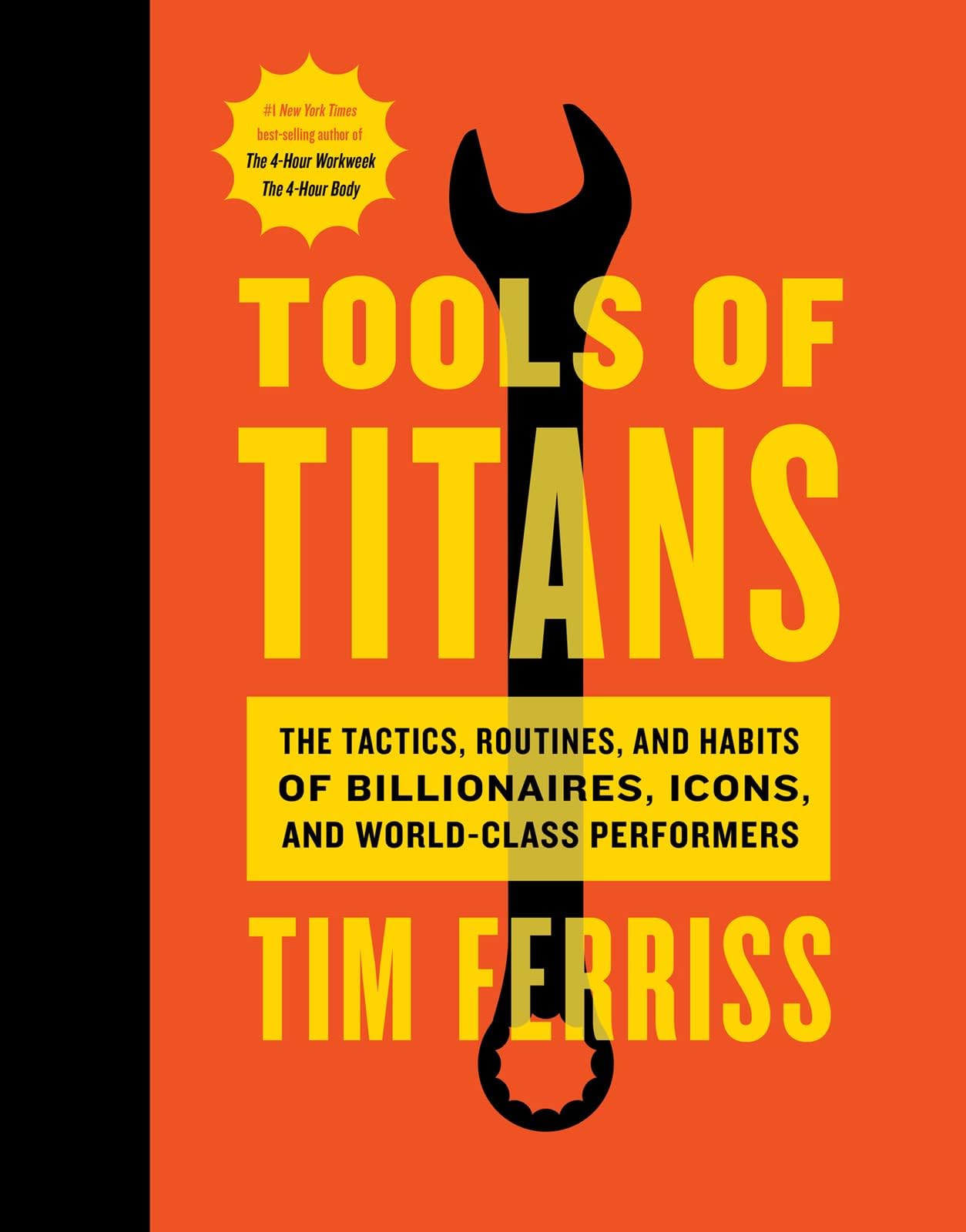
Tools Of Titans: A Comprehensive Guide To High-Performance Tools And Tactics For Success
Product ID: 36504665
💡Actionable tactics for success
📚673 pages of distilled wisdom
🎙️Insights from 200+ world-class interviews
Desertcart purchases this item on your behalf and handles shipping, customs, and support to South Korea.
🚀 Unlock the secrets of the world’s top performers — don’t just keep up, lead the pack!
Tools Of Titans is Tim Ferriss’s ultimate compendium of high-performance habits, tactics, and life lessons distilled from over 200 in-depth interviews with celebrities, athletes, entrepreneurs, and special operators. Spanning 673 pages, this best-selling guide offers actionable strategies across health, wealth, and wisdom, backed by Ferriss’s own experiments and successes. Featuring a signed edition, it’s a must-have for ambitious professionals seeking a competitive edge and authentic connection to the minds of today’s titans.
| Best Sellers Rank | #33,258 in Books ( See Top 100 in Books ) #240 in Motivational Management & Leadership #701 in Success Self-Help #739 in Motivational Self-Help (Books) |
| Customer Reviews | 4.6 out of 5 stars 9,600 Reviews |
R**S
Tim Wrote This Book So I Wouldn't Have To
On my list of "Someday/Maybe" projects was this one, innocent little item: "Distill notes on Tim Ferriss's best podcasts." Backstory: in the beginning, I didn't like Tim's podcast much, because I thought it was too long. No editing. Eventually, I realized the fault was not with Tim's approach - it was with my premise. That premise: good interviews are tight, controlled, and edited down to maximize the "pithiness factor". Sound bytes. Our culture is trained to react to the 10-second sound byte, the 140-character tweet, and the 300-word "blog post." Longer content causes our brain to burn calories. As I was awakened from the matrix, I realized these long interviews allowed Tim to dig deeper, pursue "tangents", and get the person he's interviewing to say things they might never have said in a traditional interview. Conversations. Tim Ferriss was having conversations. One day I was perusing all the show notes, looking at the guest's names, and it struck me: I had a cave full of dragon's treasure in front of me. Wide open. I was free to take as much as I could carry. That's when the idea occurred to me: it would be extraordinarily useful to comb through all this material, to sift and sort, and to distill the very best idea, tools, methods, habits, and routines into a single document. Big project. But worthwhile. There is rested, on my "Someday/Maybe" list, until an obscure day somewhere in the distant future. Then I heard Tim talking about this new project. He was going to sift, sort, organize, and summarize all this material for me! (Okay, so it's not just for me... but it sure felt that way when I heard the news!) And who better to unearth not only the obvious moments of genius, but also the more obscure moments of deeper insight, the unglamorous truths that yield exponential results, and the profound moment of insight that might easily be missed when listening to a podcast. What You Will Find In The Book Tim has divided this tome (673 pages) into three main sections: • Healthy (containing the best material regarding health, nutrition, strength training, wight loss, and healing... among other subjects). • Wealthy (insight, tools, techniques, and approaches for building one's material fortune). • Wise (how to pursue a live worth living, learn from mistakes and challenges... and summaries of the wisdom of his most sages guests). Tim suggests thinking of these three categories as the legs on a tripod upon which life is balanced. Each of the three main sections includes dozens of profiles focused on the best guests from The Tim Ferriss Show podcast scattered throughout each interview. The profiles are like "Cliff Notes" of the conversations Tim shared with each guest. These are NOT transcripts, but something mich better. These are the actionable, usable, profitable, beneficial gems sc He also includes some of his best writing not tied to a guest profile. Among my favorites: • How To Earn Your Freedom • How To Say "No" When It Matters Most • Is This What I So Feared? • Testing The Impossible": 17 Questions That Changed My Life I found the book to be well-organized and Tim's choices of who/what to include spot on. If I had written up these summaries, would I have made different choices? In some cases yes. But if this project had been left to me, there would have been a few problems: 1. It would probably have never been finished (hey, I have work of my own to do!) 2. It would have been more focused on only the things of obvious value to me - Tim's approach is undoubtedly broader, and therefore more useful to the reading public at large. 3. And finally, the most obvious problem: these are Tim's guests, Tim's articles, and Tim's ideas. If I had written up these notes, they would not have been as good. And more problematic: nobody else would have ever read them. I give the book my highest recommendation. And thanks Tim, for writing it so I wouldn't have to.
C**Z
A great book for founders
From the perspective of a VC-backed founder + also former seed investor: I just finished Tool of Titans. I bought this book on June 11th 2025 and finished it on June 25th (~45 pages a day). Over the past few months and the 20+ books I have read in my own self-curriculum to self-growth, I catch myself saying “this was the best book ever.” Tim Ferris’s book - “Tool of Titans” generally has felt like the best book so far. When I first opened the book, my first observation was around how thin the pages were. It almost felt as thin as the pages in the bible. Of which my first thought based on that observation was: “ugh, gosh. Is this guy trying to create what is the modern day bible for tech-entrepreneur-abes?” I bought this book to understand how “billionaires” think so that I could understand the rules in which to understand them, play alongside them, and ultimately beat them. Now having finished the 645 pages of this book, I walk away feeling: they are all just normal people. They all wished they “worried” less when they were younger, they all are practicing some form of “meditation” to fight their inner self-talk of doubt. Taking risks, leaning into discomfort, to hard conversations, living more authentically, reframing from people-pleasing…these are “hardships” we put onto ourselves and that rather life is so simple, to become a “titan” is so simple: it's about being led by love and curiosity. This is my first Tim Ferriss Book. Actually, this is the first anything I’ve consumed by Tim. I never wanted to buy his work because I thought it wouldn’t resonate with me given how different our identities are. He’s a presumably fit white man who went to Princeton. I am a 5’2 medium-sized east-asian woman who grew up in the Bay Area and went to Stanford. There are many things to like about this book in its encyclopedic style of short form Q&A recaps with these Titans, but what I appreciated most actually were Tim’s essays: “the lazy manifesto” and “suicide”. Those short essays / manifestos spoke to me. I’ve read a lot of books over the past couple months on my sabbatical (I am in month three) - 5,000 pages, 20-ish books (most of which are NYT bestsellers) about mindset/the brain/ego to be exact. I’ve enjoyed each book but a few stand out in having produced a “bodily feeling”: - Inner Excellence left me with what it felt like to release ego, this feeling of nakedness. I remember finishing this book on a bus ride from the airport to my friend’s apt in Los Angeles to attend a gathering of the top 100 most influential AAPI leaders, thinking…”how can I go? I feel this uncomfortable feeling of rawness.” That rawness was the temporary release of ego. This book produced that same feeling of ego-release that sometimes takes place when taking psychedelics. I realized how much I had driven by ego (self centered thoughts of “I must..”) the past few months of my founder’s journey - The Upside of Stress left me with a deep sense of relief. I felt like I finally realized how powerful our minds are and how we have choice and agency in the beliefs we choose to let guide our thoughts and actions. This book taught me the extent to how powerful “the mind-body” connection is. - Messy Middle left me with a sense of connection in the founder’s journey. That I was not alone. Scott’s way of describing feelings of the founder’s journey and all the messy turns almost perfectly encapsulated a lot of the thoughts I had in my own journey. I sometimes wonder what it would have been like to have read this book before starting my company or at least at some point when I was running it and if it would have led to a different outcome - maybe I could have been a better CEO to my team. Probably more to chew on there. Now, Tools of Titans was the book I cried to the most of, most of the crying taking place in the last fifty pages or so. Towards the end, he talks about the chapter of meeting a fan, Silas, who asks Tim to sign the book for his brother only to find out later that Silas’s brother had committed suicide shortly before and Silas wanted to have a signed copy to leave in his dead room’s brother given how much his brother loved listening to Tim. In this chapter, Tim walks through then his own battle of struggling against thoughts of suicide. For me, as I rank the 20 something books I’ve read now, I put Tools of Titans as probably #1 and the reason for it is the last two lines that Tim ends his book with: “it is my hope that when you read and reread this book, you will feel the spirit of these titans with you. No matter the hardship, challenge, or grand ambition before you, they are here. You are not alone, and you are better than you think. As Jocko would say: Get after it.” This book goes as my #1 of the books I’ve read so far because it helped me feel seen. And the chapter that helped me feel most seen, was the suicide chapter. It served as a reminder that dark thoughts are universally felt. In that universalness, we then feel connected. In all of my travel, prompted journaling, reading I’ve done over the past 3 months across Turkey, Egypt, Ironman week in Houston, Los Angeles, Bay Area, San Diego, the one prompt I never wrote about was my own battle with suicidal thoughts. When I reflect back on January to end of March 2025 as I was working through the transitions of removing myself as CEO of my company, passing the baton on to our co-founder and COO (who I respect deeply), that was the darkest moment of my professional life. The only other moment that felt that dark was more of a personal experience when a family member was battling with thoughts of suicide. Normally, I am someone who would describe myself as extroverted (almost too extroverted), happy-go-lucky, jovial. But during this dark time, I felt alone. I retreated to social conversations only with my husband. This dark period started when one of my favorite board members had abruptly left to join another venture capital firm, returning then another board member, who I deeply respect but is someone who I was intimidated by. I was scared to be honest with him, whereas with this previous board member, he had a calmness where moments of honesty felt more like brainstorming. As I reflect back, it was my own fear of being honest with this new board member that led to the need for my transition out. I was scared to admit where we weren’t thriving as a business and as a result, I was doing a greater disservice to the business. My transition out was the best decision for the business at that point in time for two reasons: 1. Deep down, I knew that our COO would be willing to serve the business’s purpose greater than me having lived the journey of the customer (and for anyone in the founder’s journey or thinking about starting a company, you need to be willing to suffer. She was willing to suffer). And 2. If the board functions as your married partner, chemistry matters and my chemistry was no longer there with this board change. The dark time was initiated when the new board member had called me and shared that in a couple months, we should decide if you are the right CEO. It was a comment made in passing, I don’t know if he remembers even saying it. But for me, that was the moment where I lost complete faith in myself. Perhaps for other founders, hearing a statement like that would have evoked a sense of: “well, I am going to prove him wrong.” For me, at that moment in time, I took it as: “I know enough about this person to know that if he is thinking that, I shouldn’t try fighting this because the thought has already been planted.” The backstory I haven’t shared is that I had worked in the past with this board member as his right-hand for almost 5-6 years. I know him well, and he knows me well and that is probably why that statement hit me harder than it should have. I am not a parent, but it felt as if at that moment in time, the person I wanted to believe in me the most, no longer did. I now know that it mustn’t have been easy for him to share that statement with me either and that he was doing his fiduciary responsibility as a board member to be tough on me. While board members are certainly not parents, the board-member to founder relationship can feel like a parental one for a first time founder - where we are seeking the “approvals” of board members. With more experience, we learn that board members, if assembled correctly, are not parents; rather they are extra guardians of the vision. Their job is to help us catch blind-spots and ultimately it is to determine when to hire/fire the CEO. The loss of faith in me, which I do not fault anyone because I was not my most authentic and honest self in the woes of the business in that January board meeting, was debilitating. Everyday after, I woke up in panic. What used to be days where I looked forward to meeting the team, to reading patient quotes and how much they valued our experience, turned into my worst thoughts of: “does the team respect me? Will they leave me?” And worst of all…”will they conspire against me?” I sleep in a room with black-out shades and every morning felt like walking with black-out shades that never left. Everything felt dimmer. My heart would race wondering…”when are they going to fire me?” I lived this for almost 3 months. The first thing I did when we announced my transition into the board member role as our COO stepped into the CEO role was go to the doctor because my armpits/lymph nodes were so swollen it hurt to exercise. I thought I had cancer. (Isn’t that crazy?) I remember one of our physician board members texting me on a Friday…”can you share the number of the new board member’s number? He emailed me to connect. It probably isn’t about you but about the election.” I shared his number, but I knew that it was about me. I actually am grateful for that text from the physician board member because it helped prime me. So when the Wednesday call happened announcing the mutual consensus for the need to consider a CEO transition, I already knew. I wasn’t surprised. Rather, the first thought that came to mind was: relief. Relief was the #1 feeling I had. Leading up to that call, I called one of my best friends - someone who now I only cherish even more - out of emotional desperation. For the past few weeks leading up to that call, I started developing a thought that was only becoming louder and that was: “I don’t want to live anymore.” It had started as a very slow comment - maybe only presenting itself every now and then. But towards those last few weeks, It had started becoming louder and louder to where on my commute to work, I would imagine what it would look like to jump into the train tracks. I don’t think I ever would, but I hated that the thought even surfaced. Now three months post this board transition and grateful for this transition, I realize how devastating of a thought that is to have especially for all the love that surrounds me with my husband, my family, and my friends. I look back now, and I think to myself: how tragic would it have been to off myself because of a company not working out, where we know the odds are <10% of it not working out anyways? But in the moment, the company felt like my identity, my sense of self worth, the reason that people found me interesting. That board member who gave the call saved me. As much as it was because of the self doubt I placed on myself when he had shared “his thoughts of if I was the right CEO”, he was also the one that I think saved me from what would have been months more of this sadness for a mission / purpose that no longer quite compelled me after three years of serving it. The reason why Tim’s book ranks #1 for me is because of how deeply vulnerable his own manifestos were in the book. It takes a great deal of courage to share your own bouts of doubts, let alone thoughts of suicide with others. Heck, it's taken me 7 cities, 3 countries, 20+ books, 5,000 pages of reading on the brain/mindset, to have the courage to write my own battle with those then dark thoughts. Now being on the other side, 3 months post board decision of transition, I feel so thankful for that board decision. It takes courage to walk away when you feel so easily like a quitter. The last 3 months for me have been the first time in the last 8 years where I have given myself more than 10 business days off. These last 3 months have been my own self-guided curriculum of “books” as I understand the emotions that I had to wrestle with as a founder/CEO who raised probably more venture funding than we should have during that point in time. When I was in my dark era, I had lost my will to be curious. Rather, I felt like I was in survival mode serving my ego of “how not to get fired” rather than my questions being centered around “how to best serve the mission of our company.” Stepping away was the best thing I could do for the business, but also for regaining my curiosity to live. And that curiosity has been regained. Books did that for me. Reading these 5,000 pages, 20+ books, restored my perspective so that I can be deeply curious, a trait that I have always prided myself in having. Tim’s books restored a sense of connectedness in that all of us - even the Titans - fall down and over again. That we are not alone in the inner battles of self-doubt. That “the greats”are battling their gremlins every day. The last two sentences of his book are a masterful ending and encapsulate why this books means so much to me.”
M**O
Tools of Titans is the most motivating book of the year.
I will admit, when I first heard Tim was going to release this book, my ears perked up. I was at the time in quite a funk, both personally and professionally. Having become a slave to some unproductive habits and spinning within some prehistoric negative feedback loops that felt impossible to unwind. On top of this, I have spent the last 2 years revitalizing my soul through a journey of healing from sustained trauma that imprinted me with a case of Complex PTSD. For people with this wiring, it can be doubly difficult to reprogram and dismantle self defeating beliefs and the behaviors they feed. I pre-ordered this book in the hopes that it would serve at the very least as a motivational catalyst towards implementation of subtle changes within my environment day to day. The analysis paralysis phase in which I found myself didn't lend itself very well to the monolithic task of reading this book! I blocked off 1-2 hours each day when I would consume the gems of knowledge sprawled liberally throughout this compendium. The simple task of setting aside and scheduling a date with Tools of Titans each day was the launching pad that I required in order to enter into a state of motion, as inconsequential as that seemed. And that is the magic of this book. I found that as I gained momentum and read each day, I was rewarded with actionable items that I could pepper into my routine without a lot of pressure or commitment. We are talking about things like the 5 minute journal, writing down affirmations each day, stretching, moving and forcing myself to get sunshine when possible. I did all of this in the kindest way possible, avoiding any impulse to punish myself when I failed, and instead celebrating each small victory. I will admit, I wasn't sure whether the book would fulfill my idealized objectives, but as I continued to flow through the motions, the re-wiring started to become apparent in various facets of my life. From the book and all the people represented there, I began to feel a sense of encouragement which then translated into satisfaction, accomplishment and discipline. All coalescing towards the strength required in order to pull myself out of the slippery rut I'd descended into within the last couple of years. In the month that I've dedicated towards self actualization, I've managed to reset my brain, write daily in my journal, collect ideas for future endeavors, reentered my body through a daily yoga practice that starts at dawn every day and transitioned out of reactionary defense physiology. This has allowed me focus on regaining my health and mobility which directly sustains a balanced mental state. I started to feel myself growing out of the discomfort of doing things that I didn't really want to do, but knew were necessary medicine. I managed to complete tasks that I had been procrastinating on for months due to physical limitations and lagging energy. I have been unemployed, (mostly due to burnout) for about 4 months and living on a dearth of savings feeling quite irrelevant, expendable and kind of hopeless. I had little motivation to better my situation. I became somewhat addicted to digital media having for over a month been immobile due to a back injury and having little in way of productivity. I've slowly weaned myself off this nefarious internet addiction, using some of the principles in this book, mostly through the sense that what I am doing now is tangible and measurable vs. the nebulous engagement with non-productive content on the web.We have all lost hours to aimless browsing so I know I'm not the only one who has struggled with this. And guess what? I finally landed a job. It is remote which is what I wanted for obvious reasons. The position aligns with my values through a philosophy known as the results oriented work environment. This basically gives me the flexibility to design the life I want around experiences instead of hoping I can just fit in the things I love around my schedule. I start next week. The position will pay just enough for me to get by for the time being, and I am banking on Ryan Holiday's advice regarding advancement through service. I am hoping, as I develop efficiency through adding layers of actionable items to my routine, that I will have the flexibility and time required to start learning about how to develop additional streams of income for myself. I have a 3-5 year plan that I think is definitely achievable as long as I am able to stay the course. I may have to get very creative, and that plan will adjust as I learn through action. I will continue to re-read and reference this book as my situation evolves since it has been such a source of inspiration to me during this trying time. Thank you Tim, for condensing the takeaways derived from these influencers in an easy to understand, palatable and actionable manner. I've benefited tremendously from your podcast and from Tools of Titans. ~Monica L.
M**G
Very Good But Doesn't Quite Fill the Shoes of Its Challenging Premise Despite 700 Pages
"The 4 Hour Work Week" remains one of the most important non-fiction books I have ever read, and I've read hundreds, maybe a thousand by now. It remains probably the most highlighted book in my library; nearly every page is marked up with yellow highlights and penciled notes in the margin. Ferriss continues to write and talk about valuable life and business hacks that have, over the years, profoundly changed my lifestyle and businesses. Maybe because of this, I found less to highlight in "Tools for Titans" -- less that blew me away, like "4 Hour" did. To be sure, there are some great tactics, routines, and habits, much of which you are familiar with if you have followed Tim for any length of time. One of the limits of the book is that it is only about the "titans" he has interviewed on his podcast. It's not a fault (many titans no doubt are on his wish list to interview), but it is a limit. While the book has the likes of Peter Diamandis, Malcolm Gladwell, Kevin Kelly, General Stan McChrystal, Tony Robbins, Arnold Schwarzenegger, and Peter Thiel -- and personal favorites of mine like James Altucher and Rolf Potts (who I discovered thru Tim), there are others who I would not necessarily consider a titan. I have nothing against Margaret Cho, Whitney Cummings, and Rainn Wilson, but "titans" might be a stretch. But again -- I get it -- it's about whose who Ferriss has interviewed. Some tips that resonated with me: Travel with boxes of sardines, oysters, and macadamia nuts (page 28), the Sleep Mask (page 141, bought it immediately and now use it), capping the downside and asymmetrical risk and reward (page 214 and 215), the Law of Category (page 276), being reminded about 1,000 true fans (page 292), I really need to read Surely You're Joking, Mr. Feynman (page 327 and I think elsewhere), the importance of saying no; if you say yes to too many things, your agenda becomes a list of other people's agendas (page 387), leveraging strengths instead of fixing weaknesses (page 389), star therapy (page 401), using pseudonyms while traveling (page 425), cover up your laptop camera (page 429), the Dickens Process (449), submerge yourself in the greatest works of all time (page 505), you should always have hot chilies, shallots, and lemons in your kitchen (page 541), how to make soft-boiled eggs (page 559), Marlon Brando and genius (page 562). Oh and Rick Rubin is awesome. I just noticed in going through these tips (some I knew, some I was reminded of), that many of the titans are from Silicon Valley/tech oriented and many are young, perhaps too young to be in the Wise Section just yet. The only tip I physically disliked was the young professor who said the worst advice he ever heard was "follow your passions." I tried to read his reasoning, which as I recall included words like "satisfying." He's wrong, and ironically, I would tell Tim that THAT was the worst advice I have heard. It may be a cliché and I know it can be fashionable to criticize a cliché, but you absolutely must figure out what makes you say "Hell ya," as is described elsewhere in the book. To conclude, I would say "Titans" is a tome of some very useful information, especially if you are unfamiliar with Ferriss and his work. But it doesn't quite fill the shoes of its lofty and challenging premise, again because it was limited to the podcast interviewees. And it probably didn't need to be almost 700 pages. Having said that, I would still recommend it to those still living in The Matrix. And if you haven't read "4 Hour Workweek" -- do it.
M**A
It is ALL in the DOING
I've read so much success literature and most authors managed to squeeze 3 pages into 300. Tim's work 'Tools of Titans' does the opposite and is one of the most - SCRATCH THAT IT IS THE MOST calorically dense advice/insight/tools written works I have ever read. I know some of the 'Titans' he references (ex: Tony Robbins - long ago my wife an I used to help volunteer staff his programs) I say this not as 'Heck yah! I KNOW these guys' ... No, it is in a wonderful way that I can read something about and from someone I know AND STILL COME AWAY WITH A NEW INSIGHT! SO HERE IS MY SELF APPOINTED CHALLENGE: As I read, re-read, jumped around, highlighted, underlined and feel asleep and woke up thinking about all that I found in Tim's book ... I felt had I MUST do this. Background: I have been diagnosed with Parkinson's from exposure to Agent Orange and/or toxic water from Camp Lejeune. I have had multiple TBI. I have had 21 surgeries and ... my cervical spine is exhibiting the same signs as it did prior to my last (and botched) cervical spine surgery. I weigh 292 lbs ... though my caloric intake, according to Myfitnesspal dot come should be showing a 1.5 lb/week loss ... and yet, I have gained 60 some lbs in the past year. (if you are the impatient type skip the next few paragraphs as this is background info) My local Medical doctors shrug and either tell me 'Don't worry about it' - shorthand for dude, you are so SCREWED that ain't gonna be what gets ya!' OR they insist I am overeating despite my willingness to show them my nutrition logs. I even went to Mayo clinic this past June ... a process that took 3 months to book. My wife and I sat down with the Doc on my first day and he liked at us like 'What the ____ are you doing here?" He cleared his throat and said "Well, I'm leaving for Germany in 6 hours to give a speech' (anyone know german cuss words to describe this ?) So, somewhat discouraged I shuffled down for my blood draw and then went to scheduling to see what tests I had for the rest of my scheduled week. Have you ever watched someone squirm when they have to give you really bad news ... but don't know how to say it? That was my experience watching the Lady at Mayo Clinic assigned to give me my week's schedule. The poor woman looked like a 2nd grader that had a seriously full bladder squirming in their seat. She kept looking around to see if ANYONE could/would relive her of telling us and on realizing "Nope, i gotta tell this guy to go poo in his hat' she blurted out "YOUR NEXT APPOINT FOR THIS WEEK IS SCHEDULED FOR .... AUGUST 2ND" That was on Tuesday June 7th. August was a TEENSY BIT LONGER THAN I WAS PREPARED TO SPEND WAITING IN THEIR WAITING ROOM! Bottom line: Traditional Medicine has written me off. Which is fine ... as I have written them off too! ************** if you were skipping paragraphs please rejoin us here ******************** Good people of the Amazonian reading tribe ... I have to STRIKE THAT ... I MUST DO SOMETHING DIFFERENT OR ... I WILL DIE. That is not hyperbole. That is not exaggeration. I believe this to be fact. I placed photos of my scale ... and of my medicines (blurry so no label info shows) I take 21 some meds/day. Yes ... wayyyy too many! I am a 'pill-serf' IF DO NOT CHANGE THE PROCESS OF HOW I FEED, CARE FOR AND PROVIDE FOR THIS PHYSICAL BODY I WILL NOT LIKELY INHABIT IT MUCH LONGER. To that end, I pledge I will start blogging and logging my results as I work through Tim's 'Tools of Titans'. (Talk about go BIG or go home ... yeah? precisely!) The blog will be named That Lonesome Road dot ____ (apologies if Amazon thinks this is promotional, I seek to serve not promote and ask you allow me to do this in a way that meets your standards) and I invite any and all of you to join me as I do my all to save my life and insure my Music does not go to my grave unplayed. I pledge: 1. I will be brutally honest. 2. If I feel the desire to hold back from fear of ____ ... then I know I am on the right path. 3. I will keep an honest record and tell you if what I have done works ... and if not whether I think I was the reason or no. 4. I am doing this to hold myself accountable NOT seek notoriety. If I sound like a pompous jerk please let me know. 5. I will do one of the hardest things I rarely do - I will ask for help. 6. Though the subject is ... well, it ain't Sunshine and Roses ... I pledge to have a sense of humor about this! 7. I will say Please; Thank You; I am Sorry; Will be on Time; & Will finish what I start. Genuine good manners, Graciousness, and Accountability are very scarce these days. I pledge I will embody that ... or you have my complete permission to take a whiz in my cup of ... Thank you Tim for writing this and capturing these insights. Thank you to all who contributed. Thank you to all who read this - I pray it is of service. DS
T**N
Strap in for a wonderful journey...you are about to encournter amazing and discover yourself
What do people who are crazy successful or who have accomplished the amazing have it common with you and me? Everything in common...they are absolutely no different than you and me Tools of Titans: The Tactics, Routines, and Habits of Billionaires, Icons, and World-Class Performers ...as you'll discover. I bought a book called Tools of the Titans by Tim Ferriss. The best way I can describe reading this book is every turn of the page, your jaw drops and you get a window into greatest that never stops through the entire book. I can't tell you how many times I have said, "just when I thought I'd read the best part, I turn the page and there is another gift and my mind would be absolutely blown away." Tim Ferriss interviews hundreds of people who have accomplished crazy amazing things in life. Yet, you realize that these people are just like you and me. I could easily been reading about you. The book gives a couple pages to each person and reveals something unique about them that will definitely leave you with a golden nugget of knowledge, inspiration or a sense that you should absolutely take action on what you are been dreaming about all your life. How does someone with no legs and only one arm get on a motorcycle and go full throttle on the open road? You'll meet BJ Miller. Arnold Schwarzenegger is in the book and you'll learn something about him that will leave you with, "hmm, I did not know that. This is how he stays sharp. I didn't not know that." This book is about regular people who have itches and they scratch those itches and basically change the world. OMG you have to meet Amanda Palmer. She's on page 520. This woman changed me. I highly encourage you to watch her TEDTalk. Tools of the Titans is about 679 pages and I just turned the page on 606. I started reading it the last week in January. I read just 10-30 mins each morning. Every time I come across something really good I would jot it down on a note pad. I've got 7 pages of jots. The best way I can describe the book is that it is like a present that has another present inside the present inside the present inside the present. Like a flower that opens and never stops opening. Honestly, I'm kind of sad that I'm about to finish the book. Oh wait...so Tim Ferriss provides each person's twitter or website at the beginning of each person's page(s). You can then get to know these people even more through twitter, Instagram, their website and become even more amazed. I got to communicate with a retired Navy Seal who was Chris Kyle's command and he actually responded to one of my tweets where I asked him, "Jocko, what goals are you chasing/achieving/working on?" His response back to me was STRONGER. FASTER. SMARTER. BETTER. If you want inspiration, to be amazed, uplifted, challenged, I recommend this book. If you want to discover that there is nothing different between you and these Titans. Trust me, they are just as jack'd up as you and I as you'll discover. Basically, they are normal. Wait til your read about Derek Sivers p. 184 and his dolphin story on p. 190. This story alone is worth 10x what the price of the book is. Changed my outlook on life immediately and now everyday I practice what you'll learn about Derek. Wow! Funny story, I had just been back in July exactly where Derek's story takes place so it made it all the cooler. If you'd like to treat yourself, or bless someone else, I recommend Tools of the Titans by Tim Ferriss.
J**L
Written for every human!
Congrats to Tim Ferriss for breaking from the "The Four-Hour..." title series! I was equally suspiscious and anxious that the next book might be some variant of "The Four-Hour Dad." Even more congrats for doing so with such a powerful, diverse, actionable book! ----------------------- Are you a non-listener of "The Tim Ferriss Show Podcast," or have you only heard a few episodes? If yes -- read the book. Do it now! See the hundreds of other reviews for why. One tip: you should read another book (or books) concurrently with this one. Why? Most Americans read far too little, and when we do read, we get into a "I-must-finish-this-book-before-I-start-another-book!" mindset. That makes reading far less pleasurable and it really nulls the effect of the information in this book. That's double true if you read the book too quickly. Read, say, a section or two a day, ingest it slowly, and take action on what you learn. After that section or so -- notes welcome! -- read something else, or take action based on what you read. ----------------------- Recommendation for all: Even better, and perhaps coincidentally, the past few months I've been thinking I'd give up podcasts in 2017, including TED talks or other otherwise indulgent info- or curiosity-porn: sources of information that scratch our itch to learn something new without actually improving our lives. Podcasts have also taken away from my reading time, as I feel the new episodes "piling up" and exerting their pressure. Thus, in December 2017, I know I can easily search "best podcast episodes of ____ in 2017." This book sealed the deal! I'm even more excited to review and take action on everything I've learned from this behemoth. ----------------------- For other listeners of the podcast: I, too, have listened to the podcast since the first episode. Freakonomics and Paleo solution? Great. RadioLab and TED talks? I'll admit, I'm a drug addict. But even when I did take notes on random episodes of other podcasts, none compared with the frequency or quantity of notes I took based on Tim Ferriss' interviews over the past several years. I've even been reviewing my notes and bolding (then highlighting in color) important parts, just like I do with book highlights. That's a valuable podcast! And at points, I certainly had the attitude of, "dammit! another freaking 3 hours this week from this damn interview podcast!" Yet without fail, every time I browsed the show notes, flipped through an (or listened to an entire) episode, I'd take notes and learn valuable lessons. Thus, I was skeptical about reading this book, especially when starting and seeing the table of contents. Wouldn't this just be rehashed information? Wouldn't I be better served reading other books and reviewing my podcast notes? Hardly. The book is an excellent supplement to the podcasts: not only with more information, but far better formatted, structured, and polished. I read about 95% of the book in short period and highlighted perhaps 20-30% of it (damn you, Kindle DRM!). Now what? A daily plan where I'll spend 30-45 minutes reviewing my highlights, organizing their importance, and implementing their lessons into my life over the next few months. I don't know it all, but this book is such a massive glut of wisdom. Personally, I don't need to read much nonfiction for a while: I feel like my highlights, notes, and actions from this book will keep me busy for the better part of the new year. ----------------------- Here's to a better society as a result of this book's influence. With regard to life, here's hoping we can all just "enjoy it." Thank you Tim Ferriss, and keep up the great work! John -----------------------
D**N
Huge fan is disappointed
Tim, if you're reading this, I have a great idea for you at the end of this review. No sarcasm, no snark. DISCLAIMER: I am a Tim Ferriss apologist. I've listened to almost every episode of his podcast. Own his books. Have been following him since 4 Hour Work Week came out. Tim's podcast has rewired my brain. My life is measurably better because of what I've learned. Literally. I have hereditary cholesterol problems and my forays into a ketogenic lifestyle dropped my particle count from ~1950 to ~1225. There are many other great things that have come as a result of my exposure to Tim's podcast, too many to list here. When he announced TOOLS OF TITANS, I was ecstatic. I pre-ordered this book in September. I'm sad to say that I'm non-plussed, borderline disappointed. On one hand, I love having a "totem" of something that has changed my life so profoundly. To that end, I am happy to own the book. On the other hand, it does not deliver on its promise. This is supposedly a "recipe book" (according to page xvi in the Foreword). It is no such thing. If I want to bake an apple pie, I go to the Table of Contents, I look up apple pie, I turn to that page. You cannot do that in this book. Tim has amazing things to say about meditation. A few guests on his podcast have amazing things to say about meditation (Sam Harris, Naval Ravikant, Kevin Rose, etc.). But there is no central place to which you can turn to find out the collected wisdom of the many guests who have delved into this topic. The same goes for investing. The same goes for particular health hacks. In fact, there's not even one central place in the book that gives a list of the commonalities between the guests. That's a HUGE missed opportunity. THE ADVICE: Make a second edition. Soon. It doesn't even have to add new content. Just tighten this up and make it so that you can read about certain topics in a centralized place. If there are parts that don't fit, maybe have an author section at the back... but, dang. FINAL THOUGHT: Millionaires become millionaires (in part) because they've learned to say "no." They have the discipline to turn down the good, so that they can pursue (and achieve) the great. This book is just too too too much good. It doesn't tell you what is great. It will leave you chasing dozens upon dozens of random tactics and thoughts in a dozen different fields. It might teach the tactics and routines and habits of world-class performers, but there's FAR TOO MUCH here to make it valuable in showing YOU how to achieve those heights. And, if there is ONE person that you could model to become like them in their field... there is FAR TOO LITTLE here to actually help you on your way.
G**S
Muito bom
Vale a pena ler este livro, conta várias histórias de várias pessoas de sucesso empresarial pelo mundo todo. Muitk bom
R**.
La densità
Non pensò esista altro libro con un "servizio al cliente" attento come questo. Voglio dire, dal contenuto all'impaginazione ella struttura si sente in ogni singola pagina lo sforzo di dare qualcosa in più che due chiacchiere. Il libro è denso. Solitamente i libri di self help hanno un concetto centrale e poi il resto del libro è spesso un brodo tanto per raggiungere un minimo di pagine e capitoli. Questo libro si fa fatica a leggerlo più di tot pagine perché ognuna è zeppa e densa di informazioni nonché di link e rimandi ad altre informazioni. Bravo. Gran bel libro.
D**A
El único libro de productividad que necesitarás
Me irrito con los libros que explican alguna técnica de productividad tipo como gestionar el tiempo, o como utilizar mejor el email y acabo leyendo un texto de 150 páginas para descubrir que las recomendaciones realmente útiles se podían explicar en un par de páginas como mucho. Este libro es diferente Ferris captura la esencia de la técnica en unas pocas frases, ya sea para tomar mejores decisiones, aumentar musculatura, convertirse en inversor o practicar la meditación. Nada de paja. Es un libro para leer con una libreta al lado e ir tomando notas de todas las excelentes ideas que van apareciendo.
J**H
In one word, "Good" ... that'll make sense around page 700
This book is like an encyclopedia of knowledge that I would hand down to my child. I highlighted no less than 50 books I now consider "must reads" and took down more quotes of wisdom, insight and brilliance than I think I'll ever be able to memorize. Most notably, Tim shares a person passage on suicide. In a world of tech start-ups, billionaires, world class performers and chess prodigies (to paraphrase) this raw, humble and touching part of the book brought me to tears. I've already recommended this book to the smartest 10 people I know and would definitely consider myself 'one of 1,000 true fans' having read the whole book off my iPhone in 4 days, while accomplishing 4 straight days of meditation for the first time in my life, starting the 5 Minute Journal, religiously making my bed the tidiest in the house, doing my fair share of Wim Hof breathing in the freezing shower of a morning and star gazing therapy before bed at night. You're changing lives Tim and this book is a triumph! Thank you.
T**E
One of the best collective wisdom books ever!
I really enjoyed taking the time to read this book, a chapter or so at the time to allow all this knowledge to sink in... take a pause, and enjoy this reading.
Trustpilot
1 month ago
4 days ago