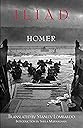
Iliad (Hackett Classics)
Product ID: 4600156
📚Classic epic reimagined
⚔️Vivid battle scenes
🗣️Performance-ready prose
Desertcart purchases this item on your behalf and handles shipping, customs, and support to South Korea.
⚡ Dive into the Iliad that everyone’s talking about — where ancient legend meets modern readability!
Stanley Lombardo’s 'Iliad' is a critically acclaimed, performance-inspired translation that revitalizes Homer’s epic with vivid battle scenes and accessible modern language. Highly rated by readers and scholars alike, this edition bridges classical eloquence and contemporary storytelling, making it a must-have for anyone eager to experience the timeless power of Greek mythology.
| Best Sellers Rank | #38,956 in Books ( See Top 100 in Books ) #4 in European Literature (Books) #7 in Ancient History (Books) #68 in Ancient & Classical Poetry |
| Customer Reviews | 4.6 out of 5 stars 581 Reviews |
J**O
A fine translator and performer
Stanley Lombardo strives to bring a classic to the hearts and minds of a modern, disinterested audience, an audience which may regard this epic as a relic of ancient times. As language mutates over time and the meaning of words change, a point is reached at which literature becomes unintelligible except to an elitist educated minority. We see this happening in Shakespeare right now for example. Similarly, translations of Ancient Greek classics from 80 years or more ago now sound 'archaic' in style. Lombardo attempts in his translation to bring the Iliad into an 'ultra-modern' idiom, and he does this with the heart of a poet himself. His search for the poetic message in the modern idiom comes at some slight cost in translational precision, too much for some purists. However there can be no doubt that Lombardo possesses a profound insight into his subject material and he has chosen his words deliberately and carefully. For those interested in the sound of the original language, Dr Lombardo has, to my mind, his simply wonderful recitation of the first book of the 'Iliad' in Ancient Greek on the internet. When Chryses speaks, one visualises the old man and when Achilles and Agamemnon argue, the emotions sound fully authentic. So too he achieves emotional integrity in this recording. The technical quality is excellent, with clarity throughout. Although an introduction of some sort is probably mandatory in a recording of this nature, and Susan Sarandon's introduction is fine, I found her preamble to each book of the 'Iliad' quite annoying. These are nothing more than a plot-revealing, in fact plot-diminishing summary of what is about to happen. What point in this when Lombardo's translation rings so lucidly to the modern ear? Perhaps they are placed out of fear of monotony developing in so long a tale. Also the music, which initiates and concludes each Book is unvarying and a little too long at 60 seconds every time. Such are the decisions made by the marketing people these days. I side-stepped annoyance by down-loading only the Lombardo tracks to my mp3 player. (My apologies to Ms Sarandon, whom I admire as a fine actor.) If you are interested in a modern recording of an ancient classic, then I would recommend this without reservation. After listening to Lombardo, he has won me over and I'm a big fan.
M**N
Brilliant and readable. Ten stars.
Having attempted many times over the years to read Homer's "Iliad," but being frustrated at every turn, I was thrilled to come across Stanley Lombardo's brilliant translation. Previously, I had turned to the modern classics by Lattimore and Fitzgerald. And as well done and powerful as they were, I somehow did not find them as smooth-flowing and readable as I could have wished. Lombardo has changed all that. His "Iliad" combines the best of modern vernacular with the power of classical eloquence. When the men are in battle, skulls get crushed and entrails ruptured with graphic and immediate violence. Yet when the heroes address one another or the gods converse, the language soars to the appropriate heights of formality. I was drawn in from the first line, and it has not let me go. I am now reading Book 19, and Achilles has just gotten his new armor from Hephaestus via his mother, Thetis. He is about to join the battle at last, and the suspense is every bit as thrilling as it is supposed to be. In fact, I often find myself so pulled into the story and the poetry that I begin to read it aloud (albeit very quietly) and my wife has to remind me that I'm speaking. Nonetheless, do yourself a favor and find a quiet place where you can be alone and read some of these immortal lines aloud. The power and sweep of the dialogue and the narrative will amaze you. In fact, Lombardo himself worked and reworked this translation, in part, as a performance piece, and he has himself performed portions of it many times. Now, I am no scholar. I do not read Greek. I cannot tell you if this translation hews to the original with extreme accuracy. But I can tell you this: It will get you to READ it. If you have always wanted to read this great classic but, like me, have shied away because it required too much effort, then get this translation immediately. Leave the scholarship to the scholars. This is just one hell of a great story. Next up, Lombardo's translation of "The Odyssey." I can't wait.
Z**M
Excellent translation for casual reading or academic.
I really enjoyed this translation. The word choice doesn't detract from this excellent delve into the world of heores and honor, but does make the messages and themes much easier to digest as the book reads more like a modern story plus heavy violence. A note in general on this book: I think this is a great read academically to try and puzzle out how these themes may have translated to cultural values of some age of greek society (read M. Finley's World of Odysseus and The Odyssey at the same time would be my recommendation). Other readers may simply enjoy the story, although a word of warning, I feel like female readers may have a hard time getting past their lack of representstion in this book. Any representation that does exist is very superficial and roles for both genders are clearly carved out with power and honor for the house clearly being the males role. It's very focused on ancient greek male values and often relationships and interations bothered me. Given it's less personal for me as I am male, I might have had a harder time getting threw this if i was a member of the segment that is repressed constantly in the story. I overcame this because 1) it's a story 2) it seems to me many characters are trapped by their roles and the book plays with the illusion of choice. We as modern readers simply view the men in the story as having a choice and the women having none, but if both men and women have no choice it's more tolerable, even though the power dynamic is still so one sided. Reading this book showed me an ancient perspective I had never before percieved or attempted to know. After reading this and The Odyssey, I am convienced I could spend the rest of my life trying to understand the ancient greeks and still have questions on my death bed. I am not saying this book changed me and now I am going to live my life like a Greek hero, but understanding an ancient perspective can perhaps help us shape a future we like to pretend has fully departed from our ancient roots.
C**Y
Not the best translation of one of the best stories
Having just read The Iliad for a Greek Civilization class in the spring of 2009, I owned a copy of the Robert Fagels translation. However, for my Troy and the Trojan War class in the fall of the same year, we had to buy the Stanley Lombardo translation. We also had to read the Introduction by Sheila Murnaghan. The translation is certainly not terrible, but I came to the conclusion that Fagels' was the superior version. The Fagels translation is beautifully poetic and impossible to put down. The Lombardo version takes a timeless, fascinating story and merely takes it down slightly. It is really not a bad translation, but if you want to take the most from The Iliad, get the Robert Fagels version. Also, while I'm sure the Introduction supplemented the reading decently, I thought it was pedantic and pretentious. Overall: By no means the worst you could do, but also not the best.
F**N
Thoroughly Modern Homer
A lot of things that were required reading in college should not have been; that is not the case for Homer's Illiad. There is a good reason why it's called a classic. Sure, it's a little long and the catalogues get a bit tedious. But I was totally blown away by how totally modern this story remains. The battle scenes are as bloody as anything about modern warefare we see on the nighly news. (The book cover has a photograph taken of World War II soldiers landing at Normandy entitled "Into the Jaws of Death.) And while reading this, I opened up an issue of USA Today and see that Brad Pitt will be starring in a movie based on this epic. The Iliad does have so much universal appeal. For example, the scene where Hector's son is frightened by his father's helmet and cries as Hector attempts to say goodbye before going into battle. Or when King Priam comes to plead with Achilles for the body of Hector and Achilles suggests that he eat in order to assuage his grief for his beloved fallen son. How many times have we all taken food to our bereaved friends and family. Sometimes it's all we know to do. If the purists are upset about this translation, I am not. Parts of this work read like a modern novel. In addition to an occasional four letter word, we see phrases like "get the hell out," "put me out of commission," "tough customer," and "you're nothing but trash," to name a few. There are beautifully constructed phrases as well: in one of the many battle scenes "death enfolded them" and Priam describes himself as being on the "threshold of old age." Sheila Murnaghan has written a long, interesting introduction to the work. There is also a catalogue of "Combat Deaths," and who killed whom if you are keeping up with that sort of thing, as well as a list of the speeches and an index of the major Greeks, Trojans and, of course, Zeus and his crowd. A thoroughly enjoyable reread!
C**N
Nice translation, but Kindle formatting is tricky.
I first stumbled across Lombardo's translation of the Iliad in high school, and I absolutely loved it. It was my first exposure to Homer's poem, and I was struck by how fast the pacing was---at the time, I thought that any long poem was, by definition, a boring, glacially-paced affair, and that calling a poem 'epic' was a polite way of saying it was extra long (and by extension, extra boring). I'm no expert on Homer, and thus can't say very much about the accuracy of Lombardo's translation, but it is most definitely not dull. His decision to use vernacular American English in his translation is occasionally jarring (one doesn't ordinarily expect to encounter phrases like "eat your heart out" when reading the classics, after all), but this becomes less bothersome once you get used to it. My primary quibble (and it is a relatively minor one) is with the Kindle version---quite frankly, some of the lines are just too long to fit on the Kindle's screen without shrinking the text down to a near-unreadable size. I eventually was able to overcome this by using the Kindle in its "Landscape" orientation instead of the standard "Portrait," which provides much more room for the actual poetic lines, meaning the translator's intended typography is not meddled with. Still, even though it is a minor hassle, it's still a hassle, albeit one that's not worthy of a reduction in my overall star rating.
L**0
The Iliad is about Achilles
I bought this four years ago for a course on The Iliad. I could discuss this epic, but I will drop two small observations here. First, it is widely known that Homer never used the word 'blue'. But the word 'blue' is used twice in this translation. If you know something about Homer's language, reading the word 'blue' is a "Huh? moment. Did Lombardo not know? Second, the cover art. The Iliad is no more about the Trojan War than Gone With the WInd is about the Civil War, or "From Here to Eternity" is about WW2. Yes, the war is the backdrop to the story. But the real story the author is telling you is the personal story, in this case, Achilles dealing with the conflicts he faces. Painters in the Renaissance knew this. Any of the Renaissance works would have made a better and more fitting cover art.
P**N
Lombardo's translation: Wonderful
This is a review of Stanley Lombardo's translation of the Iliad. Many other Iliad's have made it to this forum, including Fagle's translation and Derick Jacoby's reading, currently rated the most helpful negative and positive reviews, even though neither is a review of this book! Unfortunately, I can't read the original in Greek, so I have no idea how faithful this is to the original. However, I do know that the "original" was a spoken story long before it was a written poem, and what I get from Lombardo's translation is first and foremost an oral story. I don't know how he does it, but many times as I read the book, I "heard" the bard telling me the story, and what a story! As I read, I was caught up in it in ways that I hadn't been with Fagle's translation. I wanted to curse the gods for overriding the good sense of the men who wanted to go home, or to give Helen back. I had a pain in my gut when Andromache fainted at the loss of Hector. I cried with Achilles and Priam in their tent. And most important: Achilles, Priam, Hecabe, Menelaus, Agamemnon, Diomedes and all the rest lived again, which was exactly the whole point of the original poem. If you've ever slogged through the Iliad because you thought it would be "good for you" or wanted to know what the fuss was all about and are still wondering, read this translation, and hear Homer tell you the story of the men who were better than gods because they knew how to die.
A**A
Lombardo is a truly great translator
If you need to read Greek literature in translation Lombardo is the translator to go for. He is not a purest but he does keep with the feels of the works. I have read Ovid and Homer in translation ( yes I know Ovid is Latin) by Lombardo as well as other translators such as Fagel and Wilson and I would recommend Lombardo 100%. For students struggling with ancient literature I would say try Lombardo he will bring it to life. There are also brilliant audio books narrated by Lombardo himself. You won’t regret it
T**S
good writing,
modern vocabulary (end 20th century), good imagery, nice notes; good version to start with, good version to add if you're a homer buff
M**S
A Most Accessible Translation
Stanley Lombardo's translation of the Iliad, one of the most significant works in the western canon, is to my mind the most accessible translation I've seen. A number of years ago I tried to read a different translation and gave up after a couple of chapters thinking life was to short. However Lombardo's translation is fresh and full of energy and engages you in the story. Some will no doubt find the colloquial elements and modern English not to their tastes prefering their classics to have a more archaic feel. However for the reader new to the Iliad and for the casual reader after an engaging, readable translation this is a great place to start. There is no such thing, in my opinion, as a perfect translation. Something will always be lost. As such I would recommened those with a strong intererset in the Iliad to consult a number of translations. The most readily available are probably the Lattimore, Fagles, Fitzgerald and Rieu translations (though there are many more). Lombardo, who is Professor of Classics at the University of Kansas, has also produced translations of The Odyssey and The Aeneid (Links are to Kindle editions. Paperback editions are also available.)
A**P
Blood fiction
Rather than reviewing Homer, which I have neither the time nor vocabulary for, my review is for the audio book. Nicely presented, good quality box set and book of words, and 12 discs. The content seems to be, to me as a Brit, an americanisation of the text. This is both an interesting slant, and often amusing, giving the work a modern interpretation. Stanley Lombardo does not read the text, he acts it enthusiastically, making for a really dramatic listen. Susan whatserface, who provides the synopses, comes across as stiff in comparison, but the content and delivery is both clear and concise. Because there are two voices, and because of Lombardo's acting, the volume fluctuates, so if you want this for bedtime lulls, you'll be kept up all night wondering what will become of big Ajax. If you want a shortcut into the work itself, you'll be hard pressed to find such an accessible presentation.
A**N
10/10 translation, 2/10 children suitability
Make no mistake, there are absolutely no issues with this edition. However I would say it is more appealing for scholars rather than children. Excellent translation, excellent paperback print, small print, black-and-white not particularly children-friendly illustrations. As an adult I enjoy it greatly, I would read it aloud, however I doubt any child would read it by himself.
Trustpilot
3 weeks ago
1 month ago