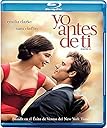
ME BEFORE YOU (YO ANTES DE TI) BLU-RAY (Audio and Subtitles: English, Spanish, French & Portuguese) - IMPORT
Product ID: 46229978
Details
- GenreRomance
- FormatColor DTS NTSC
- ContributorEmilia Clarke
- LanguageEnglish
- Runtime1 hour and 50
***SPANISH REVIEW: A veces el amor te lleva a donde no esperas ir. Louisa "Lou" Clark (Emilia Clarke) vive en la campiña inglesa. Su normalmente alegre actitud se pone a prueba cuando conoce un nuevo reto profesional: cuidadora y acompañante de Will Traynor (Sam Claflin). Confinado a una silla de ruedas desde su accidente, Will se ha rendido. Eso es hasta que Lou decide mostrarle que la vida vale la pena. Al embarcarse en una serie de aventuras, Lou y Will obtienen más de lo que pensaron y descubren que sus vidas - y corazones - están cambiando de maneras que ninguno pudo haber imaginado. ***ENGLISH REVIEW: Louisa “Lou” Clark (Emilia Clarke) lives in a quaint town in the English countryside. When she faces her newest career challenge: Taking a job as a caregiver and companion to Will Traynor (Sam Claflin), a wealthy young banker who became wheelchair bound in an accident two years prior, and whose whole world changed dramatically in the blink of an eye. Embarking together on a series of adventures, both Lou and Will find their lives and hearts changing in ways neither one could have imagined. Review: "It's Not For Me to Say ... - ... you'll love it. It's not for me to say you'll care ...." ... for Coltrane's playing, that is, or post bebop jazz in general, for that matter. Or for me to say that you'll be comfortable with Coltrane's musical affirmation of his religious "recovery' from drugs and booze. His "love supreme" is not of the flesh in this music; he is seriously seeking transcendence through submission to the Love of God. Whether you'll hear Coltrane's awakened spirituality in the music, or simply some very fine lyrical jazz supported by superb piano-playing from McCoy Tyner, will probably depend on your own sense of transcendence. It's that question of transcendence that interests me. I'm not sure how this will play out in evolutionary terms, but I have to wonder whether the "yearning for transcendence" isn't instinctual in Homo sapiens. Next to Fear and Loathing of Mortality -AKA death - the longing for 'just a little bit' of Transcendence must be the wellspring of all human religious beliefs. That must be why Religion has inspired such a huge amount of the world's great music. Of all the arts - in words, in paint, in stone - music seems to me to have the greatest potential for expressing transcendence of our paltry material existence, possibly because it's the least material in itself. Music exists only immaterially, only in the moment of hearing and in the memory of the hearer. Post-modernist critics now insist that the 'meaning' of a poem or a novel has to be negotiated between the writer and the reader, but the words are solid on the page where they will remain until the paper crumbles. Music is always negotiated between the composer and the "first listener", i.e. the performer. Even jazz improvisation is negotiated by ear; Coltrane's 4-part composition on "A Love Supreme" is after all not finally HIS, but rather a collaboration of four irrevocably individual human beings. At its peak, the negotiation can be ecstatic. So. From Gregorian chant to Bach cantatas to Arvo Pärt or John Coltrane, Religion has always made great Music. Some of that amounts to the merely pragmatic question of patronage; churches have always been splendid performance spaces. I imagine also that the experience of a sense of transcendence through music made fervent believers of many great composers. John Coltrane professed that his religious awakening saved his life from the despair and contempt of his earlier music. The music was the man, whom Lenny Tristano called "all emotion, no feeling." Biographically speaking, Coltrane's "salvation" in life preceded any "salvation" after death that Christians expect. A lot of self-hating drug/booze abusers, many of them musical, have had their lives 'turned around' by "a Love supreme". More power to religion then! In the end, it's not for me to say .... Review: Analog Productions Perfection - Analog Productions has become a world class operation, not only in owning and operating their own record pressing plant (QRP), but also in mastering music at the highest level possible. This is AAA mastering at its absolute best. I have purchased many of their releases through the years and they have always surpassed my discerning expectations. John Coltrane’s musical legacy deserves to be preserved with the highest quality sound possible. With this newest release we have been given a perfect pressing with exquisite analog mastering. I have owned several different pressings of this exceptional recording through the years and this one is hands down the very best I’ve ever heard. I also purchased AP’s pressing of the Coltrane Quintet Ballads LP, and again the quality of the sound and pressing is consistently mind blowing from beginning to end. If you’re interested in hearing John Coltrane on vinyl and you want to really feel the music, then you need to seek out these new pressings from Analog Productions. The attention to detail is truly remarkable right down to the album jacket, which come in heavy cardboard with glossy cover photo. A Love Supreme is one of the most legendary moments in jazz, and it has never sounded better than it does here. By far, one of the best sounding pressings I own. Highly recommended for any vinyl jazz enthusiast.
| Contributor | Emilia Clarke, Sam Claflin, Thea Sharrock |
| Customer Reviews | 4.8 out of 5 stars 2,056 Reviews |
| Format | Color, DTS Surround Sound, NTSC, Subtitled, Widescreen |
| Genre | Romance |
| Language | English |
| Runtime | 1 hour and 50 minutes |
G**O
"It's Not For Me to Say ...
... you'll love it. It's not for me to say you'll care ...." ... for Coltrane's playing, that is, or post bebop jazz in general, for that matter. Or for me to say that you'll be comfortable with Coltrane's musical affirmation of his religious "recovery' from drugs and booze. His "love supreme" is not of the flesh in this music; he is seriously seeking transcendence through submission to the Love of God. Whether you'll hear Coltrane's awakened spirituality in the music, or simply some very fine lyrical jazz supported by superb piano-playing from McCoy Tyner, will probably depend on your own sense of transcendence. It's that question of transcendence that interests me. I'm not sure how this will play out in evolutionary terms, but I have to wonder whether the "yearning for transcendence" isn't instinctual in Homo sapiens. Next to Fear and Loathing of Mortality -AKA death - the longing for 'just a little bit' of Transcendence must be the wellspring of all human religious beliefs. That must be why Religion has inspired such a huge amount of the world's great music. Of all the arts - in words, in paint, in stone - music seems to me to have the greatest potential for expressing transcendence of our paltry material existence, possibly because it's the least material in itself. Music exists only immaterially, only in the moment of hearing and in the memory of the hearer. Post-modernist critics now insist that the 'meaning' of a poem or a novel has to be negotiated between the writer and the reader, but the words are solid on the page where they will remain until the paper crumbles. Music is always negotiated between the composer and the "first listener", i.e. the performer. Even jazz improvisation is negotiated by ear; Coltrane's 4-part composition on "A Love Supreme" is after all not finally HIS, but rather a collaboration of four irrevocably individual human beings. At its peak, the negotiation can be ecstatic. So. From Gregorian chant to Bach cantatas to Arvo Pärt or John Coltrane, Religion has always made great Music. Some of that amounts to the merely pragmatic question of patronage; churches have always been splendid performance spaces. I imagine also that the experience of a sense of transcendence through music made fervent believers of many great composers. John Coltrane professed that his religious awakening saved his life from the despair and contempt of his earlier music. The music was the man, whom Lenny Tristano called "all emotion, no feeling." Biographically speaking, Coltrane's "salvation" in life preceded any "salvation" after death that Christians expect. A lot of self-hating drug/booze abusers, many of them musical, have had their lives 'turned around' by "a Love supreme". More power to religion then! In the end, it's not for me to say ....
S**G
Analog Productions Perfection
Analog Productions has become a world class operation, not only in owning and operating their own record pressing plant (QRP), but also in mastering music at the highest level possible. This is AAA mastering at its absolute best. I have purchased many of their releases through the years and they have always surpassed my discerning expectations. John Coltrane’s musical legacy deserves to be preserved with the highest quality sound possible. With this newest release we have been given a perfect pressing with exquisite analog mastering. I have owned several different pressings of this exceptional recording through the years and this one is hands down the very best I’ve ever heard. I also purchased AP’s pressing of the Coltrane Quintet Ballads LP, and again the quality of the sound and pressing is consistently mind blowing from beginning to end. If you’re interested in hearing John Coltrane on vinyl and you want to really feel the music, then you need to seek out these new pressings from Analog Productions. The attention to detail is truly remarkable right down to the album jacket, which come in heavy cardboard with glossy cover photo. A Love Supreme is one of the most legendary moments in jazz, and it has never sounded better than it does here. By far, one of the best sounding pressings I own. Highly recommended for any vinyl jazz enthusiast.
H**S
An Exemplary Recording.
What more can be said about this recording that hasn't been said? Inspired by God, played to perfection, the pinnacle of Coltrane's artistic career. A Love Supreme Indeed!
D**A
Very good quality
Good tunes, came right away.
T**N
Love me some Trane
Vintage Trane..over and over!❤️
A**E
John Coltrane
A love supreme says it all
W**E
Why don't I chime in too?
"A Love Supreme" was one of my first purchases a few years ago when I began to explore jazz, and it has been one of my best. There is an obvious motif (the notes to which "A Love Supreme" is chanted), and you can just sit there and listen to what Coltrane does with it, and be impressed, especially if you've got a bit of music theory knowledge. It's a simple, beautiful, brilliant, and spiritual artistic achievement. If you haven't checked it out yet, and you have any interest in jazz, check it out ASAP. By the way, if you're reading this and haven't heard "A Love Supreme" yet, there are probably a few other highlights from the jazz tradition that you haven't checked out. So I'll just let you know a few of my favorites at this time; if you like or think you might like "A Love Supreme," then maybe you should look into: - Anthony Braxton, "For Alto" - Charles Mingus, "The Black Saint and the Sinner Lady" - Miles Davis, "B...'s Brew" - Charlie Parker, "The Complete Savoy and Dial Master Takes" - Paul Motian, "Conception Vessel" - Ornette Coleman, "The Shape of Jazz to Come" - Eric Dolphy, "Out to Lunch" - Freddie Hubbard, "Red Clay" - Albert Ayler, "Spiritual Unity" - Herbie Hancock, "Sextant" Ok, of course there's lots more, but that's more than enough for my little advertisement. Happy listening, friends!
M**R
Important addition to my collection.
A very important addition to my music collection.
S**O
Five Stars
The giant of jazz with giant steps
H**H
Wahre Liebe
Ich muss einen Satz von Michelle Houllebecq aufgreifen, der er dem Protagonisten seines letzten Romans Unterwerfung in den Mund gelegt hat. Monsieur Houllebecq ließ durch ihn verlauten, dass er von den 3 Kunstformen die Literatur bevorzuge und sie die Königin derer sei. Sie sei also der Malerei, also der bildenen Kunst und der Musik überlegen. Ganz so einfach ist das nicht. Man muss erstmal lesen und schreiben lernen und auch den langen Atem besitzen um zu lesen und dann das Gelesene geistig umsetzen, nicht jeder ist dazu in der Lage. Bei der Musik muss man nicht einmal die Ohren aufmachen, die sind schon offen. OK, vielleicht ist es hilfreich, wenn man einmal selbst Musik gemacht hat, weiß, wie sie durch einen hindurch fließt. Aber davor muss man viel viel üben und auch erstmal Noten lesen lernen bevor die Musik fließt. Und es gibt ja auch "Musik", die über den Status eines Werbejingles nicht hinaus kommt. Hier, A Love Supreme von John Coltrane, das ist ein Stück Literatur. Ich denke, die Königin der 3 Künste ist zweifelsohne die Musik. Man kann sie auch nicht "schön hören", wie man sich auch nicht etwas "schön trinken" kann, zumindest bei mir funkioniert das nicht sehr gut. Die Musik muss dich tragen, wenn sie das nicht tut, vergiss es. Du bist zu schwach um sie zu tragen. Bei der Musik gibt es auch nichts zu verstehen. Der Empfang findet rein und absolut auf der emotionalen Gehirnhälfte statt (ich möchte so Poeten wie Leonard Cohen und Bob Dylan einmal aussen vor lassen, weil die mit dem Wort und der Sprache gewirkt haben, und so eine Mischform aus Musik und Poesie hervor gebracht haben).Und hier ist ein besonders geniales Exemplar. Absolut aus einem Guss. Aber vielleicht wollte Michelle Houllebecq auch einfach nur provozieren.
C**N
Jazz SUPREME
un album classico, leggendario e fondamentale per la musica di genere jazz ma, credo, non solo per quella.
S**S
The master.
Great stuff!
B**D
MUST HAVE jazz album!
If You don’t have the original pressing or don’t want to pay tons of money for an original pressing, this is the BEST alternative pressing to get. The Acoustic Sound Series is: -Mastered from the original analog tapes -Manufactured at Quality Record Pressing (QRP) on 180 gram vinyl -Gatefold sleeves printed at Stoughton Printing Company
Trustpilot
1 day ago
2 weeks ago