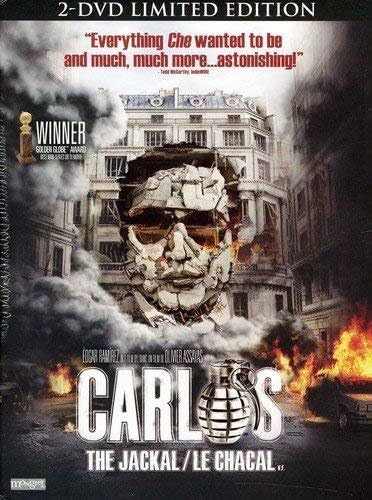

Carlos The Jackal (Double Disc - Series + Extras)
Product ID: 47931735
Details
- ContributorAlexander Nora
- FormatPAL
- GenreAction Crime
- LanguageFrench
- Runtime5 hours and 25
Desertcart purchases this item on your behalf and handles shipping, customs, and support to South Korea.
The story of Venezuelan revolutionary, Ilich Ramirez Sanchez, who founded a worldwide terrorist organization and raided the OPEC headquarters in 1975 before being caught by the French police. Review: The French are good at this sort of film - This film is a tour de force by a gifted director and a brilliant new actor. It is 350 minutes long and split into 3 episodes over 3 DVDs, but I was sorry when it ended. Edgar Ramirez played the central character of Carlos with so much understated style and simmering violence, he was fascinating to watch. I have lived through Carlos' entire career, some of the time in Paris, and this film is so believable. It is not a documentary. The director himself points out in an interview on disc 3 that it is part fact, part fiction, because he had to fictionalise events that are not documented, but it is evident that he had a lot of research material to work from. For many years the authorities had only one indistinct photograph of Carlos, who was also a master of disguise and a chameleon who could change his appearance, and, of course, changed naturally over the years. That is all apparent in this film. The man matures as the film progresses but his basic nature does not change. He was dangerous. He scares people but also excites them. He used the media to his own ends. He was a marxist, he said, and later converted to Islam but one always has the impression that he really only believes in himself and his own agenda. He and his faithful German sidekick Weinrich would visit their paymasters looking like a couple of businessmen doing a deal, and they had contacts throughout the world of revolutionaries, from Moscow to Tripoli, East Germany to the Basque territories. They used the Stasi by playing the Soviet card when it suited them; they used terror to browbeat the Hungarian secret service into cooperating with them. They used the PFLP as a cover for some of their worst atrocities such as the killings in the Rue Marbeuf in Paris, or the OPEC kidnappings in Vienna. The interaction between Carlos and Sheikh Yamani is a superb little vignette, played against a background of unremitting violence. A word about language. It is billed as being in French with English subtitles. In fact everyone speaks their own language, so much of the film actually takes place in English. There are sequences in Arabic, in Spanish, in German, in French and in other languages. Carlos speaks Arabic with Arabs, French with Frenchmen, German with Germans, Spanish with South Americans and English with almost everyone else. All except the English sequences are subtitled in English, but as I speak French and German in addition to my native English and understand Spanish and some Arabic it was no trouble for me to follow everything. The body language and continuity also contribute to the flow. My German girlfriend had no trouble following it either. Edgar Ramirez with his multilingualism and his quiet-spoken manner interspersed with outbreaks of terrifying violence is a great discovery. He plays Carlos so convoncingly that it is easy to forget that he is acting. This from a man in his first rôle is amazing. Despite its length I shall watch this film again and again. It is spellbinding. It is worthy of general release but is too long for the cinema. Canal+ made it for TV but it is a crossover between TV and cinema. It is reminiscent of the Baader Meinhof Complex and Mesrine both of which have comparable qualities, but, in my view, it surpasses both of these admirable productions. As I said at the beginning, a tour de force, a major work that deserves a wide audience. I cannot recommend it highly enough. Review: Compelling View of an Radical Outlaw - "Carlos The Jackal" joins the small list of terrorist biographies which have crept onto our screens in the last few years. From Baader-Mienhoff to the IRA the stories are being told of people who some might see as either folk heroes or modern day pariahs. Carlos is probably the most problematic of the current group as he was far more mercenary than some. Consequently from a political perspective he is somewhat harder to understand. It is this dilemma that director Olivier Assayas tries to explore. His biggest challenge is to try and sort out the myth from the truth. The work commences with an explanation that this has been researched but that despite some in-depth work done on this matter (and living protagonists to draw upon) Assayas clearly acknowledges the almost impossible task of spltting the myth from the actual fact. Carlos was media savvy in a time before many fully understood the power of the media in creating a mythical persona. Assayas calls upon his audience to view this as a work of fiction. What then takes place is a story of very epic proportions. Assayas tries to present not just a story of a radical invloved in many infamous and high profile terrorist incidents but also look at the person behind the story. Here his casting of Edgar Ramirez as Carlos is inspired. Ramirez clearly bears a passing resemblance and also gives a startlingly convincing performance of a man whose main aim seems to be to wage war on imperialism. Its a wonderfully charismatic and compelling performance which holds the attention throughout the 5+ hours of its duration. Whilst there is a shorter cinematic version of this piece it's worth seeing the full version origninally shot for French TV. Here you get not just the action and the build up but also a lot of the political machinations behind the scenes showing that Carlos was very much a political player. This adds an interesting dimension to the piece and although I suspect that this is not exactly based on absolute truth it presents the more problematic side of his persona very well. Compared to many of his contemporiaries Carlos was clearly something of a mercenary than some. This provides a very revealing insight into how some states were also involved in terrorism and times the feeling is that you're watching a man who is doing the covert bidding of Governments - with little sense of the outlaw approach many would consider these acts to have been at the time. The highlights of the series (split here into 3 parts) are mainly based around the major events. The attempted shooting down of an Isaeli jumbo jet early on is a shocking more for the fact that the group walk calmly into the airport almost unchallenged. The OPEC seige is covered in great detail and forms the centrepiece and includes the almost farcical aftermath where the group fly around North Africa trying to find somewhere to land and stay. The climax is also fascinating in depicting Carlos as something of an irrelevance clinging to ideas and ideals which belong to another era. It is complelling stuff throughout and has a great supporting cast to commend it too. The only slight false note is the soundtrack which rather puzzlingly veers across the punk/post-punk divide. It is never less than tasteful but could perhaps have been organised to ensure that the songs fitted the times the scenes they were depicting. That said it was nice to hear a number of well chosen Wire songs alongside some great music from the likes of New Order and A Certain Ratio. Whatever this work is, fiction or fact, or a curious imagining of the two, "Carlos The Jackal" is an engrossing look into the life of an enigmatically mysetrious figure.
| Contributor | Alexander Scheer, Edgar Ramirez, Nora von Waldstätten, Olivier Assayas |
| Customer Reviews | 4.3 out of 5 stars 146 Reviews |
| Format | PAL |
| Genre | Action, Biography, Crime, Drama, Thriller |
| Language | French |
| Manufacturer | Studiocanal |
| Number of discs | 3 |
| Runtime | 5 hours and 25 minutes |
R**S
The French are good at this sort of film
This film is a tour de force by a gifted director and a brilliant new actor. It is 350 minutes long and split into 3 episodes over 3 DVDs, but I was sorry when it ended. Edgar Ramirez played the central character of Carlos with so much understated style and simmering violence, he was fascinating to watch. I have lived through Carlos' entire career, some of the time in Paris, and this film is so believable. It is not a documentary. The director himself points out in an interview on disc 3 that it is part fact, part fiction, because he had to fictionalise events that are not documented, but it is evident that he had a lot of research material to work from. For many years the authorities had only one indistinct photograph of Carlos, who was also a master of disguise and a chameleon who could change his appearance, and, of course, changed naturally over the years. That is all apparent in this film. The man matures as the film progresses but his basic nature does not change. He was dangerous. He scares people but also excites them. He used the media to his own ends. He was a marxist, he said, and later converted to Islam but one always has the impression that he really only believes in himself and his own agenda. He and his faithful German sidekick Weinrich would visit their paymasters looking like a couple of businessmen doing a deal, and they had contacts throughout the world of revolutionaries, from Moscow to Tripoli, East Germany to the Basque territories. They used the Stasi by playing the Soviet card when it suited them; they used terror to browbeat the Hungarian secret service into cooperating with them. They used the PFLP as a cover for some of their worst atrocities such as the killings in the Rue Marbeuf in Paris, or the OPEC kidnappings in Vienna. The interaction between Carlos and Sheikh Yamani is a superb little vignette, played against a background of unremitting violence. A word about language. It is billed as being in French with English subtitles. In fact everyone speaks their own language, so much of the film actually takes place in English. There are sequences in Arabic, in Spanish, in German, in French and in other languages. Carlos speaks Arabic with Arabs, French with Frenchmen, German with Germans, Spanish with South Americans and English with almost everyone else. All except the English sequences are subtitled in English, but as I speak French and German in addition to my native English and understand Spanish and some Arabic it was no trouble for me to follow everything. The body language and continuity also contribute to the flow. My German girlfriend had no trouble following it either. Edgar Ramirez with his multilingualism and his quiet-spoken manner interspersed with outbreaks of terrifying violence is a great discovery. He plays Carlos so convoncingly that it is easy to forget that he is acting. This from a man in his first rôle is amazing. Despite its length I shall watch this film again and again. It is spellbinding. It is worthy of general release but is too long for the cinema. Canal+ made it for TV but it is a crossover between TV and cinema. It is reminiscent of the Baader Meinhof Complex and Mesrine both of which have comparable qualities, but, in my view, it surpasses both of these admirable productions. As I said at the beginning, a tour de force, a major work that deserves a wide audience. I cannot recommend it highly enough.
P**R
Compelling View of an Radical Outlaw
"Carlos The Jackal" joins the small list of terrorist biographies which have crept onto our screens in the last few years. From Baader-Mienhoff to the IRA the stories are being told of people who some might see as either folk heroes or modern day pariahs. Carlos is probably the most problematic of the current group as he was far more mercenary than some. Consequently from a political perspective he is somewhat harder to understand. It is this dilemma that director Olivier Assayas tries to explore. His biggest challenge is to try and sort out the myth from the truth. The work commences with an explanation that this has been researched but that despite some in-depth work done on this matter (and living protagonists to draw upon) Assayas clearly acknowledges the almost impossible task of spltting the myth from the actual fact. Carlos was media savvy in a time before many fully understood the power of the media in creating a mythical persona. Assayas calls upon his audience to view this as a work of fiction. What then takes place is a story of very epic proportions. Assayas tries to present not just a story of a radical invloved in many infamous and high profile terrorist incidents but also look at the person behind the story. Here his casting of Edgar Ramirez as Carlos is inspired. Ramirez clearly bears a passing resemblance and also gives a startlingly convincing performance of a man whose main aim seems to be to wage war on imperialism. Its a wonderfully charismatic and compelling performance which holds the attention throughout the 5+ hours of its duration. Whilst there is a shorter cinematic version of this piece it's worth seeing the full version origninally shot for French TV. Here you get not just the action and the build up but also a lot of the political machinations behind the scenes showing that Carlos was very much a political player. This adds an interesting dimension to the piece and although I suspect that this is not exactly based on absolute truth it presents the more problematic side of his persona very well. Compared to many of his contemporiaries Carlos was clearly something of a mercenary than some. This provides a very revealing insight into how some states were also involved in terrorism and times the feeling is that you're watching a man who is doing the covert bidding of Governments - with little sense of the outlaw approach many would consider these acts to have been at the time. The highlights of the series (split here into 3 parts) are mainly based around the major events. The attempted shooting down of an Isaeli jumbo jet early on is a shocking more for the fact that the group walk calmly into the airport almost unchallenged. The OPEC seige is covered in great detail and forms the centrepiece and includes the almost farcical aftermath where the group fly around North Africa trying to find somewhere to land and stay. The climax is also fascinating in depicting Carlos as something of an irrelevance clinging to ideas and ideals which belong to another era. It is complelling stuff throughout and has a great supporting cast to commend it too. The only slight false note is the soundtrack which rather puzzlingly veers across the punk/post-punk divide. It is never less than tasteful but could perhaps have been organised to ensure that the songs fitted the times the scenes they were depicting. That said it was nice to hear a number of well chosen Wire songs alongside some great music from the likes of New Order and A Certain Ratio. Whatever this work is, fiction or fact, or a curious imagining of the two, "Carlos The Jackal" is an engrossing look into the life of an enigmatically mysetrious figure.
D**G
so so
while action was good, i just felt that this film was lacking in some kind of substance and real plot. it's a film that really lacks that 'punch' to make it an excellent film. having seen the baader meinhof komplex, i was expecting something similar but was a little let down. it's a good film but lacks the substance to make it a great and meaningful film of a popular man
G**K
Carlos the Jackass
A factual story very much of it's time. He might last 1/2 a contract with all todays technology stacked against him. I remember all the newspaper stories from the time but was still pretty amazed by all he did. I'm not sure he actually achieved anything apart from killing a lot, drinking a lot and sleeping around a lot but if you have an interest in terrorism and how it spawns the pawns of the world (Carlos was used by several governments with axes to grind)you will probably quite like this. It is best seen in one sitting - really good for a wet and windy Sunday - as he was a bit of a busy boy Mr Carlos and you may have trouble remembering what, why, who, how and when if you try to split it over a week or two. Not as good as the Bader - Mienhof Complex (a similar true story), but still well worth your time.
O**I
Carlos
Terrorism as a sub-species of warfare, civil insurrection, and as an apparatus of state oppression has existed for millennia. The slaughter of high status officials, combatants, civilians as well as the destruction of property, is a weapon which is purposefully calibrated so as to effect a result in which the level of psychological damage exceeds the attendant human and material destruction. As a tool of liberation, there is some evidence of its success. The terror tactics utilised by the Kenyan Mau Mau, although a largely defeated group, created the circumstances in which the British will to continue to govern Kenya was sapped as was the will of the French to continue their war with the FLN of Algeria. The assassination of Admiral Carrero Blanco in 1973 by Euskadi Ta Askatasuna, the Basque separatist group, is seen as one of the pivotal moments in the dismantling of the Francoist state and the transition to the democratization of Spanish society. The 1970s saw an upsurge in ideologically motivated domestic terrorism in many European capital cities. The West German Baader-Meinhoff group rebelled against the post-World War economic order which they interpreted as being merely a reincarnation of the Third Reich, while Italy saw the Marxist-Leninist Red Brigade trade bombings and assassinations with the sinister forces of the extreme right in the era of Strategia della tensione. In other countries, nationalism and separatist aims motivated the actions of the Irish Republican Army in Britain and E.T.A. in Spain. Concomitant to this, from the late 1960s and on to the next decade was the development of terrorism as an international instrument for revolutionary warfare. The Popular Front for the Liberation of Palestine (P.F.L.P.) in combination with groups like the German Revolutionary Cells (G.R.C.) and the Japanese Red Army Faction traversed national borders wreaking havoc through a succession of high profile airline hijackings, kidnappings and assassinations. In the midst of a lot of these happenings was Ilich Ramirez Sanchez, who would become better known by his media cognomen of `Carlos the Jackal', the subject of a biopic by French filmmaker Olivier Assayas. Carlos, the son of a Venezuelan Marxist lawyer, was born into upper middle class privilege and would become a superstar terrorist subject to a macabre form of celebrity interest; so effectively becoming a poster boy for 1970s terrorism in the manner that the Argentine Che Guevara had been for 1960s guerrilla movements. Already the subject of a number of books as well as investigatory documentaries, it was perhaps something of an inevitability that he would at some point become the focus of a film given the alchemy of violence, personal mystery and international intrigue that surrounded his life. Carlos did not fit the mould of the anonymous `soldier' acting selflessly for a cause. It appeared that he was a buccaneering figure, somewhat a mercenary, and certainly a maverick. Truth can be an elusive commodity when dealing with a character like Carlos whose role, ironically given his public notoriety, made him well-practised in the dark arts of stealth and deception. The director does well to warn of the grey areas in the various renditions of Carlos's life and exploits, and to inform viewers that the depictions of personal relations are fictionalised. Assayas is also prudent in only depicting the murders attributed by Carlos for which he has been formally tried and convicted. Although made largely under the auspices of the French Canal Plus cable company, Carlos has the feel and quality of a motion picture. Assayas, shot the scenes in cinemascope format; favouring a documentary-like mode by which events unfold and avoiding the heavily stylised visual cadences of a Paolo Sorrentino. And it works. The movie is well-paced and possesses a sense of realism that is heightened with the interspersing of original news report footage of relevant events with the scripted reconstructions of the intrigues within which Carlos was involved. As a period piece, it successfully depicts the era: from the cars parked on the streets of Paris and London, the clothes worn, right down to the sideburns cultivated by lead actor, Edgar Ramirez. The eclecticism of the soundtrack which has music by artists ranging from purveyors of post-punk like The Wire and Deadboys to the Malian songstress Oumou Sangare, is matched by the international scope of location shooting which included London, Paris, The Hague, Vienna, Lebanon and Yemen. Another refreshingly multi-dimensional aspect of the movie contributing to its realism, are the languages spoken in scenes: English, Spanish, French, German and Arabic. Ably portrayed by Ramirez, who like Carlos is of Venezuelan nationality, the anti-hero turns out to be passionate about his beliefs, but also vain and something of a cad in his use of women. Assayas's scripted dialogue refers to and offers explanations on a number of previously underexplored areas of Carlos's career notably in regard to the reason why he decided to cast his lot with the Palestinian cause under the aegis of Wadi Haddad's P.F.L.P. in a largely European `theatre of war.' There were after all, during this period of time a plethora of violently suppressive right wing regimes across Latin America from the Tierra del Fuego to the jungles of Central America. Would his ideological pretentions, it is worth asking, have been better served if he had honed his freedom fighting instincts by combating the dictatorships in Brazil, Argentina, Chile or fought alongside the Sandinistas in Nicaragua or hunted the Salvadorian death squads of Major D'Aubuisson? It is left to the viewer to make something of an informed appraisal of Carlos. Did he remain true to the Marxist principles instilled in him from an early age by his father? And did his actions achieve his goals? Regarding the latter, the film depicts several failures including the attempt to shoot down an El Al aeroplane at Orly Airport, such that Carlos's cohorts could have been monikered as "the gang that couldn't shoot straight". Certainly, the acts of terrorism perpetrated, while bringing attention to the Palestinian cause arguably did little to further it. Palestine is still not liberated, and it was Yasir Arafat's `olive branch in one hand and the gun in the other' approach (along with help of the Intifada) which led to the minimal concessions to date by the Israeli side. Much of Carlos's legend has been demystified over the years and Assayas's portrait is not far from what several believe he became, if he had not already been that way in the first place: a suave, cravat wearing fop who was bourgeois rather than proletarian in his image and in his preferred style of living. His motivations were seemingly geared towards high living; consuming fine food, fine drink and fine women in almost equal measure. Carlos, of course, is not the only idealistic revolutionary to be scrutinized and found to be wanting. Among the secular, radical Marxist-Leninists found in the ranks of the young Palestinian militants who daubed Mosques with Lenin's sayings and who denounced materialism from the microphones used by the muezzins, were many charlatans who while professing to confiscate luxury items such as Mercedes cars "in the name of the Proleteriat"; were actually indulging in thievery disguised as ideological conviction. The ending of the Cold War proved to be Carlos's undoing as indeed it did for the remnant-survivor terrorists of his era. And although not referred to in the film, the change in the world order since the fall of the Berlin Wall reveals Carlos's opportunism and his principles. Ever the contrarian, he now professes radical Islam to be the only valid means of unshackling nations from the grasp of capitalist subservience; once announcing himself as being an admirer of the secular Saddam Hussein who he described as "the last Arab knight" and also Osama Bin Laden, the chief symbol of Jihadist terror. Assayas's film faithfully chronicles the known circumstances of Carlos's downfall, first as an outcast in the post-Cold War world, and then his capture as a middle-aged, paunchy, inactive figure largely insignificant to a world which had once revelled in his infamy. It was always going to be too much to live up to the legend that was Carlos. Adeyinka Makinde (2010)
A**Y
Andrew
A freind lent me this once. Brilliant mini series. I just had to but my own copy. He were a reet swine, not for the the faint hearted though.
K**G
Brilliantly directed and acted character study of terrorism and politics
Fascinating 5 hour plus, 3 part film about Carlos the Jackal (although he never actually called himself that) the headline grabbing terrorist of the 70s and 80s. With little exposition, we're dropped into a whirlwind of violence, self-aggrandizement, sexual seduction, and power games, moving at an almost dizzying speed. The film allows us to slowly figure out Carlos, instead of explain him in a simple facile way. While never sympathetic, somehow the amazing Edgar Rameriez allows us to feel for this id and ego driven creature, powered far more by the need for attention and adulation (whether from women or the press) than by true belief. Indeed, one of the most interesting things about the film is how (intentionally) shallow and hollow Carlos's political monologues ring. The last 1/3 is the slowest and hardest to sit through. Carlos's slow decline into ineffectiveness and unimportance is sometimes patience trying. But Rob Nelson, in his excellent New York Village Voice review makes a strong argument that this is 1) unavoidable after the high paced rush of the first two parts and 2) part of the point of the film; without his fixes of women and power there wasn't much to Carlos, and without them both he and we want it to be over. This is a film I'd like to see again. While I don't quite agree (yet) with the many critics who have hailed this as of the best films of last 10 years, I do think it's a challenging, brilliantly acted, wonderfully made film, that gives context both to modern terrorism and recent world history. Add to that, an exploration of the blurring fine line between power and uncontrolled narcissism that seems to dog leaders (especially male) of all political stripes from Hitler to Bill Clinton to George Bush to Carlos. That's a lot to successfully cover, even in 5 hours.
R**O
subtitles
it would be a good idea to put the subtitle languages of the dvd. The purchase would be more accurate.
E**A
Awesome film!
Olivier Assayas is a great director. He directed this movie. It is about 6 hours long so I recommend watching it in 2 hour portions. Also, Edgar Ramirez plays the main character very well. He gives a great performance. I also think the soundtrack is incredible and is perfect for the different moments in the movie. This film is highly recommended by me. You will not be disappointed after having seen it! An epic film.
K**B
The most essential quality of a revolutionary is narcissism.
When Carlos, then known as Ilich Ramirez Sanchez, joined the PFLP in 1970, he was a radical and desired to be a solider in the international fight against capitalism and Zionism. It was not until 1975, in a raid on the OPEC headquarters in Vienna, that he discovered his true calling - himself. He was daring and charismatic, becoming a celebrity of a sort as his notoriety made his name a household word. Whereas such a strange life would lend itself comfortably to a biopic, in Carlos it becomes a study in vanity, and how the revolutionary is perhaps the ultimate egocentrist. The idea is not a new one, but seldom has it been rendered in such vivid tones. Clocking in at five and a half hours while maintaining a brisk pace and wasting not a moment of time, Olivier Assayas's new work further solidifies him as a master of the craft. At the helm is Edgar Ramirez with a stunning performance that captures the megalomaniac disguised as an idealist, though perhaps only disguised to himself. Carlos sticks to the meat of the man's career, from his early days volunteering for the People's Front for the Liberation of Palestine. He staged several poorly planned jobs involving explosives and a botched assassination attempt on the Vice President of the British Zionist Federation. None of these achieved any sort of satisfaction, and it slowly becomes evident that Carlos is already an actor in his own drama. It is fun to play soldier, and he relishes the feeling of joining an international struggle to unite revolutionaries. He finally ascends the stage meant for his wily talents in the 1975 raid on OPEC headquarters, and his rhetoric is allowed to emanate from a megaphone to a global audience. Though staged as a way to call attention to the Palestinian cause, the real purpose was to kill the finance minister of Iran and the oil minister of Saudi Arabia to facilitate the crushing of a Kurdish uprising on behalf of Saddam Hussein. How this relates to power for the people, I have no idea. Neither does Carlos, but the raid reflects his ability to solidly plan for a strike, but also betrays his lack of experience and poor grasp of who he really is. The OPEC raid is the centerpiece of the film, and though it varies from the actual event, it is made clear that this terrorist is nothing of the sort. When given the chance to die for what he voiced as a higher cause, he bellows "I'm a soldier, not a martyr!" And also a coward. Rather than execute his orders by offing the targets, he takes a massive payoff from an unspecified country and reportedly pockets a good portion of the money. Interestingly, this reveals the inherent failure destined for armed struggle. If one's philosophy is unable to compete with, say, capitalism without taking hostages and threatening violence against soft targets, then that philosophy is doomed. Such efforts would have been better spent coming up with a viable oppositional belief system that would win hearts and minds rather than providing fuel for angry, disaffected youths who only know they don't agree with what is in front of them. Still, any overt point to be made in Carlos is avoided in favor of painting in tremendous detail on a canvas that spans decades and countries, allowing the viewer to make their own conclusions. Carlos is expelled from the PFLP for his failure to follow orders. After this, he used his fame, wealth, and ability to fundraise to form his own Organization for Armed Struggle, was given assistance by the Stasi and KGB, and set up shop in Eastern Europe to attack Western targets. After seven years, pressure was applied to the nations that harbored him and his increasingly frenzied attempts to stay relevant. Finally pushed out of nearly every country left on Earth, he was isolated in Syria, and later Sudan. Surely, running guns for Sudanese butchers is for the lowest of the low. With the end of the Cold War, he was more of a curiosity and a pathetic figure. The revolutionary can be expected to rage at the death of cherished beliefs, though Ramirez plays him as more bemused than anything. After all, Carlos was a capitalist at heart, a bourgeois twit cloaked in the proper rhetoric. This decline into obscurity is sumptuously realized by Assayas, as capitalism just outlasts such nuisances. This is not for lack of trying, but perhaps a lack of a viable philosophy to sustain any sort of movement. There is a wry sense of humor at work here; the idea that Carlos was immobilized by testicular pain when seized by French authorities because he placed a higher priority on liposuctioning his muffin top than taking proper care of his balls is hilarious. Carlos is a wonderfully assembled work, crossing the globe with a dizzying number of characters and remaining as true as necessary to real events. The supporting work by the performers comprising the various revolutionaries who drift in and out of Sanchez's life is impeccable, and the audience is transported into a seamless recreation of a chaotic time. As entertainment, Carlos is magnificent, with a propulsive pace and an immediacy that lends an unsettling tension to any scene with Ramirez. Assayas leaves bare his subject, a supremely confident young man who grows into a fighter most capable of deluding himself into believing such conflict was in the name of freedom. One can see the seed of figures like Castro, Mugabe, or Chavez, all universally beloved soldiers for their people who became despots with a cult of personality. When the rebel - whether left or right - believes they alone hold the key to changing the world and demand that others follow, they are at the pinnacle of narcissism. The love and fealty demanded by such leaders must inevitably turn to contempt for those who give it so freely. Carlos did not even get that far. He was brought down not by enemies, but by irrelevance.
D**A
Shocked
I have been reading the Bourne series of books and wanted to know more about Carlos the Jackel. I was all set to trudge through the foreign languages and English subtitles just to get more of an idea about who this man was. Approximately 15 minutes into the movie Carlos was sitting in a bathtub got out and sat right in front of the camera absolutely stark naked and I was not prepared for the male sex organ to be the focus of attention at that moment. Shocked, I stopped the movie, destroyed the dvds and call me a prude if you wish but I am very disappointed that I could not dare to watch the rest of the movie because of this. I watch violence and barebreasted women but I do not condone it. This particular scene in the movie went too far for my eyes. Thus I am disappointed and will look for a book on the guy instead. That being said, I as an older woman do have my boundaries for what I will watch. I am certain the movie is very informative and interesting to watch for others. Just be prepared and give it a look-see at your discretion. Packaging and format were excellent.
A**S
R
I ordered it on july 8 and should have received no later then July 24, what is already very late and much longer as I used to (at amazon UK) but on July 25 I still didn't received it? Is this fraud???
Y**D
rapide et fiable
Le tout m'a été livré en bon état et dans un délai raisonnable.
Trustpilot
1 week ago
1 month ago