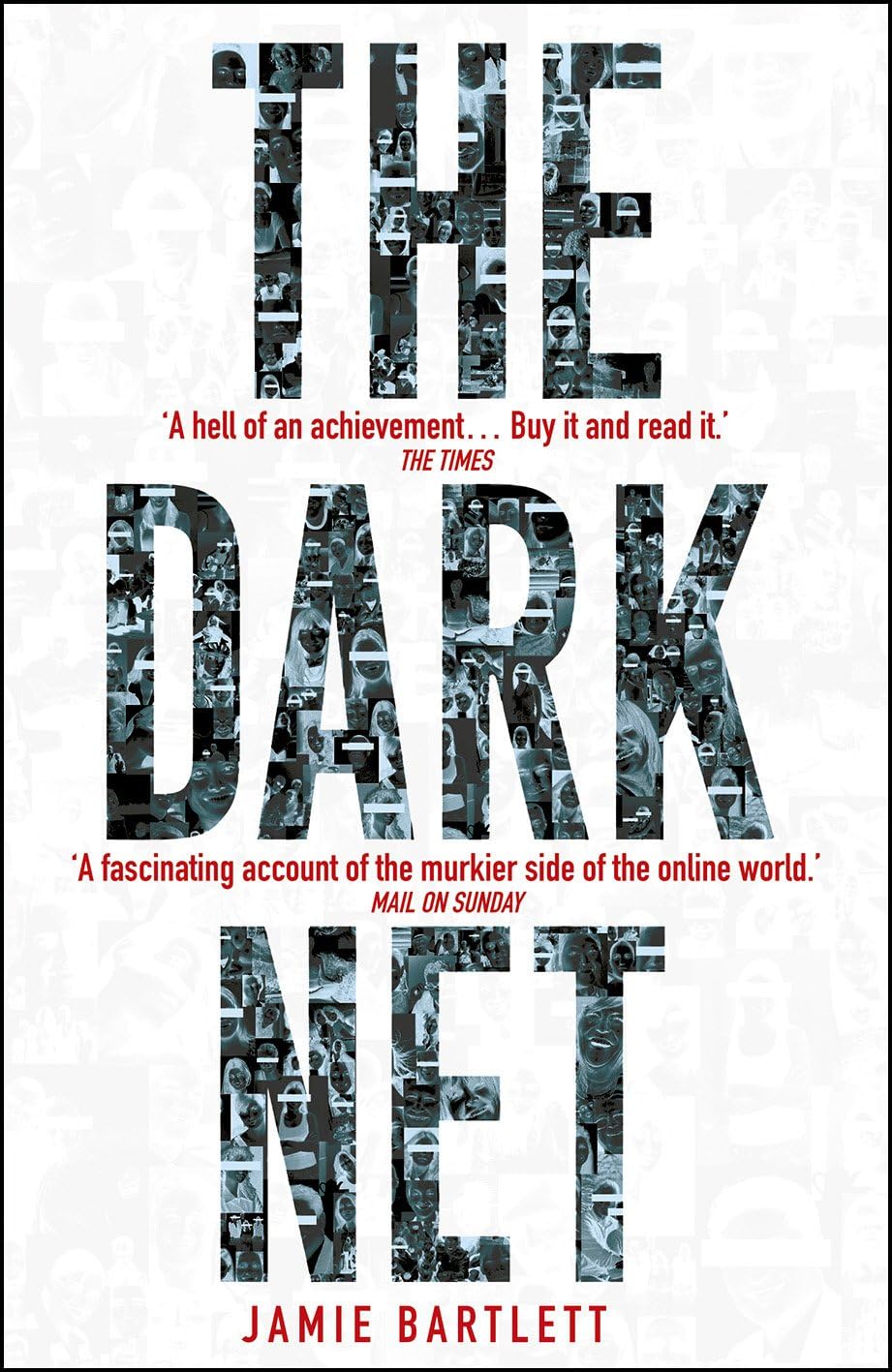


The Dark Net : Bartlett, Jamie: desertcart.co.uk: Books Review: Exploring the dark side. - As a daily user of computers for over 50 years, starting with mainframe machines by manufacturers who have long since disappeared from the scene, through supercomputers and the earliest personal computers with their unreliable dial-up modems, to modern powerful laptops, I am well aware of many of the developments described in this book. The rapidity and these and the inventiveness of the individuals involved is truly remarkable, but enabling technologies inevitably have downsides, particularly in the realm of the so-called `the dark net'. This term refers to areas of the internet/web that are only accessible via the use of techniques that render the user essentially `invisible' to third parties. How this is achieved, for example by using the Tor browser, is briefly described in simple non-technical terms. There are legitimate uses of these techniques, where secrecy is vital, but they also offer the opportunity for more dubious activities. Thus the dark net contains child pornography sites, sites selling illegal drugs, such as the notorious Silk Road, and others that actively encourage disturbed individuals to engage in destructive behavior, such as self-harming and committing suicide. There is even a site where users can bet on when someone will die, possibly encouraging murder, although there is not, as yet, evidence that this has happened. All these, and many more, are explored in some detail and with authority, clearly coming from extensive research by the author. But the book contains much more than this. There is also an interesting brief history of the early days of the internet, and simple explanations of terms such as `trolling', Bitcoin and many others. Where is all this going? This is the question explored at the end of the book, where the author examines beliefs at both extremes of the spectrum: those of the anarcho-primitivitists and the transhumanists . The former see all technology, particularly computers, as intrinsically bad and advocate returning to small agricultural self-sufficient communities. The inconsistency of this position is revealed when a leading exponent of this belief communicates with the author via the internet! The transhumanists have absolute belief in the power of computers and are convinced that in the future, disease, aging and even death will become irrelevant. A leading exponent is working towards having his brain uploaded as a computer file and wears round his neck at all times detailed instructions about how his body should be frozen and treated in the event of his sudden death. His instructions to his wife are "Pop me in the freezer as soon as possible". Bizarre as these beliefs may seem, perhaps they really are the future; who knows? This is a well-written book that explores a rapidly changing area with great skill and clarity. It is sometimes upsetting and disturbing, and some of the activities described challenge our beliefs about what is `normal' human behavior. The author makes no moral judgments; the book is just as much about the sociology of the dark net and the characters that interact with it, as it is about its technical aspect. It is well worth reading about a subject that will become increasingly important and that will impact more and more on all aspects of our daily lives. Review: Jamie Bartlett searches below the surface of the Net - Jamie Bartlett explores the dark underbelly of the internet exposing some of the less known and disturbing things you can find if you care to look. I find this an extremely easy to read and interesting book. The only reason I did not give it 5 stars is that nowadays technology moves at such a pace that I feel that things have probably moved on since this was published but it shouldn't detract from the fact that this book teaches about the what is hidden beneath the surface of the internet. Bartlett goes through things such as trolling, radicalisation/extremism (albeit right wing rather than Islamic), online privacy/secrecy, online child abuse, drugs, web cam pornography, lifestyle forums (pro anorexia/suicide) and the debate of whether technology is good or bad. He talks to those involved and so gives the reader a better insight into the how and why people got involved rather than just a list of facts which makes the book far more enjoyable and thought provoking. If, like me, you basically use the internet to browse the football scores, send an email, check Sky Sports and BBC websites and buy a book on desertcart, this book will give you an insight into some of the less familiar and darker sides of the internet.
| ASIN | 0099592029 |
| Best Sellers Rank | 77,361 in Books ( See Top 100 in Books ) 68 in E-Business 920 in Computing & Internet 9,956 in Social Sciences (Books) |
| Customer reviews | 4.1 4.1 out of 5 stars (1,490) |
| Dimensions | 12.9 x 2 x 19.8 cm |
| ISBN-10 | 9780099592020 |
| ISBN-13 | 978-0099592020 |
| Item weight | 224 g |
| Language | English |
| Print length | 320 pages |
| Publication date | 12 Mar. 2015 |
| Publisher | Windmill Books |
B**N
Exploring the dark side.
As a daily user of computers for over 50 years, starting with mainframe machines by manufacturers who have long since disappeared from the scene, through supercomputers and the earliest personal computers with their unreliable dial-up modems, to modern powerful laptops, I am well aware of many of the developments described in this book. The rapidity and these and the inventiveness of the individuals involved is truly remarkable, but enabling technologies inevitably have downsides, particularly in the realm of the so-called `the dark net'. This term refers to areas of the internet/web that are only accessible via the use of techniques that render the user essentially `invisible' to third parties. How this is achieved, for example by using the Tor browser, is briefly described in simple non-technical terms. There are legitimate uses of these techniques, where secrecy is vital, but they also offer the opportunity for more dubious activities. Thus the dark net contains child pornography sites, sites selling illegal drugs, such as the notorious Silk Road, and others that actively encourage disturbed individuals to engage in destructive behavior, such as self-harming and committing suicide. There is even a site where users can bet on when someone will die, possibly encouraging murder, although there is not, as yet, evidence that this has happened. All these, and many more, are explored in some detail and with authority, clearly coming from extensive research by the author. But the book contains much more than this. There is also an interesting brief history of the early days of the internet, and simple explanations of terms such as `trolling', Bitcoin and many others. Where is all this going? This is the question explored at the end of the book, where the author examines beliefs at both extremes of the spectrum: those of the anarcho-primitivitists and the transhumanists . The former see all technology, particularly computers, as intrinsically bad and advocate returning to small agricultural self-sufficient communities. The inconsistency of this position is revealed when a leading exponent of this belief communicates with the author via the internet! The transhumanists have absolute belief in the power of computers and are convinced that in the future, disease, aging and even death will become irrelevant. A leading exponent is working towards having his brain uploaded as a computer file and wears round his neck at all times detailed instructions about how his body should be frozen and treated in the event of his sudden death. His instructions to his wife are "Pop me in the freezer as soon as possible". Bizarre as these beliefs may seem, perhaps they really are the future; who knows? This is a well-written book that explores a rapidly changing area with great skill and clarity. It is sometimes upsetting and disturbing, and some of the activities described challenge our beliefs about what is `normal' human behavior. The author makes no moral judgments; the book is just as much about the sociology of the dark net and the characters that interact with it, as it is about its technical aspect. It is well worth reading about a subject that will become increasingly important and that will impact more and more on all aspects of our daily lives.
A**R
Jamie Bartlett searches below the surface of the Net
Jamie Bartlett explores the dark underbelly of the internet exposing some of the less known and disturbing things you can find if you care to look. I find this an extremely easy to read and interesting book. The only reason I did not give it 5 stars is that nowadays technology moves at such a pace that I feel that things have probably moved on since this was published but it shouldn't detract from the fact that this book teaches about the what is hidden beneath the surface of the internet. Bartlett goes through things such as trolling, radicalisation/extremism (albeit right wing rather than Islamic), online privacy/secrecy, online child abuse, drugs, web cam pornography, lifestyle forums (pro anorexia/suicide) and the debate of whether technology is good or bad. He talks to those involved and so gives the reader a better insight into the how and why people got involved rather than just a list of facts which makes the book far more enjoyable and thought provoking. If, like me, you basically use the internet to browse the football scores, send an email, check Sky Sports and BBC websites and buy a book on Amazon, this book will give you an insight into some of the less familiar and darker sides of the internet.
B**N
Reaches parts of the web other browsers don't (...almost)
This is a somewhat sensationalised but very readable account of the parts of the Internet you might not ever go (or, indeed, ever realise existed) - however, Bartlett doesn't stay too long in 'Dark Net' territory. I found the first few chapters the most interesting: a look at the development of the 'net' as an academic/military tool in the 70s and its almost immediate descent into trolling and abuse. From there there's a look at 4Chan and the Anonymous cultures it's given rise to. Bitcoin and Silk Road also feature in the first half of the book. Around half the book comprises journalistic accounts of characters Bartlett's encountered along the way and who illustrate the seedier side of the surface web: extremist politics, child abuse, web-camming and self-harm instigators. Bartlett's conclusion, that there's a 'dystopian nightmare' under the surface of the web, seems to have been the driving definition of this book - it's not always specifically about the culture, politics and history of hidden browsing and Bitcoin, but internet phenomena that in different ways are 'dark', and why human nature is so drawn to them. When Bartlett writes about Dark Net proper it raises lots of meaty questions: there's a real grey area about whether crypto anarchists are the good guys or deluded and spiteful; whether governments can ever be trusted with anything; even whether Bartlett's slightly moralising but colourful accounts can be trusted. It's a good but, ultimately, slightly superficial read once it veers away from the premise of the book I'd been expecting.
J**S
Lucid and balanced introduction to the darker aspects of the net
Each of the chapters of The Dark Net take for their subject a different aspect of the internet's underbelly : trolling, pro-ano(rexia) forums, pornography, Silk Road to name a few. They each give a highly readable insight into the origins of these parts of the web, backed up by the author's conversations with the figures involved and research around the area. Some but not all of the book deals with the Dark Web as accessed by TOR browsers, an interesting look into an area I didn't know much about but had often heard allusions to and wanted to understand. Generously laid out on the page and written with clarity and without labouring the point I thought this book captivating. Would recommend to anyone interested in understanding this area more, particularly if relatively new to discussion of the darker aspects of the web. This book also provides a mostly balanced portrait of the good and bad of the dark net - though the author comes down more on the libertarian side when it comes to regulating the types of internet behaviours that he describes.
M**O
A great view of the darkest aspects of the depp web as well as the good side of it, a must read.
B**R
Well written. A lot of interesting information.
W**R
Tatsächlich verspricht der Titel bisschen was anderes, es geht nicht nur ums Darknet sondern um die "Schatten"seiten des gesamten Internets. Nichtsdestotrotz ist das Buch spannend, informativ, leicht zu lesen und nur weiterzuempfehlen.
T**R
Even though this book is 10 years old now, it is still really interesting to read and super relevant. It doesn't feel dated at all. Quite the opposite in fact. The topic is fascinating and it goes into great detail about the various platforms and online behaviors. He describes the dark net not so much as specific places online but more like certain kinds of deviant groups and behaviors outside of the mainstream. There is a lot about trolling, for example, including its history and origins. This is different from the "deep web" which is all the site accessible via TOR. Also, the author appears to have done a lot of original research and interviews too, which is refreshing. And the writing style is very smooth and easy to follow. It is not overly complex or filled with jargon. Rather, it feels more like reading a novel that pulls you along in the story. It's a great addition to my bookcase. You should check it out.
J**E
Very fluent, engaging writing style that makes it worthwhile right until the end. Fascinating research on subcultures floating below the surface of the Internet. I liked the in depth discussion of how Bitcoin works mathematically to ensure anonymity of consumers on the drug market. By looking at extreme examples- neo-nazis, self mutation forums, radically anti technology communities, transhumanist advocates- we are offered a broad tour of identity, self expression, and creative subversion.
Trustpilot
3 weeks ago
1 week ago