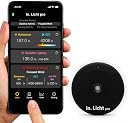


In.Licht Pro Light Meter - Handheld EML & Lux Illuminance Sensor, CCT Color Temperature & Light Uniformity Tester, Bluetooth Circadian Rhythm Monitor for Well V2, Architects, Interior Design
Product ID: 524115591
Desertcart purchases this item on your behalf and handles shipping, customs, and support to South Korea.
In. Licht pro is the best tool to support who intents to build the path to lighting environment with quality and well.The measurement includes 5 key indexes: illuminance(Lux), correlated color temperature(CCT), contrast, uniformity and Equivalent Melanopic Lux (EML).“In. Licht pro” puts together the knowledge from professional designers and optical engineers to create a state of art device and UI which could help the designers, architects, WELL AP, property managers, photographers and artists to check the lighting environments and compare to the reference target to close the gaps to build quality and well lighting environments easily.The lighting design is complicated by different factors and knowledges, but you could be an expert by “In. Licht pro”. Review: Superb product. Works 100% as describe and it is a mandatory tool for all photographs - Superb product. Works 100% as describe and it is a mandatory tool for all photographs Review: In. Lcht color test vs Sony ZVE10 vs Neewer FS 150B - I contacted the seller asking him how it should be used. I initially thought I should take a gray card and bounce it off the light source. This is how to take the color temp from a camera. He corrected me and told me to face it directly to the light right in front of the subject. I did a test because I wanted to know its accuracy. I used a Neewer FS 150B COB LED light, Sony ZV-E10 and the In. Lcht Pro. I also added a Nanlite 500B. See the results in the photo attachment. Note: 1) There is no difference between the color temp with or without a soft box. 2) A gray card was used to get the Sony color temp. 3) In. lcht was facing the light directly. 4) all were exposed at the same distance. 5) The Color temp was led and set on the FS150B. Followed by In. Lcht Pro and then the gray card reading from the Sony ZV- E10. 6) I later added a Nanlite 500B to the test because I wanted to know it's color accuracy compared to the the other devices. Summary: The readings between the In. Lcht and the Sony camera are close. It will not be exactly the same but very usable. The discrepancy between the Sony color temp reading, the In. Lcht reading and Neewer FS 150B and Nanlite 500B are much wider only at the higher or cooler temps specially of 6500k. Below 6500k, the discrepancies showed a range of 50k to 300k. From my research, the Sony color temp is not as accurate as a spectrometer. Sony uses its own color science and averages the reading. The supplier said I could use the In. Lcht reading as the basis for adjusting the color temp of both the Sony and Neewer FS 150B or the Nanlite 500B. The readings were more accurate and close to the In. Lcht Pro and Sony ZV-E10. Both have a CRI of 97+ This is the final advice of the seller: “ Yes, you can use the Pro to lead the setup. I’d put it at the subject’s position and adjust the Neewer, with the softbox fitted, until the Pro reads the color temperature you want. Then set the Sony for that lighting. For example, with the 6,224 K reading in your corrected sheet, I’d start at about 6,200 K in the Sony’s manual white balance mode and check a test shot. If you use this setup regularly and want a neutral result, I’d do the gray-card procedure once after the lighting is set and save it to one of the Sony’s Custom White Balance slots. Next time, use the Pro to bring the same lamp and softbox back to the recorded color temperature and light level, then recall the Sony preset. That gives you a way to keep the Pro in charge of the lighting and save yourself the gray-card steps each time you recreate that setup. This is also where the updated Pro app can help. The Value screen gives you a quick view of color temperature and light level. The updated Chart lets you watch both readings as you adjust the lamp and capture the final values for next time.( the Android version is released, iOS is under approval procedures by Apple)“ end of quote. Lawrence Lin (CEO of In. Lcht) Conclusion: For my final settings on my camera, I would use this table as my guide. I would take a reading from In. Lcht adjust for the discrepancy and set the Sony and Nanlite 500B to the same color temp. Then I would adjust the FS 150B light and use the discrepancy from the test chart. I will do a skin test next and update my review. I'm curious what a 300-500k discrepancy looks like. *I did a shoot today and my skin tones on the talent looked perfect. My final recommendation. In. Lcht is a reliable color meter to acquire CCT for studio use. I recommend it. I have not had a chance to compare it with an expensive Spectrometer like a Sekonic C800 costing $1750.


| ASIN | B0BLV5Y56H |
| Batteries | 3 AAA batteries required. (included) |
| Best Sellers Rank | #25 in Photographic Light Meters |
| Date First Available | November 1, 2022 |
| Item Weight | 1.44 ounces |
| Manufacturer | Lawrence Co., Ltd. |
| Product Dimensions | 2.83 x 2.83 x 0.94 inches |
M**D
Superb product. Works 100% as describe and it is a mandatory tool for all photographs
Superb product. Works 100% as describe and it is a mandatory tool for all photographs
E**C
In. Lcht color test vs Sony ZVE10 vs Neewer FS 150B
I contacted the seller asking him how it should be used. I initially thought I should take a gray card and bounce it off the light source. This is how to take the color temp from a camera. He corrected me and told me to face it directly to the light right in front of the subject. I did a test because I wanted to know its accuracy. I used a Neewer FS 150B COB LED light, Sony ZV-E10 and the In. Lcht Pro. I also added a Nanlite 500B. See the results in the photo attachment. Note: 1) There is no difference between the color temp with or without a soft box. 2) A gray card was used to get the Sony color temp. 3) In. lcht was facing the light directly. 4) all were exposed at the same distance. 5) The Color temp was led and set on the FS150B. Followed by In. Lcht Pro and then the gray card reading from the Sony ZV- E10. 6) I later added a Nanlite 500B to the test because I wanted to know it's color accuracy compared to the the other devices. Summary: The readings between the In. Lcht and the Sony camera are close. It will not be exactly the same but very usable. The discrepancy between the Sony color temp reading, the In. Lcht reading and Neewer FS 150B and Nanlite 500B are much wider only at the higher or cooler temps specially of 6500k. Below 6500k, the discrepancies showed a range of 50k to 300k. From my research, the Sony color temp is not as accurate as a spectrometer. Sony uses its own color science and averages the reading. The supplier said I could use the In. Lcht reading as the basis for adjusting the color temp of both the Sony and Neewer FS 150B or the Nanlite 500B. The readings were more accurate and close to the In. Lcht Pro and Sony ZV-E10. Both have a CRI of 97+ This is the final advice of the seller: “ Yes, you can use the Pro to lead the setup. I’d put it at the subject’s position and adjust the Neewer, with the softbox fitted, until the Pro reads the color temperature you want. Then set the Sony for that lighting. For example, with the 6,224 K reading in your corrected sheet, I’d start at about 6,200 K in the Sony’s manual white balance mode and check a test shot. If you use this setup regularly and want a neutral result, I’d do the gray-card procedure once after the lighting is set and save it to one of the Sony’s Custom White Balance slots. Next time, use the Pro to bring the same lamp and softbox back to the recorded color temperature and light level, then recall the Sony preset. That gives you a way to keep the Pro in charge of the lighting and save yourself the gray-card steps each time you recreate that setup. This is also where the updated Pro app can help. The Value screen gives you a quick view of color temperature and light level. The updated Chart lets you watch both readings as you adjust the lamp and capture the final values for next time.( the Android version is released, iOS is under approval procedures by Apple)“ end of quote. Lawrence Lin (CEO of In. Lcht) Conclusion: For my final settings on my camera, I would use this table as my guide. I would take a reading from In. Lcht adjust for the discrepancy and set the Sony and Nanlite 500B to the same color temp. Then I would adjust the FS 150B light and use the discrepancy from the test chart. I will do a skin test next and update my review. I'm curious what a 300-500k discrepancy looks like. *I did a shoot today and my skin tones on the talent looked perfect. My final recommendation. In. Lcht is a reliable color meter to acquire CCT for studio use. I recommend it. I have not had a chance to compare it with an expensive Spectrometer like a Sekonic C800 costing $1750.
T**.
Worth the money
I shoot mostly indoor sports which has me working in some really antiquated lighting situations with the variations in differing gym lights. Skin tones suffer greatly. This allows me to set the white balance to exactly what I,need and the colors come out far better than using the in-camera auto setting on my Canon R1. Great little tool.
L**K
White balance by the numbers
Terrific little color meter that works as well as a gray card, but is much easier for solo videographers. Step over to the subject area with this puck and your phone, go back to the camera and dial it in. It has nailed the color every time I've used it. Sweet.
M**S
Highly inconsistent readings
Highly inconsistent readings so it is worthless for photography use. I tried to contact their customer support but the email address that is supplied on their website doesn't work. Save your money and find a similar product elsewhere.
Trustpilot
2 weeks ago
2 weeks ago