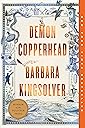
Demon Copperhead: A Pulitzer Prize Winner
Product ID: 532126786
Desertcart purchases this item on your behalf and handles shipping, customs, and support to South Korea.
WINNER OF THE PULITZER PRIZE • WINNER OF THE WOMEN'S PRIZE FOR FICTION New York Times Readers’ Pick: Top 100 Books of the 21 st Century • An Oprah’s Book Club Selection • An Instant New York Times Bestseller • An Instant Wall Street Journal Bestseller • A #1 Washington Post Bestseller • A New York Times "Ten Best Books of the Year" "Demon is a voice for the ages—akin to Huck Finn or Holden Caulfield—only even more resilient.” —Beth Macy, author of Dopesick "May be the best novel of [the year]. . . . Equal parts hilarious and heartbreaking, this is the story of an irrepressible boy nobody wants, but readers will love.” — Ron Charles, Washington Post From the acclaimed author of The Poisonwood Bible and The Bean Trees and the recipient of the National Book Foundation's Medal for Distinguished Contribution to American Letters , a brilliant novel that enthralls, compels, and captures the heart as it evokes a young hero’s unforgettable journey to maturity Set in the mountains of southern Appalachia, Demon Copperhead is the story of a boy born to a teenaged single mother in a single-wide trailer, with no assets beyond his dead father’s good looks and copper-colored hair, a caustic wit, and a fierce talent for survival. Relayed in his own unsparing voice, Demon braves the modern perils of foster care, child labor, derelict schools, athletic success, addiction, disastrous loves, and crushing losses. Through all of it, he reckons with his own invisibility in a popular culture where even the superheroes have abandoned rural people in favor of cities. Many generations ago, Charles Dickens wrote David Copperfield from his experience as a survivor of institutional poverty and its damages to children in his society. Those problems have yet to be solved in ours. Dickens is not a prerequisite for readers of this novel, but he provided its inspiration. In transposing a Victorian epic novel to the contemporary American South, Barbara Kingsolver enlists Dickens’ anger and compassion, and above all, his faith in the transformative powers of a good story. Demon Copperhead speaks for a new generation of lost boys, and all those born into beautiful, cursed places they can’t imagine leaving behind. Review: More than a Dickens rewrite - When, at the age of 15, I first read David Copperfield, Charles Dickens’ classic novel of the protagonist’s struggle to rise above child poverty in a society seemingly structured to keep him poor, it was the first book that made me tear up at the end, that glorious end with the angelic Agnes ever “pointing upward.” I wasn’t sure that Barbara Kingsolver’s DemonCopperhead could possibly elicit anything like that response from my jaded, seen-it-all-before, read-it-all-before consciousness. Re-imagining the quintessentially British Dickens’ nineteenth-century story as a twenty-first century slice of American Appalachian life? How’s that likely to work? Well, of course, it was likely to bomb spectacularly. But instead, what I found from the book’s very first paragraph was a voice that explodes off the page with both confidence and world-weariness, with stoicism and self-knowledge, with everything the character is going to exhibit in the rest of this blockbuster of a novel. Dickens’ David famously opens with, “Whether I shall turn out to be the hero of my own life, or whether that station will be held by anybody else, these pages must show.” By contrast, Kingsolver’s Copperhead (whose real name is Damon Fields, but he has red hair, so…) opens with, “First, I got myself born. A decent crowd was on hand to watch and they’ve always given me that much: the worst of the job was up to me, my mother being let’s just say out of it.” In this life, you make your own choices, and if you’re going to get anywhere, and your mother is in and out of rehab constantly, you have to do it yourself, Damon tells you at the beginning. You think there’s going to be a hero in your life? Think again. There’s just you, trying to make your way in a world that’s stacked against you. Here’s a voice that, in its tone of genuine down-home rural Americanism sounds a lot more like Huck Finn than anybody in Dickens. Like Huck, he has a memorable way of putting things in his colorful American vernacular: He’s “the Eagle Scout of trailer trash,” he tells us at one point. And I don’t mean to say that you must be familiar with David Copperfield to enjoy Demon Copperhead. You can follow the plot, empathize with the characters and absorb the themes of Kingsolver’s book without ever having heard of Dickens. But it does add something to the overall experience of the book if you know the Copperfield story. In particular, there’s a bit of fun for readers when they can recognize by name a Kingsolvian character intended to parallel a Dickensian one. Thus, when Damon’s abusive stepfather bears the name of “Stoner,” it’s easy to see the connection with David’s equally cruel stepfather, whose name happens to be “Murdstone.” Damon’s kind neighbors, the Peggots, clearly recall David’s friends the Peggottys and Clara Peggoty, David’s early nurse and lifelong friend. Dickens’ charming and narcissistic James Steerforth, who for a while promises to be that “hero of my own life” David looks forward to in his opening sentence, finds his counterpoint in Kingsolver’s Sterling Ford, nicknamed Fast Forward, star quarterback on the high school football team and, for awhile, Damon’s idol. Copperfield’s “child wife” Dora Spenlowe is echoed in Kingsolver’s Dori, and when Damon falls for his needy, childish Dori you don’t have to remember David Copperfield to know that relationship is going to be a disaster, but it helps. Occasionally Kingsolver’s parallel characters are direct mirror images of Dickens’, as in the case of Damon’s grandmother Betsy and her eccentric friend Mr. Dick, who liked flying kites, mirroring David’s great-aunt Betsy and her eccentric friend Mr. Dick who also liked flying kites. Sometimes there’s more of a difference: Damon’s short-term foster father Mr. McCobb has a few things in common with David’s Mr. Micawber, lack of steady employment and perpetual new schemes to get rich among them, but Micawber is a well-meaning screwup, while McCobb is just trying to take advantage of the system. And Dickens’ Uriah Heep is a far more insidious villain than Kingsolver’s assistant coach U-Haul Pyles, whose downfall is far less precipitous than Heep’s in Dickens. And then there is “Angus” Winfield, daughter of the high school football coach and Damon’s foster-sister during the best and worst years of his life, who clearly parallels David’s guardian angel, Agnes Wickfield, and who you know from the first is going to be a major influence in Damon’s life. Of course, knowing Dickens gives you an idea of the role these characters are going to play in the story. But the plot of Demon Copperhead is not therefore predictable, as Kingsolver translates these characters’ motivations and effects on the protagonist into a completely different milieu of time and place. Ultimately, what’s important about the influence of Dickens on Kingsolver’s book is not the superficial correspondences of plot or character, but rather their very significant agreement in terms of theme and authorial intent. In an afterword to her novel, Kingsolver writes, “I’m grateful to Charles Dickens for writing David Copperfield, his impassioned critique of institutional poverty and its damaging effects on children in his society. Those problems are still with us. In adapting his novel to my own place and time, working for years with his outrage, inventiveness, and empathy at my elbow, I’ve come to think of him as my genius friend.” It is precisely those social evils that Kingsolver has directly in her sites in this novel: The institutional poverty of former coal-mining areas of her native Appalachia; the effects of that poverty on children, especially children whose parents have been victims of that poverty and are dead or imprisoned. She attacks the ineptitude and bureaucracy of child welfare services, the abuse of the system of foster care that allows people like Damon’s foster parents to take children solely for the sake of taking the monthly support money, or for gaining slave labor like the tobacco farmer who first fosters Damon. She attacks a justice system that will accept the testimony of an abusive stepfather rather than the word of the abused child. But more than anything else she attacks the opioid crisis. Damon, who has a brief period when it seems he may escape the cesspool of his luckless life through success on the gridiron as a high school football star, has a terrible knee injury for which he is prescribed opioid pain relievers to which he becomes hopelessly addicted, and Kingsolver’s indictment of the doctors, salesmen, druggists, and especially the Sackler-owned Purdue Pharma are is merciless in the novel. It truly seems like there is no way out for Damon—but as David Copperfield had a talent in writing that finally helped pull him out of poverty, the fact that Damon has a talent for drawing—all he has left after football—does give him a ray of hope. I won’t spoil the end by telling you whether he’s able to use it. Thus Kingsolver is not simply the heir of Dickens in recasting his most personal novel; she is more importantly the spiritual heir of Dickens’ novel of social criticism, something you don’t see much of any more. Where is Dickens today? Where are the Zolas? The Sinclair Lewises? The John Steinbecks? Gone. But we’ve still got Barbara Kingsolver. Review: Shadows Cast down help illuminate Appalachia - The coal-filled mountains of Appalachia cast darkness on the small towns dotted throughout the eastern us. The book begins as the main character, Demon, starts to tell his story, which is a twisting path at the bottom of the mountain that begins interjectory not up the mountain but down into the darkness where spiderwebs of misfortune are found deep in the coal mines. Demon’s childhood is a spiral of terrible circumstances and an environment accompanied by adults who make poor decisions in a community that thrives on coal and drugs (both legal and illegal.) Demon, throughout his childhood, is raised by his young mother, a drug addict, and his neighbors, the Peggots, who assist in trying to keep Demon on a straight path as they deal with the same institutional issues living in the mountaintop small-town Appalachia, drug addiction, crime, poverty, and a poor economy. “The wonder is that you could start life with nothing, end with nothing, and lose so much in between.” Demon’s mother soon marries a man called Stoner, who is abusive to both Demon and his mother; during their marriage, Demon’s mother relapses, and Demon and Stoner struggle as Demon attempts to call for help and Stoner attempts to stop him, and Demon loses his mother and his unborn sibling. After his mother’s death, he’s given to a foster home where he is worked like hired help on a tobacco farm, echoing the horribleness of how the American foster system can harm a child. Demon learns the ins and outs of the family on this farm through his peers getting into trouble, lusting for a good meal, and starting to take drugs for fun. Eventually, Demon, as he ages and moves to another foster family who struggles in the poverty of Appalachia, Demon runs away to his grandmother’s house in Murder Valley, Tennessee. On his trip, he meets a preacher, gets his money stolen by a prostitute, and sleeps in a barn. Eventually, he meets Betsy Woodall and her disabled brother Dick who get Demon back in shape and, using her connections, gets him a foster home with a football coach. Demon’s problems for a short while disappear, as he starts school again, taking special classes in art and getting by in other courses, but eventually, the freedom of youth escapes him, and he spirals back down, even as he’s the star player a football team the pinnacle of any small town. Demon eventually gets injured and addicted to oxicotten on a legal script that doctors at the time were pushing to everyone to deal with pain, knowing the drug was addictive; in doing so, Demon falls for a girl, Dori, who had her own addiction issues and Demon’s life course even when going well for just a few short years spirals again. “I said probably they were just scared he was going to put ideas in our heads.” She smiled. “Imagine that. A teacher, putting ideas in kids’ heads.” The ending is not a tragic blunder about addiction and poverty but a tour of struggle and pain as Demon grows and fails and picks himself up, eventually using his artistic skills to slowly build a world around him that may give him enough structure to break a cycle that many fail to do. Eventually, Demon realizes the few people close to him who constantly annoyed him were the very few people that only wanted Demon Copperhead to stand tall and be the better person he deserved to be. “I can still feel in my bones how being mad was the one thing holding me together.” The book’s plot is based on a request given to Demon during his struggles and is only released at the end. Mrs. Kingsolver’s writing style has a tone and character not seen in writing, often using appropriate slang and terms in the Appalachian area. Demon’s voice, written by Mrs. Kingsolver, is unique and baked in with a sincerity of hard luck and oppression not often found in modern literary writing. The book was hard to put down and flowed well chapter into the chapter as Demon continued to be put into horrible situations by those who were supposed to take care of him. At times, during the parts of the story about addiction and drugs, I would step away from the book because the trauma, pain, and hopelessness portrayed in the words and mood can become very real. These are all complex topics to read and, at times, to enjoy, but Mrs. Kingsolver provides the proper framing in Demon’s voice and the appropriate amount of darkness and light to keep the pages turning, never letting the pace or tone become too much for the reader. I would consider adding this book to every high school-required reading list. Demon Copperhead was the Women’s Prize for Fiction in 2023, was named “10 best books of 2022” by the NYT and Washington Post, and shared the 2023 Pulitzer Prize for Fiction with Hernan Diaz’s book Trust. This was the first time the prize was split. The novel has lingered on the fringes of books I wanted to read. I picked it up as part of my book club reads for 2024, and I’m glad I did. I would recommend it to anyone, as it features superior prose, various authentic characters, and a modern setting with hundreds of tragedies, comedies, and dramas that must be told. Word of note, this book can get dark and deals with modern-day problems that may trigger emotions and people impacted in such situations.


| Best Sellers Rank | #162 in Books ( See Top 100 in Books ) #1 in American Fiction Anthologies #4 in Classic American Literature #5 in Small Town & Rural Fiction (Books) |
| Customer Reviews | 4.6 out of 5 stars 158,421 Reviews |
J**D
More than a Dickens rewrite
When, at the age of 15, I first read David Copperfield, Charles Dickens’ classic novel of the protagonist’s struggle to rise above child poverty in a society seemingly structured to keep him poor, it was the first book that made me tear up at the end, that glorious end with the angelic Agnes ever “pointing upward.” I wasn’t sure that Barbara Kingsolver’s DemonCopperhead could possibly elicit anything like that response from my jaded, seen-it-all-before, read-it-all-before consciousness. Re-imagining the quintessentially British Dickens’ nineteenth-century story as a twenty-first century slice of American Appalachian life? How’s that likely to work? Well, of course, it was likely to bomb spectacularly. But instead, what I found from the book’s very first paragraph was a voice that explodes off the page with both confidence and world-weariness, with stoicism and self-knowledge, with everything the character is going to exhibit in the rest of this blockbuster of a novel. Dickens’ David famously opens with, “Whether I shall turn out to be the hero of my own life, or whether that station will be held by anybody else, these pages must show.” By contrast, Kingsolver’s Copperhead (whose real name is Damon Fields, but he has red hair, so…) opens with, “First, I got myself born. A decent crowd was on hand to watch and they’ve always given me that much: the worst of the job was up to me, my mother being let’s just say out of it.” In this life, you make your own choices, and if you’re going to get anywhere, and your mother is in and out of rehab constantly, you have to do it yourself, Damon tells you at the beginning. You think there’s going to be a hero in your life? Think again. There’s just you, trying to make your way in a world that’s stacked against you. Here’s a voice that, in its tone of genuine down-home rural Americanism sounds a lot more like Huck Finn than anybody in Dickens. Like Huck, he has a memorable way of putting things in his colorful American vernacular: He’s “the Eagle Scout of trailer trash,” he tells us at one point. And I don’t mean to say that you must be familiar with David Copperfield to enjoy Demon Copperhead. You can follow the plot, empathize with the characters and absorb the themes of Kingsolver’s book without ever having heard of Dickens. But it does add something to the overall experience of the book if you know the Copperfield story. In particular, there’s a bit of fun for readers when they can recognize by name a Kingsolvian character intended to parallel a Dickensian one. Thus, when Damon’s abusive stepfather bears the name of “Stoner,” it’s easy to see the connection with David’s equally cruel stepfather, whose name happens to be “Murdstone.” Damon’s kind neighbors, the Peggots, clearly recall David’s friends the Peggottys and Clara Peggoty, David’s early nurse and lifelong friend. Dickens’ charming and narcissistic James Steerforth, who for a while promises to be that “hero of my own life” David looks forward to in his opening sentence, finds his counterpoint in Kingsolver’s Sterling Ford, nicknamed Fast Forward, star quarterback on the high school football team and, for awhile, Damon’s idol. Copperfield’s “child wife” Dora Spenlowe is echoed in Kingsolver’s Dori, and when Damon falls for his needy, childish Dori you don’t have to remember David Copperfield to know that relationship is going to be a disaster, but it helps. Occasionally Kingsolver’s parallel characters are direct mirror images of Dickens’, as in the case of Damon’s grandmother Betsy and her eccentric friend Mr. Dick, who liked flying kites, mirroring David’s great-aunt Betsy and her eccentric friend Mr. Dick who also liked flying kites. Sometimes there’s more of a difference: Damon’s short-term foster father Mr. McCobb has a few things in common with David’s Mr. Micawber, lack of steady employment and perpetual new schemes to get rich among them, but Micawber is a well-meaning screwup, while McCobb is just trying to take advantage of the system. And Dickens’ Uriah Heep is a far more insidious villain than Kingsolver’s assistant coach U-Haul Pyles, whose downfall is far less precipitous than Heep’s in Dickens. And then there is “Angus” Winfield, daughter of the high school football coach and Damon’s foster-sister during the best and worst years of his life, who clearly parallels David’s guardian angel, Agnes Wickfield, and who you know from the first is going to be a major influence in Damon’s life. Of course, knowing Dickens gives you an idea of the role these characters are going to play in the story. But the plot of Demon Copperhead is not therefore predictable, as Kingsolver translates these characters’ motivations and effects on the protagonist into a completely different milieu of time and place. Ultimately, what’s important about the influence of Dickens on Kingsolver’s book is not the superficial correspondences of plot or character, but rather their very significant agreement in terms of theme and authorial intent. In an afterword to her novel, Kingsolver writes, “I’m grateful to Charles Dickens for writing David Copperfield, his impassioned critique of institutional poverty and its damaging effects on children in his society. Those problems are still with us. In adapting his novel to my own place and time, working for years with his outrage, inventiveness, and empathy at my elbow, I’ve come to think of him as my genius friend.” It is precisely those social evils that Kingsolver has directly in her sites in this novel: The institutional poverty of former coal-mining areas of her native Appalachia; the effects of that poverty on children, especially children whose parents have been victims of that poverty and are dead or imprisoned. She attacks the ineptitude and bureaucracy of child welfare services, the abuse of the system of foster care that allows people like Damon’s foster parents to take children solely for the sake of taking the monthly support money, or for gaining slave labor like the tobacco farmer who first fosters Damon. She attacks a justice system that will accept the testimony of an abusive stepfather rather than the word of the abused child. But more than anything else she attacks the opioid crisis. Damon, who has a brief period when it seems he may escape the cesspool of his luckless life through success on the gridiron as a high school football star, has a terrible knee injury for which he is prescribed opioid pain relievers to which he becomes hopelessly addicted, and Kingsolver’s indictment of the doctors, salesmen, druggists, and especially the Sackler-owned Purdue Pharma are is merciless in the novel. It truly seems like there is no way out for Damon—but as David Copperfield had a talent in writing that finally helped pull him out of poverty, the fact that Damon has a talent for drawing—all he has left after football—does give him a ray of hope. I won’t spoil the end by telling you whether he’s able to use it. Thus Kingsolver is not simply the heir of Dickens in recasting his most personal novel; she is more importantly the spiritual heir of Dickens’ novel of social criticism, something you don’t see much of any more. Where is Dickens today? Where are the Zolas? The Sinclair Lewises? The John Steinbecks? Gone. But we’ve still got Barbara Kingsolver.
M**W
Shadows Cast down help illuminate Appalachia
The coal-filled mountains of Appalachia cast darkness on the small towns dotted throughout the eastern us. The book begins as the main character, Demon, starts to tell his story, which is a twisting path at the bottom of the mountain that begins interjectory not up the mountain but down into the darkness where spiderwebs of misfortune are found deep in the coal mines. Demon’s childhood is a spiral of terrible circumstances and an environment accompanied by adults who make poor decisions in a community that thrives on coal and drugs (both legal and illegal.) Demon, throughout his childhood, is raised by his young mother, a drug addict, and his neighbors, the Peggots, who assist in trying to keep Demon on a straight path as they deal with the same institutional issues living in the mountaintop small-town Appalachia, drug addiction, crime, poverty, and a poor economy. “The wonder is that you could start life with nothing, end with nothing, and lose so much in between.” Demon’s mother soon marries a man called Stoner, who is abusive to both Demon and his mother; during their marriage, Demon’s mother relapses, and Demon and Stoner struggle as Demon attempts to call for help and Stoner attempts to stop him, and Demon loses his mother and his unborn sibling. After his mother’s death, he’s given to a foster home where he is worked like hired help on a tobacco farm, echoing the horribleness of how the American foster system can harm a child. Demon learns the ins and outs of the family on this farm through his peers getting into trouble, lusting for a good meal, and starting to take drugs for fun. Eventually, Demon, as he ages and moves to another foster family who struggles in the poverty of Appalachia, Demon runs away to his grandmother’s house in Murder Valley, Tennessee. On his trip, he meets a preacher, gets his money stolen by a prostitute, and sleeps in a barn. Eventually, he meets Betsy Woodall and her disabled brother Dick who get Demon back in shape and, using her connections, gets him a foster home with a football coach. Demon’s problems for a short while disappear, as he starts school again, taking special classes in art and getting by in other courses, but eventually, the freedom of youth escapes him, and he spirals back down, even as he’s the star player a football team the pinnacle of any small town. Demon eventually gets injured and addicted to oxicotten on a legal script that doctors at the time were pushing to everyone to deal with pain, knowing the drug was addictive; in doing so, Demon falls for a girl, Dori, who had her own addiction issues and Demon’s life course even when going well for just a few short years spirals again. “I said probably they were just scared he was going to put ideas in our heads.” She smiled. “Imagine that. A teacher, putting ideas in kids’ heads.” The ending is not a tragic blunder about addiction and poverty but a tour of struggle and pain as Demon grows and fails and picks himself up, eventually using his artistic skills to slowly build a world around him that may give him enough structure to break a cycle that many fail to do. Eventually, Demon realizes the few people close to him who constantly annoyed him were the very few people that only wanted Demon Copperhead to stand tall and be the better person he deserved to be. “I can still feel in my bones how being mad was the one thing holding me together.” The book’s plot is based on a request given to Demon during his struggles and is only released at the end. Mrs. Kingsolver’s writing style has a tone and character not seen in writing, often using appropriate slang and terms in the Appalachian area. Demon’s voice, written by Mrs. Kingsolver, is unique and baked in with a sincerity of hard luck and oppression not often found in modern literary writing. The book was hard to put down and flowed well chapter into the chapter as Demon continued to be put into horrible situations by those who were supposed to take care of him. At times, during the parts of the story about addiction and drugs, I would step away from the book because the trauma, pain, and hopelessness portrayed in the words and mood can become very real. These are all complex topics to read and, at times, to enjoy, but Mrs. Kingsolver provides the proper framing in Demon’s voice and the appropriate amount of darkness and light to keep the pages turning, never letting the pace or tone become too much for the reader. I would consider adding this book to every high school-required reading list. Demon Copperhead was the Women’s Prize for Fiction in 2023, was named “10 best books of 2022” by the NYT and Washington Post, and shared the 2023 Pulitzer Prize for Fiction with Hernan Diaz’s book Trust. This was the first time the prize was split. The novel has lingered on the fringes of books I wanted to read. I picked it up as part of my book club reads for 2024, and I’m glad I did. I would recommend it to anyone, as it features superior prose, various authentic characters, and a modern setting with hundreds of tragedies, comedies, and dramas that must be told. Word of note, this book can get dark and deals with modern-day problems that may trigger emotions and people impacted in such situations.
L**R
A story to remember.
I was not in a place to deal with the sadness and the tragedy of this story. I almost didn’t finish it, but went back again after I’d put it down. I loved the writing and the happy, “sigh of relief” ending, finally a feel-good experience. It made the read worthwhile. Tremendous writing throughout. Kingsolver deserves a Nobel.
H**A
Wild
What a wild ride this book was. Very well developed characters. Wavered between heartbreak and wanting to pop Demon up side his head. Such a great story about the opioid crisis and generational addiction cycles. Also fitting description of the foster care system where there are more kids than homes and so many hard working people trying to juggle it all. Kingsolver knows how to make you fall in love with characters and then rip your heart out. Very well written and worth the read!
H**H
Demon Copperfield is a True Literary Hero
I knew very little about this book before deciding to read it. One of the few things I read is that it was based on Huckleberry Finn. I was confused as I was reading and decided, no no no, this is David Copperfield! And duh, when you compare the main character‘s name along with his nickname to that of D. C., the intention is pretty obvious. This is a much longer book than D. C. which I read as a teenager in just a few sittings, (I might’ve been reading an abridged version) but establishing the various settings of this story was an essential use of space. Unless you grow up in Appalachia, you really have no idea. This California native certainly did not. I found this story absolutely fascinating from a number of perspectives. For example; I loved learning about a new place right here in my own country, having attended high school in the 80s it was very fun to relive some of those days, and, of course, it was fascinating to compare the various characters and threads of the story to that of Charles Dicken’s original. I will say that some of this is not ordinarily my cup of tea, and there was a lot of of it that was quite distressing and depressing, but it ended much more happily then similar books that were written to enlarge on their British Victorian counterparts. Aside from all that, I just love Demon. He’s a true hero.
M**S
Copperhead Road
In an interview with Ezra Klein on his podcast, Barbara Kingsolver said she wanted to write “the great Appalachian novel.” She conceded, however, that the notion “probably sounds ridiculous.” In particular, Kingsolver said she wanted to write about the fact that the people who live in Appalachia “are the most resourceful Americans you’re probably going to find anywhere.” Kingsolver, who was raised in rural Kentucky and now lives in rural Virginia, said she wanted to explore the shame she had internalized from her choice of a place to live. “How many people well-meaning people have asked me, ‘how could I live there in the middle of nowhere?’” said Kingsolver. “People, this is my everywhere. This is my everything.” Later in the chat: “Everybody looks down on the country people and the country people sort of absorb that. You can’t help but absorb it. So when I set out to write my great Appalachian novel. I was paralyzed with self-doubt because, I mean, my starting point was that I wanted to write about the opioid epidemic, which is become a huge assault on our culture, our families, our communities. It’s devastated so many of the good things about this region that we value and that we love. And so I wanted to write about these kids who’ve been damaged and this place that’s been damaged, and it seemed like a really hopelessly sad story. Plus, it’s about people that I didn’t feel the outer world cared about. And so I just really, I spent a couple of years walking around and around this story, trying to figure out how to break into that house because I really felt sure nobody wants to read it.” Well, Kingsolver was wrong. At least, she was wrong about the interest in her topic—not her take on the people of Appalachia. Winner of the Pulitzer Prize for fiction and 85,000+ ratings on Amazon (4.6 stars). There’s so much to like about Demon Copperhead but one of the main things is that it’s so breezily readable. For a 546-page epic, it goes down fast. It’s episodic, a la Dickens, but the character flow is organic, unforced. Demon’s voice is engaging and his struggles are real, particularly when it comes to the challenges of the foster care system and the brutality of OxyContin addictions. Kingsolver’s empathy for addicts comes pouring out of the story. She is non-judgmental, plays it straight. Here is Demon, somewhat early on, looking back on the power of addiction: “I had roads to travel before I would know it’s not that simple, the dope versus the person you love. That a craving can ratchet itself up and up inside a body and a mind, at the same time that body’s strength for tolerating is favorite drug goes down and down. That the longer you’ve gone hurting between fixes, the higher the odds that you’ll reach too hard for the stars next time. That first big rush of relief could be your last. In the long run, that’s how I’ve come to picture Mom at the end: reaching as hard as her little body would stretch, trying to touch the blue sky, reaching for some peace.” That’s as good a passage about the feeling of addiction, and a description of its power, that I’ve ever read. (Kingsolver also read that section on Klein’s podcast.) Kingsolver is a deceiving writer. Her style is unassuming and keen-eyed. The text is full of specificity. And energy. If you have any doubts about tackling this book because it looks too heavy, squash those notions. Here’s the beginning of Chapter 34: “A lot of firsts that school year. First scrimmage, first JV game, first tackle, first passing yards made. First school dance, with an eighth-grader girl that was dead serious about it. So, my first real date, evidently. Angus and Sax went together dressed as Planet of the Apes, loser of their grade contest (Sax) being the human on a leash. This is Homecoming mind you, not Halloween, so. Not a date. But Angus took mine over, ordered the corsage from Walmart, took me to Goodwill where we found this dope white suit from the sixties. In my size, unbelievable. I’ve grown into my hands and feet by this point, and I’m pushing 6 feet. Thank you, Mattie Kate.” Mattie Kate is the housekeeper who worked for football Coach Wingate, where Demon lived while he was being developed as a potential football star. There are plenty of characters to keep track of, but Kingsolver gives them juicy nicknames (again, a la Dickens) or colorful descriptions so they are easy to track. U-Haul. Fast Forward. Waddles. Mouse. If you know David Copperfield (it’s been decades since I read it) you’ll have a great time with what Kingsolver did with her names. For instance, Uriah Heep becomes Ryan Pyles. The “resourcefulness” of Demon is apparent in his stubborn ability to survive. He’s smarter than he acknowledges, and very observant. In Demon Copperhead, bad things happen to bad people and bad things happen to good people, too. Many around Demon are not so fortunate and literally or metaphorically drown. You can’t help but think about the failure of our institutions around child welfare, the foster care system, adult welfare, and drug abuse. But Demon finds his talent, develops a passion, and puts it to use. Hello, the power of art. And love. Every great novel, and this is one, is a love story in the end. Demon Copperfield was written with passion for Kingsolver’s very personal reasons. The execution is a thing of beauty—and something we can all admire.
S**S
Lush writing packed with heartache and humor
BetweenTheLines said what I would: "What makes this book so remarkable is Demon himself. His voice is so authentic that I stopped feeling like I was reading fiction and started feeling like someone was telling me the story of their life. Kingsolver has an incredible gift for creating characters who feel completely real, flaws and all. This isn't always an easy read because it doesn't look away from poverty, addiction, or the failures of the systems that are supposed to protect children. But it's never hopeless. There is humor, resilience, and just enough light to keep you turning the pages. A story about survival and the people who shape us, for better or worse. It's beautifully written and emotionally honest." I had to put the book down for a day here and there due to the subject matter, but I am so glad I stayed with it.
S**S
Leaves a impact!
I was recommended Demon Copperhead by a friend, and after seeing it buzzing around the book world, I finally decided to give it a try. I started listening to the audiobook, and by the second chapter, I was completely hooked. Set in Appalachia, not far from where I grew up, the story resonated deeply with me. Having worked in healthcare for 15 years, I’ve seen firsthand the devastating effects of addiction, which is a central theme in the book. As an advocate for improving the foster care system, I found the portrayal of the challenges faced by foster children incredibly authentic and moving. Barbara Kingsolver excels at creating complex, fully fleshed-out characters who each experience growth—or in some cases, stagnation—throughout the story. The detailed narrative brings each character to life and evokes a wide range of emotions. The book is lengthy and richly detailed, which I appreciated, although I wished the ending had been a bit longer to match the strong buildup. I’m still curious about how Demon’s life unfolds beyond the last page. One minor annoyance for me was the occasional inaccurate pop culture references—it was a small gripe, but it did pull me out of the story at times. Overall, Demon Copperhead is a powerful, affecting read that offers a poignant look at addiction, resilience, and the complexities of life in Appalachia. I highly recommend it to anyone interested in stories grounded in real social issues and deeply human characters.
Y**A
A must read!
Loved this! Cried through the first half 🤭🤭🤭
I**S
Look forward to the ending please. It makes you smile I promise!
Hands down to the best fiction I've read in a while!!! It has been an amazing roller coaster ride with Demon. All the ups and downs, mostly downs. It's astonishing to see how well the author depicts the mind of a teenage boy going through trauma, addiction, and loss. Along the way I was hoping please don't make it sexual between Angus and Demon, but in the end I found myself the no.1 fan shipping these two. What a wholesome and hopeful ending. So heart-breaking and thus more heart-warming felt at the end.
A**A
A pesar de los premios, no es para mí
Tenía muchísimas expectativas por todas las recomendaciones, premios y reseñas, pero lamentablemente no fue para mí. Reconozco que Barbara Kingsolver escribe muy bien y que la construcción del personaje principal es excelente. La historia invita a reflexionar sobre el trauma, la pobreza, la resiliencia y cómo una infancia marcada por las pérdidas puede hacer que alguien nunca deje de esperar que todo vuelva a salir mal. Esa parte me pareció muy poderosa. Sin embargo, sentí que el libro es excesivamente largo y repetitivo. La autora dedica cientos de páginas a narrar cada etapa del sufrimiento de Demon con un nivel de detalle que, en mi caso, terminó siendo agotador. Llegó un punto en el que más que disfrutar la lectura, la estaba soportando. Entiendo por qué muchos consideran esta novela una obra maestra, pero para mí fue una lectura pesada, emocionalmente desgastante y con un cierre que no estuvo a la altura del camino recorrido. Terminé el libro con alivio más que con satisfacción.
L**M
Raw and moving
A reimagining of Dickens' David Copperfield, this is the story of Damon Fields, aka, Demon Copperhead, a young boy growing up in the mountains of Southern Appalachia, and charting his journey into adulthood. Born to a teen-aged single mother battling a drug habit, Demon is orphaned at a young age, forced to face the hardships of a broken foster care system. Later, he finally finds a home with Coach Winfield and his daughter Angus, briefly enjoying stardom on the football pitch, only to suffer a devastating injury. From there, Demon finds himself on a downward spiral, battling addiction issues himself, however, through all the adversities, Demon never loses the fighting spirit and resilience he was born with. My first read from Barbara Kingsolver, and easily my favourite read of the year so far, though not always an easy read, given the oftentimes depressing subject matter. Yet, no matter how bleak and harrowing the story got, ultimately the message was one of triumph and hope, and I think that always shone through. Demon, as the central character, is a joy. I simply loved his voice, and thought Kingsolver did a remarkable job of so wonderfully capturing the inner thoughts and feelings of a young boy/teenager. He narrates his story with a darkly sardonic sense of humour, that also helps keep the tone of the story entertaining no matter what he is enduring. Demon has a zest for life that simply cannot be stamped out, even at his lowest ebb, and whilst at times the choices he makes are questionable, I was rooting for him all the way. His heart was always in the right place, such that it was impossible not to like him. I've never actually read David Copperfield, but am familiar with the story though various television and movie adaptations over the years. I don't think you necessarily have to be familiar with the story, in order to enjoy this, but if you are, then I think you'll likely appreciate all the nods, and how cleverly Kingsolver takes Dickens' story and characters and translates them in this modern day setting. I did also find it rather thought-provoking, how so many of the social issues that Dickens was writing about, such as poverty, child labour and the bleak life of an orphan, are still so relevant today. Here, the orphanages are replaced instead by a broken foster care system that is no less harrowing. Another important issue covered in the story is drug abuse, Kingsolver going into a fair amount of detail on the heroin epidemic that affected these parts and destroyed so many lives and communities, and the role the pharmaceutical industry played in this. Kinsgsolver's love for her native Appalachia was clear to see and infused throughout the story, be it in Demon's love for the nature around him, or in the interesting history of the area that she weaves into the story. Its there in the commentary on how rural folk are so often misrepresented, and in Demon's comic strips and later graphic novel that try to hit back and give his people a voice. Yes, perhaps at times her social commentary could seem a little forced, however, I appreciated the passion behind it nevertheless. The novel is certainly lengthy, however, I never found myself losing attention. Whilst Demon owned my heart from very early on, there were a whole host of characters here to love, and some to love to hate. Some of my favorites included Angus, Tommy, and Aunt June, though the Peggotts as a whole family were a lovable bunch. Overall, this was a masterful reworking of a classic, and yet also entirely Kingsolver's own. A story that is as likely to have you laughing as it is crying; I found this an incredibly raw and moving read, with a big-hearted hero who will stay with me for a long time.
E**N
Amazing
I couldn't put this by book down. It's a rollercoaster of emotion; brutal and stark in places but a story told so tenderly that it might just break your heart. Definitely recommended.
Trustpilot
3 weeks ago
2 months ago