

5 8GB
Product ID: 600024479
Details
- BrandRaspberry Pi
- CPU Speed2.4 GHz
- Memory Storage Capacity8 GB
- Model NameRaspberry Pi 5
- Ram Memory Installed Size8 GB
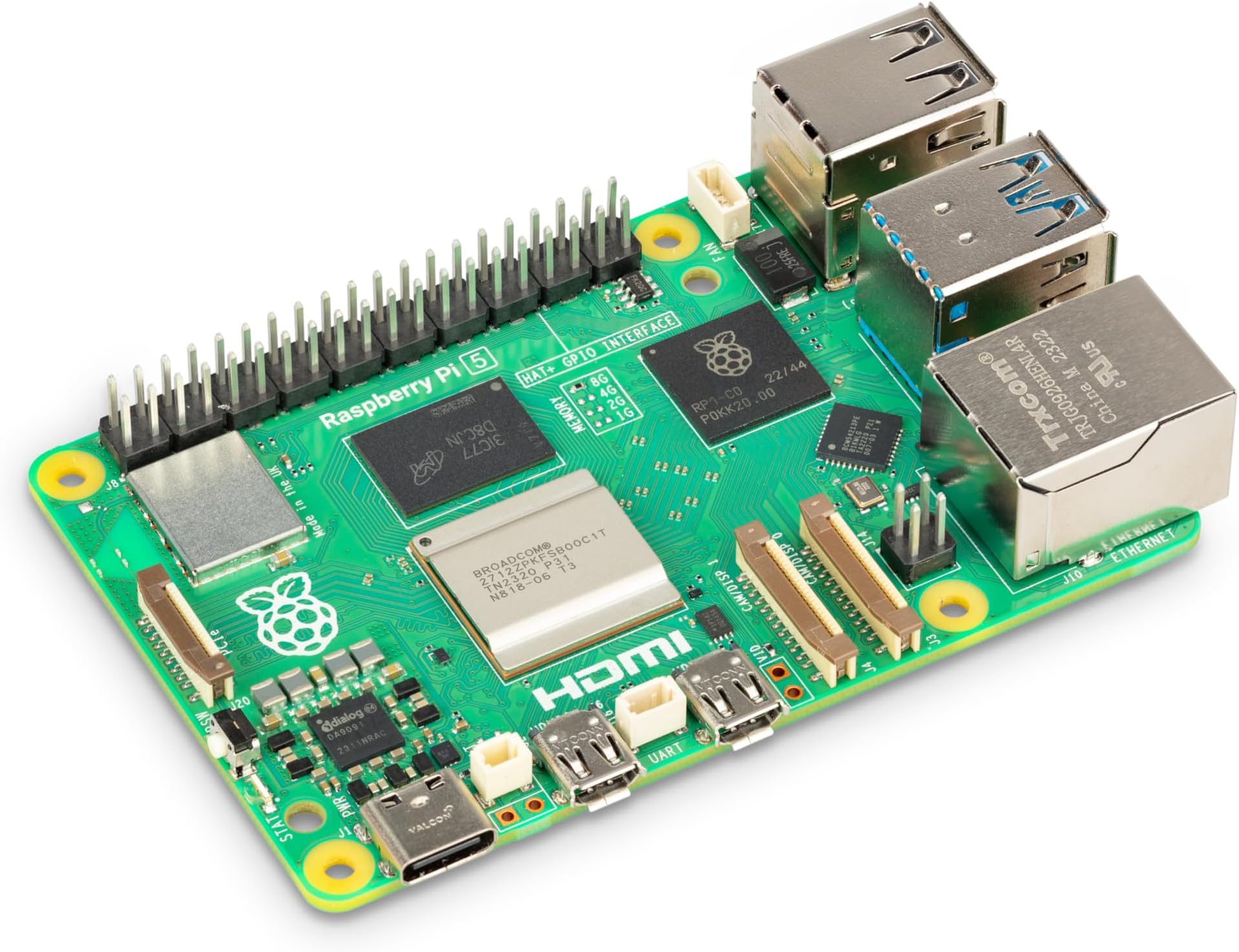
🎮Dual 4Kp60 HDMI
💻2.4GHz quad-core CPU
📶Bluetooth 5.0
Buy anything from 5,000+ international stores. One checkout price. No surprise fees. Join 2M+ shoppers on Desertcart.
Desertcart purchases this item on your behalf and handles shipping, customs, and support to South Korea.
🚀 Elevate Your Tech Game with Raspberry Pi 5!
The Raspberry Pi 5 8GB is a compact yet powerful computing solution featuring a 2.4GHz quad-core CPU, dual 4K HDMI outputs, and advanced Bluetooth 5.0 connectivity, making it perfect for innovative projects and seamless multimedia experiences.


| ASIN | B0CK2FCG1K |
| Best Sellers Rank | #10 in Single Board Computers (Computers & Accessories) |
| Brand | Raspberry Pi |
| CPU Speed | 2.4 GHz |
| Compatible Devices | Raspberry Pi Camera Module V2, 4K displays with HDMI input |
| Connectivity Technology | Bluetooth, HDMI |
| Customer Reviews | 4.7 out of 5 stars 2,817 Reviews |
| Global Trade Identification Number | 05056561803326 |
| Item Weight | 60 Grams |
| Manufacturer | Raspberry Pi |
| Memory Storage Capacity | 8 GB |
| Mfr Part Number | SC1112 |
| Model Name | Raspberry Pi 5 |
| Model Number | SC1112 |
| Operating System | Raspberry Pi OS |
| Processor Brand | ARM |
| Processor Count | 4 |
| Processor Speed | 2.4 GHz |
| RAM Memory Installed | 8 GB |
| RAM Memory Technology | LPDDR4X |
| Ram Memory Installed Size | 8 GB |
| Total Usb Ports | 4 |
| Unit Count | 1.0 Count |
| Wireless Compability | 802.11ac, Bluetooth |
D**N
Raspberry Pi 5: The Tiny Computer That Does EVERYTHING!
If you’re shopping for a Raspberry Pi 5, I’d strongly consider stepping up to the 16GB model—especially if your plan includes an AI HAT, heavier multitasking, or squeezing the most out of emulation/gaming. While the 8GB version is both functional and durable. The 8GB version is absolutely excellent for the majority of use cases (general Linux projects, home server tasks, Kali, etc.), but once you start stacking bigger workloads, the extra RAM gives you more breathing room and a noticeably smoother experience. On pricing: yes, the 16GB usually carries a small premium, but in my experience that difference is justified—particularly when it’s paired with fast shipping and you want to get building immediately. A few practical notes that will save you headaches: Power supply matters—big time. The Pi 5 really wants a proper 5V/5A supply. Underpower it and you’re asking for brownouts, instability, and random weird behavior. If you’re running from a battery, 5V/3A can work, but you’ll need to be smart about it: use a powered USB hub for peripherals so you’re not dragging the Pi down when you plug in devices. For the first boot, using a TV/monitor setup can make life easier—especially until you’ve updated to the latest firmware. Don’t skip active cooling. The Pi 5 can run hot under load, and throttling will undo a lot of the performance you’re paying for. Use a case. There are tons of options—just get something, even if it’s a simple silicone base. Protection + airflow is the goal. Finally, if you’re buying the Pi 5 specifically for penetration testing, plan on adding a compatible external Wi-Fi adapter. The built-in Broadcom wireless is fine for normal connectivity, but it’s not the right tool for packet injection/monitor-mode workflows—an external adapter will make your life much easier. One of the biggest perks of the Raspberry Pi 5 is how many operating systems you can run, depending on what you want to build: Raspberry Pi OS (64-bit) – the official, best-supported daily driver Ubuntu (Desktop/Server) – great for productivity, dev work, and servers Kali Linux – popular for security testing and training labs Retro gaming OS options – RetroPie, Recalbox, Batocera (awesome for emulation setups) Media center builds – LibreELEC/OSMC for a dedicated TV/streaming box Lightweight Linux distros – faster, lean builds for specific projects and low overhead Android-based builds (community-supported) – for an Android-style experience on Pi hardware No matter your goal—desktop, server, security lab, arcade console, or media box—the Pi 5 has an OS path that fits. Overall: 8GB is a fantastic value and handles most projects effortlessly, but if you’re aiming for AI, more demanding workloads, or a “buy once, cry once” setup, the 16GB model is the smarter long-term pick.
J**R
What’s to say, it’s raspberry
Good product all around, got it for a project in my truck to tune my ecm. Setup was nice, just plug in and hit the button to turn it on, setting up Linux and running the programs/coding was fluid and straightforward. Dropped it a few times and it stays in a warm area of my truck and doesn’t have any throttling problems even with my truck cab sitting upwards of 100 degrees in the southern heat, but I do recommend getting an active cooler if you’re gonna have it in such hot conditions. Good SBC, though the new price is a lot it’s expected in this economy
M**E
Everyone needs at least one Pi.
I own most of the Raspberry Pi variations and other tiny computers and the Pi 5 was a good improvement. As they progressed they do consume more power but still use a relatively small amount by comparison. With current prices it might not be as competitive as it once was if you only need it to perform as a computer. But as anyone who likes to tinker with these devices knows, the Pi provides endless days of entertainment and learning if you like to create projects or play around with code.
R**R
Good product
Have 2 of these. Works great. I run a bitcoin node on one of them
J**H
Great value (or it was 🥲)
Happy to have gotten one before prices went up. Unreal what this little computer can do!
O**1
Good purchase for our kids' engineering projects
Good purchase for our kids' engineering projects. I would have preferred that the box shipped in a protected, bubble-wrapped box, instead of a box in an envelope with no padding. But the system works well as designed.
H**R
Not a toy!!
This is an extremely capable and very powerful device. My system is set with a 256GB NVME solid state drive with the PO OS installed. I set it to power up from the SSD and not from the micro card slot. I installed in it a web server, file vault, an email server, a DNS server, a messaging server, a VPN and a Modbus tcp server. This is of course oversimplified but should give an idea of what this system is capable of. Definitely not an experimental toy. Is a fully capable computer.
J**J
Best one yet
Using for HA, but this thing is fast enough to do most non gaming/video editing desktop duties easily. Amazing times when when you get a computer that fits in your hand for under $100 bucks
V**.
Excelente calidad.
Magnifica navaja suiza. Tengo montado home assistant, pi hole, jellyfin y tvheadend y va como un tiro. Una de las mejores compras que he hecho en años.
J**H
Tiny Board, Massive Storage: Dual 4TB NVMe Drives on a Raspberry Pi 5
The Raspberry Pi 5 (8GB) has become the central brain of my home setup, and I say this as someone who works with tech daily and builds systems not just for fun but for productivity and long-term use. I purchased this particular unit in December 2024, and since the first day, it has run 24/7 with absolute consistency. For what it offers at its price point, it truly feels like a life-changing device, especially for those who are eager to tinker, automate, learn to code, or even run serious applications from a tiny board. One of the most transformative upgrades I’ve made to my Raspberry Pi 5 is integrating a dual-NVMe expansion setup using two 4TB NVMe SSDs. This is made possible via a PCIe HAT+ adapter board that includes a switch chip to handle dual drives over the Pi 5’s single PCIe 2.0 x1 lane. Despite the bandwidth limitation (theoretical max ~500MB/s), the performance is surprisingly solid for most real-world use cases. I regularly hit sequential read speeds of around 400–430MB/s and writes of 350–390MB/s, which is more than enough for backups, local file hosting, and even video streaming directly from the Pi. I’ve configured one of the NVMe drives as the primary boot device using Raspberry Pi OS, while the second is dedicated to storage. I use it for scheduled nightly backups from both my Android phone (via Syncthing) and my wife's iPhone (using the Photosync app in SFTP mode), and the reliability has been outstanding. The dual-NVMe board I use is passively cooled with heatsinks, and both drives stay under 55°C during extended file transfers. In my case, the Pi 5 serves multiple roles simultaneously. It acts as a Pi-hole DNS sinkhole, filters and logs internet traffic for every device in the house, handles over 250 persistent Pi-Seer MQTT device connections, runs Node-RED automations, and manages two IP cameras as a local NVR. This isn’t a stretch—it’s a real test for a system that’s passively cooled and silently humming away inside a small server-grade enclosure. I paired it with the Armor Lite V5 aluminium heatsink and PWM fan (which I also reviewed), and that combination keeps temperatures below 55°C under full load. The performance delta from the Pi 4 is noticeable and significant; where the 4 might get bogged down or throttle, the Pi 5 simply pushes through. I use the official 27W USB-C power supply, which is essential for keeping things stable when peripherals are attached. This includes an NVMe SSD via the M.2 PCIe HAT+, allowing for ultra-fast read/write speeds. This alone transforms the Pi into something that behaves more like a mini desktop or server than a single-board computer. Boot times are snappy, databases load instantly, and there's no delay in system response even when under concurrent tasks. Where the Pi 5 really shines is in development and education. I’ve been writing Python scripts, working with Docker containers, and even experimenting with AI tools—all from this board. A huge part of this success is thanks to ChatGPT and similar code assistants. In the past, learning how to set up a Pi as a local LAMP server or writing Flask applications with dynamic APIs would require deep technical knowledge and time-consuming trial and error. Now, I can prompt an AI to help generate boilerplate code, troubleshoot errors, or refactor inefficient blocks. I’ve used VS Code remotely through SSH, integrated Git workflows, and set up CI pipelines with relative ease. Anyone willing to follow a couple of guides can now build incredible things in a weekend. I recently used the Pi 5 to prototype a home energy monitoring dashboard. Using InfluxDB and Grafana, I track power consumption from smart plugs around the home and visualise it beautifully. MQTT messages come in from Zigbee2MQTT and ESPHome devices, get processed by Node-RED, and are stored and visualised with zero noticeable lag. The Pi 5 handles all this with remarkable grace. CPU usage typically sits at around 35% with peaks around 70% during compilation tasks. This board is also ideal for light AI experimentation. With the right USB accelerators or the new AI HATs, you can run object detection models locally, perform facial recognition, or build smart assistants without ever sending data to the cloud. Privacy-respecting edge computing has never been more accessible. I used the Pi 5 to run a basic LLaMA 2 language model stubbed with a local API, running inference through ONNX Runtime. The board doesn’t break a sweat and remains quiet while doing it. The Raspberry Pi OS has matured significantly, and with the community providing excellent support for Ubuntu Server, DietPi, and other Linux distributions, there’s a flavour for everyone. GPIO compatibility is excellent, with plenty of updated libraries replacing RPi.GPIO for the new architecture. The new RP1 I/O controller truly unlocks the performance potential for USB 3.0 and PCIe lanes. File transfers over USB 3.0 with my SSD hit consistent 350MB/s—something unimaginable a few years ago on a Pi. This is s a capable platform that can sit at the heart of home labs, IoT systems, learning environments, or even small businesses. Whether you're an educator setting up classrooms, a parent wanting to introduce your child to computing, or a hobbyist trying to build something custom and meaningful—the Pi 5 enables it all. Power usage on the second Pi 5, configured as our NAS and photo backup server, is incredibly efficient—averaging around 3.8W at idle and peaking at about 7.2W during simultaneous file transfers and photo uploads from two devices. I measured this using a USB-C inline power meter over a full 24-hour cycle, including overnight auto-backups and daytime access from multiple devices. Even when handling encrypted file syncs, indexed thumbnails, and NVMe activity, it remains cool and stable—truly impressive for a system replacing my QNAP 872XT, which used to idle at over 50W. In my own experience, this board has dramatically changed how I think about computing. It’s made me more resourceful, more curious, and ironically, more minimalistic. I no longer reach for the heavy-duty workstation for tasks that the Pi 5 can handle quietly in the corner. To wrap it up: The Raspberry Pi 5 is a gateway. It’s the computer I wish I had as a kid, and the one that’s going to power so many more ideas in the future. I wholeheartedly recommend it for anyone even remotely interested in computing. If you’ve got an idea and a bit of time, this tiny board can make it real.
D**R
Ein technisches Wunderwerk mit unendlichen Möglichkeiten
Der Raspberry Pi 5 mit 8 GB RAM ist ein herausragendes Upgrade in der Welt der Einplatinencomputer. Als erfahrener Techniker und langjähriger Nutzer der Raspberry Pi-Reihe bin ich beeindruckt von den signifikanten Leistungssteigerungen und den erweiterten Möglichkeiten, die dieses Modell bietet. Leistung und Technik: Der Pi 5 setzt mit seinem leistungsstarken Quad-Core ARM Cortex-A76 Prozessor einen neuen Standard in Sachen Rechenleistung. Mit einer Taktrate von 2,4 GHz ist er etwa dreimal schneller als sein Vorgänger, der Raspberry Pi 4. Die 8 GB LPDDR4X RAM bieten ausreichend Speicher für anspruchsvolle Anwendungen wie Virtualisierung, maschinelles Lernen und sogar leichte Desktop-Anwendungen. Besonders hervorzuheben ist die verbesserte thermische Architektur, die durch den integrierten Kühlkörper und den optionalen aktiven Lüfterbetrieb eine stabile Leistung unter hoher Last ermöglicht. Erweiterte Anschlussmöglichkeiten: Die verbesserte I/O-Schnittstelle macht den Pi 5 zu einem vielseitigen Werkzeug für verschiedenste Projekte. Mit zwei HDMI 2.0-Ausgängen, die 4K-Displays bei 60Hz unterstützen, ist der Pi 5 ideal für Multi-Monitor-Setups. Die dualen USB 3.0-Ports ermöglichen schnelle Datenübertragungen und das neue PCIe-Interface eröffnet faszinierende Erweiterungsmöglichkeiten, darunter die Anbindung von NVMe-SSDs, was in puncto Speichergeschwindigkeit ein Game-Changer ist. Besondere Möglichkeiten: Dank des neuen GPIO-Standards und der gesteigerten Leistung eignet sich der Raspberry Pi 5 hervorragend für fortgeschrittene IoT-Anwendungen, Automatisierungsprojekte und selbst für den Einsatz in Edge-Computing-Umgebungen. Die native Unterstützung für das Raspberry Pi OS und andere Linux-Distributionen macht es leicht, sofort loszulegen. Besonders begeistert bin ich von der Möglichkeit, mit dem Raspberry Pi 5 Kubernetes-Cluster und Docker-Container effizient zu betreiben – ein echter Meilenstein für Entwickler und Techniker, die kostengünstige, aber leistungsfähige Test- und Produktionsumgebungen benötigen. Fazit: Der Raspberry Pi 5 8 GB ist nicht nur ein Schritt nach vorne, sondern ein riesiger Sprung in der Evolution der Einplatinencomputer. Er bietet Technikbegeisterten, Entwicklern und Profis eine leistungsfähige, flexible und preiswerte Plattform, die keine Wünsche offenlässt. Ob für persönliche Projekte, professionelle Entwicklungsumgebungen oder als Teil eines größeren Systems – dieser kleine Computer meistert jede Herausforderung. Ich kann den Raspberry Pi 5 uneingeschränkt empfehlen und freue mich darauf, die Grenzen dessen, was mit diesem Gerät möglich ist, weiter auszuloten.
M**E
Terrible it doesn’t work and it’s a raspberry pi 4 not 5
It’s a 4 not 5
M**L
⭐⭐⭐⭐⭐ Prestazioni straordinarie e versatilità senza pari!
Il Raspberry Pi 5 8GB è un dispositivo incredibile che offre prestazioni eccezionali per un'ampia gamma di applicazioni. Con il processore Quad-Core ARM A76 a 2,4 GHz, offre potenza sufficiente per progetti complessi e multitasking, rendendolo ideale sia per esperti che per chi è alle prime armi. La versione con 8GB di RAM garantisce un'esperienza fluida e veloce, anche con applicazioni più esigenti. Questo modello è perfetto per una varietà di utilizzi: dalla programmazione e sviluppo di software, al media center, ai progetti di Internet of Things (IoT) e oltre. Il supporto per 64 bit migliora ulteriormente le prestazioni rispetto ai modelli precedenti, e la compatibilità con una vasta gamma di sistemi operativi (come Raspberry Pi OS, Ubuntu, e altri) lo rende altamente versatile. L'ingombro ridotto e il prezzo competitivo lo rendono una scelta ideale per chi cerca un mini-computer potente e accessibile. Assolutamente consigliato per chi cerca un dispositivo performante e flessibile!
Trustpilot
2 months ago
3 weeks ago