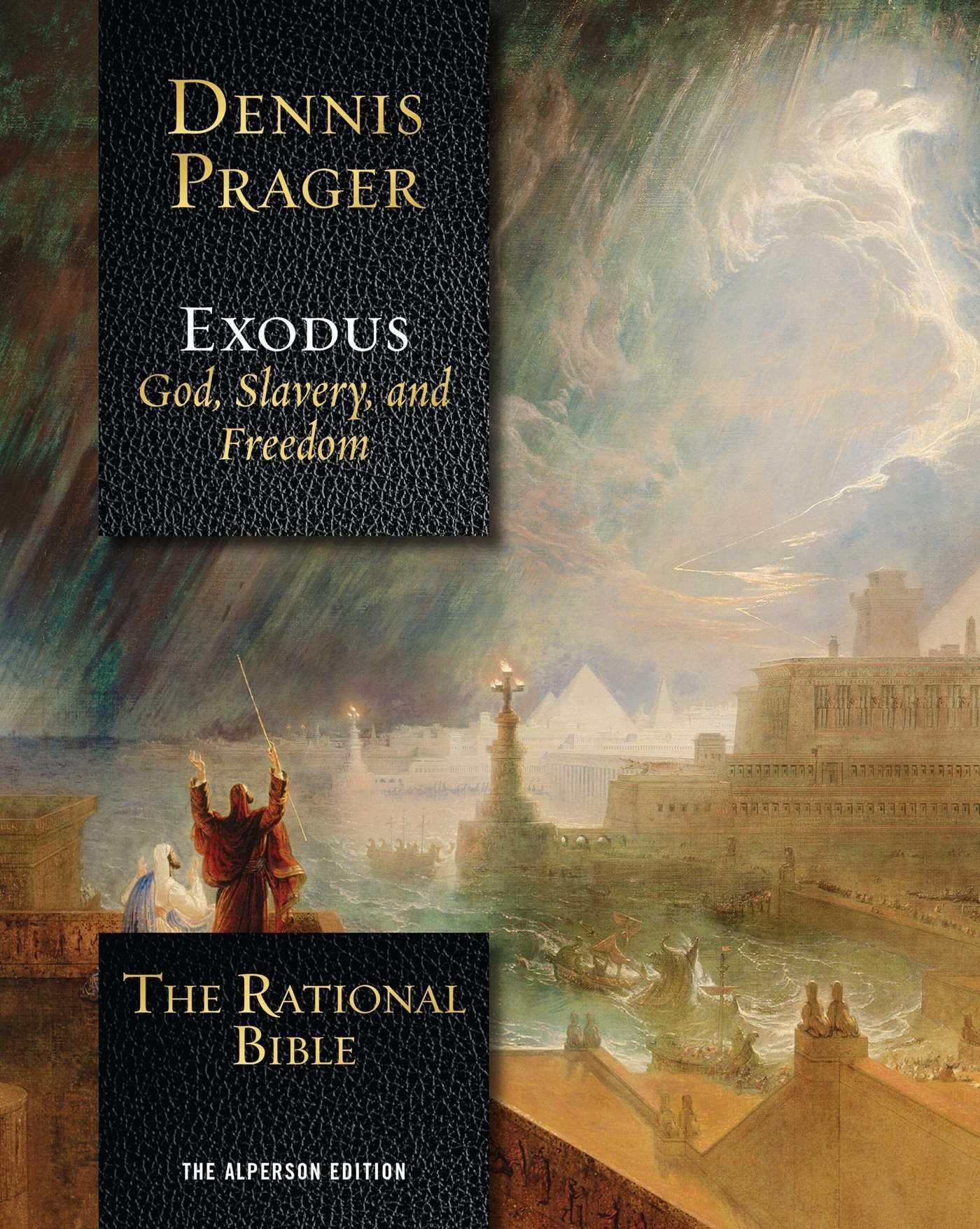
The Rational Bible: Exodus
Product ID: 60956199
Desertcart purchases this item on your behalf and handles shipping, customs, and support to South Korea.
NATIONAL BESTSELLER "Dennis Prager has put together one of the most stunning commentaries in modern times on the most profound document in human history. It's a must-read that every person, religious and non-religious, should buy and peruse every night before bed. It'll make you think harder, pray more ardently, and understand your civilization better." — Ben Shapiro, host of "The Ben Shapiro Show" "Dennis Prager’s commentary on Exodus will rank among the greatest modern Torah commentaries. That is how important I think it is. And I am clearly not alone... It might well be on its way to becoming the most widely read Torah commentary of our time—and by non-Jews as well as by Jews." — Rabbi Joseph Telushkin, bestselling author of Jewish Literacy Why do so many people think the Bible, the most influential book in world history, is outdated? Why do our friends and neighbors – and sometimes we ourselves – dismiss the Bible as irrelevant, irrational, immoral, or all of these things? This explanation of the Book of Exodus, the second book of the Bible, will demonstrate that the Bible is not only powerfully relevant to today’s issues, but completely consistent with rational thought. Do you think the Bible permitted the trans-Atlantic slave trade? You won’t after reading this book. Do you struggle to love your parents? If you do, you need this book. Do you doubt the existence of God because belief in God is “irrational?” This book will give you reason after reason to rethink your doubts. The title of this commentary is, “The Rational Bible” because its approach is entirely reason-based. The reader is never asked to accept anything on faith alone. As Prager says, “If something I write does not make rational sense, I have not done my job.” The Rational Bible is the fruit of Dennis Prager’s forty years of teaching the Bible to people of every faith, and no faith. On virtually every page, you will discover how the text relates to the contemporary world and to your life. His goal: to change your mind – and then change your life. Review: An insightful and approachable commentary - The Exodus is probably the most important story in Judaism, and certainly among the most important stories in Christianity as well. But while Prager writes for audiences of all faiths, his perspective is certainly the Jewish one. Prager’s argument (or at least one of his arguments) is that though the Torah (or the Bible at large) was written for specific people at a specific point in history, its relevance has not faded in modernity. Therefore, much of his commentary is aimed at translating certain verses in such a way as to render them comprehensible to modern ears or to applying the teachings of Exodus to modern situations. In those goals he succeeds admirably. Obviously, readers will come at this book from a variety of perspectives. There are certain passages atheists will struggle to understand even despite Prager’s best attempts to explain (atheists might argue explain away) some of the difficult passages. Christians will notice a lack of commentary pointing toward what they believe are foreshadowings of the New Testament. And though Prager’s Jewish commentary will feel most comfortable to the Jewish people, different movements within Judaism might agree or disagree on a variety of points. But where the book really shines, despite not quite succeeding in being all things to all people, is in rendering the text more approachable to modern readers. I’ve read Exodus before. I’ve read the entire Bible, of course. But even though the story is quite familiar to me, Prager nevertheless provided countless new insights that helped me to understand both much of the wisdom contained in the ancient text and why it is considered such a central element in Jewish culture. Long essays explain the Ten Commandments in great detail, and I think are a real highlight of this volume. Going back to the original Hebrew as necessary, Prager explains why he thinks those ten laws are so foundational to morality, as well as how many people—including many religious people—have misunderstood their meaning and misapplied their guidance. One might criticize the book for repetitiveness, but that’s not entirely Prager’s fault. Biblical texts themselves are often repetitive. Even still, Prager himself does repeat some of the same points multiple times. A few of these can be forgiven as repetition for emphasis, but in some cases, I think he added the same commentary to multiple verses simply because he had similar thoughts about each verse. If one wants to read this commentary as a reference book, that’s good; that way, the commentary is present at each verse whenever one might look it up. But if one wants to read it straight through, as I did, some of the repeated passages just felt extraneous. Nevertheless, I found this quite a useful book, and I’ll be first in line to get Prager’s commentary on Leviticus whenever it is released. Review: Maybe you thought the Torah lacked relevance to contemporary life - I am familiar with some of Rabbi Dennis Prager’s writing before coming to this book. Readers like me will find Exodus, like earlier works by this author, written in a style notable for its clarity and complete lack of pretension. It is a highly scholarly work that does not read like scholarship. One reason it does not read like an academic text is that it is also a highly personal work. Any reader encountering this book will see that it arises from a lifetime of one particular man’s contemplation of the Torah—its challenges, its rewards, its ever-expanding meaningfulness over the course of that lifetime. The book offers all of that to us as a gift to enrich our own lives. (As I read over the last two sentences written, I almost changed the word “arises” to the past tense, ”arose”—but I felt promptly that would be inappropriate. This book feels alive and exists in the present tense. One finishes each chapter with the feeling that the last word has not been said in the commentary one has just read. Let us all live a little longer, read the passage again, and Rabbi Prager would have more commentary to offer. This is just one of his accomplishments here—his book itself communicates the sense of the Torah as intensely alive and intensely relevant to us at all phases of our lives. The dialogue each reader has with the Torah may start at one specific place, but the conversation never ends. I will finish reading this book, set it aside and return to it in a few months… or years. When I do, I think I will find the book still arises….) More specifically: Rabbi Prager reads Exodus line by line, verse by verse and offers his commentary immediately as he does so. Commentary may not accompany every single line but often does; no group of verses lacks comment. Interspersed among the linear remarks are short (about 1-2 pages in length) passages the author identifies as Essays he uses to emphasize points, or to set the background for an upcoming passage, or to frame an argument. The commentary is frequently annotated with specific references to other works and authors. The text acknowledges and quotes directly from many previous Torah scholars. Why, any reader may reasonably ask, do we need another commentary on the Torah, on Exodus or any other of the five books of Moses? Our literature abounds with superb commentaries already. How could there be anything remaining to say about any line of the Torah? The facile answer is that there can never be too many commentaries on the Torah, that its plenty is inexhaustible. That may be true, but that is not the answer I want to offer on reading this book. What Rabbi Prager has done for me is to make Exodus relevant to contemporary life. His commentary is at various times refracted through ancient history and scholarship, through medieval times, through modern European history, up to the 20th century and the Holocaust, and through to the present day. He excels at drawing parallels between our times and the past as described in the Torah, and displays an uncanny ability to render our current moral and cultural dilemmas in Old Testament terms. This is why I feel the need specifically for this book at this time. I eagerly await his commentary on the rest of the Torah. One last point: In my opinion this book is readily understandable by younger readers. A high school student could benefit greatly from reading it. There is nothing ponderous here; there is no obstacle to understanding. Nothing in the prose commentary is stuffy or old fashioned. It appears that every effort has been made to allow the book to be accessible to the widest audience. George B. Goodman
| Best Sellers Rank | #75,271 in Books ( See Top 100 in Books ) #13 in Torah #118 in Old Testament Bible Study (Books) #212 in Christian Church History (Books) |
| Customer Reviews | 4.8 out of 5 stars 3,139 Reviews |
B**S
An insightful and approachable commentary
The Exodus is probably the most important story in Judaism, and certainly among the most important stories in Christianity as well. But while Prager writes for audiences of all faiths, his perspective is certainly the Jewish one. Prager’s argument (or at least one of his arguments) is that though the Torah (or the Bible at large) was written for specific people at a specific point in history, its relevance has not faded in modernity. Therefore, much of his commentary is aimed at translating certain verses in such a way as to render them comprehensible to modern ears or to applying the teachings of Exodus to modern situations. In those goals he succeeds admirably. Obviously, readers will come at this book from a variety of perspectives. There are certain passages atheists will struggle to understand even despite Prager’s best attempts to explain (atheists might argue explain away) some of the difficult passages. Christians will notice a lack of commentary pointing toward what they believe are foreshadowings of the New Testament. And though Prager’s Jewish commentary will feel most comfortable to the Jewish people, different movements within Judaism might agree or disagree on a variety of points. But where the book really shines, despite not quite succeeding in being all things to all people, is in rendering the text more approachable to modern readers. I’ve read Exodus before. I’ve read the entire Bible, of course. But even though the story is quite familiar to me, Prager nevertheless provided countless new insights that helped me to understand both much of the wisdom contained in the ancient text and why it is considered such a central element in Jewish culture. Long essays explain the Ten Commandments in great detail, and I think are a real highlight of this volume. Going back to the original Hebrew as necessary, Prager explains why he thinks those ten laws are so foundational to morality, as well as how many people—including many religious people—have misunderstood their meaning and misapplied their guidance. One might criticize the book for repetitiveness, but that’s not entirely Prager’s fault. Biblical texts themselves are often repetitive. Even still, Prager himself does repeat some of the same points multiple times. A few of these can be forgiven as repetition for emphasis, but in some cases, I think he added the same commentary to multiple verses simply because he had similar thoughts about each verse. If one wants to read this commentary as a reference book, that’s good; that way, the commentary is present at each verse whenever one might look it up. But if one wants to read it straight through, as I did, some of the repeated passages just felt extraneous. Nevertheless, I found this quite a useful book, and I’ll be first in line to get Prager’s commentary on Leviticus whenever it is released.
G**N
Maybe you thought the Torah lacked relevance to contemporary life
I am familiar with some of Rabbi Dennis Prager’s writing before coming to this book. Readers like me will find Exodus, like earlier works by this author, written in a style notable for its clarity and complete lack of pretension. It is a highly scholarly work that does not read like scholarship. One reason it does not read like an academic text is that it is also a highly personal work. Any reader encountering this book will see that it arises from a lifetime of one particular man’s contemplation of the Torah—its challenges, its rewards, its ever-expanding meaningfulness over the course of that lifetime. The book offers all of that to us as a gift to enrich our own lives. (As I read over the last two sentences written, I almost changed the word “arises” to the past tense, ”arose”—but I felt promptly that would be inappropriate. This book feels alive and exists in the present tense. One finishes each chapter with the feeling that the last word has not been said in the commentary one has just read. Let us all live a little longer, read the passage again, and Rabbi Prager would have more commentary to offer. This is just one of his accomplishments here—his book itself communicates the sense of the Torah as intensely alive and intensely relevant to us at all phases of our lives. The dialogue each reader has with the Torah may start at one specific place, but the conversation never ends. I will finish reading this book, set it aside and return to it in a few months… or years. When I do, I think I will find the book still arises….) More specifically: Rabbi Prager reads Exodus line by line, verse by verse and offers his commentary immediately as he does so. Commentary may not accompany every single line but often does; no group of verses lacks comment. Interspersed among the linear remarks are short (about 1-2 pages in length) passages the author identifies as Essays he uses to emphasize points, or to set the background for an upcoming passage, or to frame an argument. The commentary is frequently annotated with specific references to other works and authors. The text acknowledges and quotes directly from many previous Torah scholars. Why, any reader may reasonably ask, do we need another commentary on the Torah, on Exodus or any other of the five books of Moses? Our literature abounds with superb commentaries already. How could there be anything remaining to say about any line of the Torah? The facile answer is that there can never be too many commentaries on the Torah, that its plenty is inexhaustible. That may be true, but that is not the answer I want to offer on reading this book. What Rabbi Prager has done for me is to make Exodus relevant to contemporary life. His commentary is at various times refracted through ancient history and scholarship, through medieval times, through modern European history, up to the 20th century and the Holocaust, and through to the present day. He excels at drawing parallels between our times and the past as described in the Torah, and displays an uncanny ability to render our current moral and cultural dilemmas in Old Testament terms. This is why I feel the need specifically for this book at this time. I eagerly await his commentary on the rest of the Torah. One last point: In my opinion this book is readily understandable by younger readers. A high school student could benefit greatly from reading it. There is nothing ponderous here; there is no obstacle to understanding. Nothing in the prose commentary is stuffy or old fashioned. It appears that every effort has been made to allow the book to be accessible to the widest audience. George B. Goodman
M**S
A most excellent read. Well laid out. Speaks to Jews, Christians, and non-believers alike.
(Never mind my name. It has nothing to do with this book or my review of it. It literally is my name.) This review comes from the perspective of a believing Christian. This book is very well written and can be read in a number of ways. You can read straight through to gain a deeper knowledge of the book of Exodus if that's what you're after. In doing so, you can read the Bible verses only, reading Dennis's comments only when you want to stop for insight from the perspective of my favorite Jew. The beginning is basically a topical index, giving you the gist of the major topics Dennis comments on in the chapters and the page numbers to find them. You can skim that for something that speaks to your soul instead of a straight read. For example, the first topic in the second chapter is "The preeminent role of women in Moses's life - and in the Torah." This comment is on the first verse of the chapter. He describes, preemptively, the roles of Moses's mother and sister, the midwives who defied the Pharaoh to save Moses, the Pharaoh's daughter, and on. Some of these comments are so in-depth, that they become essays and are listed as such. My favorite essay is in chapter 15. In the index, it says "Essay: Is it moral to celebrate the death of evildoers?" The essay pins the infinite worth of human souls against the horrific acts that these souls can do to each other. This is my favorite because I read it at a time in my life that I felt God open to me just how much our souls are worth and how loved each of us are even if we don't feel love for ourselves. Shortly after that, I learned of an unspeakable thing that happened to my neighbor's daughter. The contrast between worth and evil actions couldn't be more acute to me, and Dennis gives his insight on the matter here. The introduction is an informative read, telling us that while it's written from the perspective of a believing Jew, it's aimed at believing Christians as well and even to the non-believer who is open to rational thought on religious subjects. We don't even have to believe in God to believe that a grounding moral compass such as the Bible is good for society whether you actually believe in it or not. Take the Bible literally or figuratively, the teaching contained in it provide good direction. The format of the book is that he gives a verse (numbered) in bold text, left justified, followed by his comments in plain text, block indented about 3/4". Where he has the major topics listed in the index at the beginning of the book, they precede the relevant verst in large-print dark red text, making it super-easy to go from index to the text. The physical layout of the print makes it easy to separate the actual Bible verses, his comments on them, and the major topics covered easy to spot at a glance, so you can even thumb through the book quickly for whatever jups out at you. The end of the book, which he calls "Notes," is a bibliography of material he references. Out of curiosity, I've read other reviews that were critical of the book. These seem to come from people who are not verified buyers of the book and often seem to want to attack Dennis's character more than the book or from Christians who feel that this book attacks Christianity. I do not feel that Dennis attacks my religion as a Christian at all, but presents his thoughts on his own religion from a rational perspective and bears in mind that Christianity and Judaism share a lot in common. He uses this commonality to speak to others on common ground.
W**R
A Christian Pastor Who Is Teaching The Book of Exodus Reviews "The Rational Bible"...
Last August, our congregation and I began studying the second book of the Torah together...the fascinating book of Exodus. I have always had a deep love for the Old Testament, and have lamented the fact that Christians by and large are ignorant of it’s content, focusing at times almost exclusively on the New Testament. When I heard that Dennis Prager was writing a commentary on the Torah starting with Exodus, my ears perked up. I bought the book the day it came it. I have read the first half (which brings me up to where we are studying in our Wednesday night Bible study) and intend to finish it as we continue studying Exodus. But why would a Christian pastor buy a Jewish commentary and recommend other Christians read it? Here are two reasons: 1. Dennis has devoted over fifty years of his life to the study and teaching of the Torah. He speaks Hebrew as well as he speaks English (which is very well, I might add!), and has immersed himself in the Hebrew of the Bible – both its grammar and its vocabulary. As one who doesn’t have that linguistic background, I appreciate his willingness to share this skill with others like myself. 2. We are living in an age of unprecedented dialogue between Jews and Christians like none other in history. For me to participate in this God-honoring dialogue, I need to understand where my Jewish brothers and sisters are coming from. In addition, I have a great desire to share the good news of the gospel as found in the New Testament with my Jewish neighbors, as do millions of others Christians. Yet, how can I share my perspective with them if I don’t understand and respect their perspective? Here are excerpts from my review of this book on my blog (which you can find at waynenalljr.blogspot.com): This book is like no commentary I have ever read...and I have read from many of them. It is not stuffy at all. Dennis chose to write it in the first person and to include personal anecdotes where appropriate. What other commentary would quote Maimonides, Abraham Lincoln,...and Woody Allen? ...Here are a few quotes from this book which caught my attention: ...The central message of the Torah is “that God is good and demands we be good...is the only belief that will enable us to make a good world.” ...“People (today) greatly value knowledge and intelligence, but not wisdom. And the lack of wisdom—-certainly in America and the rest of the West – is directly related to the decline in biblical literacy. In the American past, virtually every home, no matter how poor, owned a Bible. It was the primary vehicle by which parents passed wisdom on to their children.” ...“The Torah is so different – morally, theologically, and in terms of wisdom – from anything else preceding it and, for that matter, from anything written since, that a reasonable person would have to conclude either moral supermen or God was responsible for it.” (I would put the entire Bible in this category, including the New Testament.) ...“Another major reason I am convinced the Torah is not man-made is it so often depicts the people of the Book, the Jews, in a negative light. ...“Remembering – the good others have done, the evil others have done, and one’s moral obligations – is an indispensable aspect of a good and meaningful life.” ...“Biology is not destiny; you can be the child of an evil person and be a good person.” ...“Gratitude takes effort; resentment is effortless.” (So true!) I believe there is great value to this work for anyone who is seeking wisdom...whatever your religious background!
L**P
This book has taught me more about Exodus than 12 years of Catholic school did
In my twenties, when I knew everything, was a hardcore liberal and a self proclaimed atheist (having been born and raised a Catholic), Sean Hannity brought me to conservatism. In my 30’s, I was too bogged down with my first marriage, getting a house, having a child, going through a divorce, and rebuilding my life to care much about anything else. In my 40’s, in addition to finding my loving wife, I found Dennis Prager. Mr. Prager is not a “firebrand conservative” who wants to get you all excited so that you may go out and shout others down. He is a calm, rational thinker. His mind is his weapon, his intellect is his tool, and his demeanor makes it difficult for a reasonable person to simply dismiss him, let alone dislike him. He utterly changed my debating style from “hard hitting, in your face” to “here are my facts, what do you have to say, let’s discuss it”. He is the epitome of the old saying, “you get more flies with honey than you do vinegar”. I had every intention of purchasing this book. In fact, I preordered it. I read the first chapter when he sent it to his fans, and I loved it. I purchased the kindle version for myself, and a hardcover copy for the Reverend of my church. When I saw how nice the book looked, I decided to purchase a hardcover copy for myself to proudly display in my home bookcase of “chosen books”. I have since purchased an additional copy for my best friend. I’ll likely purchase a copy for any of my family and friends who express interest in reading it. It is that profound. I attended a private Catholic school from grades 1 through 8, and I then went to a private Catholic school through high school. Simply put, I learned more from this book about Exodus than I did from all those years in school. Mr. Prager is a brilliant man, who has debated at Oxford University on several occasions. He has been studying the Bible for decades, and his wealth of knowledge is evident in the book. He goes line by line through Exodus, and offers his explaination in layman’s terms. I believe what makes this book invaluable is, Mr. Prager is not trying to convert anyone to any specific religion. One does not feel that buried within his commentary is a certain degree of political correctness out of fear of offense. His only desire is to explain the book of Exodus to you. To, as the title says, explain just how rational the Bible is, when you know it in it’s full context. I have learned so much. To say that this book has strengthened my faith is a gross understatement. Simply put, I wish he would offer his insight on the entire Bible, both Old and New Testament! In closing, who can benefit from this book? Certainly any practicing Jew or Christian. Absolutely any Jew or Christian who is struggling with their faith. Any agnostic who is truly only uncertain becasuse he/she has not read anything compelling enough for him/her to say, “I can believe that”. An atheist who is open to debate, and would like to hear a fair, learned man’s point of view. Finally, anyone would like to read something that can only be described as an excellent perspective on a section of a book over 2000 years and why it’s still a great, if not THE BEST, source of wisdom for human behavior. Bravo Mr. Prager. And from the bottom of my heart, thank you. Louis C.
I**N
While I do not agree with all Prager writes, I find much that is very thoughtful
The eighth weekly biblical portion, Tetzavveh (Exodus 27:20-30:10), deals primarily with the sanctuary, later called temple and still later synagogue, and priests who functioned in the first two types of buildings that no longer exist. Priests are not prominent in synagogues today but are given honors and functions. While the sanctuary and temples no longer exist and priests have a considerably reduced role in synagogues, we can learn much from these ancient items that are relevant today. I will give examples from a non-Orthodox Jewish thinker. Dennis Prager Maimonides wrote that the truth is the truth no matter what its source. Rabbi Abraham Isaac Kook, the first Ashkenazi Chief Rabbi of British Mandatory Palestine (1865-1935), wrote similarly that we can learn much even from atheists. Dennis Prager (born 1948), an American conservative radio talk show host and writer, is a good example. He was trained in his youth as an Orthodox Jew but abandoned Orthodoxy. He states he maintains many traditional Jewish practices and is religious. He wrote many books, including a series called “The Rational Bible.” I find much in them interesting, but I differ from him because he takes Bible stories literally and is usually convinced that the events really happened. I see many events as parables and read many statements as metaphors, hyperbole, and poetry. I disagree, for example, with the following: He asks, "Who was the most tragic figure in the Bible?" He answers, "God, because of God’s disappointment in humans." He feels that God has emotions. I do not think that God has emotions. True, the Torah mentions that God becomes angry at times. But this is not done to reveal a fact about God but to frighten people who find it hard, if not impossible, to reason into thinking they will be punished if they misbehave with fierce divine anger and be prompted to act appropriately. The pagan Plato calls this a “Noble Lie.” The Jew Maimonides named it “Essential Truths.” The Muslim ibn Tofayl wrote about it in his philosophical novel “Hay ibn Yakdan.” It is one of my favorite books. Everyone should read it. Another example of Prager’s statements that I disagree with is his reply to the question: Why did God kill animals in the flood? He wrote animals were created for human use, and since only one family remained after the flood, there was no need for so many animals. I agree with Maimonides in his Guide for the Perplexed 2:48 that the Torah ascribes natural events to God not because God performed the acts that were natural and caused by the forces of nature but because God is the ultimate cause since He created or formed the laws of nature. I also agree with Maimonides, who wrote that animals have feelings, so why would God hurt innocent animals? I see the flood as a natural event; most likely, not all animals died, and fish weren’t killed. It is even possible that the flood only struck a small area. Having said this, I still think Prager has much to offer. He raises good questions, and many of his explanations are good. The following are his ideas about the buildings constructed for God and the priests who functioned in them. He gives four reasons why it is wrong to say the Torah is filled with immorality because, among other of its teachings, animal sacrifices are immoral. First, Maimonides taught that God did not desire animal sacrifices. The ancient Israelites accepted the primitive notion of their pagan neighbors that God needed sacrifices, and the sacrifices of animals showed their love for God. The ancients even sacrificed their children. Maimonides stressed that the Torah dislikes sacrifices and allows them only as concessions. Since the ancient Israelites felt so strongly that sacrifices were necessary, had the Torah prohibited them, they would have rejected the entire Torah. Prager wisely adds that sacrificing children has not changed. We still send young men and women to war and on suicide missions. Second, the majority of humanity that eats animal flesh has no legitimate or even logical reason to oppose animal sacrifices on moral grounds. They are eating animals without any consideration of the living being killed to satisfy their lusts and stomachs. While being forced to allow the killings, the Torah took the murders and eating exceptionally seriously. The animals sacrificed were not subjected to the cruelties existing in modern slaughtering and the brutalities of how the animals are farmed. Third, sacrifices were imbued with sanctity and given noble goals, such as atoning for destructive past behaviors and bringing people closer to God. The Hebrew word for sacrifice is korban, which literally means bringing one close (to God). Fourth, sacrifice teaches that nothing worthwhile comes without sacrifice. Parents sacrifice a great deal for their children, spouses sacrifice for their marriage, friends sacrifice to maintain the friendship, and people desiring to improve their lives sacrifice years of fun and leisure to learn and improve their skills. Prager addresses the traditional Jewish view that priests were males. Although others disagree, he contends that the Torah’s depiction of women was often remarkably egalitarian. He could have added, as he did above, speaking about sacrifices, that the Torah could not tell the somewhat primitive Israelites when it was given that women were equal to men, but he did not. Instead, he notes that the first woman, Eve, is described as “a helper equal to Adam.” The matriarchs play a decisive role in determining the Israelite destiny. Rebecca, not her husband Isaac, guaranteed Jacob to become the third patriarch. A woman saved Moses when Pharaoh ordered all male children to be killed. Women also served as prophets. Prager then explains that the Torah needed to give the priestly role to men and mandated that the priests wear modest clothing to de-sexualize religion. Female priests and their sexual activity in their temples were significant features of many primitive religions. The Torah stresses family, a world-changing role that benefited women and men, Jews and non-Jews. Behaviors have changed, but not enough. People still focus on sex and other personal desires. I think it is tragic that people still haven’t realized the benefits of a proper marriage. If they love their spouses and treat each other with mutual trust, their actions will train them to behave with others similarly and inaugurate a messianic era. It is terrible to hear that sociologists have found that fifty percent of marriages end in divorce, and a third of married spouses hide their income and spending from each other. The total of just these two behaviors shows that eighty-three percent of marriages do not function properly today.
D**G
Good resource - needs help
If you have never read Exodus, this is a good place to start. If you have read more serious Bible commentaries, this book will seem “light.” Prager’s effort is a really useful, introductory, supplementary book to be read along side other, more scholastic, books about Exodus. There is much value in this book for nearly everyone. Prager has many enjoyable insights from a Jewish perspective, particularly the morality, theology, and historical/cultural significance of the Torah. He helpfully decodes many of the Hebrew nuances which are lost in the English translations. For example, how the Plagues of Egypt had a specific pattern which is not an obvious fact in Exodus without closer study. He also puts Exodus into today’s world by comparing the penalties on Egypt to the price of American slavery in the Civil War. I only rate this book 4 stars as a strong layman’s effort at Biblical exposition. We study the Bible with more than one resource. It’s the best way to discover new perspectives and deeper meanings. If you seriously want to grow from reading Exodus, you need more than Prager’s book. I strongly recommend getting Philip Ryken’s “Exodus – Saved for God’s Glory” as your main companion resource. Ryken, a truly professional Bible scholar, brings every passage in Exodus to life, making it personal, useful and relevant. He is as steeped in the Hebrew as Prager and also has a larger understanding of the OT and NT. For example, the seemingly out of place genealogy in Exodus 6, which most people skip, becomes a marvelous insight into the Levites and their long term role in Israel. What takes a few verses in Exodus unfolds into pages of inspiring wisdom that will amaze you. I also recommend Peter Enns in his “NIV Application Commentary” on Exodus. While it is hampered by the NIV translation, he also has many thoughtful observations for nearly everyone. Its fun to see Ryken drawing from Enns on more than one occasion. Enns book is lighter on scholarship but useful too. Overall, Prager’s book is a strong starter. We prefer Bible first, amplified by great side resources. If you use Prager’s book in this manner, you will be richly rewarded.
B**H
Perfect
Excellent quality and price!! Super impressed
J**A
Te faz refletir!
Não terminei de ler ainda pois é longo e após cada nova “revelação” apresentada é necessário parar de ler para refletir sobre aquilo. Muita informação nova, mesmo para alguém que já estuda a Bíblia a muitos anos. Recomendo muito!
L**C
A classic
This book provides a brilliant contextual and ethical commentary on the Book of Exodus. It brings the Torah closer to the earth and the reader closer to the Sinaï!
J**M
Great commentary for beginners
The rational bible is great for readinf the bible the first time, but also if you already read the bible it gives you new insights! Must read!
W**Y
Make The Bible Great Again!
If you have never read the Bible in your life but want to understand its importance, this book is the perfect way to start. Dennis Prager is a master communicator, and as such is able to impart the great wisdom of the Bible in a simple and engrossing manner. Not only will you learn of the Bible's historical significance but also how it remains as relevant today as it did when it was written. Our ancestors, the people who built the freest, most prosperous and fundamentally decent society in history, which we enjoy in the West today, were all steeped in the Bible from an early age. Perhaps we should be humble enough to acknowledge that the Bible has as much to teach us as it did them. If not, we are doomed to forget the great wisdom of the past and in doing so forget who we are and what we stand for. It is Mr. Prager's belief that the Bible is key to creating a better world, and after reading this you will find it hard to disagree with him.
R**R
Simply the best Exodus commentary
This book has concise and strong commentary which you will most certainly learn a lot from. It has consistency and depth. On top of that, it looks great as well, from the cover to the page design.
Trustpilot
1 week ago
2 weeks ago